What Is the Eligible Census Tract EV Charger Tax Credit?
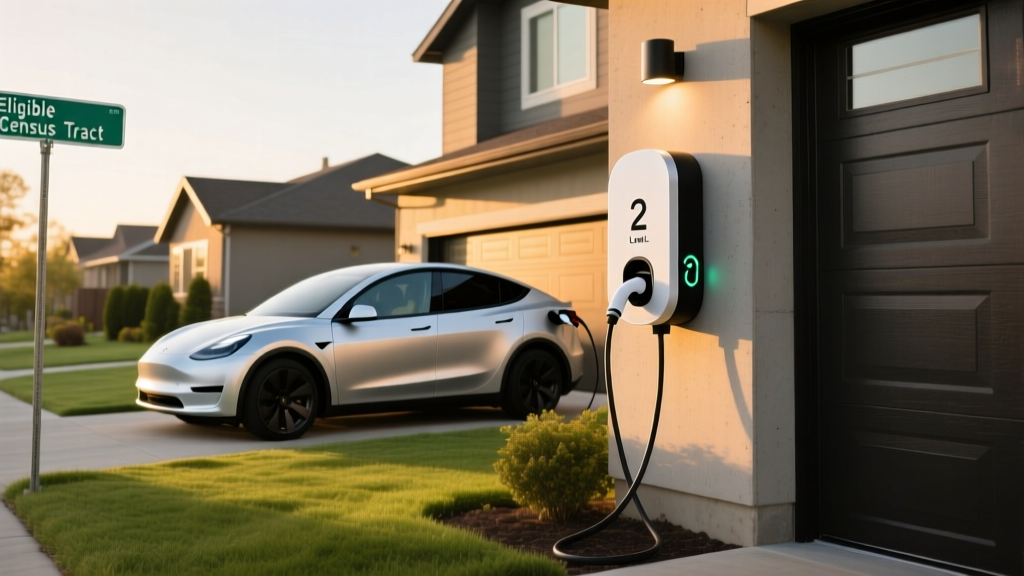
If you've been researching home EV charging costs, you may have encountered the phrase eligible census tract EV charger and wondered what it means for your wallet. It refers to a specific provision under the IRC §30C Alternative Fuel Vehicle Refueling Property Credit, which was reshaped by the Inflation Reduction Act (IRA) and remains active through 2032. Unlike the better-known §30D vehicle purchase credit, §30C applies to the charging equipment itself — and it only applies if your home is located in a qualifying area.
The credit covers 30% of the cost of qualified EV charging equipment and its installation, up to a maximum of $1,000 per tax year for residential property. However, beginning in 2023, eligibility is restricted to equipment installed in:
- A low-income community census tract (as defined by the IRS and Treasury), or
- A non-urban area (outside a metropolitan statistical area).
This geographic restriction caught many buyers off guard. You can no longer simply buy a Level 2 home charger and claim the credit anywhere. You must verify your address against the IRS-designated list of qualifying census tracts, published and updated on irs.gov.
How the §30C Credit Works for Home Charger Installation
The credit calculation is straightforward but has important nuances:
- Credit rate: 30% of total qualified expenditures (equipment + installation labor).
- Maximum credit: $1,000 per year for residential installations.
- Eligible costs include: The charger unit itself, electrical wiring, conduit, labor by a licensed electrician, permit fees, and any panel sub-components directly related to the charger circuit.
- Non-eligible costs: Full electrical panel upgrades (e.g., upgrading from 100A to 200A service) are generally not considered part of the refueling property, though the wiring from the panel to the charger is eligible.
Example: You spend $450 on a ChargePoint Home Flex and $1,200 on electrician labor and permits, totaling $1,650. The 30% credit would be $495 — well under the $1,000 cap. If your total project costs $3,500 (perhaps including a panel sub-upgrade for a dedicated 60A circuit), 30% equals $1,050, but you'd receive the capped $1,000.
The credit is non-refundable, meaning it can reduce your federal tax liability to zero but won't result in a refund beyond what you owe. It is also not available as a point-of-sale discount the way §30D vehicle credits can be transferred to dealers — you claim §30C when you file your federal return using IRS Form 8911.
Understanding EV Charging Levels: Speed and Power
Before selecting equipment, you need to understand the three charging levels available to EV owners. The critical distinction: kW (kilowatts) measures power — how fast energy flows into your battery, while kWh (kilowatt-hours) measures energy — the total capacity stored. Think of kW as the flow rate of a hose and kWh as the size of the bucket.
| Level | Voltage / Power | kW Output | Miles of Range Added Per Hour | Typical Use Case |
|---|---|---|---|---|
| Level 1 | 120V AC / 12-16A | 1.4–1.9 kW | 3–5 miles/hr | Overnight top-up, low-mileage drivers, PHEVs |
| Level 2 | 240V AC / 16–80A | 3.8–19.2 kW | 14–75 miles/hr | Home primary charging, workplace, retail |
| DC Fast | 200–500V DC / variable | 50–350+ kW | 150–1,200+ miles/hr (peak) | Road trips, highway corridors, commercial fleets |
For most EV owners, Level 2 at home is the practical standard. A 48A (11.5 kW) Level 2 charger will fully replenish a 75 kWh battery (such as a Tesla Model Y Long Range) in roughly 7–8 hours — ideal for overnight charging. DC fast charging is reserved for road trips, as it requires commercial-grade infrastructure and is not installable in a typical residence.
Home Charger Installation: Electrical Requirements and Costs
Installing a Level 2 home charger is an electrical project that requires planning, a licensed professional, and typically a local permit. Here's what's involved:
Electrical Specifications
- Voltage: 240V (same as a dryer or oven outlet).
- Amperage: Common circuits are 40A (delivering 32A continuous to the vehicle, or ~7.7 kW) or 60A (delivering 48A continuous, or ~11.5 kW). The National Electrical Code requires circuits rated at 125% of the continuous load — so a 48A charger needs a 60A breaker.
- Wiring: Typically 6 AWG copper for 40A circuits, 4 AWG for 60A. Longer runs may require thicker gauge to limit voltage drop.
- Dedicated circuit: Your charger must be on its own dedicated breaker — it cannot share a circuit with other major appliances.
Panel Upgrade Considerations
This is the hidden cost that surprises many homeowners. If your electrical panel is already near capacity — common in homes with 100A service, older builds, or homes with electric heating/AC — adding a 40–60A EV circuit may exceed your panel's rated load. A panel upgrade from 100A to 200A service typically costs $1,500–$3,500 on top of the charger installation. Some homeowners with 200A panels still need a sub-panel or a load-management device if existing circuits consume most of the available capacity.
Installation Cost Breakdown
| Cost Component | Low Estimate | High Estimate | Notes |
|---|---|---|---|
| Level 2 charger unit | $300 | $700 | Varies by brand, amperage, smart features |
| Electrician labor | $500 | $2,000 | Depends on run length, wall type, conduit |
| Permit & inspection | $50 | $300 | Varies by municipality |
| Electrical materials (wire, conduit, breaker) | $100 | $400 | Longer runs = more material |
| Total (no panel upgrade) | $950 | $3,400 | Average: $1,200–$2,000 |
| Panel upgrade (if needed) | $1,500 | $3,500 | Not covered by §30C credit |
If your total eligible installation cost is $2,000 and you qualify for the §30C credit in an eligible census tract, you'd receive a $600 federal tax credit (30% of $2,000). If your project totals $3,334 or more, you'd hit the $1,000 cap.
Connector Compatibility: NACS, CCS, and CHAdeMO
The EV charging connector landscape has shifted dramatically. As of the 2025–2026 model years, the North American Charging Standard (NACS), originally developed by Tesla, has been adopted by Ford, GM, Rivian, Volvo, Hyundai, Kia, BMW, and most other major automakers. CCS1 remains on many vehicles sold through 2024, and CHAdeMO is effectively legacy (Nissan Leaf being the primary remaining user).
| Connector | Brands Using It | Adapter Needed? |
|---|---|---|
| NACS (J3400) | Tesla (all), Ford, GM, Rivian, Volvo, Polestar, Hyundai, Kia, BMW, Mercedes (2025+), Subaru | No — native on new models. CCS-to-NACS adapters available for CCS vehicles (~$200). |
| CCS1 | Volkswagen, Audi (some), older Ford/GM/Hyundai/Kia (pre-2025), Stellantis, Lucid | NACS-to-CCS adapter needed for Tesla Superchargers (~$200–$250). |
| CHAdeMO | Nissan Leaf (legacy), Mitsubishi Outlander PHEV (older) | Limited adapter options; CHAdeMO infrastructure declining. |
For Level 2 home charging, all non-Tesla EVs use a J1772 connector (including NACS-equipped vehicles for AC charging — the NACS inlet handles both AC and DC). Tesla vehicles use a proprietary connector for Level 2 but include a J1772 adapter in the trunk. This means a J1772 Level 2 home charger will work with virtually every EV on the road with the appropriate adapter.
Recommended Level 2 Home Chargers for 2026
Below are three well-regarded Level 2 chargers suited for different needs and budgets. All are UL-listed (or equivalent) and support the §30C credit's requirement for qualified equipment.
ChargePoint Home Flex
- Power: Up to 11.5 kW (48A, requires 60A circuit)
- Connector: J1772 (NACS adapter included for newer versions)
- Cable length: 23 feet
- Smart features: Wi-Fi, app scheduling, energy tracking, Alexa integration
- Price: ~$550–$650
Best for: Most homeowners wanting a reliable, feature-rich charger with flexible amperage settings (can be configured from 16A to 48A via dip switches).
Emporia Level 2 EV Charger
- Power: Up to 11.5 kW (48A, requires 60A circuit)
- Connector: J1772
- Cable length: 24 feet
- Smart features: Wi-Fi, app control, integration with Emporia Vue energy monitor, load management
- Price: ~$350–$400
Best for: Budget-conscious buyers who want smart features and potential load-management integration without a panel upgrade.
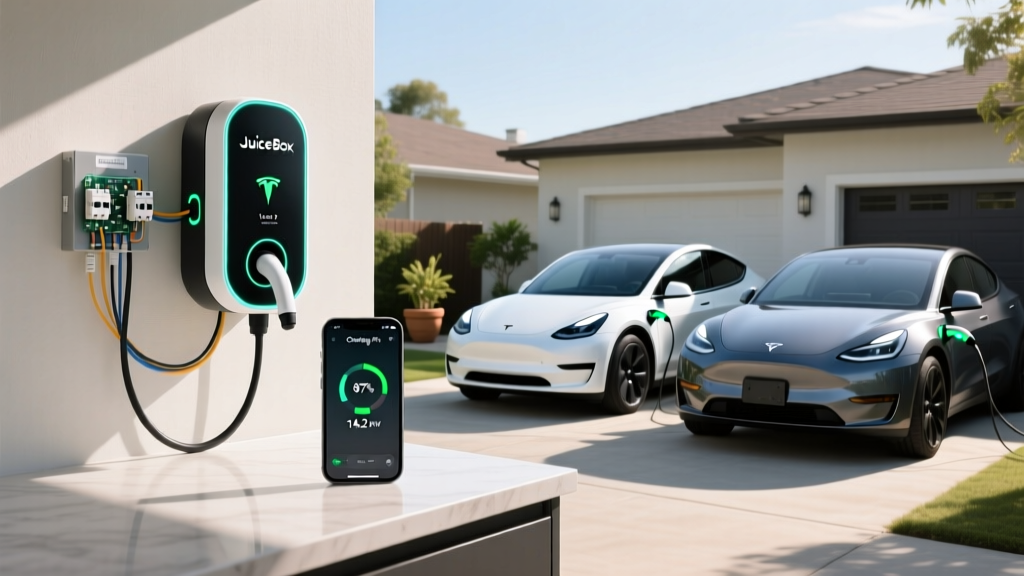
Tesla Wall Connector
- Power: Up to 11.5 kW (48A, requires 60A circuit)
- Connector: NACS (includes J1772 adapter for non-Tesla vehicles in box)
- Cable length: 24 feet
- Smart features: Wi-Fi, over-the-air updates, power sharing (link multiple units on one circuit), access control
- Price: ~$425–$475
Best for: Tesla owners or households with mixed Tesla/NACS and J1772 vehicles. Excellent value with power-sharing for multi-EV garages.
Charging Cost Per Mile: EV vs. Gas
One of the strongest financial arguments for home EV charging is the per-mile fuel cost. Electricity prices vary significantly by region and time-of-use, so the savings depend on your utility rate and charging habits.
| Scenario | Rate | Cost per Mile* |
|---|---|---|
| Home charging (off-peak / time-of-use rate) | $0.08–$0.12/kWh | $0.024–$0.036 |
| Home charging (standard residential rate) | $0.14–$0.18/kWh | $0.042–$0.054 |
| Public Level 2 (network pricing) | $0.25–$0.49/kWh | $0.075–$0.147 |
| DC fast charging (Electrify America, EVgo, etc.) | $0.35–$0.55/kWh | $0.105–$0.165 |
| Gasoline vehicle (30 MPG combined, $3.40/gal) | $3.40/gallon | $0.113 |
*Based on an EV efficiency of 3.0 miles/kWh (approximately 112 MPGe combined, typical for a midsize crossover like the Hyundai Ioniq 5 or Tesla Model Y). Source for efficiency data: fueleconomy.gov.
The takeaway is clear: home charging at off-peak rates delivers fuel costs roughly one-third to one-quarter that of gasoline. Even at standard residential rates, the EV wins decisively. Public DC fast charging, however, can approach or exceed gasoline cost per mile — which is why home charging access is the linchpin of EV ownership economics.
Charging Time Examples: Real-World 10–80% Estimates
Manufacturers quote 10–80% DC fast charge times because charging above 80% slows dramatically to protect battery health (the charge curve tapers). Here's what to expect with common battery sizes at different charger types:
- 75 kWh battery (e.g., Tesla Model Y LR, Hyundai Ioniq 5) at a 48A (11.5 kW) Level 2 charger: 10–80% (~52.5 kWh) in approximately 4.5–5 hours. Ideal for overnight.
- 75 kWh battery at a 150 kW DC fast charger: 10–80% in approximately 25–30 minutes (peak rate ~150 kW, tapering above 60–70% SoC).
- 75 kWh battery at a 350 kW DC fast charger (vehicle must support it): 10–80% in approximately 18–22 minutes for vehicles like the Ioniq 5 (peak ~240 kW) or Porsche Taycan (peak ~270 kW).
- 100 kWh battery (e.g., Ford F-150 Lightning Extended Range) at 48A Level 2: 10–80% (~70 kWh) in approximately 6–6.5 hours.
For daily driving of 30–50 miles, a Level 2 charger replenishes that usage in 1–2 hours. Most EV owners never need to charge to 100% daily — keeping the battery between 20% and 80% optimizes long-term battery health, particularly for NMC chemistry.
Safety and Electrical Code Requirements
Home EV charger installation must comply with the National Electrical Code (NEC) Article 625 and any local amendments. Key safety requirements include:
- Dedicated circuit: The charger must have its own breaker — no shared circuits.
- GFCI protection: NEC 2020 and later requires GFCI (Ground Fault Circuit Interrupter) protection for outdoor receptacles used for EV charging. Hardwired installations may not require a GFCI breaker if the charger has built-in ground-fault protection (most UL-listed units do).
- Outdoor rating: If installing outdoors, the charger must carry a NEMA 4 or NEMA 4X rating for weather resistance. All chargers listed above meet this standard.
- Cable management: The NEC requires that charging cables not create a trip hazard. Wall-mounted cord organizers or retractors are recommended.
- Permit and inspection: Most jurisdictions require an electrical permit and a post-installation inspection. Skipping this step can void homeowner's insurance coverage for electrical fires and may disqualify you from the §30C credit (the IRS expects proper documentation).
Always hire a licensed electrician familiar with EV charger installations. Ask for a load calculation on your panel before committing to a specific amperage — this avoids costly change orders mid-project.
Frequently Asked Questions
How do I know if I live in an eligible census tract for the EV charger tax credit?
The IRS publishes a list of qualifying low-income census tracts and non-urban areas on irs.gov under the §30C credit guidance. You can also use the DOE's mapping tool at the Argonne National Laboratory site to look up your address. Eligibility is based on where the charger is installed — your home address — not where you purchased the equipment.
How much does it cost to install a home EV charger?
Expect to pay $950–$3,400 for a complete Level 2 installation (charger + electrician + permit + materials) if no panel upgrade is needed. The national average falls between $1,200 and $2,000. If your home needs a panel upgrade from 100A to 200A service, add $1,500–$3,500. The §30C credit can offset up to $1,000 of eligible costs if you're in a qualifying census tract.
Which connector and charger is compatible with my EV?
For Level 2 home charging, all EVs use the J1772 connector (or NACS, which handles AC charging natively on Tesla and newer NACS-adopting vehicles). A J1772 home charger works with every EV — Tesla owners use the included J1772-to-NACS adapter, and non-Tesla NACS vehicles accept J1772 directly. For DC fast charging, check whether your vehicle has a CCS1, NACS, or CHAdeMO inlet and plan road-trip routes accordingly.
How much does EV charging cost per mile compared to gas?
At home off-peak rates ($0.08–$0.12/kWh), EV charging costs roughly $0.024–$0.036 per mile — about one-quarter to one-third the cost of gasoline at $3.40/gal and 30 MPG ($0.113/mile). Public DC fast charging at $0.40–$0.55/kWh rises to $0.12–$0.165/mile, narrowing or eliminating the savings. This is why home charging access is critical to EV economics.
What electrical upgrades might I need for a home charger?
The most common upgrade is a panel capacity increase (100A → 200A) if your existing service can't accommodate a new 40–60A dedicated circuit. Other potential needs: a sub-panel if the main panel is full, heavier-gauge wiring for long conduit runs (over 50 feet from panel to charger), or a smart load-management system to avoid the panel upgrade entirely. A licensed electrician's load calculation will determine exactly what your home requires.