For years, Tesla's Supercharger network was the walled garden that made every other EV owner envious. That changed when Tesla opened its NACS connector standard and major automakers adopted it — and when Electrify America (EA) expanded aggressively along highway corridors. If you're shopping for an EV in 2026, you'll likely use both networks. Here's exactly how they compare on speed, cost, reliability, and what you need in your trunk to make it all work.
Understanding DC Fast Charging: kW, kWh, and Why It Matters
Before comparing networks, let's nail the terminology that trips up most new EV buyers:
- kW (kilowatts) = power, or how fast energy flows into your battery. Think of it as the width of the hose filling a bucket.
- kWh (kilowatt-hours) = energy, or how much total electricity your battery stores. Think of it as the size of the bucket itself.
A charger rated at 350 kW can deliver energy very quickly — but only if your EV's onboard system can accept that rate. A Tesla Model 3 Long Range with an 82 kWh (usable ~75 kWh) battery won't pull 350 kW the entire session. It follows a charge curve: ramping up to a peak rate, then tapering as the battery fills to protect cell longevity. That's why we measure charging speed in 10-80% time, not peak kW alone.
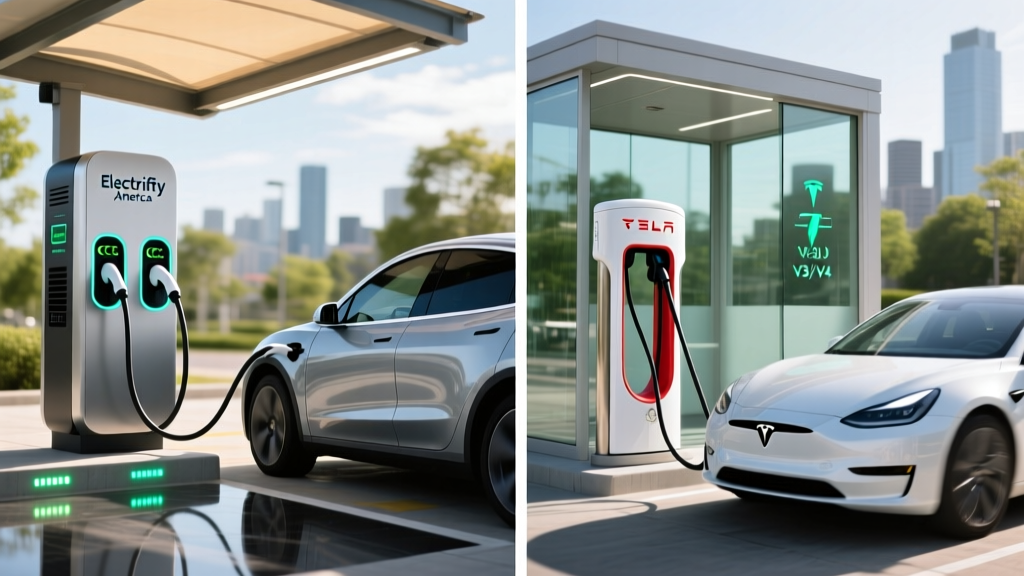
Network Showdown: Electrify America vs Tesla Supercharger
| Attribute | Electrify America | Tesla Supercharger |
|---|---|---|
| Connector (native) | CCS1 + NACS (expanding) | NACS (formerly Tesla proprietary) |
| Max stall power | 350 kW (Hypercharge); 150 kW common | 250 kW (V3); 350 kW (V4, rolling out) |
| US locations (approx.) | ~1,000+ stations, ~5,000+ stalls | ~2,200+ stations, ~28,000+ stalls |
| Non-Tesla access | All CCS/NACS vehicles | Open to NACS-equipped non-Teslas via Magic Dock or native NACS |
| Typical pricing (non-members) | $0.48–$0.64/kWh | $0.35–$0.50/kWh (varies by location/time) |
| Membership discount | Pass+ plan (~$7/mo) reduces rate ~25% | No membership; Tesla owners may see lower rates at some stations |
| Idle fees | $0.40/min after 10-min grace | $0.50–$1.00/min (varies by station occupancy) |
| Uptime/reliability | Improved to ~90%+ in 2025-2026 | ~95%+ historically |
Connector Compatibility: Do You Need an Adapter?
The connector landscape has consolidated significantly. Here's what fits what in 2026:
| Brand | Native Connector | At Electrify America | At Tesla Supercharger |
|---|---|---|---|
| Tesla (all models) | NACS | NACS cable (at updated EA stalls) or CCS adapter | Plug and play |
| Ford (F-150 Lightning, Mustang Mach-E 2025+) | NACS | Plug NACS cable directly | Plug NACS directly |
| Hyundai/Kia (Ioniq 5/6, EV6/9) | NACS (2026 models); CCS1 (2024-2025) | CCS1 or NACS depending on model year | Native NACS (2026) or CCS-to-NACS adapter (older) |
| GM (Equinox EV, Blazer EV, Silverado EV) | NACS | Plug NACS cable directly | Plug NACS directly |
| Rivian (R1T, R1S) | NACS | Plug NACS cable directly | Plug NACS directly |
| VW (ID.4 2025+) | NACS (2025+); CCS1 (2021-2024) | CCS1 or NACS depending on model year | NACS (2025+) or adapter (older CCS1) |
| Nissan (Leaf, Ariya) | CHAdeMO (Leaf); CCS1/NACS (Ariya) | CHAdeMO available at select stalls; CCS/NACS for Ariya | Ariya via adapter; Leaf not compatible |
Adapter reality check: If you own a 2023-2025 CCS1-equipped EV (like an earlier Ioniq 5 or ID.4), you'll need a CCS-to-NACS adapter (~$200-$250 from Lectron, A2Z, or your OEM) to use Tesla Superchargers. Ford and GM provided these adapters free to early adopters; check with your dealer. Tesla sells a CCS1 adapter (~$250) for Teslas visiting EA stations that only have CCS cables.
Real-World Charging Speeds: 10-80% Times on Each Network
Peak kW ratings don't tell the full story. Here are observed 10-80% session times on both networks for popular EVs with preconditioned batteries:
| Vehicle | Battery (usable kWh) | Peak Charge Rate | EA 350 kW Stall | Tesla V3 (250 kW) |
|---|---|---|---|---|
| Hyundai Ioniq 5 (2026) | 80.0 kWh (NMC) | ~240 kW | ~18 min | ~22 min |
| Tesla Model Y LR (2026) | ~75 kWh (NMC) | ~250 kW | N/A (or via adapter) | ~20 min |
| Ford F-150 Lightning Ext. Range | 131 kWh (NMC) | ~170 kW | ~41 min | ~43 min |
| Chevrolet Equinox EV (2026) | ~85 kWh (NMC) | ~190 kW | ~28 min | ~30 min |
| Kia EV6 GT-Line (2026) | 84.0 kWh (NMC) | ~260 kW | ~17 min | ~21 min |
Charging Cost: Electrify America vs Tesla vs Home
Public DC fast charging is a convenience premium — you'll always pay more than home charging. Here's how the economics break down:
| Charging Scenario | Rate ($/kWh) | Cost/mile (3 mi/kWh EV) | Cost/mile (25 MPG gas @ $3.40/gal) |
|---|---|---|---|
| Home Level 2 (national avg) | $0.16/kWh | $0.053 | $0.136 |
| Home off-peak (time-of-use) | $0.09/kWh | $0.030 | $0.136 |
| Tesla Supercharger (avg) | $0.40/kWh | $0.133 | $0.136 |
| Electrify America (non-member) | $0.56/kWh | $0.187 | $0.136 |
| Electrify America (Pass+ member) | $0.42/kWh | $0.140 | $0.136 |
The takeaway: Home charging at off-peak rates costs roughly 75% less per mile than gasoline. Tesla Supercharging is roughly cost-parity with gas on a per-mile basis. Electrify America without a membership plan is the most expensive option — the $7/month Pass+ subscription pays for itself within a single road-trip charging session. According to fueleconomy.gov, most EVs achieve 3-4 miles per kWh; adjust the math above for your specific vehicle's efficiency.
Level 1, Level 2, and DC Fast Charging Explained
| Level | Voltage / Power | Miles of Range Per Hour | Best For |
|---|---|---|---|
| Level 1 (120V) | 120V / 1.4-1.9 kW | 3-5 mi/hr | Overnight top-ups, PHEVs, emergencies |
| Level 2 (240V) | 240V / 7.2-19.2 kW | 20-60 mi/hr | Daily home/workplace charging |
| DC Fast Charge | 400-800V / 50-350 kW | 150-1,000+ mi/hr (peak) | Road trips, quick top-ups |
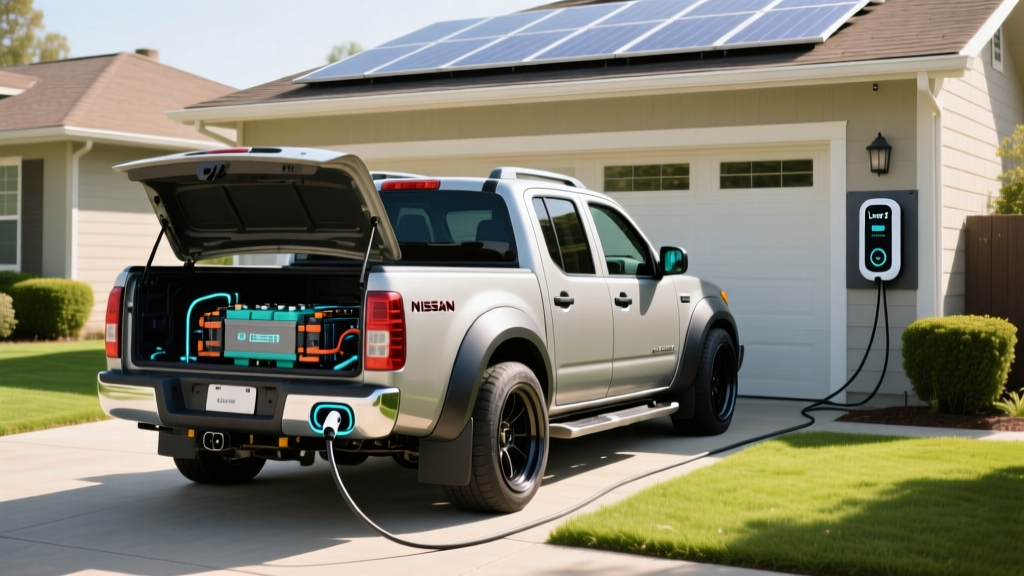
For daily use, Level 2 home charging is the backbone of EV ownership. A 40A Level 2 charger delivers ~9.6 kW, adding roughly 30-35 miles of range per hour — enough to fully replenish most EVs overnight. DC fast charging (what Electrify America and Tesla Superchargers provide) is for road trips and situations where you need a large charge quickly.
Home Charger Installation: What It Actually Costs
This is where many new EV owners get surprised. The charger hardware is often the cheapest part of the equation.
| Component | Typical Range | Notes |
|---|---|---|
| Level 2 charger (hardware) | $350 – $750 | 40A-48A smart chargers |
| Electrician labor (standard install) | $500 – $1,500 | Short run from panel, same wall |
| Electrician labor (complex run) | $1,500 – $3,000+ | Long conduit runs, trenching, garage detached |
| Permit & inspection | $50 – $300 | Varies by municipality; some waive for EV |
| Electrical panel upgrade (if needed) | $1,500 – $4,000 | 100A → 200A service; common in pre-2000 homes |
| TOTAL (no panel upgrade) | $900 – $2,550 | |
| TOTAL (with panel upgrade) | $2,400 – $6,550 |
Electrical requirements for a typical 48A Level 2 charger:
- Circuit: Dedicated 60A breaker (NEC requires 125% overhead — a 48A charger needs a 60A circuit)
- Wire: 6 AWG copper (THHN in conduit) or 4 AWG aluminum for longer runs
- Outlet or hardwired: NEMA 14-50 receptacle (allows charger portability) or hardwired (often preferred for outdoor installations and avoids GFCI nuisance trips)
- GFCI: NEC 2020+ requires GFCI protection for receptacle-based EVSE in garages. Hardwired units have built-in ground-fault protection and avoid breaker-level GFCI conflicts.
Recommended Home Chargers: What to Buy in 2026
Emporia Vue Level 2 EV Charger
- Power: 48A / 11.5 kW (240V, hardwired) or 40A / 9.6 kW (NEMA 14-50)
- Connector: NACS (native); J1772 available
- Cable length: 24 ft
- Smart features: Wi-Fi, scheduling, solar integration, energy monitoring
- Price: ~$399
- Best for: Budget-conscious buyers wanting smart features; solar homes
ChargePoint Home Flex (2nd Gen)
- Power: Up to 50A / 12 kW (adjustable 16A-50A)
- Connector: NACS or J1772 (configurable)
- Cable length: 23 ft
- Smart features: Wi-Fi, Alexa, app scheduling, utility demand-response
- Price: ~$599
- Best for: Flexibility on amperage; strong app ecosystem
Tesla Wall Connector (Gen 4)
- Power: 48A / 11.5 kW (240V/60A circuit)
- Connector: NACS (native); J1772 adapter included
- Cable length: 24 ft
- Smart features: Wi-Fi, OTA updates, power sharing (link up to 6 units)
- Price: ~$475
- Best for: Tesla owners; multi-EV households (power sharing)
Hardwired vs. plug-in: If your install location is outdoors or your local code requires GFCI breakers on receptacles, go hardwired. A hardwired installation avoids the nuisance GFCI tripping that plagues some NEMA 14-50 setups and allows the full 48A continuous draw. A plug-in NEMA 14-50 setup gives you portability if you move.
Strategy: When to Use Electrify America vs Tesla Supercharger
Having both networks in your toolkit is the optimal 2026 road-trip strategy. Here's a practical decision framework:
Choose Tesla Supercharger When:
- You drive a Tesla or a NACS-native vehicle (Ford, GM, Rivian, 2025+ Hyundai/Kia/VW)
- Reliability is paramount — Tesla's uptime and stall count still lead
- You're in rural corridors where Superchargers outnumber alternatives
- You want the lowest per-kWh public rate without a subscription
Choose Electrify America When:
- You drive a CCS1-equipped EV (2021-2024 models) and don't have a NACS adapter
- You're near an EA station at a shopping center or Walmart where you can combine charging with errands
- You have a Pass+ membership, bringing rates close to Tesla's
- You drive a vehicle with 800V architecture (Ioniq 5, EV6, Taycan) and want to exploit 350 kW Hypercharge stalls for faster 10-80% times than V3 Superchargers provide
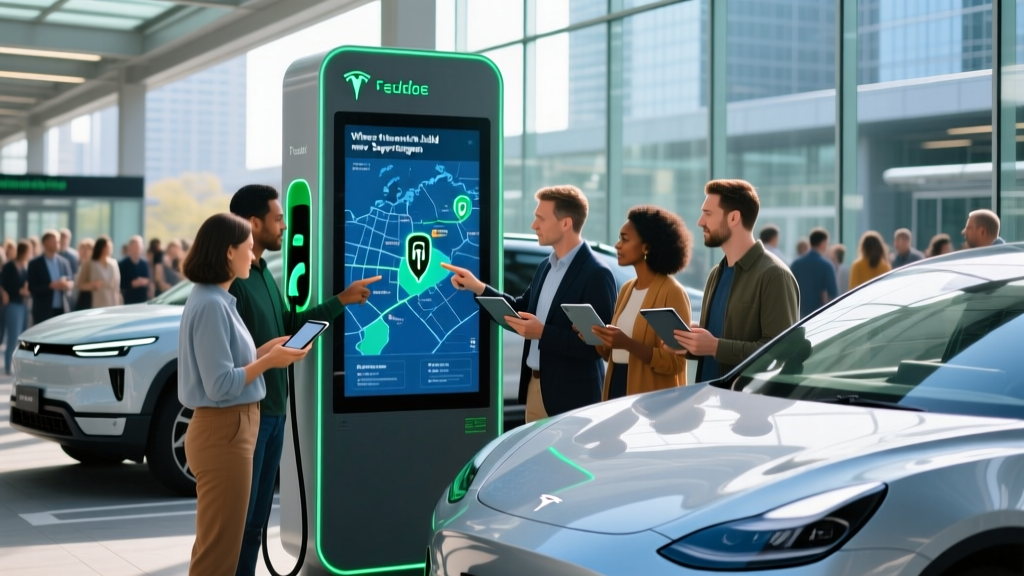
According to the Alternative Fuels Data Center, you can map both networks and plan routes that use the fastest, cheapest, or most reliable option at each stop.
Frequently Asked Questions
Can non-Tesla EVs use Tesla Superchargers?
Yes, if your vehicle has a NACS charge port (Ford, GM, Rivian, 2025+ Hyundai/Kia/VW models) or you have a CCS-to-NACS adapter. Tesla's "Open Supercharger" program also provides Magic Dock-equipped stalls at select locations for CCS vehicles without adapters, though these are still limited in number.
Can Teslas charge at Electrify America?
Yes. Electrify America has been adding NACS cables to new and updated stations. At older EA stalls with only CCS cables, Tesla owners can use the Tesla CCS1 adapter (~$250 from Tesla). Charge speeds will be limited to the CCS adapter's throughput, typically ~150-170 kW.
How much does it cost to install a home EV charger?
A straightforward Level 2 installation (short wire run, no panel upgrade) typically costs $900–$2,550 total including hardware, electrician labor, and permit. If your home needs a 200A panel upgrade, add $1,500–$4,000. Always get 2-3 quotes from licensed electricians and ask about utility rebates — many utilities cover $250-$1,000 of EVSE installation costs.
How fast will each charging level add range?
Level 1 (120V) adds 3-5 miles per hour. Level 2 (240V, 48A) adds roughly 30-40 miles per hour depending on vehicle efficiency. DC fast charging adds 150-1,000+ miles per hour at peak rates, but sessions are measured in 10-80% time (typically 18-45 minutes depending on vehicle and charger power).
Which connector/charger is compatible with my EV?
Check your vehicle's charge port: NACS (Tesla, Ford, GM, Rivian, and 2025+ models from most brands), CCS1 (2021-2024 models from Hyundai, Kia, VW, BMW, and others), or CHAdeMO (Nissan Leaf). Electrify America offers both CCS1 and NACS cables at most stations. Tesla Superchargers are NACS-native. See the compatibility table above for specifics by brand.
How much does charging cost per mile vs gas?
Home charging at $0.16/kWh costs roughly $0.05/mile for an average EV. Tesla Supercharging at ~$0.40/kWh is about $0.13/mile — near parity with gas at $3.40/gallon and 25 MPG. Electrify America at $0.56/kWh (non-member) costs ~$0.19/mile — more expensive than gas. The Pass+ membership ($7/month) brings EA to ~$0.14/mile. Always compare based on your vehicle's specific efficiency (miles per kWh) and local electricity rates.
What electrical upgrades might I need for a home charger?
The most common upgrade is a panel replacement from 100A to 200A service ($1,500-$4,000), required when your existing panel can't handle the additional 60A circuit load. Other potential needs: a new sub-panel if your garage is far from the main panel, conduit runs through finished walls or underground, or a utility service upgrade if your transformer is undersized. A licensed electrician will perform a NEC Article 220 load calculation to determine exactly what's needed.
For more on federal EV incentives that can offset charger costs, check the IRS residential clean energy credit page — the §25C credit may cover 30% of home EVSE installation costs (up to $1,000) depending on your eligibility and current-year rules.