Why Meijer Hosts Electrify America DC Fast Chargers
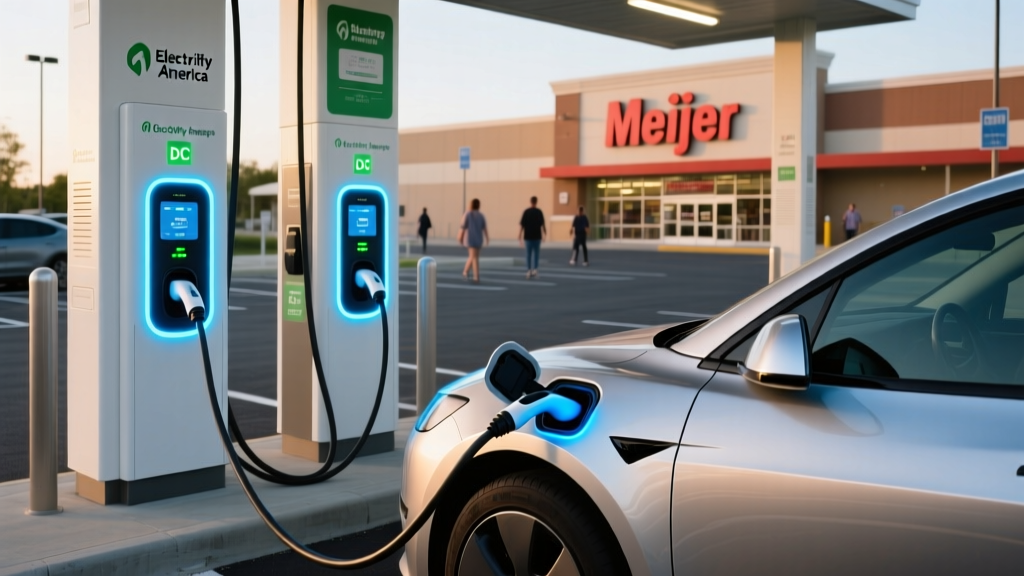
Electrify America (EA) has deployed hundreds of DC fast-charging stations at retail anchors across the Midwest and Southeast, and Meijer — the supercenter chain operating in Michigan, Ohio, Indiana, Illinois, Kentucky, and Wisconsin — is one of its most common co-locations. The logic is practical: shoppers spend 30–45 minutes inside, which aligns well with a 10–80% DC fast charge session on most modern EVs. For EV owners without home charging or those on road trips, an Electrify America charging station at Meijer can serve as a reliable pit stop.
But public fast charging is only one piece of the ownership puzzle. This guide breaks down exactly what you'll find at EA Meijer stations — connector types, peak power, pricing, and session expectations — while also covering how to build a complete charging strategy that includes a home Level 2 setup. If you've been searching for an Electrify America charging station Meijer location near you, you'll also learn what to do when public charging isn't enough.
Charging Levels Explained: How Fast Each One Adds Range
Before evaluating any public station, you need a clear picture of the three charging tiers and what they deliver. The critical distinction: kW (kilowatts) measures power — the rate at which energy flows into your battery. kWh (kilowatt-hours) measures energy — the total capacity stored. Think of kW as the speed of water through a hose and kWh as the size of the bucket.
| Level | Voltage | Power (kW) | Miles of Range Added Per Hour | Typical Use Case |
|---|---|---|---|---|
| Level 1 | 120V AC | 1.0–1.4 kW | 3–5 mi/hr | Overnight trickle, PHEV top-ups |
| Level 2 | 240V AC | 7.2–19.2 kW | 20–75 mi/hr | Home daily charging, workplace |
| DC Fast | 400–800V DC | 50–350 kW | 150–1,200+ mi/hr (peak) | Road trips, quick top-ups |
At an Electrify America Meijer station, you'll typically find 150 kW and 350 kW CCS1 chargers, plus NACS (Tesla-style) connectors at newer or recently upgraded locations. A 350 kW stall can theoretically add 200+ miles in 15 minutes on a vehicle with an 800V architecture like the Hyundai Ioniq 5 or Kia EV6. However, sustained speeds depend on your vehicle's charge curve — most EVs peak briefly then taper, especially above 80% State of Charge (SoC).
What to Expect at an Electrify America Charging Station at Meijer
EA's Meijer installations typically feature 4–8 charging stalls per location, mixing 150 kW and 350 kW hardware. Here's what matters when you pull in:
Connector Compatibility at EA Meijer Stations
Electrify America has been adding NACS connectors alongside CCS1 across its network. As of 2026, most upgraded EA stations offer both. CHAdeMO — used by the Nissan Leaf and older Mitsubishi models — has been phased out of new EA deployments, though some legacy stalls may still carry it.
| Connector | Vehicles That Use It | Available at EA Meijer? | Adapter Needed? |
|---|---|---|---|
| CCS1 | Ford Mach-E, VW ID.4, Hyundai Ioniq 5, BMW iX, most non-Tesla EVs | Yes — standard | None for CCS-native vehicles |
| NACS (Tesla) | Tesla Model 3/Y/S/X, 2025+ Ford, GM, Rivian, and others switching | Yes — at upgraded stations | Tesla-to-CCS adapter for older EA stalls |
| CHAdeMO | Nissan Leaf, Mitsubishi Outlander PHEV (older) | Limited — legacy only | No adapter available to CCS |
If you drive a Tesla and plan to use EA stations, you'll need a Tesla CCS adapter (sold by Tesla for ~$175) at locations without NACS connectors. By late 2026, most EA Meijer sites are expected to have at least one NACS-equipped stall, but it's worth checking the EA app for connector availability before you drive.
Pricing: What You'll Pay Per kWh at EA Meijer
Electrify America uses per-kWh pricing at most locations, which is more transparent than per-minute billing. As of 2026, typical rates at EA Meijer stations range from $0.39 to $0.56 per kWh, depending on the state and local utility costs. EA also offers a Pass+ subscription ($7/month) that reduces per-kWh rates by roughly 25%.
| Charging Scenario | Cost per kWh | Cost to Add 200 Miles (3.5 mi/kWh avg) | Cost per Mile |
|---|---|---|---|
| Home Level 2 (off-peak utility rate) | $0.08–$0.14 | $4.57–$8.00 | $0.02–$0.04 |
| Home Level 2 (standard rate) | $0.13–$0.18 | $7.43–$10.29 | $0.04–$0.05 |
| EA Meijer DC Fast (guest rate) | $0.39–$0.56 | $22.29–$32.00 | $0.11–$0.16 |
| EA Meijer DC Fast (Pass+ member) | $0.29–$0.42 | $16.57–$24.00 | $0.08–$0.12 |
| Gasoline (25 MPG avg, $3.40/gal) | — | $27.20 | $0.14 |
The takeaway: even at public DC fast rates, EV charging can be competitive with gasoline on a per-mile basis — but home Level 2 charging is dramatically cheaper. Relying exclusively on public fast charging erodes the EV cost advantage.
Charging Time Examples: 10–80% at EA Meijer DC Fast Chargers
Session time depends on your battery size (kWh), your vehicle's maximum charge acceptance rate (kW), and the charger's output. Here are real-world estimates for popular EVs at a 350 kW EA stall:
| Vehicle | Battery (kWh usable) | Peak Charge Rate (kW) | 10–80% Time (est.) | Architecture |
|---|---|---|---|---|
| Hyundai Ioniq 5 (2026) | 84 kWh | ~240 kW | ~18 min | 800V |
| Tesla Model Y Long Range | 75 kWh | ~250 kW | ~22 min | 400V |
| Ford Mustang Mach-E Extended Range | 91 kWh | ~150 kW | ~35 min | 400V |
| VW ID.4 Pro S | 82 kWh | ~170 kW | ~30 min | 400V |
| Chevrolet Equinox EV | 85 kWh | ~150 kW | ~33 min | 400V |
| Porsche Taycan (800V) | 83.7 kWh | ~320 kW | ~16 min | 800V |
Note that charge curves taper significantly above 80% SoC. Charging from 80–100% can take as long as the 10–80% session. For road trips, the optimal strategy is to charge to 80% and drive on — this minimizes total trip time.
Home Level 2 Charging: Requirements, Costs, and Equipment
Public DC fast chargers at Meijer are convenient for road trips and top-ups, but most EV owners do 80–90% of their charging at home on Level 2. A properly installed home Level 2 charger delivers 240V AC power at 32–48 amps, adding 25–45 miles of range per hour — enough to fully replenish any EV overnight.
Electrical Requirements for Home Level 2
A Level 2 home charger requires a dedicated 240V circuit, similar to what an electric dryer or oven uses. The specific amperage depends on your charger:
- 32-amp charger (7.7 kW): Requires a 40-amp dedicated circuit (NEC requires circuits rated 125% above continuous load)
- 40-amp charger (9.6 kW): Requires a 50-amp dedicated circuit
- 48-amp charger (11.5 kW): Requires a 60-amp dedicated circuit
If your home's electrical panel is already near capacity — common in homes built before 2000 with 100-amp service — you may need a panel upgrade to 200 amps, which adds significant cost. A licensed electrician can perform a load calculation to determine whether your current panel can handle the additional circuit.
How Much Does It Cost to Install a Home EV Charger?
Installation costs vary widely based on your home's electrical setup, the distance from the panel to the charger location, and local permit fees. Here's a realistic breakdown:
| Cost Component | Simple Install (panel near garage) | Moderate Install (50–80 ft run) | Complex Install (panel upgrade needed) |
|---|---|---|---|
| Level 2 Charger Equipment | $350–$700 | $350–$700 | $350–$700 |
| Electrician Labor | $300–$600 | $600–$1,500 | $1,000–$2,500 |
| Electrical Permit | $50–$150 | $50–$200 | $50–$200 |
| Panel Upgrade (if needed) | $0 | $0 | $1,500–$3,500 |
| Conduit/Wiring Materials | $50–$150 | $150–$400 | $200–$500 |
| Total Estimated Cost | $750–$1,600 | $1,150–$2,800 | $3,100–$7,400 |
According to the U.S. Department of Energy, most homeowners spend between $1,000 and $2,500 for a straightforward Level 2 installation. The federal Alternative Fuel Vehicle Refueling Property Credit (IRS Form 8911) may cover up to 30% of equipment and installation costs, capped at $1,000 for residential installations — check current-year eligibility with a tax professional.
What Electrical Upgrades Might I Need?
Beyond the dedicated circuit, watch for these potential upgrades:
- 200-amp panel upgrade: Required if your existing panel (100A or 150A) lacks headroom. Cost: $1,500–$3,500.
- GFCI breaker: NEC 2020 and later require GFCI protection for EV charging outlets in garages. Adds ~$50–$100 to the breaker cost.
- Outdoor-rated installation: If your charger mounts outside, you need a NEMA 4-rated enclosure and outdoor-rated conduit. Adds $100–$300 in materials.
- Sub-panel: For detached garages or long runs, a sub-panel may be more economical than a single long conduit. Adds $400–$800.
Recommended Home Level 2 Chargers
The best Level 2 chargers balance power output, cable length, smart features (scheduling, energy monitoring), and build quality. Here are proven picks for 2026:
| Charger Model | Max Power Output | Amperage | Cable Length | Connector | Smart Features | Price (est.) |
|---|---|---|---|---|---|---|
| ChargePoint Home Flex | 12 kW (50A) | Up to 50A adjustable | 23 ft | NACS or CCS (configurable) | App scheduling, Alexa, energy reports | $550–$650 |
| Emporia Level 2 EV Charger | 11.5 kW (48A) | 48A | 24 ft | NACS or J1772 | App, solar integration, load management | $350–$400 |
| Wallbox Pulsar Plus | 11.5 kW (48A) | 48A | 25 ft | NACS or J1772 | App, Power Boost load mgmt, Wi-Fi | $500–$600 |
| Tesla Wall Connector | 11.5 kW (48A) | 48A | 24 ft | NACS native | Tesla app, power sharing, Wi-Fi | $425–$475 |
| Grizzl-E Smart | 10 kW (40A) | 40A | 24 ft | J1772 (NACS adapter avail.) | App, OCPP, extreme cold rated (-40°F) | $400–$500 |
Our pick for most buyers: The ChargePoint Home Flex offers the widest amperage range (16–50A adjustable), works with any home panel, and its NACS/CCS configurability future-proofs your install. For budget-conscious buyers, the Emporia charger at ~$370 delivers excellent value with solar-aware load management.
Safety and Electrical Code Considerations
EV charging is a continuous high-draw load — your installation must meet the National Electrical Code (NEC) and local amendments. Key requirements:
- Dedicated circuit: Your EV charger must have its own breaker — no sharing with other appliances.
- 125% continuous-load rule: A 40A charger needs a 50A breaker and wiring rated for 50A (6 AWG copper or 4 AWG aluminum).
- GFCI protection: Required for all receptacle-based (plug-in) EV chargers in garages and outdoor locations per NEC 2020+. Hardwired units may be exempt in some jurisdictions.
- Outdoor rating: Outdoor chargers or outlets must carry a NEMA 3R or NEMA 4 weather rating. Use outdoor-rated conduit and fittings.
- Permit and inspection: Most municipalities require an electrical permit and a post-install inspection. Skipping this can void your homeowner's insurance coverage for electrical fires.
Always hire a licensed electrician. Per the National Fire Protection Association's NEC guidelines, improper EV charger wiring is a documented fire risk. A qualified electrician will pull permits, perform a load calculation, and ensure your installation passes inspection.
Building a Complete Charging Strategy: Home + Public
The most cost-effective and convenient EV ownership experience combines daily home Level 2 charging with occasional public DC fast charging for road trips. Here's a practical framework:
Choose home Level 2 charging if:
- You have a garage or dedicated parking spot with panel access
- You drive under 250 miles per day (covers 95% of US drivers)
- You want the lowest per-mile fuel cost ($0.03–$0.05/mi)
Rely on public DC fast charging (like EA at Meijer) if:
- You're on a road trip exceeding your EV's range
- You live in an apartment without charging access and need periodic top-ups
- Your EV's battery is large and your daily driving is minimal (charge once a week)
Use Level 1 (120V) only if:
- You drive a PHEV with a small battery (under 20 kWh)
- Your daily driving is under 30 miles and you have 12+ hours to charge overnight
- You're in a temporary living situation and can't install Level 2
Frequently Asked Questions
How do I find the nearest Electrify America charging station at Meijer?
Use the Electrify America app (iOS/Android) or the in-car navigation in vehicles with EA integration (VW, Ford, and others). Filter by "Meijer" in the station search, or enter your destination and check for EA stations along the route. The app shows real-time stall availability, connector types, and current pricing.
How fast will each charging level add range?
Level 1 (120V) adds 3–5 miles per hour. Level 2 (240V, 40A) adds roughly 30–35 miles per hour. DC fast charging at 150 kW can add 150–200 miles in 20 minutes; at 350 kW with a compatible vehicle, you can add 200+ miles in under 15 minutes. Actual speed depends on your vehicle's charge acceptance rate and battery state of charge.
Which connector does my EV need at an EA Meijer station?
Most non-Tesla EVs use CCS1. Tesla vehicles use NACS. Newer EA Meijer stations increasingly offer both connector types. If you drive a Tesla and arrive at a CCS-only EA stall, you'll need a Tesla CCS adapter (~$175). Check the EA app before visiting to confirm connector availability.
How much does charging cost per mile compared to gas?
Home Level 2 charging costs roughly $0.03–$0.05 per mile (at $0.13/kWh and 3.5 mi/kWh efficiency). Public DC fast charging at EA Meijer runs $0.08–$0.16 per mile depending on local rates and Pass+ membership. A comparable gas vehicle at 25 MPG and $3.40/gallon costs about $0.14 per mile. Home charging delivers the biggest savings; exclusive public fast charging narrows the gap.
What electrical upgrades might I need for a home charger?
At minimum, you need a dedicated 240V circuit (40–60A depending on charger amperage). Older homes with 100-amp panels may need a panel upgrade to 200 amps ($1,500–$3,500). NEC code also requires GFCI protection for plug-in chargers and a permit with inspection in most jurisdictions. A licensed electrician's load calculation will determine your exact needs.
Is it safe to charge my EV at home overnight?
Yes, when properly installed. A Level 2 charger on a dedicated, permitted circuit with correct breaker sizing and GFCI protection is as safe as any other major appliance. Modern EVs and chargers include multiple safety interlocks — charging stops automatically if a fault is detected. The National Highway Traffic Safety Administration (NHTSA) has not identified elevated fire risk from properly installed home EV charging.
Can I use an EA Meijer charger if I don't have the Electrify America app?
Yes. EA stations accept contactless credit/debit card payments directly at the charger screen. However, you'll pay the guest rate (typically $0.39–$0.56/kWh). Downloading the app and subscribing to Pass+ ($7/month) saves roughly 25% per kWh, which pays for itself in about two sessions.