The Real Story Behind Electrify America Free Charging
If you've searched for "Electrify America free charging" recently, you've likely encountered a patchwork of expired promotions, automaker trial periods, and vague references to complimentary sessions. Here's the reality for 2026: Electrify America (EA) periodically offers free charging through limited-time partnerships, new-vehicle trial credits, and regional promotions — but these are not permanent, universal programs. Some new EV purchases still include complimentary EA charging credits (typically 500–2,000 kWh spread over 1–3 years), but availability varies by manufacturer, model year, and dealership participation.
Relying on promotional free charging as a core ownership strategy is risky. Credits expire, stations go offline, and the networks that offer the best free trials today may restructure tomorrow. The smarter play is understanding the full charging ecosystem — from your garage outlet to the fastest DC corridor — so you can optimize cost and convenience regardless of which promotions are live.
This guide breaks down every charging level, real installation costs, connector compatibility for current EVs, and the actual cost-per-mile math that determines whether an EV saves you money.
Charging Levels Explained: Speeds, Power, and Range Added Per Hour
The single most common EV confusion is mixing up kW (kilowatts) and kWh (kilowatt-hours). Think of it like plumbing: kW is the flow rate of water through the pipe; kWh is the total volume in the tank. Your charger delivers power in kW; your battery stores energy in kWh. A 100 kWh battery charged at 10 kW takes 10 hours. The same battery at 150 kW (peak) takes far less — but only while the charge curve allows it.
| Level | Voltage | Power (kW) | Miles of Range Per Hour | Typical Use |
|---|---|---|---|---|
| Level 1 | 120V AC | 1.0–1.9 kW | 3–5 mi/hr | Overnight top-off, PHEVs, low-mileage drivers |
| Level 2 (Home/Public) | 240V AC | 3.3–19.2 kW | 12–70 mi/hr | Daily home charging, workplace, destination |
| DC Fast Charging | 400–800V DC | 50–350+ kW | 150–1,200+ mi/hr (peak) | Road trips, corridor travel, quick top-ups |
A few critical nuances: the "miles per hour" figure depends heavily on your vehicle's efficiency. A Hyundai Ioniq 6 (4.0 mi/kWh) gains more range per kW than a Ford F-150 Lightning (2.0 mi/kWh). And DC fast charging speeds are peak rates — your vehicle will taper charge speed as the battery fills, especially above 80% state of charge (SoC). A station advertising 350 kW won't deliver that rate for the entire session.
Charging time examples for common battery sizes (10–80% SoC):
- 60 kWh battery (e.g., base Tesla Model 3 RWD): ~18 min at 170 kW peak DCFC; ~4.5 hrs at 11.5 kW Level 2
- 82 kWh battery (e.g., VW ID.4 Pro S): ~28 min at 135 kW peak DCFC; ~6 hrs at 11.5 kW Level 2
- 100 kWh battery (e.g., Rivian R1S Dual-Motor): ~35 min at 200 kW peak DCFC; ~7.5 hrs at 11.5 kW Level 2
- 131 kWh battery (e.g., F-150 Lightning Extended Range): ~41 min at 150+ kW peak DCFC; ~10 hrs at 11.5 kW Level 2
Which Connector and Charger Is Compatible With My EV?
The connector landscape shifted dramatically between 2023 and 2026. Tesla's North American Charging Standard (NACS) has been adopted by nearly every major automaker, but thousands of CCS1-equipped EVs remain on the road, and older Nissan Leafs still use CHAdeMO. Here's where things stand for 2026 model-year vehicles:
| Connector | Brands Using It (2026 Models) | Adapter Needed? |
|---|---|---|
| NACS (native) | Tesla (all), Ford (2025+), GM (2025+), Rivian (2025+), Volvo, Polestar, Mercedes-Benz, BMW, Hyundai/Kia (2026+), Toyota | CCS1 adapter for non-Tesla DCFC stations without NACS cables |
| CCS1 | Hyundai/Kia (2024–2025), VW ID.4 (2024–2025), older BMW i4/iX, Stellantis EVs, pre-2025 Ford/GM | NACS-to-CCS adapter for Tesla Superchargers |
| CHAdeMO | Nissan Leaf (legacy only — discontinued), Mitsubishi Outlander PHEV (older) | No practical adapter; network support declining |
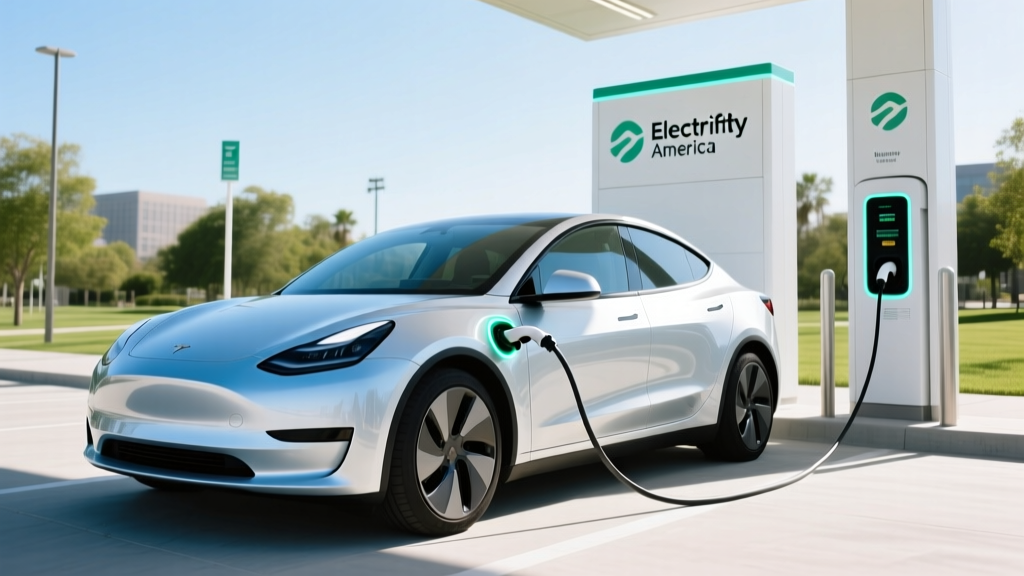
For Electrify America specifically: as of 2026, EA stations offer both CCS1 and NACS connectors at most new and retrofitted locations. Older EA stations may still be CCS1-only, so NACS-equipped drivers should carry a CCS-to-NACS adapter or verify connector availability in the EA app before routing to a station.
Electrify America free charging credits, when available, work with any connector type on their network — the credit is tied to your EA account, not the plug.
How Much Does It Cost to Install a Home EV Charger?
Home Level 2 charging is where the vast majority of EV charging happens — and where you'll save the most money. But installation costs vary enormously based on your electrical panel capacity, the distance from panel to charger location, and local permitting requirements.
Electrical requirements for a typical Level 2 home charger:
- Voltage: 240V (same as your dryer or oven circuit)
- Amperage: 40A circuit for a 32A charger (NEC code requires circuits rated 125% of continuous load); 50A or 60A circuit for 40A or 48A chargers
- Dedicated circuit: Required — you cannot share the circuit with other appliances
- GFCI protection: Required by NEC 2020+ for EV receptacles (hardwired chargers with built-in GFCI may not need an additional breaker-level GFCI)
| Cost Component | Low Estimate | High Estimate | Notes |
|---|---|---|---|
| Level 2 Charger (Equipment) | $350 | $750 | 32A–48A smart chargers (e.g., ChargePoint, Emporia, Wallbox) |
| Electrician Labor | $500 | $2,000 | Depends on run length, wall type, conduit needs |
| Electrical Permit | $50 | $300 | Varies by municipality; some waive for EV installs |
| Panel Upgrade (if needed) | $1,500 | $4,500 | 100A → 200A service upgrade; common in pre-1990 homes |
| Total (No Panel Upgrade) | $900 | $3,050 | Most homes with 200A service fall here |
| Total (With Panel Upgrade) | $2,400 | $7,550 | Older homes, high-load panels |
Panel upgrade gotcha: If your home has a 100-amp main panel already near capacity, adding a 40A EV circuit may push you over the NEC load calculation threshold. An electrician will perform a load calculation before recommending whether a panel upgrade is required. Homes built after 2000 with 200A service rarely need an upgrade. Always get a load calculation before committing to a charger amperage — oversizing your charger on an undersized panel is a fire risk.
The IRS Residential Clean Energy Credit (§25D) covers 30% of home EV charger equipment and installation costs (up to $1,000) through 2032. This is separate from the §30D vehicle purchase credit and stacks with it.
Cost to Charge: Home vs. Public vs. DC Fast — Per Mile Compared to Gas
Whether an EV saves you money depends entirely on where and when you charge. Here's the real cost breakdown for 2026:
| Charging Scenario | Cost per kWh | Cost per Mile (at 3.5 mi/kWh) | Equivalent Gas Price (at 30 MPG) |
|---|---|---|---|
| Home (off-peak utility rate) | $0.08–$0.14 | $0.02–$0.04 | $0.60–$1.20/gal |
| Home (standard residential rate) | $0.14–$0.22 | $0.04–$0.06 | $1.20–$1.80/gal |
| Public Level 2 (ChargePoint, EVgo L2) | $0.25–$0.49 | $0.07–$0.14 | $2.10–$4.20/gal |
| DC Fast (Electrify America, EA Pass+ member) | $0.36–$0.48 | $0.10–$0.14 | $3.00–$4.20/gal |
| DC Fast (EA non-member / guest rate) | $0.48–$0.64 | $0.14–$0.18 | $4.20–$5.40/gal |
| Tesla Supercharger (2026 avg.) | $0.28–$0.40 | $0.08–$0.11 | $2.40–$3.30/gal |
| Gas vehicle (30 MPG, $3.50/gal) | — | $0.12 | $3.50/gal |
Key takeaway: Home charging at off-peak rates makes EVs dramatically cheaper to fuel — roughly 70–80% less per mile than gas. But exclusive DC fast charging at non-member rates can actually exceed the cost of a fuel-efficient gas car. This is why home Level 2 installation isn't optional for cost-conscious EV owners; it's the economic foundation of EV ownership.
Electrify America's Pass+ membership ($4/month as of 2026) reduces DCFC rates by roughly 25%, making road-trip charging closer to gas parity. If you have free EA charging credits from a vehicle purchase, those credits typically apply at the guest rate — effectively making road-trip charging free until credits are exhausted.
Equipment Recommendations: Best Home Level 2 Chargers for 2026
Not all Level 2 chargers are equal. Here are four chargers we recommend based on real-world reliability, smart features, and value — each with specific power output and connector details:
Emporia Vue Level 2 Smart Charger
- Power Output: 48A (11.5 kW at 240V)
- Connector: NACS (2026 model); CCS1 adapter available
- Cable Length: 24 ft
- Smart Features: Wi-Fi, app scheduling, solar integration, energy monitoring, load management
- Price: ~$400
- Best For: Budget-conscious buyers who want full smart features and solar pairing
ChargePoint Home Flex (2nd Gen)
- Power Output: Up to 50A (12 kW at 240V) — adjustable via dip switches
- Connector: NACS native (2025+); J1772/CCS1 versions still sold
- Cable Length: 23 ft
- Smart Features: Wi-Fi, Alexa/Google Home, ChargePoint network access, flexible amperage
- Price: ~$550–$650
- Best For: Flexibility across panel capacities; set to 32A on a 40A circuit or 50A on a 60A circuit
Tesla Wall Connector (Gen 4)
- Power Output: 48A (11.5 kW at 240V)
- Connector: NACS native; includes J1772 adapter in box
- Cable Length: 24 ft
- Smart Features: Wi-Fi, over-the-air updates, Power Sharing (link multiple units), Tesla app integration
- Price: ~$450
- Best For: Tesla owners or mixed-Tesla/non-Tesla households (with J1772 adapter)
Wallbox Pulsar Plus
- Power Output: 40A (9.6 kW at 240V)
- Connector: J1772 (CCS1-compatible); NACS adapter available separately
- Cable Length: 25 ft
- Smart Features: Wi-Fi + Bluetooth, app scheduling, Eco-Smart mode (solar/grid), compact form factor
- Price: ~$450–$500
- Best For: Tight garage spaces; lower-amperage panels that can't support 48A+ circuits
For homes with 200A service and a dedicated 60A circuit available, go with a 48A charger to maximize Level 2 speed. If your electrician recommends a 40A circuit (common in older panels), choose a charger that can be set to 32A — the ChargePoint Home Flex is ideal for this scenario because its amperage is adjustable.
Safety, Code, and Installation Best Practices
EV charging involves sustained high-current draw — often 8–10 hours at a time. This makes proper installation non-negotiable. Key safety and code requirements for 2026:
- Dedicated circuit: Your EV charger must be on its own dedicated breaker. No sharing with laundry, HVAC, or lighting circuits.
- GFCI protection: NEC 2020 (Article 625) requires ground-fault protection for EV outlets. Hardwired chargers with internal GFCI protection may satisfy this without a GFCI breaker, but confirm with your local inspector.
- Outdoor rating: If installing outside, the charger must carry a NEMA 4 (or higher) weather rating. All chargers listed above meet this standard.
- Wire gauge: 6 AWG copper for 48A circuits; 4 AWG for 60A circuits. Your electrician will size wire to the breaker and run length.
- Permit and inspection: Most jurisdictions require an electrical permit and post-installation inspection. Skipping this can void homeowner's insurance coverage for electrical fires.
- Load management: If your panel is near capacity but you don't want to pay for an upgrade, consider a smart load-management system (e.g., Emporia's Smart Load Management) that dynamically throttles charger amperage when other household loads spike.
Always hire a licensed electrician — not a handyman — for EV charger installation. The sustained high-current nature of EV charging means poor connections, undersized wire, or improper torque on breaker terminals can create fire hazards that don't appear for months.
Making Electrify America Free Charging Work in Your Strategy
If you've secured EA free charging credits through a new-vehicle purchase or promotion, here's how to maximize their value:
- Register immediately: Credits are tied to your EA account. Activate them as soon as you receive the enrollment code from your dealer or automaker.
- Check expiration: Most promotional credits expire within 1–3 years of activation. Don't hoard them — use them on your longest trips where DCFC costs are highest.
- Verify station status: Use the EA app or electrifyamerica.com to check real-time station availability. Out-of-service chargers waste time, not credits.
- Pair with home charging: Use free EA credits exclusively for road trips and public charging. Do your daily charging at home on off-peak rates. This stretches credit value and reduces overall charging spend.
- Understand Pass+ pricing: Once credits expire, EA Pass+ membership ($4/month) reduces per-kWh rates significantly. If you DCFC more than twice a month, the membership pays for itself.
For the most current EA promotions and free-charging offers tied to specific vehicle purchases, check the Electrify America pricing page directly — offers change frequently and vary by region.
Frequently Asked Questions
Is Electrify America free charging still available in 2026?
Electrify America does not offer universally free charging. However, some automakers bundle complimentary EA charging credits (typically 500–2,000 kWh) with new EV purchases. These are time-limited and vary by brand and model year. Check with your dealer and register credits promptly on your EA account.
How fast will each charging level add range?
Level 1 (120V) adds 3–5 miles per hour. Level 2 (240V, 32A–48A) adds 12–70 miles per hour depending on amperage and vehicle efficiency. DC fast charging (50–350 kW) adds 150–1,200+ miles per hour at peak rates, but tapers significantly above 80% SoC. Real-world 10–80% sessions take 18–45 minutes depending on battery size and peak charge rate.
How much does charging cost per mile compared to gas?
Home charging at off-peak rates ($0.08–$0.14/kWh) costs $0.02–$0.04 per mile — equivalent to $0.60–$1.20/gallon gas. Public DC fast charging at guest rates ($0.48–$0.64/kWh) costs $0.14–$0.18 per mile — comparable to or exceeding a 30 MPG gas car at $3.50/gallon. Home charging is the economic key to EV savings.
What electrical upgrades might I need for a home charger?
Homes with 200A electrical service and available breaker space typically need only a dedicated 40A–60A circuit ($500–$2,000 installed). Homes with 100A service or panels near capacity may need a panel upgrade ($1,500–$4,500) to safely add EV charging. A licensed electrician should perform a load calculation before you commit to a charger amperage.
Which connector is compatible with my EV?
Most 2026 model-year EVs from Ford, GM, Rivian, Tesla, Volvo, BMW, Mercedes, and Hyundai/Kia now use NACS (Tesla's connector). Older or 2024–2025 models from Hyundai, Kia, VW, and Stellantis may still have CCS1. Nissan Leaf uses legacy CHAdeMO. Check your vehicle's charge port or owner's manual, and carry the appropriate adapter for the networks you'll use.
Can I use Electrify America with a Tesla or NACS-equipped vehicle?
Yes. As of 2026, most new and retrofitted Electrify America stations include NACS connectors alongside CCS1. If you encounter an older CCS1-only EA station, you'll need a CCS-to-NACS adapter. Tesla vehicles can use EA stations with the appropriate adapter or at NACS-equipped stalls.