If you're new to EV ownership or planning your first purchase, the charging landscape can feel like a maze of acronyms and conflicting advice. NACS, CCS, CHAdeMO, Level 2, DC fast — each term describes a different piece of the puzzle. This guide breaks down every electric vehicles charger type you'll encounter, with exact power figures, real-world charging times, installation costs, and the connector your specific EV actually needs.
One critical distinction before we start: kW (kilowatts) measures power — how fast energy flows into your battery. kWh (kilowatt-hours) measures energy — the total capacity of your battery, like gallons in a fuel tank. A 10 kW charger fills a 60 kWh battery faster than a 3 kW charger. Confusing these two is the single most common mistake new EV owners make.
The Three Charging Levels: Speed, Power, and Where You'll Find Them
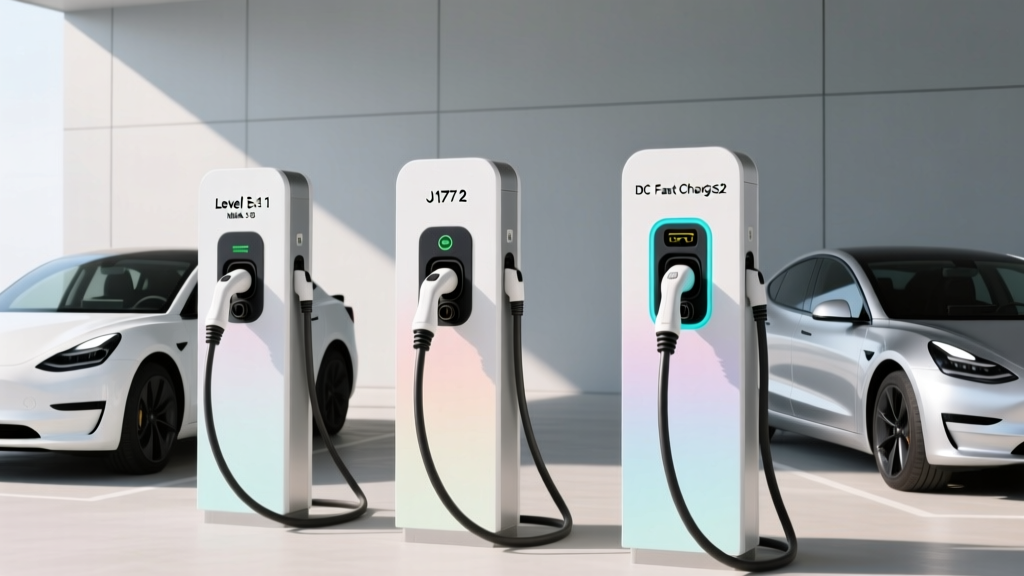
Every EV sold in the United States charges using one of three levels. Each level delivers a different amount of power and adds range at a dramatically different rate.
| Level | Voltage | Power (kW) | Miles of Range per Hour | Typical Location | 10–80% Time (60 kWh Battery) |
|---|---|---|---|---|---|
| Level 1 | 120V AC | 1.0–1.4 kW | 3–5 mi/hr | Any standard outlet | ~35–42 hours |
| Level 2 | 240V AC | 3.3–19.2 kW | 12–75 mi/hr | Home, workplace, retail | ~4–9 hours |
| DC Fast (Level 3) | 400–900V DC | 50–350+ kW | 150–1,000+ mi/hr | Highway corridors, dedicated stations | ~15–45 minutes |
Level 1: The Emergency Backup
Level 1 charging uses a standard 120V household outlet. Every EV ships with a Level 1 cord, and it requires zero installation. The trade-off is painfully slow speed: roughly 3 to 5 miles of range per hour of charging. A full charge on a 75 kWh battery pack (like the Ford F-150 Lightning Extended Range) can take 3+ days.
Level 1 makes sense if you drive under 30 miles daily, own a plug-in hybrid with a smaller 15–20 kWh battery, or need a temporary solution while waiting for a Level 2 installation. For most BEV owners, it's an emergency fallback, not a daily strategy.
Level 2: The Daily Workhorse
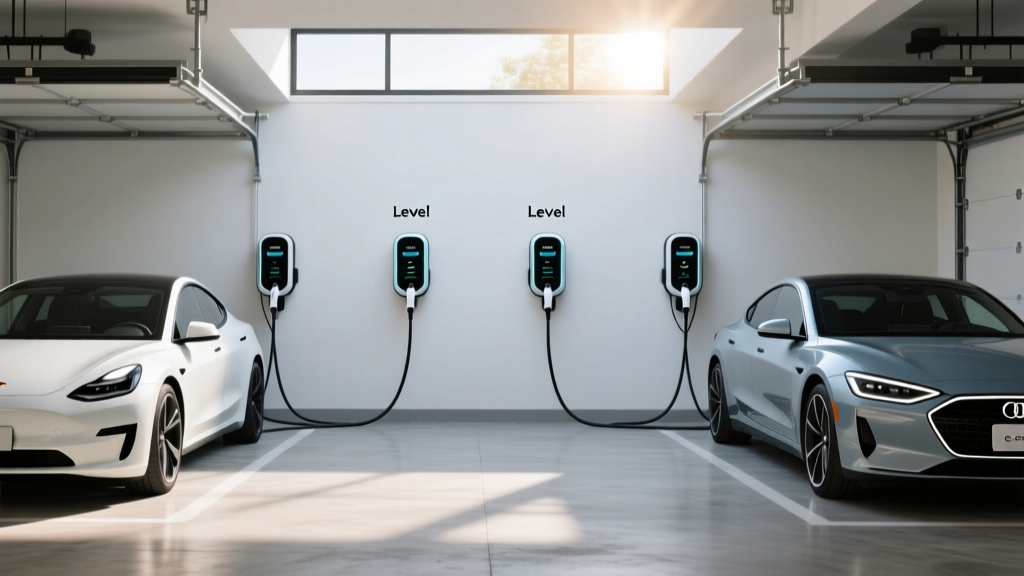
Level 2 operates on 240V — the same voltage as your electric dryer or oven. This is the charger most EV owners install at home and the type you'll find at workplaces, shopping centers, and parking garages. Power ranges from 3.3 kW (16A) up to 19.2 kW (80A), though most home installations land between 7.7 kW (32A) and 11.5 kW (48A).
At 11.5 kW, a typical 60 kWh battery (Hyundai Ioniq 5, Volkswagen ID.4) charges from 10% to 80% in roughly 4 hours. That's overnight-ready for virtually any daily driving pattern.
DC Fast Charging: The Road-Trip Essential
DC fast chargers bypass your vehicle's onboard charger and feed direct current straight to the battery. Speeds range from 50 kW (older stations) to 350 kW (Electrify America, Ionity) and even 500 kW at the newest Tesla V4 Supercharger sites. A modern 800V-architecture EV like the Hyundai Ioniq 5 or Kia EV6 can peak at 240+ kW, reaching 10–80% in approximately 18 minutes under ideal conditions.
Real-world caveat: Peak kW is not sustained kW. Every DC fast charge follows a charging curve — power ramps up to peak, then tapers significantly above 50–60% state of charge. A charger rated for 150 kW might average 80–100 kW across a full 10–80% session. Battery temperature, ambient weather, and state of charge all affect the curve. Cold batteries charge significantly slower unless preconditioned.
Connector Compatibility: Which Plug Fits Your EV?
The connector — the physical plug that mates with your EV's charge port — is where things get complicated. As of 2026, the North American market is in a major transition from CCS1 to NACS (Tesla's North American Charging Standard). Here's where each brand stands:
| Connector | Brands Using It (Native) | DC Fast Charging | Level 2 AC Charging | Adapter Available? |
|---|---|---|---|---|
| NACS (Tesla) | Tesla, Ford, GM, Rivian, Volvo, Polestar, Mercedes-Benz, Nissan, Fisker | Tesla Supercharger + NACS-equipped public stations | NACS connector | CCS-to-NACS and CHAdeMO-to-NACS adapters available |
| CCS1 | Hyundai, Kia, BMW, Volkswagen, Audi, Porsche, Stellantis, Subaru | Electrify America, EVgo, ChargePoint, most non-Tesla networks | J1772 connector | NACS-to-CCS adapters available (Ford/GM provide to owners) |
| CHAdeMO | Nissan Leaf (legacy), Mitsubishi Outlander PHEV | Limited and declining network | J1772 connector | Limited adapter options |
The NACS transition: Beginning in 2025, Ford, GM, Rivian, and several others adopted the NACS connector natively. These vehicles can charge at Tesla Superchargers using an included adapter (for 2024–2025 transitional models) or directly (2026+ models with native NACS ports). If you own a CCS1-equipped EV, check your manufacturer for a complimentary or low-cost NACS adapter to access the Supercharger network — the largest and most reliable DC fast-charging network in North America, with over 25,000 stalls.
For Level 2 AC charging, all non-Tesla EVs use the J1772 connector. Tesla uses a proprietary connector that is physically different but electrically identical. J1772-to-Tesla adapters are inexpensive (~$30–$50) and widely available.
Home EV Charger Installation: Requirements and Costs
A Level 2 home charger is the single biggest quality-of-life upgrade an EV owner can make. You wake up every morning with a full battery, and your cost per mile drops dramatically compared to public charging. But installation costs vary enormously depending on your home's electrical infrastructure.
Electrical Requirements
A Level 2 charger requires a dedicated 240V circuit. The amperage determines your charging speed:
- 32A circuit (40A breaker): 7.7 kW — adequate for most EVs and daily driving under 60 miles
- 48A circuit (60A breaker): 11.5 kW — recommended for larger batteries (80+ kWh) and higher daily mileage
- 80A circuit (100A breaker): 19.2 kW — premium setup for high-capacity trucks (F-150 Lightning, Hummer EV); requires a 200A+ panel
The National Electrical Code (NEC) requires the circuit breaker to be rated at 125% of the continuous load. So a 48A charger needs a 60A breaker, and a 32A charger needs a 40A breaker.
Do You Need a Panel Upgrade?
This is the make-or-break cost question. Most homes built after 1990 have a 200A electrical panel, which can usually support a 48A EV charger. Older homes with 100A or 150A panels may need an upgrade, especially if you already run electric heating, an electric oven, a dryer, and central AC.
Signs you may need a panel upgrade:
- Your panel is 100A or 150A
- You have no available double-pole breaker slots
- Your electrician's load calculation shows you're near capacity
- Your panel is a recalled Federal Pacific or Zinsco brand (common in pre-1990 homes)
An electrician will perform a load calculation (NEC Article 220) to determine whether your existing panel can handle the added draw. Don't skip this step — an overloaded panel is a fire hazard.
Installation Cost Breakdown
| Component | Simple Install (Panel Nearby, No Upgrade) | Complex Install (Long Run or Panel Upgrade) |
|---|---|---|
| Level 2 charger hardware | $350–$700 | $350–$700 |
| Electrician labor (2–4 hrs simple / 6–12 hrs complex) | $400–$1,000 | $1,200–$3,500 |
| Electrical permit | $50–$200 | $50–$200 |
| Panel upgrade (if needed) | $0 | $1,500–$4,000 |
| Conduit/wiring materials (long run >50 ft) | $100–$250 | $300–$800 |
| Total estimated cost | $900–$2,150 | $3,400–$9,200 |
The wide range reflects real-world variability. A condo garage with a panel 10 feet away might cost under $1,000 total. A 1960s ranch home needing a 200A panel upgrade, a 70-foot conduit run to a detached garage, and trenching could exceed $8,000. Get at least three quotes from licensed electricians and verify they have specific EV charger installation experience.
Many utilities offer rebates of $250–$1,000 for Level 2 installations, and some states provide additional incentives. Check with your local utility before scheduling work. The Alternative Fuels Data Center maintains a database of state and utility incentives.
How Much Does Charging Cost? Home vs. Public vs. Gas
Charging cost depends on where and when you charge. Here's a realistic breakdown using a 2026 Hyundai Ioniq 5 (84 kWh usable battery, ~3.5 miles per kWh efficiency) as a reference vehicle.
| Charging Scenario | Rate ($/kWh) | Cost for Full Charge (84 kWh) | Cost per Mile (~3.5 mi/kWh) | Equivalent Gas Price (at 28 MPG) |
|---|---|---|---|---|
| Home, off-peak utility rate | $0.08–$0.14 | $6.72–$11.76 | $0.023–$0.040 | $0.64–$1.12/gal |
| Home, standard residential rate | $0.14–$0.20 | $11.76–$16.80 | $0.040–$0.057 | $1.12–$1.60/gal |
| Public Level 2 (ChargePoint, EVgo) | $0.20–$0.40 | $16.80–$33.60 | $0.057–$0.114 | $1.60–$3.20/gal |
| DC Fast (Electrify America, EVgo) | $0.35–$0.55 | $29.40–$46.20 | $0.100–$0.157 | $2.80–$4.40/gal |
| Tesla Supercharger (varies by site) | $0.25–$0.40 | $21.00–$33.60 | $0.071–$0.114 | $2.00–$3.20/gal |
| Gas vehicle (reference) | — | — | $0.125 (at $3.50/gal, 28 MPG) | $3.50/gal |
The bottom line: Home charging at off-peak rates costs roughly 70–85% less per mile than gasoline. Even public DC fast charging at premium rates is often cheaper than gas on a per-mile basis, though the gap narrows significantly. If you rely exclusively on expensive public DC fast chargers, your fuel cost savings shrink — another reason a home Level 2 installation pays for itself quickly.
Best Home EV Chargers: Equipment Picks for 2026
Not all Level 2 chargers are equal. Build quality, cable length, smart features, and connector type matter. Here are four proven options across different budgets:
ChargePoint Home Flex
Power: Up to 12 kW (50A) configurable
Connector: J1772 (NACS adapter included for newer models)
Cable: 23 ft
Smart features: Wi-Fi, app scheduling, Alexa, utility TOU integration, energy reporting
Price: ~$550–$650
Best for: Most homeowners wanting reliable app control and flexible amperage
Emporia Level 2 EV Charger
Power: Up to 11.5 kW (48A)
Connector: J1772
Cable: 24 ft
Smart features: Wi-Fi, app control, solar integration, energy monitoring, TOU scheduling
Price: ~$350–$450
Best for: Budget-conscious buyers with solar panels or energy monitoring needs
Tesla Wall Connector
Power: Up to 11.5 kW (48A)
Connector: NACS native (J1772 adapter for non-Tesla EVs)
Cable: 24 ft
Smart features: Wi-Fi, OTA updates, power sharing between two units, Tesla app integration
Price: ~$475
Best for: Tesla owners or households with NACS-equipped EVs (Ford, GM, Rivian, 2026+ models)
Grizzl-E Smart
Power: Up to 10 kW (40A)
Connector: J1772 (NACS adapter available)
Cable: 24 ft
Smart features: Wi-Fi, OCPP protocol, adjustable amperage, extreme cold rated (-40°F)
Price: ~$450–$550
Best for: Cold-climate owners and those wanting open OCPP protocol for utility programs
All four chargers above are hardwired units — meaning an electrician connects them directly to your panel. Hardwired installations avoid the NEC requirement for a GFCI breaker on 240V receptacles, which can cost $100–$200 extra and occasionally causes nuisance tripping with EV chargers. Some models (ChargePoint Home Flex, Grizzl-E) also offer NEMA 14-50 plug versions for garage outlets, but hardwired is generally more reliable and code-friendly for higher-amperage circuits.
Safety, Code, and Installation Best Practices
EV chargers draw significant current for hours at a time — this is a continuous load under NEC definitions, and the installation must meet specific requirements:
- Dedicated circuit: Your EV charger must have its own dedicated breaker. Never share a circuit with other appliances.
- Breaker sizing: The breaker must be rated at 125% of the charger's maximum amperage. A 48A charger requires a 60A breaker.
- Wire gauge: Your electrician will select wire gauge based on amperage and run length. For a 48A charger on a 60A breaker, expect 6 AWG copper for runs under 50 feet; 4 AWG for longer runs to minimize voltage drop.
- GFCI protection: NEC 2020 and later requires GFCI protection for 240V receptacles used for EV charging in garages. Hardwired installations are exempt from this requirement, which is one reason hardwired is preferred.
- Outdoor rating: If your charger is installed outdoors, it must carry a NEMA 4 or NEMA 4X rating for weather resistance. All four chargers recommended above meet this standard.
- Permit and inspection: Most jurisdictions require an electrical permit and a post-installation inspection. Don't skip this — it protects you and is required for insurance and home resale.
Always hire a licensed electrician familiar with NEC Article 625 (Electric Vehicle Charging System Equipment). Ask whether they've installed EV chargers before and request references. A qualified installer will perform a load calculation, pull permits, and ensure the work passes inspection.
DC Fast Charging in Practice: What to Expect on Road Trips
Public DC fast charging is essential for road trips but requires more planning than home charging. Here's what the experience actually looks like:
Charging curve reality: A Hyundai Ioniq 5 at a 350 kW Electrify America station will peak around 230–240 kW between 10–30% state of charge, then taper to ~150 kW at 50%, ~80 kW at 70%, and ~40 kW above 85%. The 10–80% time is approximately 18 minutes under ideal conditions (warm battery, low station utilization). In winter, without preconditioning, that same session could take 30–40 minutes.
Network reliability: As of early 2026, Tesla Supercharger remains the most reliable DC fast-charging network, with uptime consistently above 95%. Electrify America and EVgo have improved significantly but still experience occasional stall outages. Apps like PlugShare and A Better Routeplanner show real-time stall status and user reviews — check them before relying on a single station in a rural area.
Charging-desert awareness: Rural stretches of I-70 (Kansas/Utah), I-90 (Montana/Dakotas), and parts of the Appalachian corridor still have gaps of 80–120 miles between DC fast chargers. If your EV has 250+ miles of real-world range, you can navigate these gaps — but plan conservatively. Cold weather, mountain driving, and high speeds (75+ mph) can reduce range by 20–35%.
Frequently Asked Questions
How much does it cost to install a home EV charger?
A straightforward Level 2 installation with a nearby electrical panel typically costs $900–$2,150 including the charger hardware, electrician labor, and permits. Complex installations requiring a panel upgrade, long conduit runs, or trenching can range from $3,400 to $9,200. Get multiple quotes and check for utility rebates before committing.
How fast will each charging level add range?
Level 1 adds roughly 3–5 miles per hour. Level 2 at 11.5 kW adds about 35–45 miles per hour for a typical sedan. DC fast charging adds 150–300+ miles in 15–30 minutes depending on the vehicle's charge acceptance rate and the station's power output. Always check your specific EV's maximum charge rate — a 150 kW-capable vehicle won't charge faster at a 350 kW station.
Which connector or charger is compatible with my EV?
Check the table in the Connector Compatibility section above. As of 2026, Tesla, Ford, GM, Rivian, Volvo, and several others use NACS. Hyundai, Kia, BMW, Volkswagen, and most legacy brands still use CCS1. The Nissan Leaf uses CHAdeMO. For Level 2 home charging, nearly all non-Tesla EVs use J1772. Adapters are widely available to cross between standards.
How much does charging cost per mile compared to gasoline?
Home charging at standard residential rates ($0.14–$0.20/kWh) costs roughly $0.04–$0.06 per mile for an efficient EV — equivalent to paying $1.12–$1.68 per gallon of gasoline. Public DC fast charging at $0.35–$0.55/kWh costs $0.10–$0.16 per mile, still competitive with gas at $3.50/gallon for a 28 MPG vehicle. The biggest savings come from home charging on off-peak utility rates.
What electrical upgrades might I need?
If your home has a 200A panel with available breaker slots and capacity headroom, you likely need only a dedicated 240V circuit. Homes with 100A or 150A panels, no available double-pole slots, or high existing electrical loads (electric heat, AC, oven, dryer) may need a panel upgrade to 200A or 400A. Your electrician will perform a load calculation to determine this. Some utilities offer "make-ready" programs that cover part of the panel upgrade cost.
Can I use a regular outlet to charge my EV?
Yes — that's Level 1 charging at 120V. It adds only 3–5 miles of range per hour and is impractical for daily BEV use, but it works for plug-in hybrids with smaller batteries or as a backup when traveling. Ensure the outlet is on a dedicated 15A or 20A circuit and avoid extension cords, which can overheat.
Is a smart charger worth the extra cost?
Smart chargers ($400–$700) offer app-based scheduling, energy monitoring, and utility TOU integration — features that can save $100–$300 per year by automatically charging during the cheapest rate windows. Basic "dumb" chargers ($250–$350) work fine if you don't need scheduling or monitoring. For most owners, the smart features justify the premium within 1–2 years through electricity savings alone.