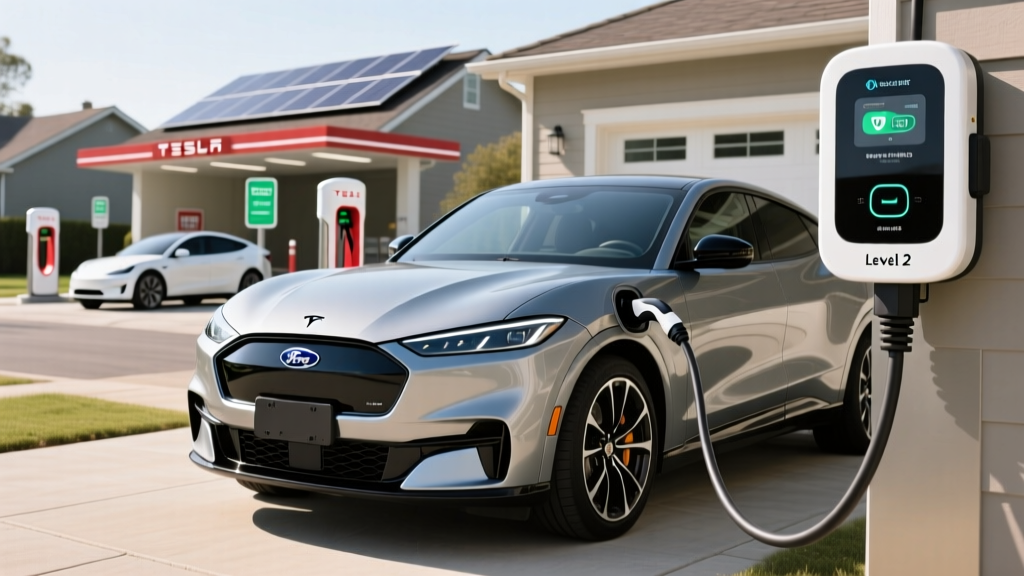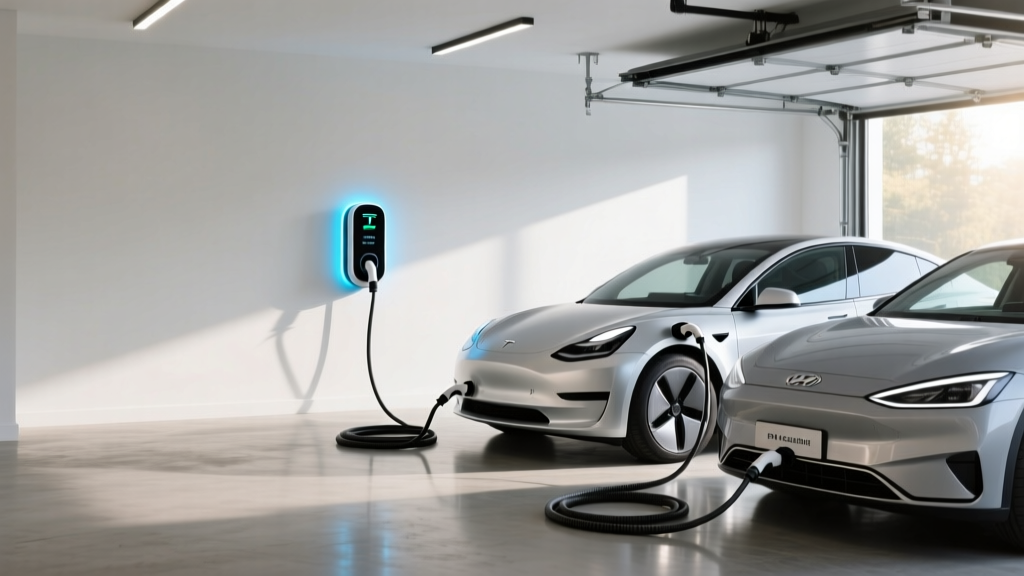
The Three Charging Levels: Speeds, Power, and Real-World Range Added
The single most important distinction in EV charging is between kW (kilowatts — the rate of power delivery, like water pressure) and kWh (kilowatt-hours — the total energy stored or delivered, like gallons of water). Your battery capacity is measured in kWh; your charger's speed is measured in kW. Confusing these two is the most common mistake new EV owners make.
Every electric vehicle EV charger falls into one of three categories. Here's what each delivers in practice:
| Level | Voltage / Amps | Power (kW) | Miles of Range Per Hour | Best For |
|---|---|---|---|---|
| Level 1 (120V) | 120V / 12A | ~1.4 kW | 3–5 mi/hr | Overnight top-ups, PHEVs, low-mileage drivers |
| Level 2 (240V) | 240V / 32–48A | 7.7–11.5 kW | 25–44 mi/hr | Daily home charging, most EV owners |
| DC Fast Charging | 400–800V DC | 50–350 kW | 150–1,200+ mi/hr (peak) | Road trips, rapid top-ups away from home |
A few practical notes from real-world use: Level 1 charging from a standard household outlet works, but it's painfully slow for a large battery. Charging a 75 kWh battery (say, a Tesla Model Y Long Range) from 10% to 80% on Level 1 takes roughly 37 hours — fine for a plug-in hybrid with a 15 kWh pack, impractical for a full BEV you drive daily.
Level 2 is where most EV owners live. A 48-amp (11.5 kW) home charger will refill that same 75 kWh battery from 10% to 80% in about 5–6 hours, easily covering a full day's driving overnight. DC fast charging is essential for road trips but isn't designed for daily use — frequent DC fast charging accelerates battery degradation due to thermal stress, and the charge curve tapers significantly above 80% State of Charge (SoC) to protect the cells.
How Much Does It Cost to Install a Home Electric Vehicle EV Charger?
This is the question that stops most prospective EV buyers in their tracks. The honest answer: it depends heavily on your home's electrical panel, the distance from panel to charger location, and local permit requirements. Here's a realistic breakdown based on typical 2026 installations:
| Component | Simple Install (Panel Nearby) | Complex Install (Long Run / Panel Upgrade) |
|---|---|---|
| Level 2 EVSE Equipment (hardwired, 48A) | $400–$700 | $400–$700 |
| Electrician Labor (licensed) | $400–$800 | $1,000–$2,500 |
| Electrical Permit | $50–$150 | $50–$200 |
| Conduit, Wiring (6 AWG copper for 48A) | $100–$300 | $300–$800 |
| Panel Upgrade (100A → 200A service), if needed | $0 (not needed) | $1,500–$3,500 |
| Total Estimated Cost | $950–$1,950 | $3,250–$7,700 |
Electrical Requirements for a Level 2 Home Charger
A typical Level 2 home electric vehicle EV charger requires:
- 240-volt dedicated circuit — never share the circuit with other appliances
- 40-amp or 50-amp breaker — for a 32A or 40A charger respectively (National Electrical Code requires the breaker to be rated at 125% of the continuous load, so a 40A charger needs a 50A breaker)
- 6 AWG copper wire for 48A circuits; 8 AWG for 32A circuits
- NEMA 14-50 outlet (if using a plug-in charger) or direct hardwire (preferred for 48A+ units — eliminates the outlet as a failure point and is required by code in some jurisdictions for high-amperage circuits)
- GFCI protection — required by NEC 2020 and later for EV outlets; hardwired units typically have GFCI built into the EVSE
Permits and Code Considerations
Most municipalities require an electrical permit for a new 240V circuit. Your electrician typically pulls this. The inspection ensures proper wire gauge, breaker sizing, grounding, and GFCI compliance. Skipping the permit risks insurance claim denial if an electrical fire occurs. For outdoor installations, confirm the charger carries a NEMA 4 or NEMA 4X rating (weatherproof) — many indoor-rated units void their warranty if mounted outside.
Connector Compatibility: NACS, CCS1, and CHAdeMO Explained
The EV industry has largely converged on the North American Charging Standard (NACS), originally developed by Tesla and now adopted by Ford, GM, Hyundai, Kia, Rivian, Volvo, BMW, and most major automakers for 2025–2026 model-year vehicles. Here's where each connector stands:
| Connector | Brands Using It (2026) | Notes |
|---|---|---|
| NACS (Tesla / SAE J3400) | Tesla, Ford, GM, Hyundai, Kia, Rivian, Volvo, BMW, Mercedes, Nissan (new models) | Industry standard for 2025+. Smaller, lighter connector. |
| CCS1 (Combined Charging System) | VW ID.4 (carryover), older BMW i4/iX, pre-2025 models | Legacy standard. Adapters available for NACS Superchargers. |
| CHAdeMO | Nissan Leaf (discontinued ~2025), Mitsubishi Outlander PHEV (older) | Effectively deprecated. Avoid for new purchases. |
Adapter reality: If you own a CCS1-equipped EV (e.g., a 2023–2024 VW ID.4 or Hyundai Ioniq 5), you can purchase a CCS-to-NACS adapter (~$150–$250) to access Tesla Supercharger stations. Ford and GM include these adapters with newer vehicles. For home Level 2 charging, most wall connectors now ship with a NACS plug, and J1772-to-NACS adapters are widely available (~$50–$100) for older vehicles. Always confirm your vehicle's charge port before ordering a home charger.
Cost to Charge: Home vs. Public vs. Gas — Per-Mile Economics
Charging cost is where EVs deliver their most compelling ownership advantage, but the savings vary dramatically depending on where and when you charge. Here's a realistic comparison using 2026 average rates:
| Scenario | Rate ($/kWh) | Efficiency (kWh/100mi) | Cost Per Mile |
|---|---|---|---|
| Home, off-peak utility rate | $0.08–$0.12 | 28–32 kWh | $0.025–$0.038 |
| Home, standard residential rate | $0.14–$0.18 | 28–32 kWh | $0.040–$0.058 |
| Public Level 2 (ChargePoint, EVgo L2) | $0.25–$0.40 | 28–32 kWh | $0.070–$0.128 |
| DC Fast Charging (Electrify America, Tesla Supercharger) | $0.35–$0.55 | 28–32 kWh | $0.098–$0.176 |
| Gasoline vehicle (30 MPG combined, $3.40/gal) | — | — | $0.113 |
Charging Time Examples: 10–80% for Common Battery Sizes
Here's what charging actually looks like in practice for popular 2026 EVs. Note that DC fast charging times reflect the charge curve — peak kW is only sustained between roughly 10–50% SoC, then tapers to protect the battery:
- Hyundai Ioniq 6 SE (77.4 kWh, NMC, 800V architecture): 10–80% in ~18 minutes at a 350 kW charger (peaks at ~240 kW); 7.5 hours on a 48A Level 2 home charger
- Tesla Model Y Long Range (~75 kWh, NMC): 10–80% in ~25 minutes at a 250 kW Supercharger (peaks at ~200 kW); 6.5 hours on 48A Level 2
- Ford F-150 Lightning Extended Range (131 kWh, NMC): 10–80% in ~41 minutes at a 150 kW DC charger; 11+ hours on 48A Level 2
- Chevrolet Equinox EV (85 kWh, NMC): 10–80% in ~30 minutes at a 150 kW charger; 7 hours on 48A Level 2
Best Electric Vehicle EV Chargers for Home: 2026 Equipment Picks
After testing and tracking reliability data across dozens of home EVSE units, here are the chargers that deliver the best combination of power output, build quality, smart features, and value for 2026:
Best Overall: Tesla Wall Connector (Gen 4)
- Power: 48A / 11.5 kW (hardwired, 240V/60A circuit)
- Connector: NACS native
- Cable: 24 ft
- Smart features: Wi-Fi, OTA updates, load sharing (pair multiple units on one circuit), Tesla app integration
- Price: ~$475
- Note: Works with any NACS-equipped EV, not just Teslas. Non-Tesla NACS vehicles use the Tesla app or Plug & Charge.
Best for CCS Vehicles: ChargePoint Home Flex
- Power: Up to 50A / 12 kW (adjustable 16–50A via DIP switches)
- Connector: J1772 (CCS-compatible with adapter) or NACS version available
- Cable: 23 ft
- Smart features: Wi-Fi, scheduling, Alexa/Google Home, detailed energy tracking, UL-listed
- Price: ~$550–$650
- Note: Amperage flexibility is excellent for homes with limited panel capacity — you can set it to 32A on a 40A breaker if needed.
Best Budget: Emporia Level 2 EV Charger
- Power: 48A / 11.5 kW (hardwired) or 40A / 9.6 kW (NEMA 14-50 plug)
- Connector: J1772 (NACS adapter included in 2026 bundle)
- Cable: 24 ft
- Smart features: Wi-Fi, Emporia energy monitoring integration, scheduling, solar-aware charging
- Price: ~$350–$400
- Note: Outstanding value. Pairs well with Emporia Vue home energy monitor for real-time cost tracking.
What Electrical Upgrades Might Your Home Need?
Before purchasing any electric vehicle EV charger, have a licensed electrician perform a load calculation on your existing panel. This determines whether your panel can safely support the added draw. Here are common scenarios:
- 200A panel, gas appliances (dryer, range, heat): Usually sufficient for a 48A EV circuit with no upgrades needed. This is the best-case scenario.
- 200A panel, all-electric home (heat pump, electric dryer, electric range, water heater): May be tight. Your electrician may recommend a 32A charger instead of 48A, or a smart load-management device like the Emporia Smart Load Manager that dynamically reduces EV charging when other appliances draw heavily.
- 100A panel: A 48A EV charger is typically not feasible without a panel upgrade to 200A ($1,500–$3,500). Alternatively, a 24A or 32A charger may work if the load calculation allows it.
- 60A panel (pre-1970s homes): Panel upgrade is almost certainly required. Budget $2,500–$4,000 for the upgrade plus charger installation.
Alternatives to a panel upgrade: Some utilities and companies now offer smart circuit splitters (e.g., NeoCharge Smart Splitter, ~$400) that share an existing 240V outlet (like a dryer outlet) between the dryer and EV charger, automatically switching between them. This avoids a new circuit run entirely, though it limits you to 24–32A charging and means you can't run the dryer and charge simultaneously at full speed.
Federal Tax Credits and Utility Rebates for Home Charging
The federal §30D Alternative Fuel Vehicle Refueling Property Credit covers up to 30% of home EV charger equipment and installation costs, capped at $1,000. However, eligibility is restricted to census tracts that are classified as low-income or non-urban per IRS guidelines. Check your census tract eligibility before counting on this credit.
Many utilities offer their own rebates that stack with the federal credit — typical ranges:
- Utility EVSE rebates: $200–$500 off equipment
- Installation rebates: $250–$750 toward electrician costs
- Time-of-use rate enrollment bonuses: $50–$150 one-time credit
- Panel upgrade assistance: some utilities offer $500–$1,000 toward panel upgrades when bundled with EV charger installation
Contact your local utility's EV program page or check the Alternative Fuels Data Center state incentive database for current programs in your area. Incentive amounts and availability vary by jurisdiction and change frequently.
Safety, Maintenance, and Code Best Practices
Home EV charging is extremely safe when installed correctly — EVSE units carry multiple layers of protection including ground-fault detection, overcurrent protection, and thermal monitoring. Follow these best practices:
- Always use a licensed electrician — DIY 240V work is dangerous and may void your homeowner's insurance
- Hardwire when possible — eliminates the NEMA 14-50 outlet as a wear point; outlets can loosen over time under continuous high-amperage load and create arcing risk
- Verify UL or ETL listing — only purchase chargers tested and certified by a Nationally Recognized Testing Laboratory (NRTL); avoid uncertified imports
- Outdoor installations: use a NEMA 4-rated unit, mount the connector holster with the plug facing downward to prevent water ingress, and ensure the conduit entry is sealed
- Cable management: use a holster or cable organizer to keep the cord off the ground; tripping hazards and cord damage from vehicles driving over them are the most common real-world failures
- Annual inspection: check the connector pins for discoloration or pitting, inspect the cable jacket for cracking, and verify the unit's indicator lights match normal operation per the manual
Frequently Asked Questions
Can I charge my EV from a regular 120V outlet?
Yes — every EV comes with a Level 1 mobile charger that plugs into a standard 120V household outlet. However, it delivers only ~1.4 kW, adding 3–5 miles of range per hour. For a 75 kWh battery, a full charge takes 2–3 days. Level 1 is practical for plug-in hybrids with small batteries (10–20 kWh) or for BEV owners who drive under 30 miles daily and can charge 10+ hours overnight.
Do I need a Tesla Wall Connector if I don't own a Tesla?
No, but it's still a strong option. The Gen 4 Tesla Wall Connector works with any NACS-equipped vehicle, and by 2026 most new EVs use NACS. If your EV has a CCS1 port, you'll need a NACS-to-CCS adapter. The ChargePoint Home Flex or Emporia charger may be more practical if you prefer J1772/CCS native compatibility without adapters.
How long does a home EV charger last?
Quality Level 2 chargers (Tesla, ChargePoint, Emporia, Grizzl-E) typically last 8–15 years. The most common failure points are the connector pins (from repeated insertion/removal and environmental exposure) and the cable jacket (UV degradation if outdoors). Most reputable units carry a 3-year warranty; the EVSE itself has no consumable parts beyond the cable and connector.
Will charging at home increase my electric bill significantly?
Expect an increase of roughly $30–$60/month for a typical driver covering 1,000 miles/month at standard residential rates ($0.14–$0.18/kWh, ~30 kWh/100mi). On an off-peak TOU plan ($0.08–$0.12/kWh), that drops to $24–$36/month. This replaces the $110–$130/month you'd spend on gasoline for the same mileage in a 30 MPG vehicle at $3.40/gallon — a net monthly savings of $50–$90.
Is DC fast charging bad for my battery?
Occasional DC fast charging (road trips, a few times per month) has minimal impact on battery health. However, exclusive reliance on DC fast charging accelerates degradation — studies show approximately 5–10% more capacity loss over 100,000 miles compared to Level 2 charging. The thermal stress from high charge rates is the primary factor. For daily use, Level 2 home charging is the longevity-optimal choice. Most manufacturers warranty battery capacity retention at 70% for 8 years/100,000 miles regardless of charging method.