If you're shopping for an EV or planning your first home charger install, understanding electric vehicle charging technology isn't optional — it's the difference between effortless daily driving and frustrating public-charger dependency. This guide breaks down every charging tier with exact power figures, real-world install costs, connector standards as of 2026, and what you'll actually pay per mile compared to gasoline.
The Three Tiers of EV Charging Technology
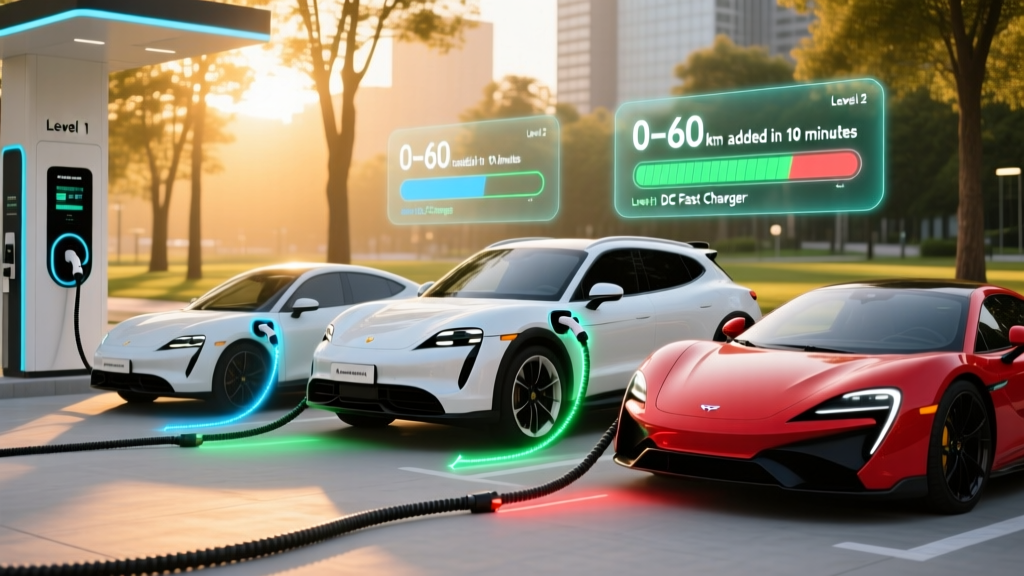
Every battery-electric and plug-in hybrid vehicle accepts electricity at one of three tiers. The critical distinction to internalize first: kW (kilowatts) measures power — how fast energy flows into the battery. kWh (kilowatt-hours) measures energy — the total capacity of the battery, like gallons in a fuel tank. A 75 kWh battery charged at 11.5 kW takes roughly 6.5 hours from empty; that same battery at 150 kW DC fast charging can recover 10–80% in about 25 minutes.
| Level | Voltage / Amps | Power (kW) | Miles of Range Added per Hour | Typical Use Case |
|---|---|---|---|---|
| Level 1 | 120V / 12A | ~1.4 kW | 3–5 mi/hr | Overnight top-up, PHEVs, emergencies |
| Level 2 (Home/Public) | 240V / 32–48A | 7.7–11.5 kW | 25–44 mi/hr | Daily home charging, workplace, hotels |
| DC Fast Charging | 400–800V DC | 50–350 kW | 150–1,000+ mi/hr (peak) | Road trips, rapid top-ups |
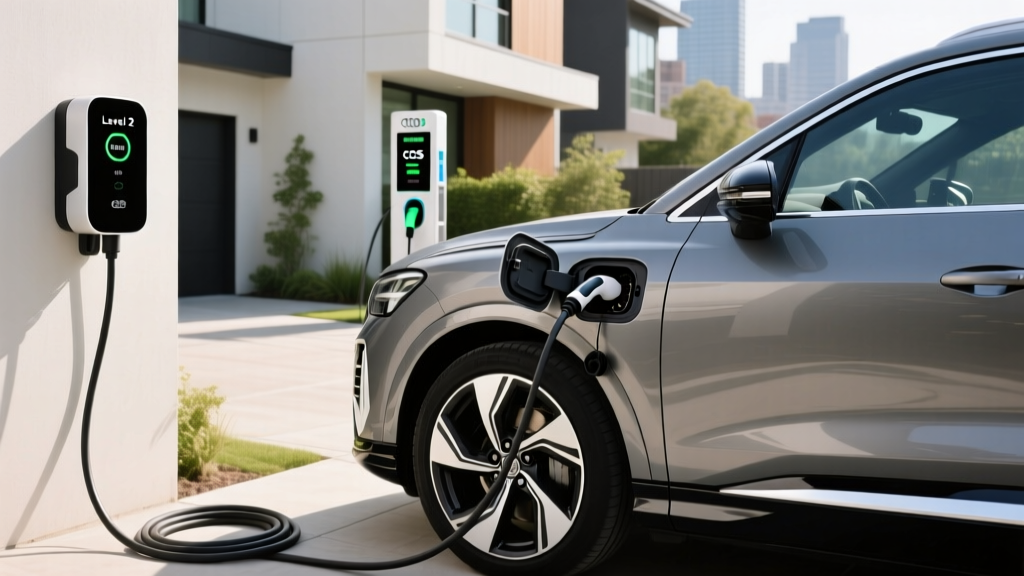
Level 1 charging comes with every EV via the included mobile cord. It's fine for plug-in hybrids with small batteries (a Toyota RAV4 Prime's 18.1 kWh battery refills in ~5.5 hours on Level 1) but painfully slow for a 90+ kWh battery in a full-size electric truck. Level 2 is the practical daily standard. DC fast charging bypasses the vehicle's onboard AC-to-DC converter and feeds DC power directly to the battery pack, which is why speeds jump dramatically.
Home Charger Installation: Electrical Requirements & Real Costs
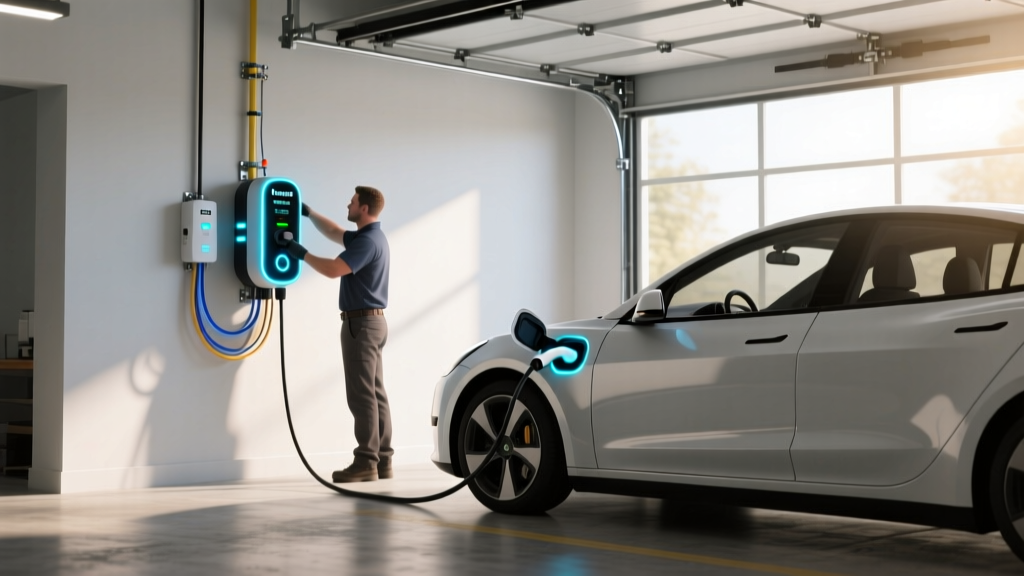
A Level 2 home charger requires a dedicated 240-volt circuit, similar to what powers an electric dryer or oven. The most common setup is a NEMA 14-50 outlet on a 50-amp breaker, which supports continuous charging at 40 amps (9.6 kW). Hardwired installations on a 60-amp breaker allow 48-amp continuous charging (11.5 kW) and are generally safer because they eliminate the plug connection as a potential failure point.
Your home's electrical panel capacity is the wildcard that determines whether the install costs $600 or $4,000. Most homes built after 1990 have a 200-amp service panel with enough spare capacity for a 50-amp EV circuit. Older homes with 100-amp service often need a panel upgrade — typically $1,500–$3,000 — or an alternative solution like a smart load-management device that throttles the charger when other high-draw appliances run.
| Component | Simple Install (Panel Nearby) | Complex Install (Long Run / Panel Upgrade) |
|---|---|---|
| Level 2 Charger Equipment | $350–$700 | $350–$700 |
| Electrician Labor | $400–$800 | $1,200–$2,500 |
| Electrical Permit | $50–$150 | $50–$250 |
| Panel Upgrade (if needed) | $0 | $1,500–$3,000 |
| Conduit / Wiring (long runs) | $0–$200 | $300–$800 |
| Total Estimated Cost | $800–$1,850 | $3,400–$7,250 |
The federal Alternative Fuel Vehicle Refueling Property Credit (IRS Form 8911) can offset up to 30% of home charger equipment and installation costs, capped at $1,000, if you live in an eligible census tract. Check your eligibility with a tax professional — the rules depend on where the charger is installed, not just what you buy.
Charging Time Examples for Common EV Battery Sizes
Charge times vary by battery capacity (measured in kWh) and the power (kW) your vehicle and charger can negotiate. Here's what 10–80% charging looks like across popular models:
- Tesla Model Y (75 kWh usable, LFP): Level 2 at 11.5 kW — approximately 4.5 hours. DC fast at 250 kW peak — ~15–20 minutes to 80%, tapering significantly above 60%.
- Hyundai Ioniq 5 (77.4 kWh, NMC, 800V architecture): Level 2 at 10.9 kW — approximately 5 hours. DC fast at 240 kW peak — ~18 minutes to 80% thanks to its 800V system sustaining higher power longer.
- Ford F-150 Lightning Extended Range (131 kWh usable, NMC): Level 2 at 11.5 kW — approximately 8 hours. DC fast at 155 kW peak — ~45 minutes to 80%. Larger batteries take longer even at high kW rates.
- Chevrolet Equinox EV (85 kWh, NMC): Level 2 at 11.5 kW — approximately 5.5 hours. DC fast at 150 kW peak — ~30 minutes to 80%.
The Hyundai Ioniq 5 and Kia EV6, with their 800-volt architectures, accept higher sustained DC fast-charging power than 400V competitors. If road-trip charging speed is a priority, vehicle voltage architecture matters as much as the charger's rated output.
Connector Standards in 2026: NACS, CCS1 & CHAdeMO
The North American connector landscape consolidated dramatically between 2023 and 2026. Tesla's North American Charging Standard (NACS) is now the dominant plug, adopted by Ford, GM, Rivian, Volvo, Hyundai/Kia, and most other major automakers. The Combined Charging System (CCS1) remains on vehicles sold before the transition and at Electrify America and many third-party networks. CHAdeMO, used primarily by the Nissan Leaf, is effectively legacy.
| Connector | Brands Using It (New Vehicles) | Network Access |
|---|---|---|
| NACS (Tesla standard) | Tesla, Ford, GM, Rivian, Volvo, Polestar, Hyundai, Kia, Mercedes-Benz (new models) | Tesla Supercharger, Electrify America (new stalls), most new networks |
| CCS1 | VW ID.4 (carryover), BMW (carryover), legacy models pre-adoption | Electrify America, EVgo, ChargePoint DC stations |
| CHAdeMO | Nissan Leaf (legacy only) | Limited and declining |
If you buy a CCS1-equipped vehicle today, a CCS-to-NACS adapter (typically $150–$250) unlocks Tesla Supercharger access, which remains the most reliable and widespread DC fast-charging network in the U.S. Tesla owners with older vehicles may need a NACS-to-CCS adapter to use some Electrify America or third-party stations. Always verify adapter compatibility with your specific model year before purchasing.
Cost to Charge: Home vs. Public vs. Gasoline
Electricity pricing varies enormously by location, time of day, and whether you're charging at home or on a public network. The national average residential electricity rate in 2026 hovers around $0.17/kWh, but time-of-use plans in states like California and Texas can drop to $0.08–$0.10/kWh during off-peak overnight hours.
| Scenario | Rate / Price | Vehicle Efficiency | Cost Per Mile |
|---|---|---|---|
| Home, off-peak (national avg.) | $0.10/kWh | 3.0 mi/kWh (typical midsize EV) | $0.033/mi |
| Home, standard rate | $0.17/kWh | 3.0 mi/kWh | $0.057/mi |
| Public Level 2 (ChargePoint, etc.) | $0.25–$0.40/kWh | 3.0 mi/kWh | $0.083–$0.133/mi |
| DC Fast Charging (Electrify America) | $0.35–$0.55/kWh | 3.0 mi/kWh | $0.117–$0.183/mi |
| Gasoline (25 MPG combined, $3.40/gal) | $3.40/gal | 25 mi/gal | $0.136/mi |
| Gasoline (30 MPG combined, $3.40/gal) | $3.40/gal | 30 mi/gal | $0.113/mi |
Home charging at off-peak rates is roughly 4× cheaper per mile than a 25-MPG gas vehicle. Even at standard residential rates, EVs hold a meaningful cost advantage. However, frequent reliance on DC fast charging at $0.45–$0.55/kWh can push per-mile costs above that of an efficient hybrid — which is why home or workplace Level 2 access remains the economic backbone of EV ownership.
Check fueleconomy.gov for the EPA-rated kWh/100mi efficiency of any specific EV you're considering, as this figure directly determines your real cost per mile.
Recommended Home Level 2 Chargers (2026)
The home charger market has matured, with reliable smart chargers available from $350 to $700. Here are three well-regarded options across price and feature tiers:
Emporia Level 2 EV Charger
- Power Output: 48 amps (11.5 kW) hardwired / 40 amps (9.6 kW) plug-in
- Connector: J1772 (NACS adapter available)
- Cable Length: 24 feet
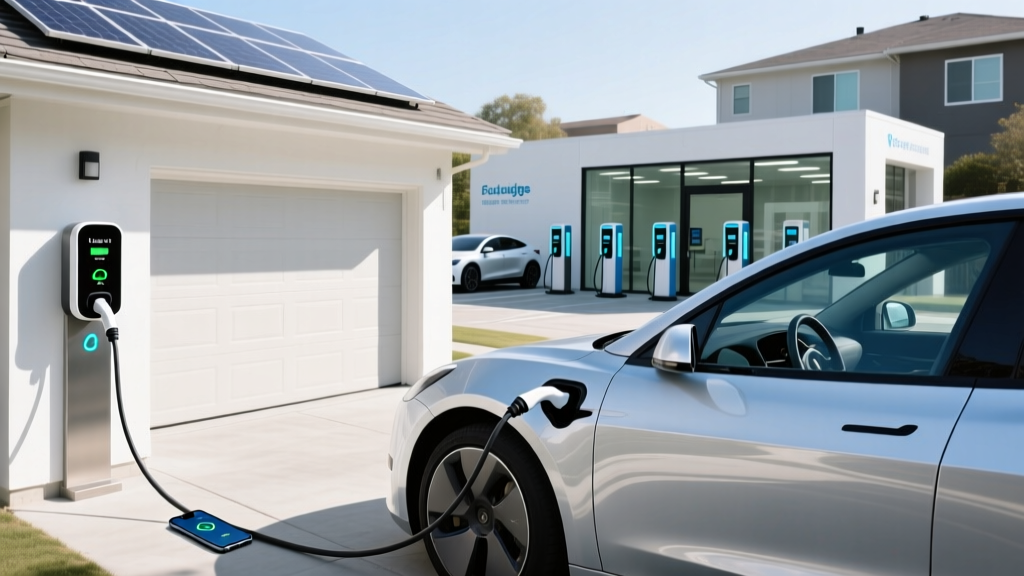
- Smart Features: Wi-Fi, energy monitoring via Emporia app, solar integration, scheduling
- Price: ~$399
- Best For: Budget-conscious buyers who want full smart features and energy tracking
ChargePoint Home Flex
- Power Output: Up to 50 amps (12 kW) hardwired, adjustable via DIP switch
- Connector: J1772 (NACS version available)
- Cable Length: 23 feet
- Smart Features: Wi-Fi, Alexa/Google Home integration, scheduling, detailed session history
- Price: ~$549
- Best For: Established brand reliability, flexible amperage adjustment for older panels
Tesla Wall Connector
- Power Output: 48 amps (11.5 kW) hardwired
- Connector: NACS native (J1772 adapter included for non-Tesla EVs)
- Cable Length: 24 feet
- Smart Features: Wi-Fi, OTA updates, power sharing between multiple units, Tesla app integration
- Price: ~$475
- Best For: Tesla owners or households with NACS-equipped vehicles who value seamless ecosystem integration
All three chargers are UL-listed and support scheduled charging to exploit off-peak electricity rates. The critical decision factor is your vehicle's connector — buy a NACS-native charger if your EV uses NACS, or a J1772 charger if it uses CCS1, to avoid permanent adapter dependency.
Safety, Code & Electrical Considerations
EV charging draws sustained high current for hours — far longer than a dryer cycle. This makes code compliance and proper installation non-negotiable:
- Dedicated circuit: Your Level 2 charger must be on its own dedicated breaker — never shared with other appliances. A 50-amp breaker supports 40 amps continuous; a 60-amp breaker supports 48 amps continuous.
- GFCI protection: The 2023 NEC (National Electrical Code) and subsequent updates require GFCI protection for EV receptacles. Hardwired chargers may be exempt depending on local code interpretation — your electrician will know.
- Outdoor rating: If your charger is installed outdoors or in an unenclosed carport, it must carry a NEMA 4 (weatherproof) rating. All three chargers recommended above meet this standard.
- Wire gauge: A 50-amp circuit requires minimum 6 AWG copper wire; a 60-amp circuit requires 4 AWG. Longer wire runs may need thicker gauge to prevent voltage drop.
- Permit and inspection: Nearly all jurisdictions require an electrical permit for EV charger installation. Skipping the permit risks insurance coverage denial if an electrical fire occurs.
Always hire a licensed electrician familiar with EV charger installs. Ask whether your panel has sufficient spare capacity before purchasing equipment — a 200-amp panel with 160 amps of existing calculated load can safely add a 40-amp circuit, but a panel already near capacity cannot.
Frequently Asked Questions
How much does it cost to install a home EV charger?
A straightforward Level 2 install with a nearby panel and short wire run typically costs $800–$1,850 including equipment, electrician labor, and permit. Complex installs requiring long conduit runs or a panel upgrade can reach $3,400–$7,250. The federal Alternative Fuel Vehicle Refueling Property Credit may offset 30% of costs up to $1,000 for eligible census tracts.
How fast will each charging level add range?
Level 1 (120V) adds roughly 3–5 miles of range per hour. Level 2 (240V) adds 25–44 miles per hour depending on amperage and vehicle efficiency. DC fast charging adds 150–1,000+ miles per hour at peak power, but sustained rates taper above 50–60% state of charge. For practical planning, use 10–80% charge times rather than peak kW figures.
Which connector and charger is compatible with my EV?
Check your vehicle's charge port. Most 2025–2026 model-year EVs from Tesla, Ford, GM, Hyundai, Kia, Rivian, and Volvo use NACS. Older models and some carryover vehicles (like the VW ID.4) still use CCS1. The Nissan Leaf uses CHAdeMO. Match your home charger's connector to your vehicle's port, or plan to use a certified adapter.
How much does EV charging cost per mile compared to gas?
At home off-peak rates (~$0.10/kWh), a typical EV costs about $0.03–$0.04 per mile. At standard residential rates (~$0.17/kWh), it's roughly $0.05–$0.06/mile. A 25-MPG gasoline vehicle at $3.40/gallon costs about $0.14/mile. Public DC fast charging at $0.45–$0.55/kWh pushes EV costs to $0.12–$0.18/mile — comparable to an efficient gas car.
What electrical upgrades might I need for a home charger?
Homes with a 200-amp electrical panel and spare breaker slots usually need no upgrades beyond the dedicated circuit. Homes with 100-amp service, full panels, or panels older than 30 years may require a panel upgrade ($1,500–$3,000) or a smart load-management device that shares capacity between the EV charger and other circuits. Your electrician's load calculation determines the answer.