If you're shopping for an EV or plugging one in for the first time, the jargon around electric vehicle charging levels can feel like learning a new language. Kilowatts, kilowatt-hours, NACS, CCS, 10-80% charge curves — the list goes on. But understanding these fundamentals is the single most important thing you can do to avoid range anxiety, overspend on equipment, or discover your home's electrical panel can't support the charger you just bought.
This guide breaks down the three EV charging levels with exact speeds, real-world installation costs, connector compatibility by brand, and what you'll actually pay per mile compared to gasoline. Whether you're wiring up a Level 2 charger in your garage or mapping out a DC fast-charging road trip, you'll leave with the numbers to make smart decisions.
The Three Electric Vehicle Charging Levels: Speed and Range at a Glance
EV charging is divided into three levels based on voltage and power delivery. Before we get into the table, let's clear up the most common confusion in the EV world: kW (kilowatts) measures power — how fast energy flows into your battery, like water pressure from a hose. kWh (kilowatt-hours) measures energy — the total amount stored in your battery, like gallons in a tank. A 75 kWh battery charged at 11.5 kW takes roughly 6.5 hours from empty; that same battery on a 150 kW DC fast charger can go from 10% to 80% in about 25 minutes.
| Level | Voltage | Power (kW) | Miles of Range Added Per Hour | Typical Use Case |
|---|---|---|---|---|
| Level 1 | 120V AC | 1.2–1.9 kW | 3–5 miles | Overnight top-up, PHEV owners, emergency backup |
| Level 2 | 240V AC | 3.3–19.2 kW | 12–75 miles | Daily home charging, workplace, public destinations |
| DC Fast Charging (Level 3) | 200–800V DC | 50–350+ kW | 150–1,200+ miles (theoretical) | Road trips, highway corridors, rapid top-ups |
Level 1 Charging: The Included-but-Slow Option
Every EV and PHEV ships with a Level 1 charging cable that plugs into a standard 120V household outlet. At 12 amps (1.4 kW), you'll recover about 4 miles of range per hour. That means fully replenishing a 75 kWh battery (like the Tesla Model Y Long Range) from empty would take roughly 53 hours.
Level 1 is perfectly adequate for plug-in hybrids with smaller batteries (10–20 kWh), which can fully recharge overnight. For a BEV with a larger battery, Level 1 works only if your daily commute is under 20 miles round-trip and you can leave the car plugged in for 12+ hours at a time. Think of it as a trickle — enough to maintain, rarely enough to fully replenish.
Level 2 Charging: The Home Standard
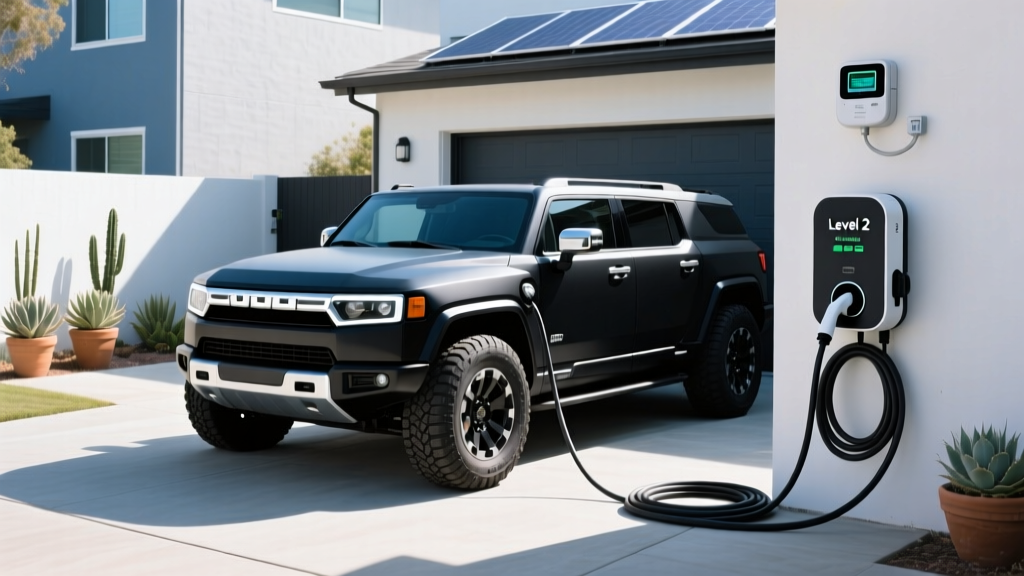
Level 2 charging runs on 240V AC — the same voltage as your electric dryer or oven. This is where the vast majority of practical home charging happens. A typical residential Level 2 setup delivers between 7.7 kW and 11.5 kW (32A to 48A on a 240V circuit), adding 25–45 miles of range per hour.
With a Level 2 charger, a vehicle like the Hyundai Ioniq 5 (84 kWh usable battery, EPA range up to 318 miles) can go from 10% to full in roughly 8–10 hours at 11.5 kW — ideal for overnight charging. Most EV owners with home Level 2 access report never thinking about range in daily life: plug in when you get home, wake up to a full battery.
Electrical Requirements for Level 2 Home Installation
Here's where many first-time EV buyers hit a wall. A Level 2 charger requires a dedicated 240V circuit in your electrical panel. The circuit amperage must be 125% of the charger's continuous draw — so a 48A charger requires a 60A breaker. Here's a breakdown of common configurations:
- 32A charger (7.7 kW): Requires a 40A breaker, uses 6 AWG copper wire
- 40A charger (9.6 kW): Requires a 50A breaker, uses 6 AWG copper wire
- 48A charger (11.5 kW): Requires a 60A breaker, uses 4 AWG copper wire
If your home's electrical panel is already near capacity — common in homes built before 1990 with 100A service — you may need a panel upgrade to 200A, which adds significant cost (details below).
DC Fast Charging: Road-Trip Speeds, Real-World Curves
DC fast chargers bypass your car's onboard charger and deliver direct current straight to the battery at much higher power levels. Public DC fast chargers range from 50 kW (older stations) to 350 kW (modern Electrify America and Tesla V4 Superchargers).
But here's the critical detail that marketing materials gloss over: peak charge rate is not sustained charge rate. A vehicle that advertises "250 kW peak charging" typically hits that speed only between roughly 10% and 30% state of charge. Above 50%, the rate tapers significantly to protect battery health. Above 80%, it slows dramatically — sometimes to Level 2 speeds.
| Vehicle | Battery (kWh usable) | Peak DC Rate (kW) | 10–80% Time (min) | Charger Required |
|---|---|---|---|---|
| Hyundai Ioniq 5 (2026) | 84 | 240 | ~18 | 350 kW station |
| Tesla Model Y Long Range (2026) | 75 | 250 | ~25 | V3 Supercharger (250 kW) |
| Ford F-150 Lightning Ext. Range | 131 | 150 | ~41 | 150+ kW station |
| Chevrolet Equinox EV (2026) | 85 | 150 | ~30 | 150+ kW station |
How Much Does It Cost to Install a Home EV Charger?
This is the question that dominates EV forums, and the honest answer has a wide range. Your total cost depends on panel capacity, the distance from your panel to the charger location, local permitting fees, and the charger hardware itself. Below is a realistic breakdown based on national averages for a 48A (11.5 kW) hardwired Level 2 charger:
| Component | Simple Install (Panel Nearby, 200A Service) | Complex Install (Long Run or Panel Upgrade) |
|---|---|---|
| Charger hardware (48A smart charger) | $400–$700 | $400–$700 |
| Electrician labor (run circuit + wire) | $300–$600 | $800–$2,000 |
| Electrical permit | $50–$150 | $50–$150 |
| Panel upgrade (100A → 200A), if needed | $0 | $1,500–$3,500 |
| Conduit, wire, misc. materials | $100–$200 | $200–$500 |
| Total estimated cost | $850–$1,650 | $2,950–$6,850 |
What Electrical Upgrades Might I Need?
Before you buy a charger, have a licensed electrician perform a load calculation on your panel. This determines whether you have spare capacity for a 40A–60A dedicated circuit. Homes with 200A service and modern panels usually accommodate a Level 2 charger without issue. Older homes with 100A service, Federal Pacific or Zinsco panels (known safety hazards), or panels already at capacity will need an upgrade.
An emerging alternative: smart panel load-management systems like the Span smart panel or Emporia VUE can dynamically throttle your charger's draw based on real-time household usage, sometimes avoiding a panel upgrade entirely. Ask your electrician if this is viable in your situation.
Connector Compatibility: Which Plug Fits Your EV?
The connector landscape has shifted dramatically since 2023, when Ford and GM adopted Tesla's NACS (North American Charging Standard). As of the 2026 model year, nearly all new EVs sold in the US ship with NACS ports. Here's where things stand:
| Connector | Brands Using It (Native Port) | Adapter Needed? |
|---|---|---|
| NACS (Tesla standard) | Tesla, Ford, GM, Rivian, Hyundai/Kia (2025+), Volvo, Polestar, BMW (2025+), Honda (2026+) | No for Tesla Superchargers; CCS adapter may be needed at non-Tesla DC stations |
| CCS1 (Combined Charging System) | VW, Audi (pre-2026), some legacy models, older Ford/GM vehicles | NACS-to-CCS adapter needed for Tesla Superchargers |
| CHAdeMO | Nissan Leaf (discontinued after 2025), Mitsubishi Outlander PHEV (older models) | Limited adapter options; CHAdeMO stations increasingly rare |
Cost to Charge: Per-Mile Economics vs. Gasoline
The financial case for EV charging hinges on where and when you charge. Here's a realistic comparison using a mid-size EV averaging 3.5 miles per kWh (roughly 115 MPGe combined) and a comparable gas vehicle at 28 MPG combined:
| Scenario | Cost per kWh | Cost per Mile | Savings vs. Gas ($3.50/gal, 28 MPG) |
|---|---|---|---|
| Home Level 2 (national avg. residential rate) | $0.16 | $0.046 | Save $0.079/mile (63% less) |
| Home Level 2 (off-peak / time-of-use rate) | $0.08 | $0.023 | Save $0.102/mile (82% less) |
| Public Level 2 (workplace / shopping) | $0.25–$0.35 | $0.071–$0.100 | Save $0.025–$0.054/mile (20–43% less) |
| DC Fast Charging (Electrify America, EVgo, etc.) | $0.40–$0.56 | $0.114–$0.160 | Comparable to or slightly above gas |
| Tesla Supercharger (avg. 2026) | $0.28–$0.36 | $0.080–$0.103 | Save $0.022–$0.045/mile (18–36% less) |
| Gasoline vehicle (28 MPG, $3.50/gal) | — | $0.125 | Baseline |
The takeaway: home charging is where the economics shine, especially if your utility offers time-of-use rates with cheap overnight power. Exclusive reliance on public DC fast charging erases most or all of the fuel-cost advantage. If you can install a Level 2 charger at home, a typical driver covering 12,000 miles per year saves roughly $550–$950 annually on fuel compared to a 28 MPG gas vehicle.
Recommended Home Level 2 Chargers (2026)
The home charger market has matured significantly. Here are four well-regarded options spanning different price points and feature sets, each with verified specifications:
ChargePoint Home Flex (NACS)
- Power: Up to 11.5 kW (48A, 240V)
- Connector: NACS native (CCS version also available)
- Cable length: 23 ft
- Smart features: Wi-Fi, app scheduling, Alexa, load sharing
- Hardwired or plug: Both (NEMA 14-50 or 6-50 plug options)
- Price: ~$599
Emporia Level 2 EV Charger
- Power: Up to 11.5 kW (48A, 240V)
- Connector: NACS or CCS (select at purchase)
- Cable length: 24 ft
- Smart features: Wi-Fi, solar integration, energy monitoring via Emporia VUE
- Hardwired or plug: Hardwired (recommended) or NEMA 14-50
- Price: ~$399
Tesla Wall Connector (NACS)
- Power: Up to 11.5 kW (48A, 240V)
- Connector: NACS
- Cable length: 24 ft
- Smart features: Wi-Fi, OTA updates, power sharing with multiple units
- Hardwired or plug: Hardwired only
- Price: ~$420
Grizzl-E Smart (United Chargers)
- Power: Up to 10 kW (40A, 240V)
- Connector: NACS or J1772/CCS (select at purchase)
- Cable length: 24 ft
- Smart features: Wi-Fi, app control, OCPP compatible
- Hardwired or plug: Both (NEMA 14-50 or hardwired)
- Price: ~$449
For most homes, a 48A hardwired charger on a 60A circuit delivers the fastest practical Level 2 speed. If your panel is tight on capacity, a 32A charger on a 40A circuit still adds 25+ miles per hour — more than enough for overnight replenishment.
Safety, Code, and Permitting: What You Must Know
National Electrical Code (NEC) Article 625 governs EV charging installations. Key requirements your electrician will follow:
- Dedicated circuit: Your EV charger must have its own dedicated breaker — no sharing with other appliances.
- Continuous-load rule: EV charging is classified as a continuous load (3+ hours), so the circuit must be rated at 125% of the charger's amperage. A 40A charger needs a 50A breaker.
- GFCI protection: The 2023 NEC update requires GFCI (ground-fault circuit interrupter) protection for all receptacles used for EV charging. Hardwired chargers with built-in ground-fault protection may satisfy this without a GFCI breaker.
- Outdoor rating: If installing outdoors, the charger must carry a NEMA 3R or NEMA 4 rating for weather resistance. All chargers listed above meet outdoor standards.
- Permitting: Most jurisdictions require an electrical permit for new 240V circuits. Your electrician typically handles this. Expect a post-installation inspection.
Do not skip the permit. Unpermitted electrical work can void your homeowner's insurance, create fire hazards, and cause issues when you sell your home. The permit fee is usually $50–$150 — a small fraction of the total install cost.
Frequently Asked Questions
How fast will each charging level add range?
Level 1 (120V) adds 3–5 miles per hour. Level 2 (240V, 48A) adds roughly 30–45 miles per hour depending on vehicle efficiency. DC fast charging can add 100–250+ miles in 15–30 minutes at a 150–350 kW station, but only up to about 80% state of charge before tapering.
How much does it cost to install a home EV charger?
Expect $850–$1,650 for a straightforward installation with a modern 200A panel. If you need a panel upgrade or a long wire run, costs can reach $3,000–$6,850. The charger hardware itself runs $400–$700 for a quality 48A smart unit. Always get 2–3 quotes from licensed electricians.
Which connector is compatible with my EV?
For 2026 model-year vehicles, most new EVs from Tesla, Ford, GM, Rivian, Hyundai, Kia, and others use the NACS connector. Older EVs and some carryover models use CCS1. The Nissan Leaf used CHAdeMO but has been discontinued. Check your vehicle's charge port or owner's manual, and verify public charger compatibility using apps like PlugShare or the Alternative Fuels Data Center station locator.
How much does charging cost per mile vs. gas?
At home on a national average electricity rate ($0.16/kWh), an efficient EV costs about $0.046 per mile — roughly 63% less than a 28 MPG gas car at $3.50/gallon ($0.125/mile). Off-peak home rates can push that below $0.03/mile. Public DC fast charging at $0.40–$0.56/kWh is comparable to or slightly above gas costs.
What electrical upgrades might I need?
The most common upgrade is a panel replacement from 100A to 200A service ($1,500–$3,500) if your existing panel lacks spare capacity. You may also need to upgrade service entrance wiring from the utility. A licensed electrician's load calculation will determine your exact needs. Some utilities offer rebates that offset panel-upgrade costs — check with your provider.
For the latest EV charging infrastructure data and station locations, the U.S. Department of Energy's Alternative Fuels Data Center remains the authoritative source. For home electrical safety standards, consult the National Fire Protection Association's NEC resources.