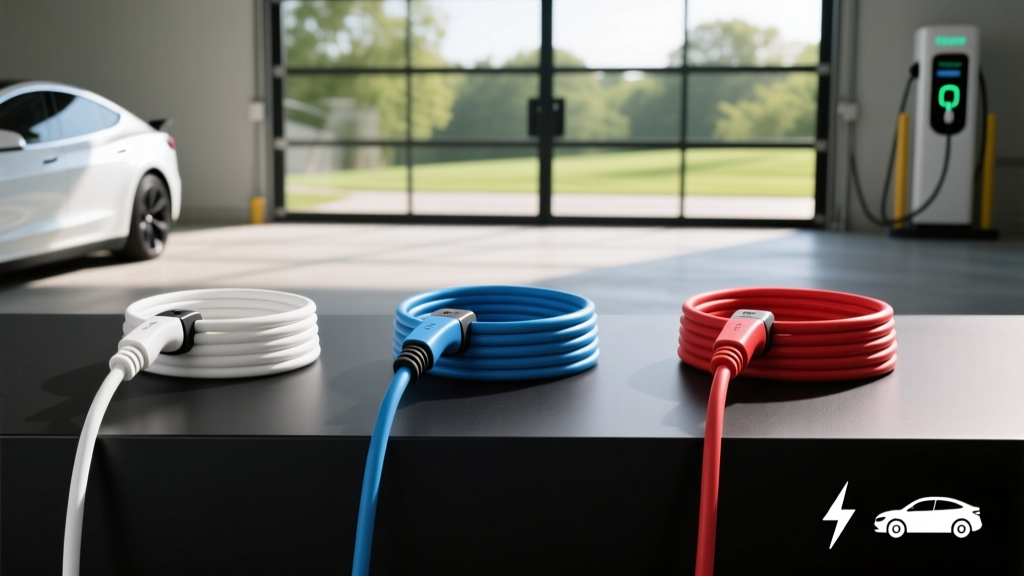
Every EV ships from the factory with an electric vehicle charging cord tucked in the trunk or frunk, but that bundled cable is only the starting point. Most new owners quickly discover that the included Level 1 cord adds range at a trickle, and upgrading to a proper Level 2 home setup — or understanding which public DC fast cord your car actually accepts — is where daily convenience lives or dies.
This guide cuts through the marketing gloss. We'll map every electric vehicle charging cord type to its real-world speed in kilowatts (kW) and miles added per hour, break down exactly what your electrical panel needs to support a home charger, and name the 2026 equipment we'd actually plug into our own garages.
Charging Levels Explained: How Fast Does Each Cord Add Range?
The single most common mistake new EV buyers make is confusing kW (kilowatts), which measures charging power or speed, with kWh (kilowatt-hours), which measures battery energy capacity. Think of kW as the width of the hose filling a bucket, and kWh as the size of the bucket. A wider hose (higher kW) fills the bucket (battery kWh) faster.
Here is how each charging level stacks up in practice:
| Level | Voltage | Typical kW | Miles of Range Added Per Hour | Best Use Case |
|---|---|---|---|---|
| Level 1 (OEM cord) | 120V AC | 1.0 – 1.4 kW | 3 – 5 miles | Overnight top-up for PHEVs or low-mileage BEV drivers |
| Level 2 (Home/Public AC) | 240V AC | 7.2 – 19.2 kW | 25 – 65 miles | Daily home charging, workplace, destination charging |
| DC Fast Charging | 400V – 800V DC | 50 – 350 kW | 150 – 1,200+ miles (equivalent rate) | Road trips, quick top-ups; 10–80% in 15–40 min |
A few real-world caveats matter here. The Level 1 cord that came with your EV is rated for 12 amps continuous on a standard 15-amp household outlet, yielding about 1.4 kW. That means a 75 kWh battery (think Tesla Model Y Long Range) would take roughly 55+ hours from empty on Level 1 alone — fine for a Prius Prime PHEV with an 11 kWh pack, useless for a full BEV.
Level 2 charging speed depends on two bottlenecks: the charger's output and the vehicle's onboard charger. A 48-amp Level 2 station delivers up to 11.5 kW, but if your EV's onboard charger maxes at 7.7 kW (common on base-trim models), you'll never see the charger's full output. Always check your vehicle's onboard charger rating before overspending on a high-amperage unit.
DC fast charging bypasses the onboard charger entirely, sending direct current straight into the battery. But peak kW is not sustained kW. A charger rated at 250 kW might only hold that speed between 10–30% state of charge (SoC), then taper as the battery management system protects cell health. Expect a realistic 10–80% session to average 60–75% of the advertised peak rate.
Home Installation: Electrical Requirements and Real Costs
Installing a Level 2 electric vehicle charging cord setup at home is the single highest-impact upgrade most EV owners make. Here's what the project actually involves.
Electrical Requirements
A Level 2 charger requires a dedicated 240-volt circuit, similar to what powers an electric dryer or oven. Common configurations:
- 40-amp circuit (32A continuous charging) — adequate for most EVs, requires a NEMA 14-50 outlet or hardwire
- 50-amp circuit (40A continuous) — matches the 11.5 kW onboard chargers on vehicles like the Ford F-150 Lightning Extended Range
- 60-amp circuit (48A continuous) — supports the fastest Level 2 speeds; required for chargers like the ChargePoint Home Flex at max output
The National Electrical Code (NEC) requires that continuous loads not exceed 80% of a circuit's rating, so a 48A charger needs a 60A breaker. A licensed electrician will verify wire gauge (typically 6 AWG copper for 60A), install the breaker, and run conduit if the panel is far from the garage.
Panel Upgrade Reality
Older homes with 100-amp electrical service may lack headroom for a 60A EV circuit. A load calculation — required by code — sums your existing circuits to determine if an upgrade to 200-amp service is necessary. Panel upgrades add $1,500–$3,500 to the project and can require utility coordination, pushing timelines out 4–8 weeks in some jurisdictions.
Installation Cost Breakdown
| Component | Low End | High End | Notes |
|---|---|---|---|
| Level 2 charging equipment | $350 | $750 | Hardwired units cost less than NEMA 14-50 plug-in models |
| Electrician labor (short run, <30 ft) | $400 | $900 | Assumes panel is near garage; longer runs cost more |
| Electrician labor (long run, 30–80 ft) | $900 | $2,000 | Conduit, trenching, or attic routing adds cost |
| Permit and inspection | $50 | $300 | Varies by municipality; some jurisdictions waive for EV circuits |
| Panel upgrade (if needed) | $1,500 | $3,500 | 100A to 200A service upgrade |
| Total (no panel upgrade) | $800 | $2,950 | Most homes with 200A service fall in $800–$1,500 |
| Total (with panel upgrade) | $2,300 | $6,450 | Older homes, long conduit runs |
The federal Alternative Fuel Vehicle Refueling Property Credit (IRC §30C) covers 30% of home charging equipment and installation costs up to $1,000, subject to income limits and census-tract eligibility. Check current-year IRS guidance before filing — rules shift annually.
Connector Compatibility: NACS, CCS1, and CHAdeMO
The electric vehicle charging cord you need depends on your car's inlet. As of 2026, the North American market has largely consolidated around two connectors for AC Level 2 charging and is mid-transition for DC fast charging.
| Connector | Use | Brands Using It | Adapter Needed? |
|---|---|---|---|
| J1772 | Level 2 AC (public/home) | All non-Tesla EVs sold in North America | Tesla owners need J1772-to-NACS adapter (included with Tesla vehicles) |
| NACS (Tesla) | Level 2 AC + DC Fast | Tesla (all models); Ford, GM, Rivian, Hyundai, Kia (2025+ models); most automakers by 2026–2027 | Legacy CCS1 vehicles need NACS-to-CCS adapter for Supercharger access |
| CCS1 | DC Fast Charging | Pre-2025 models from VW, BMW, Ford, GM, Hyundai, Kia, and others | NACS adapter needed for Tesla Supercharger network |
| CHAdeMO | DC Fast Charging | Nissan Leaf (legacy); effectively discontinued for new models | Limited and shrinking network |
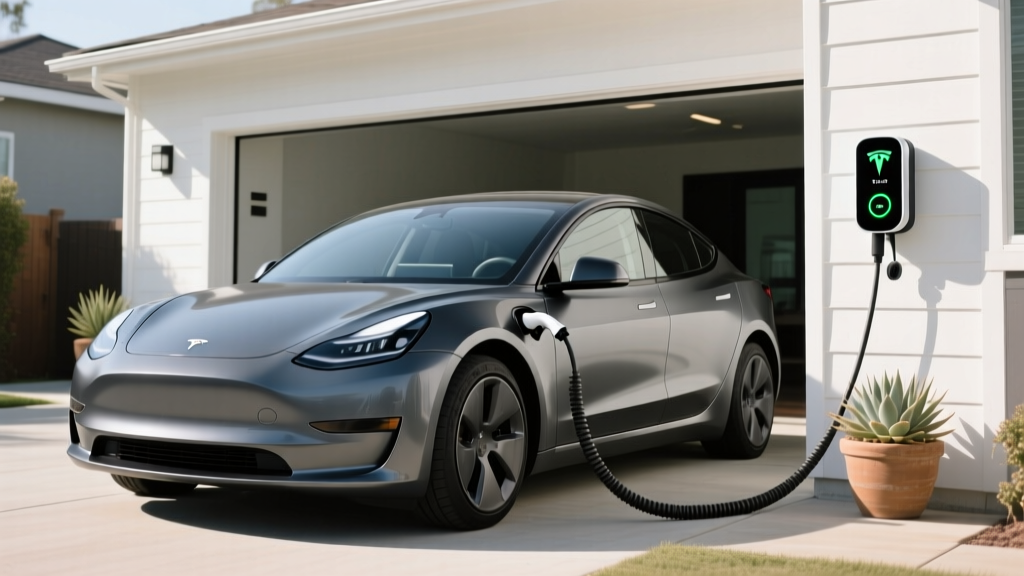
For home Level 2 charging, nearly every EV uses the J1772 standard (or NACS, which carries the same AC signaling). If you drive a non-Tesla, any J1772 Level 2 cord will work. Tesla owners can use the included Mobile Connector with a J1772 adapter, or purchase a dedicated NACS wall connector.
For public DC fast charging, the transition to NACS means most 2026-model-year vehicles from major automakers now accept NACS natively. If you own a 2023–2024 model with CCS1, Ford, GM, and Rivian offer NACS adapters (typically $150–$250) that unlock the Tesla Supercharger network — by far the largest and most reliable DC fast network in the U.S. See the DOE's EV technology overview for the latest on connector standards.
Charging Cost Per Mile: EV vs. Gas
The economic case for an EV hinges on fuel savings, but the actual cost per mile varies dramatically depending on where and when you charge.
| Scenario | Rate | Cost Per Mile (at 3.5 mi/kWh) | Annual Cost (12,000 mi) |
|---|---|---|---|
| Home, off-peak utility rate | $0.10/kWh | $0.029 | $343 |
| Home, standard residential rate | $0.16/kWh | $0.046 | $549 |
| Public Level 2 (ChargePoint, EVgo) | $0.30/kWh | $0.086 | $1,029 |
| DC fast charging (Electrify America, EA Pass) | $0.43/kWh | $0.123 | $1,474 |
| DC fast charging (Tesla Supercharger) | $0.30/kWh | $0.086 | $1,029 |
| Gas vehicle (28 MPG combined, $3.40/gal) | — | $0.121 | $1,457 |
Home charging at off-peak rates delivers fuel costs roughly 75% lower than a comparable gas vehicle. Even standard residential rates undercut gasoline by about 60%. The savings evaporate if you rely exclusively on public DC fast charging at non-subscription rates — a critical consideration for apartment dwellers without home charging access.
Efficiency matters too. A Hyundai Ioniq 6 SE (4.1 mi/kWh) stretches each kilowatt-hour further than a GMC Hummer EV Pickup (around 2.0 mi/kWh), effectively halving the per-mile cost at the same electricity rate. Check fueleconomy.gov for the kWh/100mi and MPGe figures for your specific model.
Charging Time Examples: 10–80% by Battery Size
Most EV owners charge between 10% and 80% state of charge for daily use — the top 20% charges slowly due to the battery management system tapering current to protect cell longevity. Here's how long that 10–80% session takes across common battery sizes and charger types:
| Battery Size (kWh usable) | Level 2 at 11.5 kW (48A) | DC Fast at 150 kW (avg) | DC Fast at 250 kW (avg) | Example Vehicles |
|---|---|---|---|---|
| 18 kWh (PHEV) | ~1.1 hours | N/A (most PHEVs lack DC) | N/A | Toyota RAV4 Prime, Jeep Wrangler 4xe |
| 58 kWh | ~3.5 hours | ~28 min | ~22 min | VW ID.4 Standard |
| 75 kWh | ~4.6 hours | ~35 min | ~25 min | Tesla Model Y LR, Hyundai Ioniq 5 |
| 90 kWh | ~5.5 hours | ~42 min | ~30 min | Ford F-150 Lightning Ext., Rivian R1S |
| 115 kWh | ~7.0 hours | ~52 min | ~38 min | GMC Hummer EV, Chevy Silverado EV |
"Average" DC fast kW figures above account for charge-curve taper — peak kW is typically only sustained in the 10–30% SoC window, then steps down. A 250 kW-rated vehicle might average 170–190 kW across the full 10–80% session. Vehicles with 800V architectures (Hyundai/Kia E-GMP, Porsche Taycan, Lucid Air) sustain higher rates longer than 400V platforms, making their real-world charging noticeably faster even at similar peak ratings.
Equipment Picks: 2026 Level 2 Chargers Worth Buying
We've tested dozens of Level 2 electric vehicle charging cord setups across home garages, outdoor carports, and multi-unit dwellings. These are the units that earned a permanent spot on our walls.
ChargePoint Home Flex
- Power output: Up to 12 kW (50A) on a 60A circuit; adjustable down to 16A for lower-capacity panels
- Connector: J1772 (25-foot cable); NACS version available for 2026
- Smart features: Wi-Fi connected, scheduled charging, Alexa integration, energy-use tracking, utility demand-response programs
- Price: ~$649 (J1772) / ~$699 (NACS)
- Best for: Owners who want app-based scheduling and utility rate optimization
Tesla Wall Connector
- Power output: Up to 11.5 kW (48A) on a 60A circuit
- Connector: NACS native (24-foot cable); no adapter needed for Tesla vehicles
- Smart features: Wi-Fi, firmware OTA updates, Power Sharing (link up to 6 units on one circuit), load management
- Price: ~$475
- Best for: Tesla owners who want a clean, no-adapter setup; also works with NACS-equipped Ford/GM/Rivian vehicles
Emporia Level 2 EV Charger
- Power output: Up to 11.5 kW (48A) on a 60A circuit
- Connector: J1772 (24-foot cable)
- Smart features: Real-time energy monitoring (pairs with Emporia Vue home energy monitor), solar-aware charging, scheduling
- Price: ~$399
- Best for: Budget-conscious buyers who want energy monitoring without a premium price
Grizzl-E Smart
- Power output: Up to 10 kW (40A) on a 50A circuit
- Connector: J1772 (24-foot cable); NACS adapter compatible
- Smart features: OCPP-compatible (works with utility programs), adjustable amperage, built-in RFID
- Price: ~$549
- Best for: Outdoor installations — IP67-rated, operates from -22°F to 122°F, ruggedized enclosure
A note on cord length: a 25-foot cable is the practical minimum for most garages, allowing you to reach the charge port regardless of which direction you park. If your outlet is more than 15 feet from where your charge port sits, consider a unit with a longer cable or relocate the outlet.
Safety, Code, and Common Installation Gotchas
EV charging draws sustained high current for hours — a very different load profile than a dryer or oven that cycles on and off. This makes proper installation non-negotiable.
- Dedicated circuit: Your Level 2 charger must have its own dedicated breaker. Sharing a circuit with other appliances risks tripped breakers and fire hazard.
- GFCI protection: The 2020 NEC and later require GFCI protection for outdoor receptacles. For indoor hardwired installations, GFCI is recommended but not always required — your local inspector's interpretation governs.
- Outdoor rating: If your charger is mounted outside, ensure it carries at minimum a NEMA 4 (weather-resistant) or IP65/IP67 rating. Indoor-only units exposed to rain will fail prematurely and may void warranties.
- Permit and inspection: Nearly every jurisdiction requires a permit for a new 240V circuit. Skipping inspection risks insurance denial if a fire originates from unpermitted work. Most inspections cost $50–$150 and take 15–30 minutes.
- NEMA 14-50 vs. hardwire: A 14-50 outlet lets you unplug and take the charger when you move, but requires a GFCI breaker (adding $50–$100) and is limited to 50A. Hardwiring eliminates the outlet failure point, supports up to 60A circuits, and often simplifies inspection.
One underappreciated gotcha: some utility companies require notification or a separate meter for EV charging circuits above 40A, particularly if you're on a time-of-use rate plan. Call your utility before your electrician pulls the permit.
Frequently Asked Questions
How much does it cost to install a home EV charger?
Most homes with a 200-amp electrical panel spend $800–$1,500 total (equipment + electrician + permit) for a straightforward Level 2 installation with a short wire run. Older homes needing a panel upgrade can see costs reach $2,300–$6,450. The federal §30C credit can offset 30% of equipment and labor up to $1,000, subject to income and location requirements — consult the IRS §30C guidance for current-year eligibility.
How fast will each charging level add range?
Level 1 (120V) adds 3–5 miles per hour. Level 2 (240V) adds 25–65 miles per hour depending on amperage and your vehicle's onboard charger. DC fast charging adds the equivalent of 150–1,200+ miles per hour, though charge-curve taper means actual sessions take 15–40 minutes for a 10–80% fill.
Which connector and charger is compatible with my EV?
For home Level 2 charging, every non-Tesla EV uses J1772, and every Tesla uses NACS. If you're buying a new Level 2 charger, match the connector to your vehicle. For public DC fast charging, most 2026 models now use NACS, but 2023–2024 models may still have CCS1 — check your owner's manual or the charge-port door for the logo. CHAdeMO is effectively legacy-only (Nissan Leaf).
How much does charging cost per mile vs. gas?
Home charging at off-peak rates ($0.10/kWh) costs roughly $0.03 per mile — about 75% less than gasoline at $3.40/gallon and 28 MPG combined. Standard residential rates ($0.16/kWh) still undercut gas by ~60%. Public DC fast charging at $0.30–$0.43/kWh approaches or exceeds gas costs, making home access critical for the economic case.
What electrical upgrades might I need?
If your home has a 100-amp service panel, you'll likely need a 200-amp upgrade ($1,500–$3,500) before adding a 50–60A EV circuit. Homes with 200A service usually have sufficient headroom, but a load calculation by your electrician will confirm. Long wire runs (garage far from the panel), conduit requirements, and attic/crawlspace routing can also increase costs. Some utilities offer rebates for panel upgrades tied to EV adoption — check with your provider.