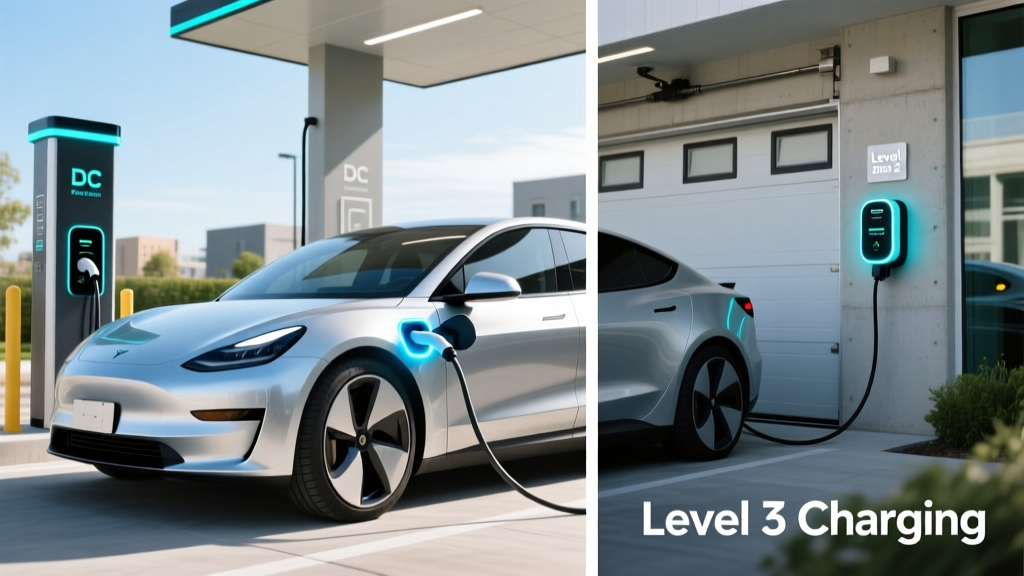
If you've searched for an electric vehicle charger level 3, you've likely encountered a confusing mix of marketing terms, connector names, and power ratings. The phrase "Level 3" is widely used by consumers and even some automakers to describe DC fast charging — the high-power stations you find along highways that can add hundreds of miles of range in 20 minutes or less. But unlike Level 1 and Level 2, "Level 3" is not an official SAE designation, and it cannot be installed in your home.
This guide cuts through the noise. We'll define exactly what DC fast charging delivers, how it compares to home charging, what it costs per mile versus gasoline, which connector your EV needs, and what a realistic home installation budget looks like in 2026.
The Three Charging Levels: Speeds, Power, and Real-World Range Added
Electric vehicle charging operates on a simple principle: kW (kilowatts) measures the rate of power delivery — how fast energy flows into your battery. kWh (kilowatt-hours) measures total energy capacity — how much your battery holds. Think of kW as the width of a hose and kWh as the size of the bucket. A wider hose (more kW) fills the bucket (kWh) faster.
Here is how the three charging tiers stack up in real-world use:
| Level | Voltage | Power Output | Miles of Range Added Per Hour | Typical Use Case |
|---|---|---|---|---|
| Level 1 | 120V AC | 1.2–1.9 kW | 3–5 miles | Overnight top-ups, PHEVs, emergency |
| Level 2 | 240V AC | 3.3–19.2 kW | 12–75 miles | Home daily charging, workplace, retail |
| DC Fast ("Level 3") | 200–1000V DC | 50–350+ kW | 150–1,200+ miles (per hour equivalent) | Highway road trips, rapid top-ups |
Why You Cannot Install a Level 3 Charger at Home
DC fast chargers require dedicated high-voltage DC infrastructure — typically 480V three-phase commercial power — plus specialized liquid-cooled cables, massive electrical service, and utility-grade transformers. A single 350 kW Electrify America or Tesla Supercharger stall can draw more power than a small neighborhood block. Equipment alone costs $40,000–$150,000+ per unit, before site work and utility upgrades.
For residential charging, Level 2 (240V AC) is the practical ceiling, and it covers the daily needs of virtually every EV owner. A 48-amp Level 2 home charger delivers roughly 11.5 kW, adding about 35–44 miles of range per hour — enough to fully replenish a 75 kWh battery overnight in 7–8 hours.
DC Fast Charging Times: 10-80% by Battery Size
DC fast charging is designed for quick top-ups, not full charges. Most EVs charge fastest between 10% and 80% State of Charge (SoC), after which the battery management system throttles power to protect cell health. Here's what to expect at public DC fast chargers:
| Battery Size (Usable) | Vehicle Example | Peak Charge Rate | 10-80% Time (Est.) |
|---|---|---|---|
| 58 kWh | VW ID.4 (Standard) | 135 kW | ~28 minutes |
| 75 kWh | Tesla Model Y Long Range | 250 kW | ~18–22 minutes |
| 77.4 kWh | Hyundai Ioniq 5 | 240 kW (800V) | ~18 minutes |
| 98 kWh | GMC Sierra EV | 350 kW (800V) | ~20–25 minutes |
| 131 kWh | Ford F-150 Lightning (Extended) | 150 kW | ~41 minutes |
Charge curve taper is real. A Hyundai Ioniq 5 may pull 235 kW at 15% SoC but taper to 80 kW by 65% and 40 kW by 80%. The "10-80% in 18 minutes" claim reflects the integrated area under the curve, not sustained peak power. Always check independent charge-curve testing, not just peak kW marketing.
Connector Compatibility: NACS, CCS1, and CHAdeMO
The connector on your EV determines which public chargers you can use without an adapter. As of 2026, the North American market is consolidating around NACS, but millions of CCS1-equipped vehicles remain on the road.
| Connector | Brands Using It (2026 Models) | Adapter Needed for Tesla Superchargers? |
|---|---|---|
| NACS (J3400) | Tesla (all), Ford (2025+), GM (2025+), Rivian (2025+), Hyundai/Kia (2026+), Volvo/Polestar (2025+) | No — native compatibility |
| CCS1 | BMW, VW, Mercedes, Stellantis, older Ford/GM/Hyundai models (pre-2025) | Yes — CCS-to-NACS adapter (~$200–$300) for Supercharger access |
| CHAdeMO | Nissan Leaf (legacy), Mitsubishi Outlander PHEV (older) | Limited adapters available; CHAdeMO infrastructure declining |
Adapter reality check: If you own a CCS1-equipped EV, a manufacturer-approved CCS-to-NACS adapter (such as the Ford or GM branded units) unlocks access to Tesla's Supercharger network — over 25,000 stalls in North America. However, adapters add a connection point, slightly reduce charge efficiency, and may limit peak charge speed to ~150 kW depending on the adapter's rating. Check your automaker's official guidance before purchasing third-party adapters.
Home Level 2 Installation: Electrical Requirements and Costs
While Level 3 DC fast charging is exclusively public, your home Level 2 setup is where 85–90% of all EV charging happens. A proper installation requires attention to your electrical panel, wiring, and local code.
Core electrical requirements:
- Voltage: 240V (same as a clothes dryer or electric range)
- Circuit amperage: 40A, 50A, or 60A dedicated breaker (matching your charger's max draw)
- Charger amperage: Most home units draw 32A, 40A, or 48A — the circuit must be rated 25% higher than continuous load per NEC Article 210.20 (e.g., a 48A charger requires a 60A breaker)
- Wiring: 6 AWG copper for 40–50A circuits; 4 AWG for 60A (varies by run length and local code)
- GFCI protection: Required by NEC 2020/2023 for EV receptacles (625.54); hardwired units may have built-in ground-fault protection
Panel upgrade considerations: Many older homes have 100A or 150A main service panels. Adding a 60A EV circuit to a panel already near capacity may require upgrading to a 200A service — a $1,500–$4,000 job that involves the utility company, a new meter base, and possibly new service entrance wiring. A licensed electrician will perform a load calculation (NEC Article 220) before recommending an upgrade.
| Cost Component | Simple Install (Panel Has Capacity) | Complex Install (Panel Upgrade Needed) |
|---|---|---|
| Level 2 Charger Equipment | $400–$750 | $400–$750 |
| Electrician Labor (wiring, breaker, outlet/hardwire) | $500–$1,200 | $800–$1,500 |
| Permit and Inspection | $50–$200 | $100–$300 |
| Electrical Panel Upgrade (if needed) | N/A | $1,500–$4,000 |
| Total Estimated Cost | $950–$2,150 | $2,800–$6,550 |
The IRS §30D tax credit does not cover home charging equipment directly, but the separate §30C Alternative Fuel Vehicle Refueling Property Credit may provide up to $1,000 for home charger installation if you live in an eligible census tract. Consult a tax professional for current eligibility.
Charging Cost Per Mile: Home vs. Public DC Fast vs. Gasoline
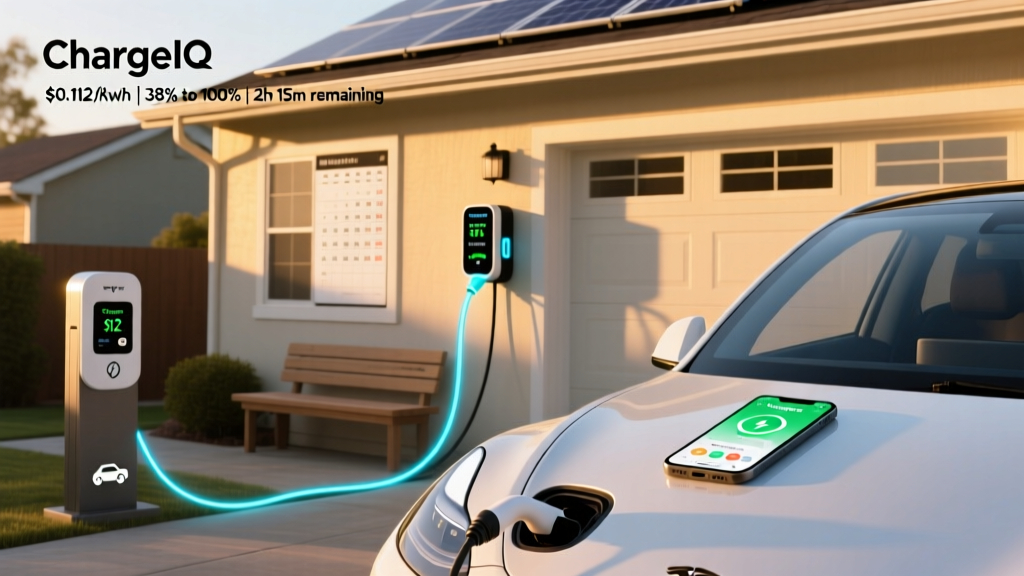
One of the strongest economic arguments for EVs is lower per-mile fueling cost — but the gap narrows significantly when you rely on public DC fast charging. Here's a realistic comparison using a 2026 Tesla Model Y Long Range (320 miles EPA, ~75 kWh usable battery, approximately 4.2 mi/kWh efficiency) as a baseline:
| Scenario | Rate | Cost for Full Charge (75 kWh) | Cost Per Mile |
|---|---|---|---|
| Home Level 2 (off-peak utility rate) | $0.09/kWh | $6.75 | $0.021/mi |
| Home Level 2 (national avg. residential) | $0.17/kWh | $12.75 | $0.040/mi |
| Public Level 2 (networked, e.g., ChargePoint) | $0.25–$0.35/kWh | $18.75–$26.25 | $0.059–$0.082/mi |
| DC Fast Charging (Electrify America, EVgo) | $0.35–$0.55/kWh | $26.25–$41.25 | $0.082–$0.129/mi |
| Tesla Supercharger (avg. 2026) | $0.28–$0.36/kWh | $21.00–$27.00 | $0.066–$0.084/mi |
| Gasoline Vehicle (28 MPG combined, $3.30/gal) | $3.30/gal | $37.67 (equiv. 320 mi) | $0.118/mi |
The takeaway: Home charging at off-peak rates delivers fuel savings of 80%+ versus gasoline. Even at national average residential rates, home charging costs roughly one-third the per-mile price of gas. But exclusive reliance on DC fast charging at $0.45–$0.55/kWh can approach or exceed gasoline costs — making home Level 2 installation the economic linchpin of EV ownership.
Recommended Home Level 2 Chargers (2026)
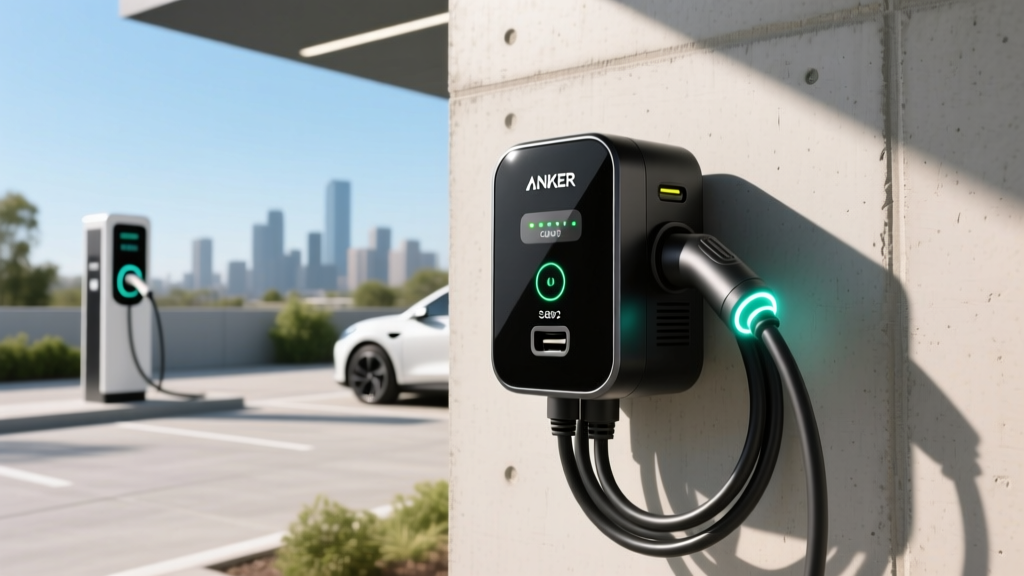
Since Level 3 DC fast charging is a public-only proposition, your home charger selection matters enormously. Here are proven Level 2 units that deliver reliable daily charging:
ChargePoint Home Flex
- Power Output: Up to 11.5 kW (48A at 240V), adjustable down to 16A for lower-capacity panels
- Connector: J1772 (NACS adapter included with newer kits)
- Cable Length: 23 feet
- Smart Features: Wi-Fi, app scheduling, Alexa/Google integration, energy tracking
- Price: ~$550–$650
Tesla Wall Connector
- Power Output: Up to 11.5 kW (48A at 240V)
- Connector: NACS native (also works with J1772 vehicles via adapter)
- Cable Length: 24 feet
- Smart Features: Wi-Fi, OTA firmware updates, power sharing between multiple units, integrated cable management
- Price: ~$475–$550
Emporia Level 2 EV Charger
- Power Output: Up to 11.5 kW (48A at 240V)
- Connector: J1772 (NACS version available 2025+)
- Cable Length: 24 feet
- Smart Features: Wi-Fi, detailed energy monitoring, solar integration with Emporia Vue panel, load management
- Price: ~$400–$500 (best value for energy monitoring)
Grizzl-E Smart
- Power Output: Up to 10 kW (40A at 240V)
- Connector: J1772 or NACS (select at purchase)
- Cable Length: 24 feet
- Smart Features: Wi-Fi, OCPP-compatible, adjustable amperage, rugged outdoor-rated enclosure
- Price: ~$450–$550
All units above are UL-listed (or ETL-listed to UL standards), carry a 3-year warranty minimum, and support NEMA 14-50 plug-in or hardwired installation. For outdoor mounting, verify the unit carries a NEMA 4 (weather-resistant) rating — the Tesla Wall Connector and Grizzl-E both qualify.
Safety, Code, and Installation Best Practices
EV charging involves sustained high-current draw — often 8+ hours continuously. This places demands on your electrical system that differ from typical household appliances:
- Dedicated circuit: Your EV charger must be on its own breaker — never shared with other outlets or appliances (NEC 625.40).
- NEMA 14-50 receptacle quality: Not all 14-50 outlets are equal. Use a commercial-grade receptacle (Hubbell, Bryant, or Cooper) rated for continuous high-amperage draw. Consumer-grade outlets from big-box stores can overheat under sustained 40A+ loads.
- GFCI protection: NEC 625.54 requires ground-fault protection for EV receptacles. Some breakers include this; some chargers have it built in. Confirm with your electrician to avoid nuisance tripping.
- Outdoor rating: If your charger is mounted outside, the unit and any junction boxes must be rated NEMA 4 or NEMA 4X for water and dust ingress.
- Permit and inspection: Most jurisdictions require an electrical permit for new 240V circuits. The inspection verifies wire gauge, breaker sizing, grounding, and GFCI compliance — protecting both your home and your insurance coverage.
Frequently Asked Questions
How much does it cost to install a home EV charger?
A straightforward Level 2 home installation with existing panel capacity typically costs $950–$2,150 (equipment + electrician + permit). If your home needs a 200A panel upgrade, total costs can reach $2,800–$6,550. Always get a load calculation from a licensed electrician before committing.
How fast will each charging level add range?
Level 1 (120V) adds 3–5 miles per hour. Level 2 (240V, 48A) adds roughly 35–44 miles per hour for an average EV. DC fast charging ("Level 3") at 150–350 kW can add 150–300+ miles in 20 minutes, depending on your battery size, chemistry, and state of charge. See the charging levels table above for specifics.
Which connector/charger is compatible with my EV?
2026 model-year vehicles from Tesla, Ford, GM, Rivian, Hyundai, Kia, Volvo, and Polestar use the NACS connector natively. BMW, VW, Mercedes, and older models from Ford/GM/Hyundai use CCS1 — a CCS-to-NACS adapter (~$200–$300) provides Supercharger access. The Nissan Leaf and older Mitsubishi PHEVs use CHAdeMO, which has declining public infrastructure support. Check your vehicle's charge port or consult fueleconomy.gov for your specific model.
How much does charging cost per mile vs gas?
Home charging at off-peak rates ($0.09/kWh) costs roughly $0.02/mile — about 83% less than a 28 MPG gas car at $3.30/gallon ($0.12/mile). At national average residential rates ($0.17/kWh), home charging runs about $0.04/mile. Public DC fast charging at $0.45–$0.55/kWh can reach $0.10–$0.13/mile, narrowing or eliminating the savings versus gas. Home charging is where the economics work best.
What electrical upgrades might I need?
The most common upgrade is a panel capacity increase from 100A or 150A to 200A service — needed when your existing panel lacks headroom for a new 40–60A dedicated circuit. Your electrician will perform an NEC Article 220 load calculation. Other potential upgrades include replacing a Federal Pacific or Zinsco panel (known fire hazards), adding a sub-panel in the garage, or upgrading the service entrance wiring from the utility. Budget $1,500–$4,000 for a panel upgrade if needed.
Can I charge faster at home by getting a higher-amp circuit?
Yes, up to your vehicle's onboard charger limit. Most 2026 EVs accept 11.5 kW (48A) on Level 2. Some, like the Tesla Model S/X and certain Ford models, accept up to 19.2 kW (80A) — but this requires a 100A dedicated circuit and heavy-gauge wiring. Installing a 48A charger on a 60A circuit covers the vast majority of EVs and avoids unnecessary electrical work.
Understanding the distinction between public DC fast charging ("Level 3") and home Level 2 charging is essential for practical EV ownership. Level 3 stations are indispensable for road trips, but your daily charging experience — and your per-mile cost savings — lives and dies with your home Level 2 setup. Size it correctly, install it to code, and choose a quality charger that matches your vehicle's connector and your panel's capacity.