Buying an electric vehicle is only half the equation. The other half — where and how you charge — determines whether EV ownership feels effortless or exasperating. For most drivers, the answer starts at home. A proper electric vehicle charge point installation transforms your garage or driveway into a personal fueling station, adding 25–40 miles of range per hour of charging and eliminating the vast majority of public-charging dependency.
But installation costs vary enormously depending on your home's electrical panel, the distance from panel to charger, local permit requirements, and the equipment you choose. This guide breaks down every cost, technical requirement, and equipment decision you'll face in 2026, with exact numbers rather than marketing generalities.
Understanding EV Charging Levels: kW, kWh, and What They Mean
Before evaluating installation, you need clarity on the single most common source of EV confusion: the difference between kW (kilowatts) and kWh (kilowatt-hours).
- kW (kilowatts) measures power — the rate at which electricity flows into your battery. Think of it as the diameter of a hose filling a bucket. A 19.2 kW Level 2 charger delivers energy faster than a 7.2 kW charger.
- kWh (kilowatt-hours) measures energy — the total capacity of your battery. A Tesla Model Y Long Range has roughly 75 kWh of usable battery capacity; a Ford F-150 Lightning Extended Range has about 131 kWh.
Charging speed is expressed in kW. Battery size is expressed in kWh. They are never interchangeable. Here's how each charging level performs in real-world conditions:
| Level | Voltage / Amperage | Power (kW) | Miles of Range Added per Hour | Typical Use Case |
|---|---|---|---|---|
| Level 1 | 120V / 12–16A | 1.4–1.9 kW | 3–5 miles | Overnight trickle; PHEVs or low daily mileage |
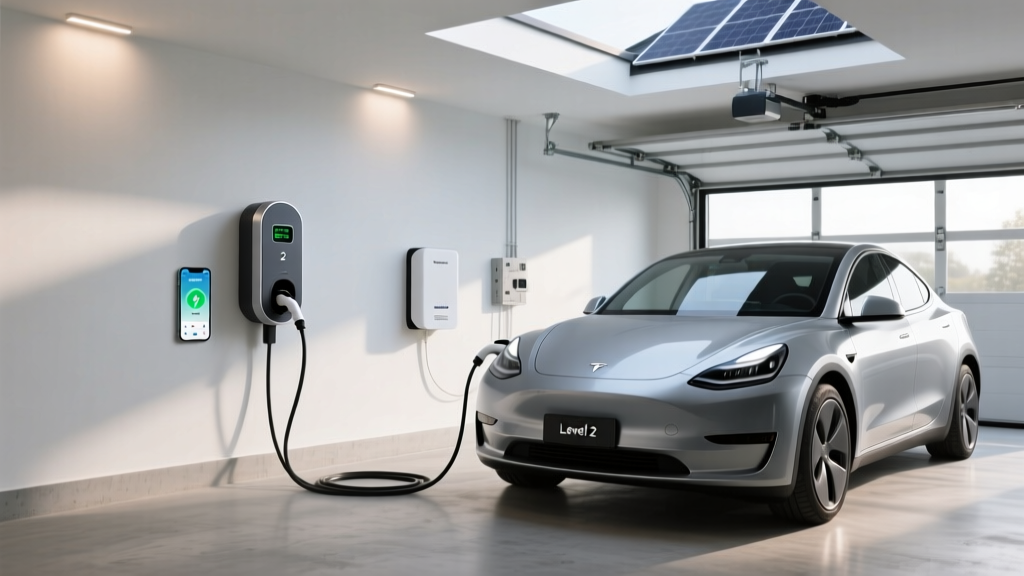
| Level 2 (basic) | 240V / 32A | 7.7 kW | 22–28 miles | Standard home install; covers most daily needs |
| Level 2 (high-power) | 240V / 48A | 11.5 kW | 32–42 miles | Large batteries (F-150 Lightning, Rivian R1T) |
| Level 2 (max residential) | 240V / 80A | 19.2 kW | 48–56 miles | Requires 100A dedicated circuit; panel upgrade likely |
| DC Fast Charging | 400–800V DC | 50–350 kW | 150–800+ miles per hour equivalent | Public stations; road trips; 10–80% in 18–45 min |
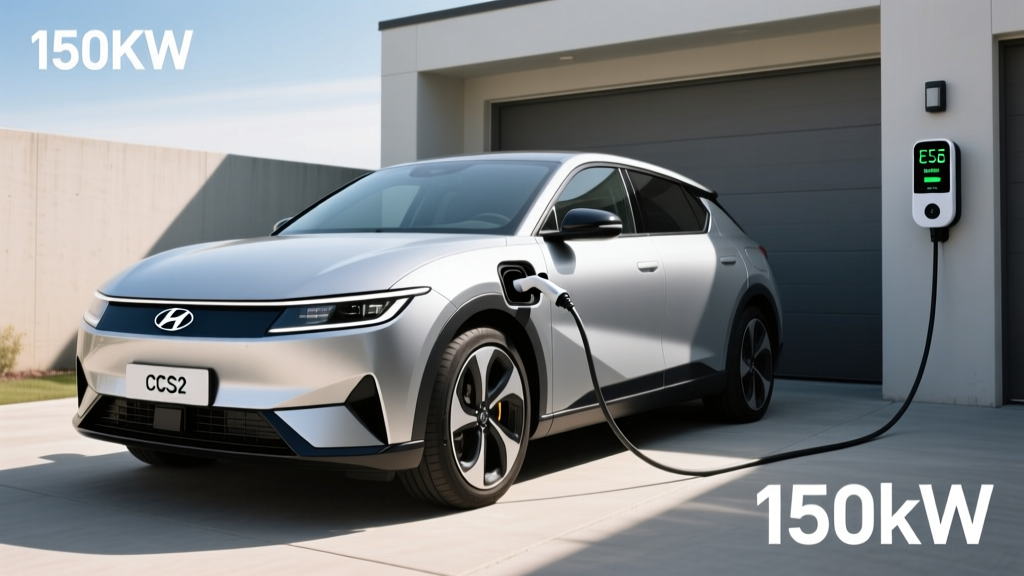
Real-world caveat: DC fast charging speeds represent peak rates, not sustained rates. A vehicle that peaks at 250 kW will taper significantly above 60–70% State of Charge (SoC) to protect the battery. Expect a typical 10–80% session on a 350 kW-capable vehicle (like the Hyundai Ioniq 5) to average roughly 150–180 kW, completing in about 18 minutes. On a 150 kW station, the same session takes 25–35 minutes.
How Much Does Electric Vehicle Charge Point Installation Actually Cost?
The honest answer: anywhere from $500 to $3,500+ depending on your home's electrical infrastructure. Here's a realistic breakdown based on 2026 national averages for licensed electrician rates and current equipment pricing.
| Cost Component | Simple Install (panel nearby) | Complex Install (long run, panel upgrade) |
|---|---|---|
| Level 2 charging equipment (hardwired, 48A) | $400–$700 | $400–$700 |
| Electrician labor (2–4 hrs simple / 6–12 hrs complex) | $300–$600 | $900–$1,800 |
| Electrical materials (conduit, wire, junction box) | $100–$250 | $300–$600 |
| Permit and inspection fees | $50–$200 | $50–$200 |
| Electrical panel upgrade (100A → 200A service), if needed | $0 | $1,500–$3,500 |
| Total estimated cost | $850–$1,750 | $3,150–$6,800 |
When Do You Need a Panel Upgrade?
This is the cost variable that catches many homeowners off guard. A Level 2 charger on a 48-amp circuit requires a dedicated 60-amp breaker (electrical code requires circuits to be rated at 125% of continuous load). If your home has a 100-amp main service panel — common in homes built before the 1990s — adding a 60-amp circuit may push your total calculated load beyond the panel's capacity.
A licensed electrician will perform a load calculation per NEC Article 220 to determine whether your existing panel can handle the additional circuit. If not, a panel upgrade to 200-amp service typically costs $1,500–$3,500 including the new panel, labor, and utility coordination. Some utilities offer rebates for panel upgrades that support EV adoption — check with your local provider.
Alternative: Lower-Amperage Circuits to Avoid Panel Upgrades
If a panel upgrade is prohibitive, consider a 32-amp charger on a 40-amp breaker. This delivers 7.7 kW — sufficient for most sedans and crossovers to fully recharge overnight (adding ~185 miles in an 8-hour session). For a vehicle with 300 miles of EPA range, that covers nearly any daily driving pattern.
Electrical Requirements, Safety, and Code Compliance
Every electric vehicle charge point installation must comply with the National Electrical Code (NEC) Article 625, which governs EV charging systems. Key requirements include:
- Dedicated circuit: Your Level 2 charger must have its own circuit — it cannot share with other appliances or outlets.
- GFCI protection: The 2020 NEC and later require Ground-Fault Circuit Interrupter protection for all EV charging outlets (hardwired chargers have built-in GFCI in many models).
- Outdoor rating: If your charger is installed outside or in an exposed garage, the unit must carry a NEMA 4 or NEMA 4X rating for weather resistance.
- Wire gauge: A 60-amp circuit typically requires 6 AWG copper wire (THHN in conduit) or 4 AWG for longer runs to minimize voltage drop. Your electrician will size wire based on run length.
- Permit and inspection: Virtually all jurisdictions require an electrical permit and post-installation inspection. Skipping this risks voiding your homeowner's insurance coverage for any electrical fire.
Hardwired vs. NEMA 14-50 outlet: Hardwired chargers eliminate the plug connection, reducing failure points and allowing higher amperage (up to 80A on some units). A NEMA 14-50 outlet provides flexibility to unplug and move the charger, but limits you to 40A continuous (48A circuit) and requires a GFCI breaker, which adds $100–$150. For a permanent installation, hardwired is generally the more reliable and code-friendly choice.
Connector Compatibility: NACS, CCS1, and CHAdeMO in 2026
The North American charging connector landscape has consolidated significantly since 2024, when Ford, GM, Rivian, Volvo, and others adopted Tesla's North American Charging Standard (NACS). Here's where things stand for the 2026 model year:
| Connector | Brands Using It (Native) | Adapter Required? |
|---|---|---|
| NACS (Tesla standard) | Tesla, Ford, GM (Cadillac, Chevrolet), Rivian, Volvo, Polestar, Nissan (new models), Fisker | No — native for these brands. CCS vehicles need a CCS-to-NACS adapter (~$150–$250). |
| CCS1 | Hyundai, Kia, BMW, Volkswagen, Audi, Porsche, Mercedes-Benz, Stellantis, Honda (Prologue), Subaru (Solterra) | No — native. May need NACS-to-CCS adapter for Tesla Supercharger access (~$200). |
| CHAdeMO | Nissan Leaf (legacy), Mitsubishi Outlander PHEV (legacy) | Increasingly rare; adapters limited. New models are switching to NACS. |
Home charger connector choice: If you currently own a CCS vehicle but plan to switch to a NACS-equipped brand within a few years, consider a charger with a detachable cable or purchase a NACS-to-CCS adapter. Some 2026 chargers, like the Emporia Level 2, offer swappable connector tips. Tesla's Wall Connector now ships with a NACS plug natively and includes a J1772 adapter for non-Tesla vehicles.
What Does Charging Cost Per Mile vs. Gasoline?
One of the strongest economic arguments for home charging is the per-mile fuel cost. Here's a realistic comparison using 2026 national averages:
| Scenario | Rate | Vehicle Efficiency | Cost Per Mile |
|---|---|---|---|
| Home charging (national avg. electricity) | $0.17/kWh | 3.0 mi/kWh (100 MPGe) | $0.057/mile |
| Home charging (off-peak time-of-use rate) | $0.09/kWh | 3.0 mi/kWh (100 MPGe) | $0.030/mile |
| Public Level 2 (network pricing) | $0.35/kWh | 3.0 mi/kWh (100 MPGe) | $0.117/mile |
| DC Fast Charging (Electrify America, EVgo) | $0.48/kWh | 3.0 mi/kWh (100 MPGe) | $0.160/mile |
| Gasoline (28 MPG combined) | $3.35/gallon | 28 MPG | $0.120/mile |
| Gasoline (18 MPG truck/SUV) | $3.35/gallon | 18 MPG | $0.186/mile |
The takeaway: Home charging — especially on off-peak rates — delivers fuel costs at roughly one-third to one-quarter the price of gasoline. Even public DC fast charging, the most expensive option, is competitive with a fuel-efficient gas car and significantly cheaper than a large SUV or truck. For a driver covering 12,000 miles annually, home off-peak charging saves approximately $1,080–$1,870 per year versus gasoline, according to EPA efficiency data.
Charging Time Examples by Battery Size
Here's how long common 2026 EVs take to charge on a 48-amp (11.5 kW) home Level 2 charger, from 10% to 80% State of Charge:
- Tesla Model 3 Long Range (75 kWh usable): ~4.5 hours
- Hyundai Ioniq 5 (77.4 kWh usable): ~4.7 hours
- Ford F-150 Lightning Extended Range (131 kWh usable): ~8 hours
- Chevrolet Equinox EV (85 kWh usable): ~5.2 hours
- Toyota bZ4X (71.4 kWh usable): ~4.3 hours
For overnight charging, a 48A Level 2 unit fully replenishes virtually any EV battery in a single session. Even the F-150 Lightning Extended Range, with its massive 131 kWh pack, reaches 80% in about 8 hours — well within a standard evening-to-morning window.
Recommended Level 2 Home Chargers for 2026
Based on reliability data, feature sets, connector options, and pricing, these are the top-performing home chargers currently available:
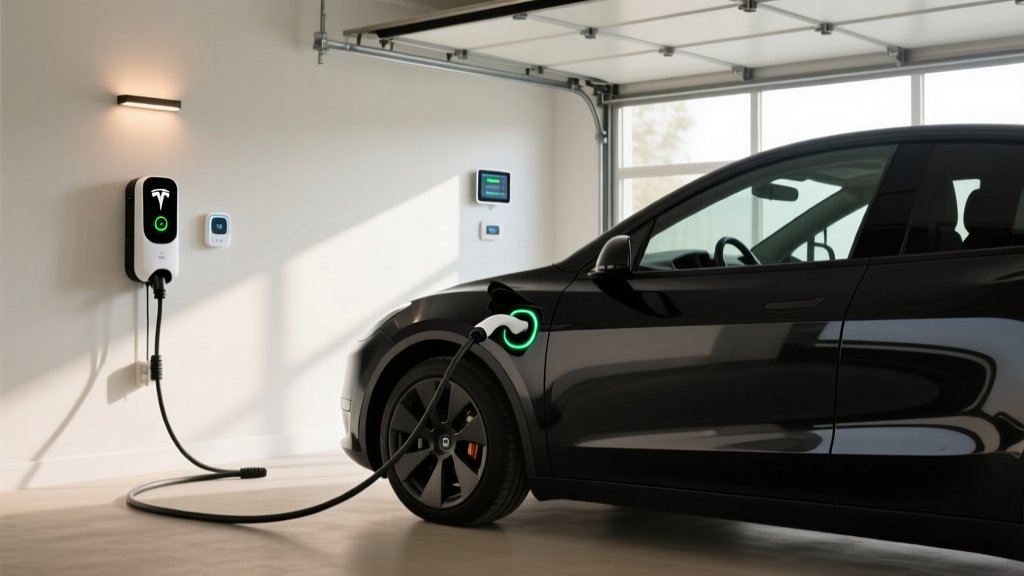
Tesla Wall Connector (Gen 4)
- Power output: Up to 11.5 kW (48A) on a 60A circuit
- Connector: NACS native; J1772 adapter included
- Cable length: 24 feet
- Smart features: Wi-Fi, OTA firmware updates, power-sharing between multiple units, access control
- Price: ~$475
- Best for: Tesla owners and NACS-equipped vehicles (Ford, GM, Rivian). Excellent build quality and reliability.
ChargePoint Home Flex (2nd Gen)
- Power output: Up to 12 kW (50A) on a 60A circuit; configurable from 16A–50A via DIP switches
- Connector: J1772 native (CCS-compatible); NACS adapter available
- Cable length: 23 feet
- Smart features: Wi-Fi, app scheduling, Alexa integration, Energy Star certified, utility demand-response compatible
- Price: ~$550–$650
- Best for: CCS vehicles (Hyundai, Kia, BMW, VW). Flexible amperage lets you match your circuit capacity without buying a different unit.
Emporia Vue Level 2 EV Charger
- Power output: Up to 11.5 kW (48A) on a 60A circuit
- Connector: J1772 native; swappable NACS tip available
- Cable length: 24 feet
- Smart features: Wi-Fi, integration with Emporia Vue energy monitor for whole-home load tracking, solar-charging scheduling
- Price: ~$399
- Best for: Budget-conscious buyers who want smart features and energy monitoring without a premium price.
Grizzl-E Smart (United Chargers)
- Power output: Up to 10 kW (40A) on a 50A circuit
- Connector: J1772 native
- Cable length: 24 feet
- Smart features: Wi-Fi, OCPP-compatible (works with utility programs), adjustable amperage, built-in GFCI
- Price: ~$499
- Best for: Canadian and cold-climate buyers (rated to -40°F). Extremely durable enclosure. Made in North America.
Federal incentive note: The Alternative Fuel Vehicle Refueling Property Credit (IRC §30C) offers up to $1,000 (30% of equipment and installation costs) for home charger installations in eligible census tracts. This is separate from the §30D vehicle purchase credit. Eligibility depends on whether your home is located in a qualifying low-income or non-urban census tract — check the IRS §30C page for current qualifying areas.
Planning Your Installation: Step-by-Step
- Assess your electrical panel. Locate your main service panel and check the amperage rating (usually printed on the main breaker: 100A, 150A, or 200A). Note the number of available breaker slots.
- Choose your charger location. Ideally within 18–24 feet of your vehicle's charge port, on a wall or pedestal. Measure the distance from panel to charger location — longer runs increase wire and conduit costs.
- Get 2–3 electrician quotes. Ask specifically for EV charger installation experience. Request a load calculation and a written estimate that breaks down labor, materials, permit, and any panel work.
- File the permit. Your electrician typically handles this. Fees range from $50–$200 depending on jurisdiction.
- Install and inspect. Installation takes 2–8 hours depending on complexity. A city/county inspector will verify code compliance, usually within 1–2 weeks.
- Configure smart features. Download the charger's app, connect to Wi-Fi, and set up scheduled charging to take advantage of off-peak electricity rates from your utility.
Frequently Asked Questions
How much does it cost to install a home EV charger?
For a straightforward installation with a 200-amp panel nearby, expect $850–$1,750 total (equipment, labor, materials, permit). If your home needs a panel upgrade from 100A to 200A service, total costs rise to $3,150–$6,800. The single biggest cost variable is whether your existing electrical panel can accommodate a new 60-amp circuit.
How fast will each charging level add range?
Level 1 (120V standard outlet) adds 3–5 miles per hour — adequate for plug-in hybrids with small batteries but impractical for full EVs. Level 2 (240V) at 48 amps adds 32–42 miles per hour, enough to fully recharge most EVs overnight. DC Fast Charging adds 150–800+ miles per hour equivalent, completing a 10–80% session in 18–45 minutes depending on the vehicle and station power.
Which connector/charger is compatible with my EV?
For 2026 models: Tesla, Ford, GM, Rivian, Volvo, and Polestar use NACS. Hyundai, Kia, BMW, VW, Mercedes, and most others use CCS1. The Nissan Leaf (legacy) uses CHAdeMO. For home Level 2 charging, a J1772 connector works with all CCS vehicles, and Tesla's Wall Connector includes a J1772 adapter. Check your vehicle's charge port or owner's manual for the specific connector type.
How much does charging cost per mile vs gas?
Home charging on average residential electricity ($0.17/kWh) costs about $0.057 per mile for an EV averaging 3 mi/kWh. Off-peak rates ($0.09/kWh) drop that to $0.030/mile. A comparable gas vehicle at 28 MPG with $3.35/gallon fuel costs $0.12/mile. Home charging saves $800–$1,100 annually for a typical 12,000-mile driver.
What electrical upgrades might I need?
The most common upgrade is a panel replacement from 100-amp to 200-amp service ($1,500–$3,500), necessary when your existing panel lacks capacity for a new 60-amp dedicated circuit. Older homes may also need service wire upgrades from the utility meter to the panel. Some homes can avoid panel upgrades by installing a 32-amp charger on a 40-amp circuit, which still provides 7.7 kW — adequate for overnight charging of most vehicles.
Can I install an EV charger myself?
Technically, a skilled homeowner can physically mount a charger, but the electrical connections, permit, and inspection should be handled by a licensed electrician. Unpermitted or improperly installed 240V circuits create fire risk and may void your homeowner's insurance. Most jurisdictions require a licensed professional for any new 240V circuit work.
Do I need a smart charger, or will a basic unit work?
A basic (non-smart) Level 2 charger will charge your vehicle just as fast. Smart features — Wi-Fi scheduling, energy monitoring, utility demand-response — are valuable if your utility offers time-of-use rates (scheduling charges during cheap off-peak hours) or if you want to track energy consumption. For most owners, the $50–$100 premium for smart features pays for itself within months through optimized charging schedules.