Most EV owners think of charging as a one-way street: electricity flows from the grid into the battery. Bidirectional charging reverses that equation, turning your EV into a mobile power station capable of running tools at a campsite, backing up your home during an outage, or even selling energy back to the utility. As of 2026, the technology is no longer experimental — but it is fragmented, with three distinct flavors (V2L, V2H, V2G), a short list of compatible vehicles, and specific electrical requirements that determine whether your house can actually use it.
This guide breaks down what electric vehicle bidirectional charging can and cannot do today, which models support it, what your home electrical panel needs to handle, and how the economics stack up against a standalone home battery like the Tesla Powerwall.
The Three Types of Bidirectional Charging
Bidirectional charging isn't a single feature — it's an umbrella term covering three distinct capabilities, each with different hardware requirements and use cases.
| Type | What It Does | Typical Output | Hardware Needed |
|---|---|---|---|
| V2L (Vehicle-to-Load) | Powers appliances and tools directly from the EV via an outlet | 1.9 kW – 3.6 kW (120V) | Built-in 120V outlet or V2L adapter dongle |
| V2H (Vehicle-to-Home) | Backs up an entire home's electrical panel during an outage | 9.6 kW – 19.2 kW (240V) | Compatible EV + bidirectional wall charger + transfer switch / energy gateway |
| V2G (Vehicle-to-Grid) | Sells stored energy back to the utility for grid balancing | Up to 19.2 kW (240V) | Compatible EV + bidirectional charger + utility program enrollment |
V2L is the simplest and most widely available. Plug a V2L adapter into your EV's charge port (or use a built-in bed outlet, as on the Ford F-150 Lightning and Rivian R1T), and you get standard 120V AC power — enough to run a microwave, power tools, a CPAP machine while camping, or string lights at a tailgate. No electrician required.
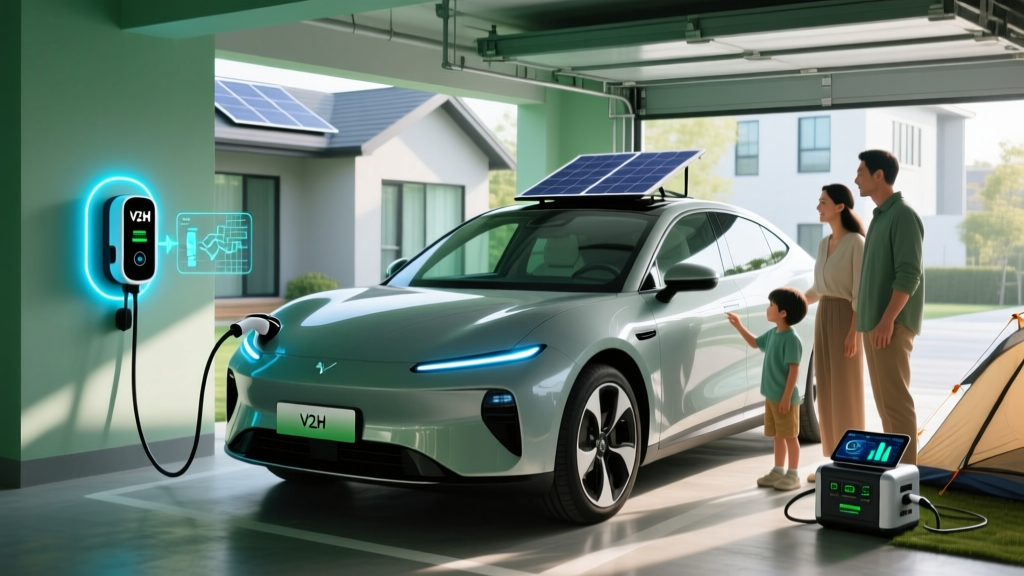
V2H is where bidirectional charging gets serious. During a grid outage, your EV disconnects from the grid and feeds 240V power through a dedicated bidirectional charger into your home's electrical panel. A 77 kWh battery (like the Hyundai Ioniq 5's) can power an average U.S. home (roughly 29 kWh/day per the U.S. EIA) for about 2–3 days. This requires professional installation of a gateway device that isolates your home from the grid (anti-islanding protection) and manages the power handoff.
V2G remains the least available to consumers. A handful of utility pilot programs — notably in California, Vermont, and parts of Europe — allow participating EV owners to discharge during peak-demand hours and earn credits on their electricity bill. V2G requires utility coordination, a compatible bidirectional charger, and currently, a very short list of approved vehicles (primarily the Ford F-150 Lightning and select Nissan Leaf models via CHAdeMO).
Which EVs Support Bidirectional Charging in 2026?
Not every EV can send power back out. Bidirectional capability requires specific onboard inverter hardware and software authorization from the manufacturer. Here's where major models stand as of the 2026 model year:
| Vehicle | V2L | V2H | V2G | Connector | Battery (kWh) | Max V2H Output |
|---|---|---|---|---|---|---|
| Ford F-150 Lightning | ✅ (built-in outlets) | ✅ (with Ford Charge Station Pro + Home Integration System) | ✅ (select utility programs) | NACS | 98 / 131 | 9.6 kW (up to 19.2 kW with dual chargers) |
| Hyundai Ioniq 5 | ✅ (V2L adapter or interior outlet) | ✅ (with approved bidirectional charger) | Limited pilots | NACS (2025+) | 77.4 | Up to 10.9 kW |
| Hyundai Ioniq 6 | ✅ | ✅ | Limited pilots | NACS (2025+) | 77.4 | Up to 10.9 kW |
| Kia EV6 / EV9 | ✅ | ✅ (EV9 with approved charger) | Limited pilots | NACS (2025+) | 77.4 / 100.0 | Up to 10.9 kW |
| Chevrolet Silverado EV | ✅ (PowerBase) | ✅ (with bidirectional charger) | Announced | NACS | 200 (max) | Up to 19.2 kW |
| Rivian R1T / R1S (Gen 2) | ✅ (bed/cargo outlets) | ❌ (not yet supported) | ❌ | NACS | 92 / 106 / 141 | N/A |
| Tesla Cybertruck | ✅ (Powershare, 120V + 240V) | ✅ (with Tesla Powershare gateway) | Announced | NACS | 123 | Up to 11.5 kW |
| Tesla Model 3 / Model Y | ❌ | ❌ | ❌ | NACS | 60–82 | N/A |
| Nissan Leaf | ❌ | ❌ | ✅ (limited V2G pilots via CHAdeMO) | CHAdeMO | 40 / 62 | N/A |
A few critical takeaways: Tesla's passenger vehicles (Model 3, Model Y, Model S, Model X) do not support any form of bidirectional charging as of 2026. The Cybertruck's Powershare system is the exception. Hyundai Motor Group (Hyundai, Kia, Genesis) has been the most aggressive in rolling out V2L across its lineup, with V2H following via partnerships with charger manufacturers. Ford's F-150 Lightning remains the most mature V2H platform, with the most real-world home-backup deployments to date.
Charging Levels and Speeds: The Foundation
Before you can send power back out, you need to put power in. Understanding charging levels is essential for any EV owner — bidirectional or not. Power is measured in kilowatts (kW), while energy stored in your battery is measured in kilowatt-hours (kWh). A 77 kWh battery charged at 7.7 kW takes roughly 10 hours from empty to full.
| Level | Voltage | Power (kW) | Miles of Range Added per Hour | Typical Use |
|---|---|---|---|---|
| Level 1 | 120V AC | 1.2 – 1.9 kW | 3 – 5 mi/hr | Overnight trickle charge; emergency top-up |
| Level 2 | 240V AC | 3.3 – 19.2 kW | 12 – 75 mi/hr | Home daily charging; workplace; public Level 2 |
| DC Fast Charging | 400V–800V DC | 50 – 350 kW | 150 – 1,200+ mi/hr (at peak) | Road trips; rapid top-ups; 10–80% in 18–40 min |
Charging time examples (10–80% SoC):
- 77 kWh battery (Hyundai Ioniq 5) on a 350 kW DC fast charger: ~18 minutes (peaks at 240 kW, tapers above 80%)
- 131 kWh battery (F-150 Lightning Extended Range) on a 150 kW DC fast charger: ~41 minutes
- 77 kWh battery on a 48-amp (11.5 kW) Level 2 home charger: ~5.5 hours (0–100%)
- 77 kWh battery on a standard 120V outlet (Level 1): ~50+ hours (0–100%)
DC fast charging never sustains its peak rate. The charge curve starts strong (often above 200 kW for 800V architectures like Hyundai/Kia's E-GMP), then tapers significantly as the battery approaches 80% SoC to protect cell health. This is why manufacturers quote 10–80% times rather than 0–100%.
Home Installation: Electrical Requirements and Costs for Bidirectional Charging
Adding V2L capability to a compatible EV requires nothing more than purchasing a V2L adapter ($150–$350). But V2H installation is a significant electrical project — more complex and expensive than a standard Level 2 charger install.
What V2H Installation Requires
A V2H system consists of three components beyond the EV itself:
- Bidirectional wall charger — Unlike a standard Level 2 EVSE, this unit must handle power flow in both directions. Examples include the Ford Charge Station Pro (~$1,300) and the Wallbox Quasar 2 (~$1,500–$2,000).
- Energy gateway / transfer switch — This device (such as the Ford Home Integration System or a Span smart panel) isolates your home from the grid during an outage and routes EV power to your electrical panel. This is legally required for anti-islanding safety.
- Electrical panel capacity — V2H draws up to 80 amps from your panel during charging and pushes power back during discharge. Most installations require a 200-amp main panel minimum. Homes with 100-amp or 150-amp service will likely need a panel upgrade.
Electrical Specifications
- Circuit: Dedicated 60A–100A breaker at 240V (for the bidirectional charger)
- Wire gauge: 4 AWG copper for 60A; 2 AWG for 80A; 1/0 AWG for 100A
- Permit: Required in virtually all U.S. jurisdictions; inspection by local AHJ (Authority Having Jurisdiction)
- GFCI: NEC 2026 requires GFCI protection for outdoor EVSE installations; bidirectional units must comply
- Outdoor rating: NEMA 4 (weatherproof) for any outdoor-mounted unit
| Component | Cost Range | Notes |
|---|---|---|
| Bidirectional charger (hardware) | $1,300 – $2,500 | Ford Charge Station Pro, Wallbox Quasar 2, or equivalent |
| Energy gateway / transfer switch | $1,500 – $4,000 | Ford HIS, Span panel, or Generac gateway |
| Electrician labor (standard install) | $1,500 – $3,500 | Assumes 200A panel, short conduit run, no panel upgrade |
| Electrical panel upgrade (if needed) | $2,000 – $5,000 | Upgrade from 100A/150A to 200A; may require utility coordination |
| Permit and inspection | $150 – $500 | Varies by municipality |
| Total (no panel upgrade) | $4,450 – $10,500 | Most homes with modern 200A panels |
| Total (with panel upgrade) | $6,450 – $15,500 | Older homes with 100A–150A service |
For comparison, a standard Level 2 home charger install (non-bidirectional, 48-amp hardwired unit on an existing 200A panel) typically runs $800–$2,000 total. The bidirectional premium is substantial — but so is the value proposition when you factor in what you're replacing.
How Much Does It Cost to Install a Home EV Charger?
For a standard Level 2 charger: $800–$2,000 (equipment + electrician + permit) if your panel has spare capacity. Add $2,000–$5,000 if you need a panel upgrade.
For a bidirectional V2H system: $4,450–$15,500 depending on hardware selection and whether your panel needs upgrading. The higher end applies to older homes requiring a full service upgrade plus a premium gateway like the Span smart panel.
Bidirectional Charging Economics: V2H vs. Home Battery
The most common question EV owners ask: "Why spend $8,000 on V2H hardware when I could buy a Tesla Powerwall?" The answer is that you probably already own the most expensive component — the battery.
| System | Battery Capacity | Total Installed Cost | Backup Duration (avg. home) | Usable for Daily Driving? |
|---|---|---|---|---|
| Tesla Powerwall 3 | 13.5 kWh | $12,000 – $16,500 | ~10–14 hours | No (stationary only) |
| Ford F-150 Lightning (131 kWh) + V2H | 131 kWh (usable ~120 kWh) | $4,500 – $10,500 (charger + gateway install) | ~3–4 days | Yes (it's your truck) |
| Hyundai Ioniq 5 (77 kWh) + V2H | 77.4 kWh (usable ~74 kWh) | $5,000 – $12,000 | ~2–2.5 days | Yes |
| Chevrolet Silverado EV (200 kWh) + V2H | 200 kWh (usable ~190 kWh) | $5,000 – $12,000 | ~5–6 days | Yes |
A Tesla Powerwall stores 13.5 kWh and costs $12,000–$16,500 installed. A Ford F-150 Lightning Extended Range stores roughly 120 usable kWh — nearly 9× the Powerwall's capacity — and the V2H hardware install is often cheaper than the Powerwall alone. The catch: your backup battery has wheels, and if you drive it to work during an outage, your home loses power.
For homes that already own a compatible EV, V2H is almost always the more cost-effective backup solution. For households that need guaranteed backup regardless of whether the car is in the garage, a dedicated battery or generator fills the gap.
Charging Cost Per Mile vs. Gas
Whether you're charging to drive or charging to power your home, the cost of electricity matters. Here's how home charging compares to gasoline on a per-mile basis:
| Scenario | Rate | Cost per Mile (EV at 3.5 mi/kWh) | Equivalent Gas Cost (at 28 MPG) |
|---|---|---|---|
| Home off-peak (utility TOU rate) | $0.08/kWh | $0.023/mi | Gas at $0.64/gal |
| Home standard rate | $0.16/kWh | $0.046/mi | Gas at $1.28/gal |
| Public Level 2 (ChargePoint, EVgo) | $0.30/kWh | $0.086/mi | Gas at $2.40/gal |
| DC Fast Charging (Electrify America) | $0.48/kWh | $0.137/mi | Gas at $3.84/gal |
| National avg. gasoline (2026) | ~$3.40/gal | — | $0.121/mi |
Home charging on an off-peak rate is roughly 5× cheaper per mile than gasoline. Even DC fast charging at public rates is comparable to or slightly above gasoline cost per mile — which is why most EV owners do 80%+ of their charging at home. Per fueleconomy.gov, the average 2026 EV achieves 100–130 MPGe combined, translating to roughly 3.0–4.0 miles per kWh.
Connector Compatibility and Adapter Requirements
The connector on your EV determines which chargers — and which bidirectional systems — you can use. The North American market has largely converged on NACS (the Tesla-designed connector, now standardized as SAE J3400), but CCS1 and CHAdeMO remain in the field.
| Connector | Brands Using It (2026) | Bidirectional Support | Adapter Options |
|---|---|---|---|
| NACS (J3400) | Tesla, Ford, GM, Rivian, Hyundai/Kia (2025+), Volvo/Polestar, BMW, Mercedes | V2L (varies); V2H via Ford Charge Station Pro, Tesla Powershare | CCS-to-NACS adapters available for legacy DCFC stations |
| CCS1 | Legacy models: pre-2025 Hyundai/Kia, VW ID.4 (pre-2025), BMW iX (pre-2025) | Limited V2L; V2H hardware options limited | NACS-to-CCS adapters for Tesla Supercharger access |
| CHAdeMO | Nissan Leaf (discontinued 2025, still on road) | V2G via CHAdeMO-specific hardware (DCC box) | No NACS adapter available; CHAdeMO infrastructure declining |
Key adapter note: If you own a CCS1-equipped EV and want to use Tesla Superchargers (now open to non-Tesla vehicles via NACS), you'll need a CCS-to-NACS adapter. Most automakers provide these free or at low cost (~$100–$200) to owners of affected models. However, adapters generally do not support bidirectional power flow — they're charge-only.
Equipment Recommendations: Bidirectional Chargers and V2L Adapters
Ford Charge Station Pro (Bidirectional, V2H)
- Power output: 9.6 kW (80A, 240V) bidirectional; up to 19.2 kW with dual units
- Connector: NACS
- Compatibility: Ford F-150 Lightning; future Ford EVs
- Smart features: FordPass app integration, scheduled charging, energy monitoring
- Price: ~$1,300 (hardware only; requires Ford Home Integration System for V2H)
- Notes: Must be paired with the Home Integration System (~$2,500–$3,500 installed) for whole-home backup. Hardwired installation required; no plug-in option.
Wallbox Quasar 2 (Bidirectional, V2H/V2G)
- Power output: 11.5 kW (48A, 240V) bidirectional
- Connector: NACS (2026 model); CCS1 (prior model year)
- Compatibility: Hyundai Ioniq 5/6, Kia EV6/EV9, Ford F-150 Lightning, and other NACS-equipped EVs with bidirectional authorization
- Smart features: myWallbox app, solar integration, load balancing, V2G program enrollment (where available)
- Price: ~$1,500–$2,000 (hardware)
- Notes: One of the few third-party bidirectional chargers available. Requires a compatible gateway for whole-home backup. Wallbox provides a compatibility checker on their site.
Hyundai/Kia V2L Adapter (V2L Only)
- Power output: 3.6 kW (120V, 30A) via standard household outlets on the adapter
- Connector: Plugs into NACS/CCS charge port
- Compatibility: Hyundai Ioniq 5/6, Kia EV6/EV9, Genesis GV60/GV70 Electrified
- Smart features: Set discharge limit via vehicle infotainment (e.g., stop at 20% SoC to preserve driving range)
- Price: ~$200–$300 (OEM); third-party options ~$150
- Notes: Simplest and cheapest entry into bidirectional. No electrician needed. Limited to 120V devices — won't run a dryer or central AC.
Tesla Cybertruck Powershare (V2L + V2H)
- Power output: Up to 11.5 kW bidirectional; 120V and 240V outlets built into the bed
- Connector: NACS
- Compatibility: Tesla Cybertruck only
- Smart features: Tesla app control, scheduled discharge, integration with Tesla Powerwall ecosystem
- Price: Included with Cybertruck; Powershare Wall Connector ~$1,200; gateway hardware additional
- Notes: The Cybertruck's 240V bed outlet is unique — it can run welders, well pumps, and other high-draw 240V equipment directly without a home gateway.
Safety, Electrical Code, and Battery Health Considerations
Bidirectional charging introduces electrical complexity that goes beyond a standard EVSE install. Here's what you need to know before signing a contractor's estimate.
Safety and Code Requirements
- Dedicated circuit: The bidirectional charger must be on its own dedicated breaker — no shared circuits with dryers, ranges, or HVAC.
- Anti-islanding protection: The gateway must automatically disconnect your home from the grid within milliseconds of an outage. This prevents your EV from energizing utility lines that lineworkers may be repairing — a life-safety requirement enforced by NEC Article 702 and utility interconnection agreements.
- GFCI protection: Required for outdoor installations per NEC 2026 (Article 625.54). Indoor garage installations may be exempt depending on local AHJ interpretation.
- NEMA 4 rating: Any outdoor-mounted bidirectional charger must be rated for weather resistance (rain, dust, ice).
- Permit and inspection: Required in virtually all U.S. jurisdictions. Your electrician should pull the permit — if they suggest skipping it, find a different electrician.
- Utility notification: For V2G systems, your utility must approve the interconnection. For V2H-only systems, notification is typically not required since the system is behind-the-meter and grid-isolated during discharge.
Battery Degradation and Warranty Impact
Using your EV battery for home backup adds charge-discharge cycles. A typical home outage lasting 12 hours might draw 15–25 kWh from the battery — roughly equivalent to a 50–70 mile drive. Occasional use (a few outages per year) has negligible impact on battery health.
However, daily V2G cycling (discharging 20–30 kWh every evening for utility demand response) will accelerate degradation. Most manufacturers specify that V2G use may affect battery warranty terms. Per IRS §30D guidelines and manufacturer warranty documents, the standard EV battery warranty is 8 years / 100,000 miles with a minimum 70% capacity retention threshold. Check your specific manufacturer's warranty language before enrolling in any V2G program.
Best practice: Set a minimum State of Charge (SoC) floor — typically 20–30% — so that home backup or V2G discharge never depletes the battery below a level that preserves driving range and avoids deep-discharge stress on the cells.
Frequently Asked Questions
How fast will each charging level add range?
Level 1 (120V): 3–5 miles per hour. Level 2 (240V, 48A): 25–35 miles per hour for most EVs. DC fast charging (150–350 kW): 150–1,200+ miles per hour at peak, but only sustained for a portion of the session. A Hyundai Ioniq 5 on a 350 kW charger adds roughly 210 miles in 18 minutes (10–80% SoC).
Which connector/charger is compatible with my EV?
Check your vehicle's charge port. If it's NACS (the smaller, Tesla-style connector), you can use Tesla Superchargers, Ford Charge Station Pro, and most new public chargers. If it's CCS1 (the larger, two-part connector common on pre-2025 models), you'll need a CCS-to-NACS adapter for Supercharger access and are limited to CCS-compatible bidirectional hardware. CHAdeMO (Nissan Leaf) is a legacy standard with declining public infrastructure.
How much does charging cost per mile vs. gas?
Home charging at the national average rate of $0.16/kWh costs about $0.046/mile in a typical EV. Gasoline at $3.40/gallon in a 28 MPG vehicle costs $0.121/mile — roughly 2.6× more. Off-peak home rates ($0.08/kWh) drop EV cost to $0.023/mile. Public DC fast charging at $0.48/kWh is the most expensive EV scenario at $0.137/mile, slightly above gasoline.
What electrical upgrades might I need?
For a standard Level 2 charger: you need a spare 240V breaker slot (40A–60A) in your panel. If your panel is full or rated below 200A, expect a panel upgrade ($2,000–$5,000). For bidirectional V2H: you'll need a 60A–100A dedicated circuit, a 200A+ main panel, and space for a gateway device. Older homes with 100A service almost certainly need an upgrade. Your electrician should perform a load calculation per NEC Article 220 before recommending equipment.
Can any EV power my home during an outage?
No. Only EVs with explicit V2H support from the manufacturer can power a home, and only when paired with a compatible bidirectional charger and energy gateway. As of 2026, the confirmed V2H-capable vehicles include the Ford F-150 Lightning, Hyundai Ioniq 5/6, Kia EV9, Chevrolet Silverado EV, and Tesla Cybertruck. V2L (powering individual devices) is more widely available but limited to 120V and ~3.6 kW.
Does bidirectional charging void my battery warranty?
Manufacturer-approved V2L and V2H use does not void the battery warranty. V2G programs may carry separate terms — some manufacturers explicitly authorize it, others restrict it. Always review your warranty documentation and confirm with the manufacturer before enrolling in a utility V2G program. The federal minimum battery warranty under EPA/CARB rules is 8 years/100,000 miles with at least 70% capacity retention.