Why Electric Truck Charging Is Different
Electric trucks — the Ford F-150 Lightning, Chevrolet Silverado EV, Rivian R1T, and Tesla Cybertruck — carry battery packs ranging from roughly 100 kWh to over 200 kWh. That's two to four times the capacity of a typical electric sedan, and it fundamentally changes the charging equation. A 130 kWh pack that's been driven down to 10% state of charge needs about 104 kWh to reach 80%. On a standard 11.5 kW Level 2 home charger, that's a nine-hour session. Understanding the power (kW) versus energy (kWh) distinction is essential: kW tells you how fast electricity flows into the battery at any given moment; kWh tells you the total energy stored. A 48-amp Level 2 charger delivers up to 11.5 kW of power, and over one hour it adds roughly 11.5 kWh of energy to your truck's battery.
This guide breaks down every charging scenario an electric-truck owner will face — from overnight Level 2 top-ups in your garage to 350 kW DC fast charging on a road trip — with the exact numbers you need to plan your electrical setup, budget, and travel time.
Charging Levels Explained: Speeds, Power, and Miles Per Hour
Every electric truck sold in the US supports three charging levels. The table below shows realistic power delivery and range recovery rates for a typical full-size electric truck achieving roughly 2.0 miles per kWh (a reasonable average for the F-150 Lightning and Silverado EV in mixed driving).
| Level | Voltage / Amperage | Max Power (kW) | Miles of Range Per Hour | Typical Use Case |
|---|---|---|---|---|
| Level 1 | 120V / 12A | 1.4 kW | ~2-3 mi/hr | Emergency / trickle top-up |
| Level 2 (32A) | 240V / 32A | 7.7 kW | ~15 mi/hr | Basic home charging |
| Level 2 (48A) | 240V / 48A | 11.5 kW | ~23 mi/hr | Recommended home setup |
| Level 2 (80A) | 240V / 80A | 19.2 kW | ~38 mi/hr | High-power home (F-150 Lightning Pro Power) |
| DC Fast (150 kW) | 400-800V DC | 150 kW | ~300 mi/hr (peak) | Public highway charging |
| DC Fast (350 kW) | 800V DC | 350 kW | ~500+ mi/hr (peak) | Ultra-fast public stations |
For context, Level 1 charging on a standard 120V household outlet adds about 2-3 miles of range per hour. For a truck with a 130 kWh battery driven to 20% remaining, a Level 1 charge to 80% would take roughly 75 hours. Level 1 is viable only as an emergency measure or for plug-in hybrid trucks with small batteries.
Home Charger Installation: Electrical Requirements and Costs
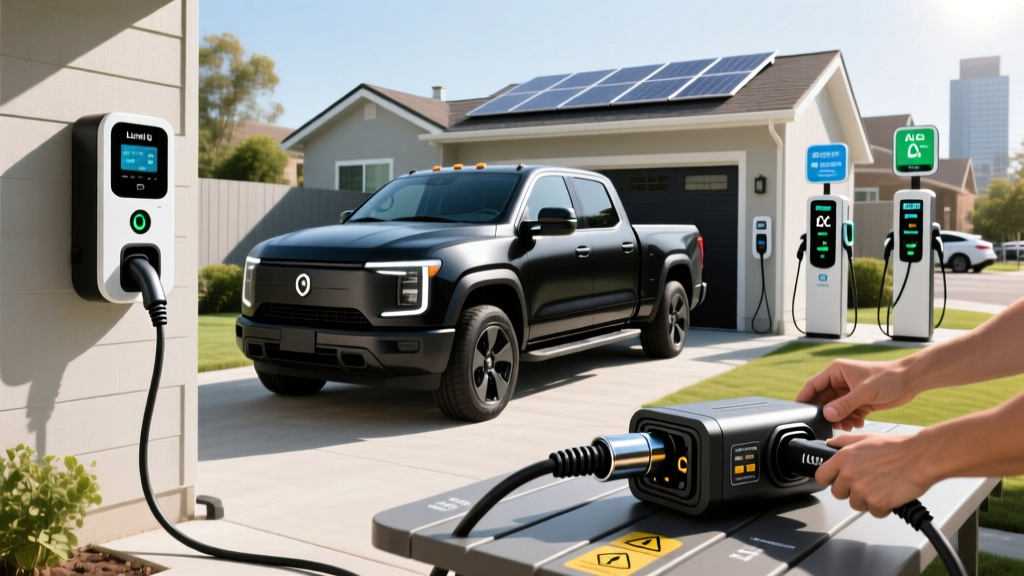
Most electric-truck owners will install a Level 2 home charger — and for trucks, a 48-amp or higher unit is strongly recommended. Here's what the electrical work involves.
Electrical Requirements
A 48-amp Level 2 charger requires a dedicated 60-amp circuit (National Electrical Code requires continuous loads to use only 80% of a circuit's rated capacity, so 48A continuous draw needs a 60A breaker). This circuit runs from your main electrical panel to the charger location using appropriately gauged copper wire (typically 6 AWG for runs under 50 feet, 4 AWG for longer runs).
For an 80-amp charger like the Ford Charge Station Pro (19.2 kW), you'll need a dedicated 100-amp circuit with 3 AWG or 2 AWG wire — a significant electrical undertaking that almost certainly requires a panel assessment.
Panel Upgrade Reality
Most modern homes have a 200-amp main electrical panel. If your panel is already near capacity — running central AC, an electric dryer, an electric oven, and a water heater — adding a 60A or 100A EV circuit may push you over the limit. A panel upgrade to 300A or 400A service typically costs $2,000-$5,000 depending on your utility and local labor rates. Homes built before 1990 with 100A or 150A panels will almost certainly need an upgrade to support a high-power truck charger.
| Component | Basic Install (48A) | High-Power Install (80A) |
|---|---|---|
| Charger Equipment | $400 - $750 | $800 - $1,300 |
| Electrician Labor (2-6 hrs) | $300 - $900 | $500 - $1,500 |
| Electrical Materials (wire, conduit, breaker) | $100 - $300 | $200 - $600 |
| Permit & Inspection | $50 - $250 | $50 - $250 |
| Panel Upgrade (if needed) | $2,000 - $4,000 | $2,500 - $5,000 |
| Total (no panel upgrade) | $850 - $2,200 | $1,550 - $3,650 |
| Total (with panel upgrade) | $2,850 - $6,200 | $4,050 - $8,650 |
According to the U.S. Department of Energy, the typical home Level 2 installation without a panel upgrade falls between $1,000 and $2,500. For electric-truck owners opting for 80A circuits, expect costs at the upper end or above that range.
Connector Compatibility: NACS, CCS1, and Adapters
The connector landscape for electric trucks shifted dramatically between 2024 and 2026. Here's where each major truck stands.
| Vehicle | Native Connector | DC Fast Charge Standard | Adapter Needed? |
|---|---|---|---|
| Ford F-150 Lightning (2025+) | NACS | NACS (Tesla Supercharger native) | CCS adapter included for legacy stations |
| Chevrolet Silverado EV | NACS | NACS | CCS adapter available |
| Rivian R1T (2025+) | NACS | NACS | CCS adapter available |
| Tesla Cybertruck | NACS | NACS | None for Superchargers; CCS adapter sold separately |
| Ford F-150 Lightning (2022-2024) | CCS1 | CCS1 | NACS adapter required for Superchargers |
| GMC Hummer EV Pickup | CCS1 | CCS1 | NACS adapter for Superchargers |
Level 2 home charging uses the J1772 standard for CCS-equipped trucks and NACS for Tesla-native trucks. Most 2026-model trucks now ship with NACS ports. If you own a CCS1 truck and buy a NACS home charger (or vice versa), a J1772-to-NACS or NACS-to-J1772 adapter (typically $150-$300) solves the problem. For DC fast charging on road trips, the adapter situation is more consequential — make sure you carry the correct adapter for the networks along your route.
Charging Cost Per Mile: Electric Truck vs. Gas Truck
Electric trucks are heavy, and their efficiency (typically 1.8-2.2 mi/kWh) is lower than a sedan's. But electricity is still cheaper per mile than gasoline in most scenarios.
| Scenario | Rate / Cost | Cost Per Mile (at 2.0 mi/kWh or 18 MPG) |
|---|---|---|
| Home charging (off-peak utility rate) | $0.12/kWh | $0.06/mi |
| Home charging (average US rate) | $0.17/kWh | $0.085/mi |
| Public Level 2 (network pricing) | $0.30/kWh | $0.15/mi |
| DC Fast Charging (Electrify America, EVgo) | $0.48/kWh | $0.24/mi |
| DC Fast Charging (Tesla Supercharger avg) | $0.30/kWh | $0.15/mi |
| Gas truck (18 MPG, $3.40/gal) | $3.40/gal | $0.19/mi |
| Gas truck (18 MPG, $4.00/gal) | $4.00/gal | $0.22/mi |
Home-charged electric trucks cost roughly $0.06-$0.09 per mile — about one-third to one-half the cost of a comparable gas truck at current fuel prices. The gap narrows when you rely exclusively on DC fast charging at public stations, where rates of $0.40-$0.55/kWh can push per-mile costs above gas in some regions. The economics strongly favor home charging as your primary fueling method.
For a truck driven 12,000 miles per year with home charging at $0.17/kWh, annual fuel cost is approximately $1,020. A gas truck at 18 MPG and $3.40/gallon would cost about $2,267. That's over $1,200 in annual savings — though individual utility rates and driving patterns will shift these numbers.
Charging Times for Common Electric Truck Batteries
Electric truck battery packs are massive. The table below shows realistic 10-80% charging times based on manufacturer data and real-world charge-curve behavior.
| Vehicle (Usable kWh) | 48A Level 2 (11.5 kW) | 80A Level 2 (19.2 kW) | 150 kW DC Fast | 350 kW DC Fast |
|---|---|---|---|---|
| Ford F-150 Lightning Extended Range (~131 kWh) | ~9.5 hrs | ~5.5 hrs | ~45 min | ~30 min |
| Chevrolet Silverado EV 4WT (~200 kWh) | ~14 hrs | ~8.5 hrs | ~65 min | ~40 min |
| Rivian R1T Dual-Motor Large (~129 kWh) | ~9 hrs | ~5.5 hrs | ~42 min | N/A (CCS limited) |
| Tesla Cybertruck AWD (~123 kWh) | ~8.5 hrs | ~5 hrs | ~40 min | ~28 min (peak) |
Recommended Home Chargers for Electric Trucks
Electric trucks benefit from higher-power Level 2 chargers. Here are top picks for 2026, chosen for power output, build quality, cable length (critical for trucks with charge ports in awkward locations), and smart features.
Best Overall: ChargePoint Home Flex (NACS or J1772)
- Power: Up to 12 kW (50A, adjustable down to 16A)
- Connector: NACS or J1772 (configurable)
- Cable Length: 23 feet
- Smart Features: Wi-Fi, app scheduling, utility rate optimization, Alexa integration
- Outdoor Rating: NEMA 4 (weatherproof)
- Price: ~$550-$650
- Why for trucks: Flexible amperage lets you match your panel capacity; 23-foot cable reaches most truck charge ports in a standard garage
Best High-Power: Ford Charge Station Pro
- Power: 19.2 kW (80A on 100A circuit)
- Connector: NACS (2025+ models); CCS1 (2022-2024)
- Cable Length: 25 feet
- Smart Features: FordPass integration, bi-directional V2H capability (with Home Integration System), scheduled charging
- Outdoor Rating: NEMA 4X
- Price: ~$1,300 (charger only; HIS panel ~$3,900 additional for V2H)
- Why for trucks: Maximum home charging speed for the F-150 Lightning; V2H can power your home during outages
Best Value: Emporia Level 2 EV Charger
- Power: Up to 11.5 kW (48A)
- Connector: J1772 (NACS adapter available)
- Cable Length: 24 feet
- Smart Features: Wi-Fi, energy monitoring, solar integration, load management with Emporia Vue panel monitor
- Outdoor Rating: NEMA 4
- Price: ~$400
- Why for trucks: Lowest-cost 48A option with excellent energy-monitoring; load-management feature prevents panel overload without a costly upgrade
Public DC Fast Charging: Networks, Speeds, and Road-Trip Strategy
For road trips, electric-truck owners depend on DC fast-charging networks. As of 2026, the major networks and their characteristics for truck charging include:
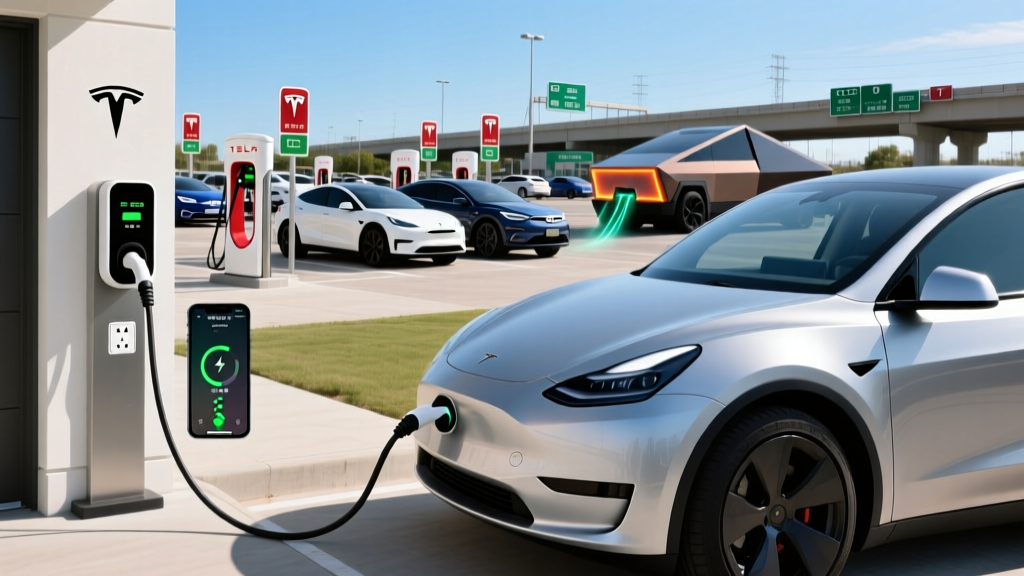
- Tesla Supercharger Network (now open to NACS-equipped non-Tesla trucks): The largest and most reliable network in the US, with over 20,000 stalls. V3 stalls deliver up to 250 kW; V4 stalls deliver up to 350 kW. Expect average truck-charging sessions of 25-40 minutes for 10-80% on V3 stalls.
- Electrify America: Offers 150 kW and 350 kW stalls. CCS1 trucks charge natively; NACS trucks need an adapter (or use EA's new NACS-equipped stalls rolling out in 2025-2026). Pricing averages $0.48/kWh without a subscription; Pass+ members pay ~$0.36/kWh.
- EVgo: Mix of 50 kW, 150 kW, and 350 kW chargers. Autocharge+ feature enables plug-and-charge without an app. Pricing averages $0.38-$0.52/kWh depending on region.
- ChargePoint (DC Fast): Smaller fast-charging footprint but expanding. Rates vary by site operator.
Road-trip planning tip for trucks: Because truck batteries are large and aerodynamics are poor at highway speeds, real-world highway range is typically 15-25% below the EPA sticker. An F-150 Lightning Extended Range rated at 320 miles EPA may deliver only 240-270 miles at 70 mph in moderate weather. Plan charging stops at 150-200 mile intervals to maintain a comfortable buffer. Use tools like A Better Route Planner (ABRP) with your specific truck model to model energy consumption across elevation changes, temperature, and speed.
Safety, Electrical Code, and Permitting
EV charger installation is electrical work governed by the National Electrical Code (NEC) and your local jurisdiction. Key requirements include:
- Dedicated circuit: Your Level 2 charger must be on its own dedicated circuit — it cannot share with other appliances.
- GFCI protection: NEC 2020 and later require GFCI protection for EV charging outlets. Hardwired chargers typically have GFCI built into the unit; receptacle-based (NEMA 14-50) installations require a GFCI breaker, which adds $50-$150 to the cost.
- Permit and inspection: Most jurisdictions require an electrical permit ($50-$250) and a post-installation inspection. Skipping this step can void your homeowner's insurance coverage for electrical fires and may cause problems during a home sale.
- Outdoor-rated equipment: If your charger is mounted outdoors or in an open carport, it must carry a NEMA 4 or NEMA 4X rating for weather resistance.
- Load management: If your panel is near capacity but you want to avoid an expensive upgrade, consider a smart load-management system (like the Emporia Vue or Span panel) that dynamically reduces charger amperage when other circuits are drawing heavily.
Always hire a licensed electrician for EV charger installation. Per the National Fire Protection Association's NEC guidelines, improper EV charger wiring is a documented fire hazard. Your electrician will perform a load calculation on your panel before recommending a circuit size.
Frequently Asked Questions
How much does it cost to install a home EV charger for my electric truck?
For a standard 48-amp Level 2 charger installation without a panel upgrade, expect $850-$2,200 including equipment, electrician labor, materials, and permit. For an 80-amp high-power installation, budget $1,550-$3,650. If your home needs a panel upgrade (common in homes with 100A or 150A service), add $2,000-$5,000. Get at least three quotes from licensed electricians — prices vary significantly by region.
How fast will each charging level add range to my electric truck?
Level 1 (120V) adds roughly 2-3 miles per hour — essentially unusable for daily truck charging. Level 2 at 48 amps (11.5 kW) adds about 23 miles per hour, which is sufficient for overnight replenishment of 200+ miles. Level 2 at 80 amps (19.2 kW) adds about 38 miles per hour. DC fast charging at 150 kW adds roughly 300 miles per hour at peak, though the charge curve tapers significantly above 80% SoC.
Which connector and charger is compatible with my electric truck?
For 2025-2026 model-year trucks (F-150 Lightning, Silverado EV, Rivian R1T, Cybertruck), the native connector is NACS. Older 2022-2024 F-150 Lightnings and the GMC Hummer EV use CCS1. For home charging, match the charger connector to your truck's port, or use an adapter. For public DC fast charging, carry the appropriate adapter if your truck's native connector doesn't match the station. Check fueleconomy.gov for your specific model's charging specifications.
How much does charging an electric truck cost per mile compared to gas?
At the US average residential electricity rate of ~$0.17/kWh and truck efficiency of ~2.0 mi/kWh, home charging costs about $0.085 per mile. A comparable gas truck at 18 MPG and $3.40/gallon costs $0.19 per mile — more than double. However, DC fast charging at $0.48/kWh pushes the cost to ~$0.24/mile, which exceeds gas in some markets. The economic advantage of an electric truck depends heavily on your access to affordable home charging.
What electrical upgrades might I need to charge an electric truck at home?
The most common upgrade is a panel capacity increase. If your home has a 200A panel with significant existing loads (electric heat, AC, dryer, oven), adding a 60A or 100A EV circuit may exceed capacity, requiring a panel upgrade to 300A-400A ($2,000-$5,000). Older homes with 100A or 150A service almost certainly need an upgrade. A smart load-management system can sometimes avoid a panel upgrade by dynamically throttling the charger when other circuits are active. Have a licensed electrician perform a load calculation before committing to a charger size.
Can I use a regular 120V outlet to charge my electric truck?
Technically yes, but practically no. A 120V Level 1 connection delivers only ~1.4 kW, adding 2-3 miles of range per hour. Charging a 131 kWh F-150 Lightning battery from 10% to 80% on Level 1 would take approximately 75 hours (over three full days). Level 1 is suitable only for emergency situations or maintaining charge on a truck that's not being driven.
Does the federal tax credit apply to home charger installation?
The federal Alternative Fuel Vehicle Refueling Property Credit (IRS Form 8911) covers up to 30% of home EV charger equipment and installation costs, capped at $1,000. However, eligibility depends on whether your census tract qualifies as a non-urban or low-income area under current IRS rules. Check the IRS census tract tool or consult a tax professional to confirm eligibility before purchasing.