Class 8 electric semi trucks have moved beyond pilot programs into real fleet deployments — but the gap between manufacturer range claims and operational reality remains a critical planning challenge. Whether you're evaluating the Tesla Semi, Freightliner eCascadia, Volvo VNR Electric, or Peterbilt 579EV, understanding how battery capacity (kWh), charging infrastructure (kW), and route profiles interact is essential before committing capital.
This guide dissects electric semi truck range under real-world conditions, the DC fast charging architecture required to keep these vehicles moving, depot-level installation costs, connector standards, and the per-mile economics versus diesel. We'll cover both highway-capable tractors and regional-haul day cabs.
Electric Semi Truck Range: EPA Claims vs. Real-World Operations
Unlike passenger EVs, electric semi trucks don't carry a single EPA range sticker. Manufacturers publish estimated ranges based on specific payloads, speeds, and terrain — and those numbers shift dramatically with a full 80,000-lb GCW (gross combined weight) load versus a bobtail run. Here's how the major Class 8 models stack up as of the 2025–2026 model year:
| Model | Battery Capacity (kWh) | Advertised Range (mi) | Real-World Range Loaded (mi) | GCW Rating (lbs) |
|---|---|---|---|---|
| Tesla Semi (Long Range) | ~900 (estimated) | 500 | 320–400 | 82,000 |
| Freightliner eCascadia | 291–448 | 230 | 150–190 | 82,000 |
| Volvo VNR Electric (6-battery) | 565 | 275 | 175–225 | 82,000 |
| Peterbilt 579EV | 396 | 200 | 130–170 | 82,000 |
| Kenworth T680E | 396 | 200 | 130–170 | 82,000 |
The efficiency metric that matters for fleet planning is kWh per mile. Most loaded Class 8 electric semis consume between 1.8 and 2.5 kWh/mile depending on speed, payload, and aerodynamics. The Tesla Semi's claimed efficiency of under 2 kWh/mile at highway speed is class-leading, largely due to its drag coefficient (~0.36) versus ~0.55 for a conventional cab-over tractor.
Charging Levels Explained: kW Power and Miles Added Per Hour
Understanding charging speed requires separating kW (power — the rate of energy delivery) from kWh (energy — the battery's total capacity). A 350 kW charger delivers energy faster than a 50 kW charger, but the truck's battery capacity in kWh determines how far that energy takes you.
| Level | Voltage / Phase | Max Power (kW) | Miles of Range Added Per Hour | Typical Use Case |
|---|---|---|---|---|
| Level 1 (AC) | 120V / 1-phase | 1.4–1.9 kW | 0.5–1 mi/hr | Not practical for Class 8 |
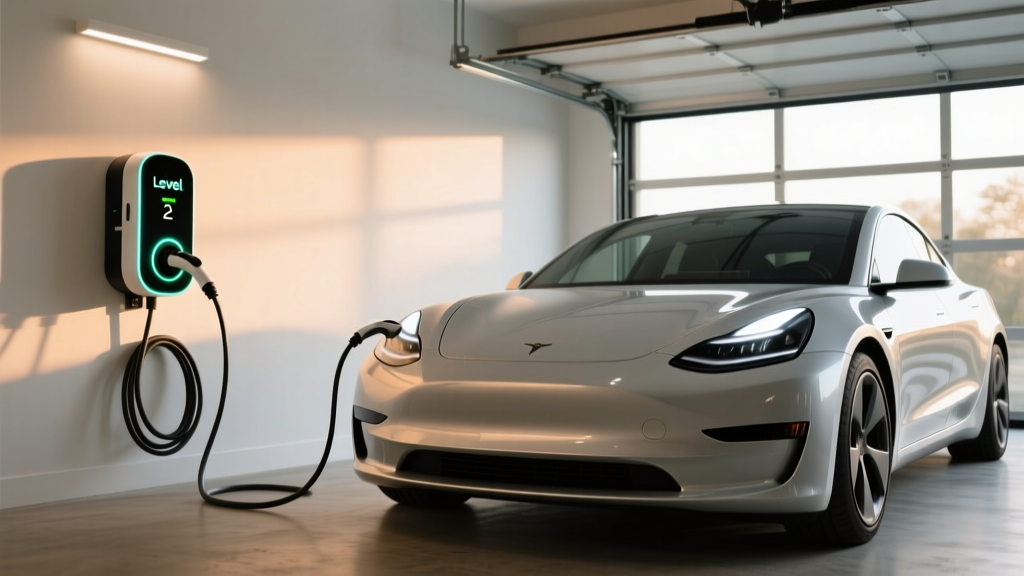
| Level 2 (AC) | 208–240V / 1-phase | 7.2–19.2 kW | 3–10 mi/hr | Overnight depot top-off |
| DC Fast (CCS/MCS) | 200–1000V DC | 50–600+ kW | 100–300+ mi/hr | En-route and depot rapid charge |
For context, adding 200 miles of range to a Freightliner eCascadia (consuming ~2.0 kWh/mile = 400 kWh needed) at a 180 kW DC fast charger would take approximately 2.2 hours under ideal conditions. At a Megawatt Charging System (MCS) connector delivering 600+ kW, that same energy could be delivered in under 45 minutes — assuming the battery management system can accept that charge rate without thermal throttling.
Charge Curve Reality for Heavy-Duty Batteries
Class 8 battery packs (300–900+ kWh) generate enormous heat during fast charging. Most trucks sustain peak charge rates only between 10–50% State of Charge (SoC), then taper significantly. A Tesla Semi at a Megacharger may sustain 750+ kW initially but taper to under 200 kW above 70% SoC. Fleet scheduling should plan around 10–80% charge times, not peak kW figures.
Depot Charging Installation: Electrical Requirements & Cost Breakdown
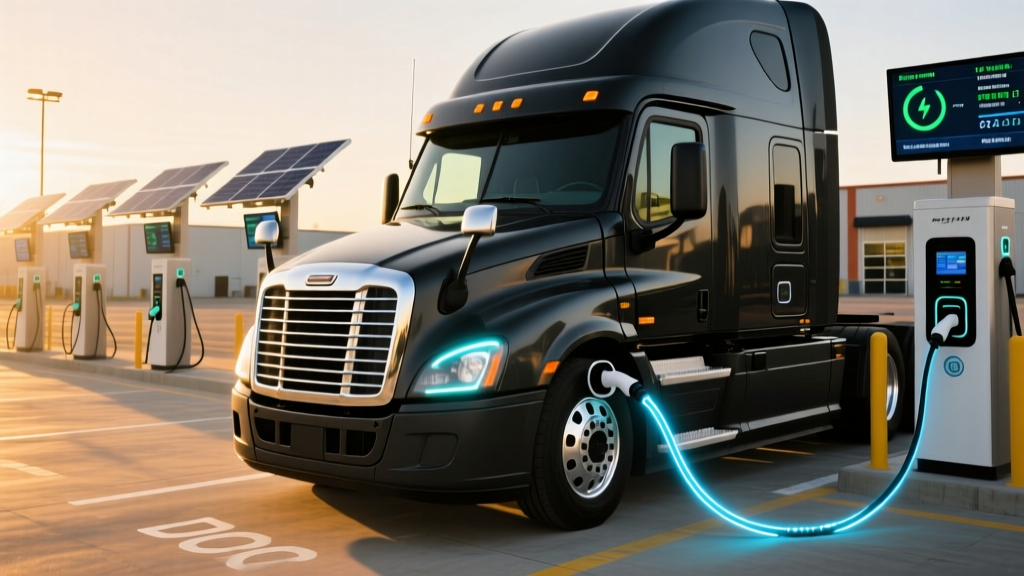
Installing commercial-grade EV charging for electric semi trucks is an infrastructure project, not a simple plug-in. Here's what a typical depot installation involves:
Electrical Requirements
- Level 2 depot chargers (19.2 kW each): 208/240V, 80A dedicated circuit per unit, 3-phase preferred for multi-unit installations
- DC fast chargers (50–180 kW): 480V 3-phase service, 200–600A per unit, dedicated transformer often required
- Megawatt Charging System (600+ kW): Medium-voltage utility service (12.47 kV), on-site substation, utility coordination required 12–24 months in advance
Panel and Service Upgrades
Most commercial facilities do not have spare capacity for multiple 180 kW DC chargers. A four-stall depot charging station at 180 kW each requires ~720 kW of continuous power — roughly equivalent to a small industrial building's total load. Expect a utility service upgrade, new switchgear, and potentially a dedicated medium-voltage drop.
| Component | Level 2 (19.2 kW) | DC Fast (180 kW) | MCS (600+ kW) |
|---|---|---|---|
| Charger Equipment | $3,000–$7,000 | $80,000–$150,000 | $250,000–$500,000+ |
| Electrical Work (conduit, wiring, panel) | $5,000–$15,000 | $30,000–$80,000 | $150,000–$400,000 |
| Utility Service Upgrade | $0–$10,000 | $50,000–$250,000 | $200,000–$1,000,000+ |
| Permitting & Engineering | $2,000–$5,000 | $15,000–$40,000 | $50,000–$150,000 |
| Total Per Stall (installed) | $10,000–$37,000 | $175,000–$520,000 | $650,000–$2,050,000 |
Connector Standards: CCS, MCS, and Tesla's Proprietary Plug
Connector compatibility is a fragmented landscape for electric semi trucks, and choosing the wrong infrastructure can strand your fleet.
| Connector | Max Power | Compatible Models | Notes |
|---|---|---|---|
| CCS1 (Combo) | ~350 kW | Freightliner eCascadia, Volvo VNR Electric, Peterbilt 579EV, Kenworth T680E | Industry standard for Class 8; J1772-Combo |
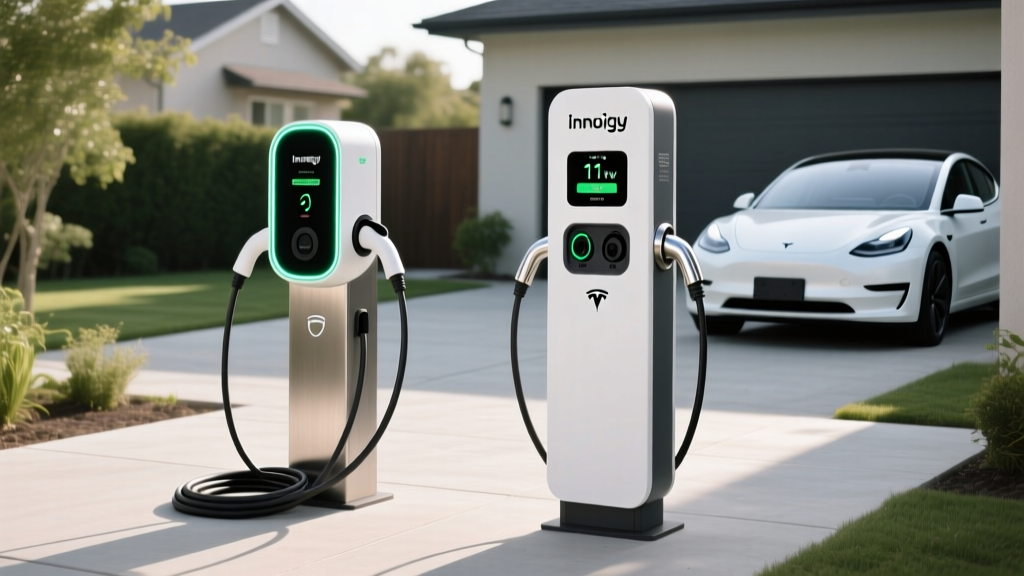
| Tesla Megacharger (NACS-derived) | ~750+ kW | Tesla Semi only | Proprietary; no public network access for other brands |
| MCS (Megawatt Charging System) | 1,000+ kW (3,000A) | Future models (standard in development) | SAE J3105 standard; expected on next-gen trucks from 2026–2028 |
| CHAdeMO | ~400 kW | Legacy/light-duty only | Not used on current Class 8 trucks |
For fleet operators deploying today, CCS1 is the safe bet — it's supported by every major OEM except Tesla. The MCS standard, ratified by SAE, will eventually unify megawatt-class charging, but hardware availability remains limited. Tesla Semi owners are locked into Tesla's Megacharger network, which is expanding along key freight corridors but remains proprietary.
Cost Per Mile: Electricity vs. Diesel
The operating-cost argument for electric semi trucks hinges on energy cost per mile. Here's how scenarios break down for a typical Class 8 tractor averaging 2.0 kWh/mile:
| Scenario | Rate | Cost Per Mile | Annual Cost (100k mi) |
|---|---|---|---|
| Depot charging (off-peak, $0.08/kWh) | $0.08/kWh × 2.0 kWh | $0.16/mi | $16,000 |
| Depot charging (blended, $0.14/kWh) | $0.14/kWh × 2.0 kWh | $0.28/mi | $28,000 |
| Public DC fast ($0.45/kWh) | $0.45/kWh × 2.0 kWh | $0.90/mi | $90,000 |
| Diesel ($4.10/gal, 6.5 MPG avg) | $4.10 ÷ 6.5 | $0.63/mi | $63,000 |
At depot off-peak rates, an electric semi's energy cost is roughly 75% lower than diesel. Even at blended commercial rates, it's 55% cheaper. However, relying on public DC fast charging erases the advantage — those rates are designed for passenger EVs, not 400 kWh battery packs. The economics demand depot charging.
Maintenance savings add another $0.08–$0.12/mile in favor of electric: no diesel exhaust fluid (DEF), no oil changes, no diesel particulate filter (DPF) replacements, and regenerative braking that extends service-brake life by 2–3×.
Charging Time Examples by Battery Size
Here's how long it takes to charge common electric semi battery packs from 10% to 80% SoC at various power levels:
| Battery Size (kWh) | Energy Needed (10–80%) | At 180 kW DC | At 350 kW DC | At 750 kW (MCS/Megacharger) |
|---|---|---|---|---|
| 291 kWh (eCascadia small pack) | ~204 kWh | ~75 min* | ~45 min* | ~25 min* |
| 448 kWh (eCascadia large pack) | ~314 kWh | ~115 min* | ~65 min* | ~35 min* |
| 565 kWh (Volvo VNR Electric) | ~396 kWh | ~145 min* | ~85 min* | ~45 min* |
| ~900 kWh (Tesla Semi) | ~630 kWh | ~230 min* | ~130 min* | ~55 min* |
*Times assume average sustained charge rate at ~70% of peak due to charge-curve taper above 50% SoC. Actual times vary with battery temperature, preconditioning, and ambient conditions.
Equipment Recommendations for Depot Charging
ABB Terra 360 (DC Fast)
- Power: Up to 360 kW (dual CCS1 cables, dynamic load sharing)
- Connector: Dual CCS1
- Features: OCPP 2.0.1, integrated payment terminal, remote diagnostics, liquid-cooled cables
- Price: ~$130,000–$170,000 (equipment only)
- Best for: Multi-truck depot with mixed Class 8 fleet
ChargePoint Express Plus 600
- Power: Up to 600 kW per block (modular power architecture)
- Connector: CCS1, MCS-ready architecture
- Features: OCPP, fleet management API, dynamic power sharing across stalls, cloud-based monitoring
- Price: ~$200,000–$350,000 per power block
- Best for: Large fleet depots planning MCS migration
BTCPower 180 kW DC Charger
- Power: 180 kW single CCS1 output
- Connector: CCS1 (J1772-Combo)
- Features: OCPP 1.6J, integrated cable management, outdoor-rated NEMA 4 enclosure
- Price: ~$85,000–$110,000
- Best for: Small fleets (2–5 trucks) with overnight turnaround
Safety, Code, and Permitting for Commercial EV Charging
Commercial charging installations for electric semi trucks fall under NEC Article 625 (Electric Vehicle Charging System Equipment) and must meet local building and electrical codes. Key requirements include:
- Dedicated circuits: Each charger requires its own breaker and circuit — no shared circuits with building loads
- GFCI protection: Required for all outdoor receptacles and charging equipment per NEC 625.54
- Outdoor rating: All outdoor equipment must be NEMA 3R (rain-tight) or NEMA 4 (watertight) rated
- Emergency disconnect: NEC 2023+ requires an externally accessible emergency disconnect within sight of charging equipment
- Ventilation: Enclosed charging areas for large battery packs may require ventilation per NFPA standards for lithium-ion energy storage
- Utility interconnection agreement: Required for any installation exceeding 100 kW; may involve demand charges, time-of-use rate enrollment, and grid impact studies
Work with a licensed electrical contractor experienced in commercial EV infrastructure and your utility's commercial rate structures. Demand charges (billed on peak kW draw, not kWh consumed) can double your effective electricity cost if not managed through staggered charging schedules or on-site battery storage.
Frequently Asked Questions
How much does it cost to install a commercial EV charger for a semi truck?
A single 180 kW DC fast charger for a Class 8 truck costs $175,000–$520,000 fully installed, including equipment, electrical work, utility service upgrades, and permitting. Megawatt-class chargers (600+ kW) can exceed $1 million per stall when medium-voltage utility service is required. State and federal incentives (including the EPA Clean Heavy-Duty Vehicles Program) can offset 25–50% of costs in qualifying areas.
How fast will each charging level add range to an electric semi?
Level 2 (19.2 kW) adds roughly 5–10 miles of range per hour to a loaded Class 8 truck — suitable only for overnight depot parking. DC fast charging at 180 kW adds approximately 90 miles per hour. Megawatt-class charging (600+ kW) can add 250–300+ miles per hour, enabling tractor-trailer charging during a mandatory 30-minute driver rest break.
Which connector is compatible with my electric semi truck?
All current non-Tesla Class 8 trucks (Freightliner, Volvo, Peterbilt, Kenworth) use the CCS1 connector. The Tesla Semi uses a proprietary Megacharger plug. The emerging MCS (Megawatt Charging System) standard will eventually unify high-power charging but is not yet widely deployed. Verify your truck's connector before purchasing depot equipment.
How much does charging an electric semi cost per mile vs. diesel?
At depot off-peak rates ($0.08–$0.14/kWh), an electric semi costs $0.16–$0.28 per mile in energy versus $0.60–$0.70 per mile for diesel at $4.00/gallon and 6–7 MPG. That's a 55–75% energy cost reduction. However, public DC fast charging at $0.40–$0.60/kWh can exceed diesel costs. Depot charging is essential for positive economics.
What electrical upgrades might my depot need for semi truck chargers?
Most commercial sites need a utility service upgrade to support even two or three 180 kW chargers. This can involve new transformers, switchgear, and medium-voltage service drops. Total electrical upgrade costs range from $50,000 to over $1 million depending on existing capacity and utility infrastructure proximity. Engage your utility early — lead times for transformer procurement can exceed 12 months. The IRS §30C Alternative Fuel Vehicle Refueling Property Credit covers up to 30% of qualified charging infrastructure costs (capped at $100,000 per item) in eligible census tracts.