Why Charging the Electric Range Rover Demands a Plan
The 2026 Land Rover Range Rover Electric (internally the JLR MLA-Flex platform) arrives with a reported 117 kWh usable battery pack and an EPA-estimated range hovering around 300–320 miles depending on final trim and wheel configuration. That massive battery is both a blessing and a logistical challenge: it gives you genuine luxury-touring range, but it also means Level 2 home charging sessions stretch well past 12 hours from empty, and DC fast charging sessions still require 30–40 minutes at a high-power station to move from 10–80% State of Charge.
If you are ordering or have reserved an Electric Range Rover, your charging infrastructure needs to be sorted before delivery day. This guide walks through every charging tier, the real electrical work your home may require, connector compatibility as the industry shifts to NACS, and what you will actually spend per mile compared to the supercharged V8 Range Rover.
Charging Levels Explained: Speeds, Times, and the Range Rover Battery
EV charging falls into three tiers. The critical distinction: kW (kilowatts) measures the power flow rate — how fast energy enters the battery. kWh (kilowatt-hours) measures total energy stored — the battery's capacity. The Electric Range Rover's ~117 kWh battery is the tank size; the charger's kW rating is the hose diameter.
| Level | Voltage / Amps | Power (kW) | Miles Added per Hour | 10–80% Time (est.) |
|---|---|---|---|---|
| Level 1 (120V household) | 120V / 12A | ~1.4 kW | ~3–4 mi/hr | Not practical (>90 hrs) |
| Level 2 (240V home/public) | 240V / 48A | ~11.5 kW | ~28–32 mi/hr | ~8–9 hours |
| Level 2 (240V / 80A) | 240V / 80A | ~19.2 kW | ~46–52 mi/hr | ~5–6 hours |
| DC Fast Charging | 400V+ architecture | Up to ~200+ kW peak | ~150–200+ mi in 10 min | ~30–40 min (10–80%) |
With a 117 kWh pack, Level 1 charging (a standard 120V outlet) is effectively useless except for emergency trickle-top-ups. You will rely on Level 2 at home and DC fast charging for road trips. The on-board charger in the Range Rover Electric is expected to support up to 11 kW on single-phase AC (common in European markets) and up to 19.2 kW on split-phase 240V/80A circuits in North America, though many homes will install 48A (11.5 kW) circuits as the practical maximum.
Home Charger Installation: Electrical Requirements and Real Costs
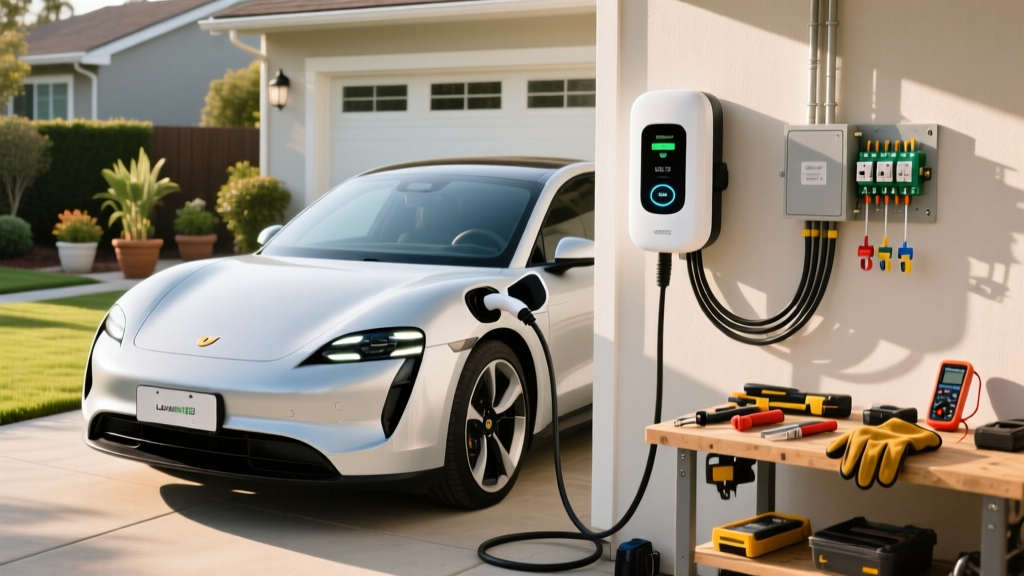
Most Electric Range Rover owners will install a wall-mounted Level 2 charger in a garage or on an exterior wall. Here is what that project actually involves.
Electrical Requirements
- Circuit: A dedicated 60-amp breaker (for a 48A continuous-load charger) or a 100-amp breaker (for an 80A charger). NEC code requires the breaker to be rated 125% above the continuous load.
- Wire: 6 AWG copper for 48A; 3 AWG copper or 1/0 aluminum for 80A, run in conduit where exposed.
- Panel capacity: Your main service panel must have both physical breaker slots and sufficient amperage headroom. A 200-amp service is standard in newer homes; older homes with 100-amp or 150-amp service may need a panel upgrade to 200A, adding $1,500–$3,500.
- Permit: Most jurisdictions require an electrical permit ($50–$200) and a post-installation inspection.
- GFCI: The 2020 NEC (and 2023 updates) requires GFCI protection for EV receptacles; hardwired chargers may bypass this requirement depending on local code interpretation.
Installation Cost Breakdown
| Component | Basic Install (48A, short run) | Complex Install (80A, long run or panel upgrade) |
|---|---|---|
| Charger hardware | $500–$750 | $600–$1,200 |
| Electrician labor | $600–$1,200 | $1,500–$3,000 |
| Wire, conduit, breaker | $150–$400 | $400–$900 |
| Permit & inspection | $50–$200 | $100–$300 |
| Panel upgrade (if needed) | $0 | $1,500–$3,500 |
| Total | $1,300–$2,550 | $4,100–$8,900 |
The wide range is not a typo. A homeowner with a 200A panel, an empty double-slot, and a garage wall directly behind the panel may spend under $2,000 all-in. A homeowner with a 100A panel in a 1970s house, needing a 60-foot wire run through a finished ceiling to an exterior wall, will spend $5,000+ easily. Get at least two quotes from licensed electricians and ask specifically about your panel's remaining amperage capacity.
Safety and Code Considerations
Do not cut corners here. A Level 2 charger pulls sustained high current for hours — this is the most demanding continuous load in a residential electrical system. Ensure your electrician pulls a permit (this protects your homeowner's insurance coverage), uses a dedicated circuit (never share with a dryer or HVAC), and installs an outdoor-rated (NEMA 4) unit if the charger is exterior-mounted. For the Range Rover Electric, which will likely charge outdoors at many estates, a weatherproof enclosure and proper cable management are essential.
Connector Compatibility: NACS, CCS1, and the Transition
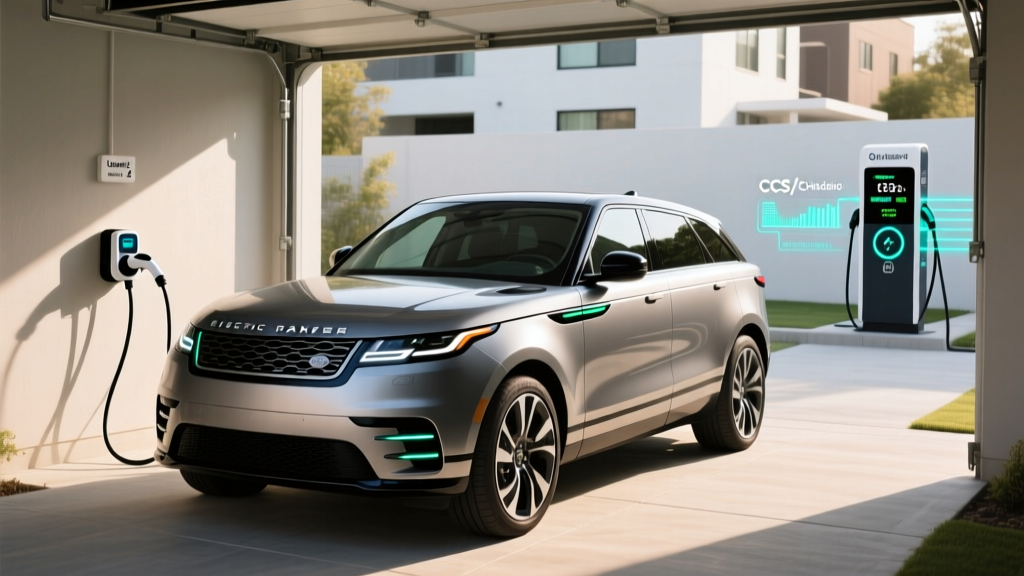
The Electric Range Rover launches into a connector landscape in flux. As of 2026, the North American Charging Standard (NACS), pioneered by Tesla, has been adopted by Ford, GM, Rivian, Volvo, BMW, and others. JLR has announced NACS adoption for future models, but the initial Range Rover Electric may ship with a CCS1 port — the legacy standard still used by Electrify America, EVgo, and most non-Tesla networks.
| Connector | Physical Shape | Used By | Network Access |
|---|---|---|---|
| NACS (J3400) | Compact, no latch | Tesla, Ford, GM, Rivian, Volvo, BMW, Hyundai (2025+) | Tesla Supercharger (full); growing adoption on EA, EVgo |
| CCS1 | Larger, latched, 2-pin DC extension | VW, Audi, Porsche, JLR (current), Stellantis | Electrify America, EVgo, ChargePoint DC, Ionity (EU) |
| CHAdeMO | Round, legacy | Nissan Leaf (discontinued in US), Mitsubishi | Limited — being phased out |
If your Range Rover Electric ships with CCS1, you can still access Tesla Superchargers using a CCS-to-NACS adapter (sold by Tesla and third parties for $200–$300). Conversely, if JLR ships with a native NACS port, you will have seamless Supercharger access and can use a NACS-to-CCS adapter at Electrify America stations. Confirm your specific vehicle's port before ordering a home charger — most Level 2 chargers now ship with a J1772 connector (universal for AC charging across all standards), and DC fast charging adapters are a separate concern.
Charging Cost: Per-Mile Comparison With the Gas Range Rover
The 2026 supercharged V8 Range Rover P530 returns roughly 16 MPG combined per fueleconomy.gov EPA data. The Electric Range Rover is expected to achieve approximately 70–80 MPGe combined (roughly 40–45 kWh per 100 miles). Here is what that translates to in real dollars.
| Scenario | Rate | Cost per Mile (EV) | Cost per Mile (Gas V8) |
|---|---|---|---|
| Home charging (off-peak utility rate) | $0.12/kWh | $0.05 | — |
| Home charging (average US rate) | $0.17/kWh | $0.07 | — |
| Public Level 2 (ChargePoint, etc.) | $0.30/kWh | $0.13 | — |
| DC Fast Charging (Electrify America) | $0.48/kWh | $0.20 | — |
| Gasoline (premium, $4.20/gal avg) | $4.20/gal | — | $0.26 |
At home on off-peak rates, the Electric Range Rover costs roughly 80% less per mile than the V8. Even on expensive DC fast chargers, you are still paying less per mile than the gas version. Over 15,000 miles per year, home-charging savings alone could reach $2,800–$3,200 annually compared to premium gasoline.
Keep in mind: the Electric Range Rover is not expected to qualify for the full $7,500 IRS §30D federal tax credit due to the MSRP cap (the credit phases out for SUVs above $80,000, and the Range Rover Electric starts well above $120,000). Factor this into your total-cost-of-ownership math — the fuel savings are real, but the upfront premium over the gas model is substantial.
Recommended Home Level 2 Chargers for the Range Rover Electric
With a ~117 kWh battery, you want the fastest Level 2 charger your electrical panel can support. Here are three proven units suited to the Range Rover's scale and the typical luxury-home installation.
ChargePoint Home Flex
- Power: Up to 11.5 kW (48A) on a 60A circuit; configurable down to 16A
- Connector: J1772 (universal AC)
- Cable length: 23 feet
- Smart features: Wi-Fi, app scheduling, Alexa integration, energy tracking
- Price: ~$650–$700
- Best for: Most Range Rover owners with a standard 60A circuit. Reliable, well-supported app, UL-listed.
Emporia Vue + Emporia Level 2 Charger
- Power: Up to 11.5 kW (48A) or 19.2 kW (80A model available)
- Connector: J1772
- Cable length: 24 feet
- Smart features: Whole-home energy monitoring integration, solar-aware charging, time-of-use optimization
- Price: ~$550–$800 (charger); $400+ for whole-home monitor
- Best for: Estate homes with solar panels or complex energy setups. The 80A model is one of the few consumer chargers that can exploit the Range Rover's full AC charge rate.
Wallbox Pulsar Plus
- Power: Up to 11.5 kW (48A)
- Connector: J1772 (NACS version also available for 2025+ vehicles)
- Cable length: 25 feet
- Smart features: Wi-Fi + Bluetooth, load balancing (shares power with other household loads), compact form factor
- Price: ~$550–$650
- Best for: Tight garage spaces and panels near capacity — the load-balancing feature prevents breaker trips by dynamically adjusting charge rate.
For the Range Rover Electric specifically, I recommend the 80A Emporia or hardwiring a high-amperage unit if your panel supports it. A 48A charger adds roughly 30 miles per hour — adequate if you plug in every night and rarely drain below 30%, but slow if you arrive home at 10% SoC and need a full charge by morning. The 80A option cuts that time nearly in half.
Public Charging on Road Trips: Networks, Speeds, and Strategy
The Electric Range Rover is expected to support DC fast charging at up to approximately 200+ kW on 400V architecture (JLR has not confirmed 800V for this platform). At peak rate, a 10–80% session should complete in roughly 30–40 minutes. However, the charging curve is critical: peak kW is only sustained between roughly 10–50% SoC. Above 60%, the rate tapers significantly, and above 80%, it drops to a trickle. This is why every manufacturer quotes 10–80% times rather than 0–100%.
On a road trip, plan your stops around the major DC networks:
- Tesla Supercharger: 15,000+ stalls in the US, many now open to non-Tesla EVs via the NACS adapter or Magic Dock. Speeds up to 250 kW (V3) or 350 kW (V4). Most reliable network by uptime.
- Electrify America: Largest non-Tesla network; 350 kW chargers at newer stations. Reliability has improved but remains inconsistent at older locations.
- EVgo: Growing 350 kW stall count; good urban coverage. Pricing varies by membership tier.
- ChargePoint: Primarily Level 2 destination charging (hotels, shopping), with limited DC fast presence.
For a vehicle this size, verify that charging stalls have pull-through spaces or wide berths — many urban stations are designed for compact EVs and cannot accommodate the Range Rover's 200+ inch length and 8-foot width without blocking adjacent chargers.
Frequently Asked Questions
How much does it cost to install a home EV charger for the Electric Range Rover?
A straightforward Level 2 installation (48A charger, short wire run, adequate panel) costs $1,300–$2,550 including equipment, electrician labor, materials, and permit. If your home needs a panel upgrade from 100A to 200A service, or if the wire run exceeds 50 feet through finished walls, expect $4,100–$8,900 total. Always get multiple quotes from licensed electricians.
How fast will each charging level add range to the Range Rover Electric?
Level 1 (120V) adds roughly 3–4 miles per hour — impractical for a 117 kWh battery. Level 2 at 48A (11.5 kW) adds approximately 28–32 miles per hour. Level 2 at 80A (19.2 kW) adds approximately 46–52 miles per hour. DC fast charging at peak rate can add 150–200+ miles in a 10-minute window, though sustained average rates are lower over a full session.
Which connector and charger is compatible with the Electric Range Rover?
For Level 2 home and destination charging, all EVs use the J1772 connector in North America — any Level 2 charger will work. For DC fast charging, confirm whether your vehicle ships with CCS1 or NACS. If CCS1, you may need a CCS-to-NACS adapter ($200–$300) for Tesla Supercharger access. Check JLR's official specifications for your model year and trim.
How much does charging cost per mile compared to gas?
At a national-average home electricity rate of $0.17/kWh, the Electric Range Rover costs approximately $0.07 per mile. The supercharged V8 gas Range Rover at 16 MPG on $4.20/gal premium costs approximately $0.26 per mile. Home charging saves roughly $0.19 per mile, or about $2,850 per year at 15,000 miles. Public DC fast charging at $0.48/kWh still undercuts gasoline at $0.20 per mile.
What electrical upgrades might I need for a Range Rover home charger?
The most common upgrade is a panel capacity increase from 100A or 150A to 200A service ($1,500–$3,500). You may also need a new double-pole breaker slot, upgraded wire gauge for long runs, and possibly a sub-panel if your main panel is full. Homes built before 1990 are the most likely candidates for panel upgrades. An electrician's load calculation will determine your exact requirements.
Can I charge the Range Rover Electric with solar panels?
Yes, but with caveats. A typical 10 kW residential solar array produces roughly 35–45 kWh per day in good conditions — enough to add about 80–100 miles of range daily. Pairing a solar-aware charger (like the Emporia) with time-of-use utility rates lets you maximize self-consumption. However, the Range Rover's 117 kWh battery will rarely charge fully from solar alone in a single day.
Charging an Electric Range Rover is not fundamentally different from any other large-battery EV, but the scale amplifies every decision. Invest in the fastest Level 2 installation your home can support, confirm your DC fast charging connector before ordering adapters, and use the per-mile cost advantage to offset the premium purchase price over time. For authoritative safety and electrical standards, reference the NHTSA EV safety guidelines and consult a licensed electrician for your specific installation.