The Electric Polaris Ranger (officially the Ranger XP Kinetic) is a 110-horsepower electric utility vehicle that trades the gas tank for a lithium-ion battery pack — and that means learning a new fueling routine. Unlike a highway EV with DC fast-charging capability, the Ranger XP Kinetic is designed to recharge where you park it: the barn, the garage, or the job site. This guide breaks down exactly what charging looks like for Polaris's electric side-by-side, what electrical work you might need, and what it costs per mile compared to the gas Ranger.
Electric Polaris Ranger Battery and Charging Specs at a Glance
Before plugging in, understand the energy hardware. The Ranger XP Kinetic comes in two battery configurations:
- Base (14.9 kWh usable): EPA-estimated ~45 miles of mixed-use range
- Premium/Ultimate (29.8 kWh usable): EPA-estimated ~110 miles of mixed-use range
| Spec | Base (14.9 kWh) | Premium/Ultimate (29.8 kWh) |
|---|---|---|
| Usable Battery Capacity | 14.9 kWh | 29.8 kWh |
| Motor Output | 110 HP / 140 lb-ft | 110 HP / 140 lb-ft |
| EPA-Est. Range (mixed use) | ~45 mi | ~110 mi |
| Onboard Charger (Level 2 AC) | ~3.3 kW | ~3.3 kW |
| Level 1 (120V) Charge Time (0–100%) | ~10 hours | ~20 hours |
| Level 2 (240V) Charge Time (0–100%) | ~5 hours | ~10 hours |
| DC Fast Charging | Not supported | Not supported |
| Connector | J1772 (adapter included) | J1772 (adapter included) |
| Base MSRP (2025 MY) | $29,990 | $36,490–$41,990 |
| Powertrain Warranty | 1 year, unlimited miles | 1 year, unlimited miles |
A critical distinction: kW (kilowatts) measures power — how fast energy flows into the battery. kWh (kilowatt-hours) measures energy — the total capacity of the battery, like gallons in a gas tank. The Ranger's onboard charger caps at roughly 3.3 kW of AC power, meaning even if you plug into a 40-amp Level 2 circuit capable of 9.6 kW, the Ranger will only accept ~3.3 kW.
Charging Levels Explained: How Fast Will Each Add Range?
Off-road utility vehicles like the Ranger XP Kinetic don't use highway DC fast chargers. Here's what's relevant:
| Level | Voltage / Amperage | Power (kW) | Approx. Miles Added per Hour | Use Case |
|---|---|---|---|---|
| Level 1 | 120V / 12A | ~1.4 kW | ~3–5 mi/hr | Overnight top-ups, no install needed |
| Level 2 | 240V / 16–40A | ~3.3 kW (Ranger onboard limit) | ~8–12 mi/hr | Primary home/worksite charging |
| DC Fast Charge | 400–800V / 50–350 kW | N/A | N/A | Not supported on Ranger XP Kinetic |
Because the Ranger's onboard charger maxes out around 3.3 kW, there's no benefit to installing a 48-amp or higher-output Level 2 station solely for this vehicle. A standard 16-amp, 240V circuit delivering 3.8 kW is more than sufficient, and the Ranger will simply draw what it needs.
Home Charger Installation: Electrical Requirements and Cost Breakdown
Most Ranger owners will want a dedicated 240V outlet or hardwired Level 2 station in a garage, barn, or carport. Here's what that involves:
Electrical Requirements
- Circuit: Dedicated 20-amp, 240V breaker minimum (a 30-amp circuit provides headroom and is standard practice)
- Outlet type: NEMA 14-50 (most common for EV charging) or NEMA 6-20 for lower-amperage setups
- Wire gauge: 10 AWG copper for 30A circuits; 6 AWG for 50A if future-proofing
- GFCI protection: Required by NEC 2020+ for outdoor receptacles and many indoor EV circuits — your electrician will include this
- Panel capacity: You need at least 30 amps of spare capacity on your main panel. Older homes with 100-amp service may require a panel upgrade to 200 amps.
Installation Cost Breakdown
| Item | Low End | High End | Notes |
|---|---|---|---|
| Level 2 EVSE Equipment | $250 | $700 | 16A–40A stations; smart Wi-Fi models cost more |
| Electrician Labor | $400 | $1,500 | Depends on run length, conduit, and accessibility |
| Permit & Inspection | $50 | $250 | Varies by municipality |
| Panel Upgrade (if needed) | $1,500 | $4,000 | 100A → 200A service; not needed in most modern homes |
| Total (no panel upgrade) | $700 | $2,450 | Most homeowners land around $1,200–$1,800 |
For the Ranger specifically, because its onboard charger is limited to ~3.3 kW, you can save money by installing a simpler 16-amp/240V circuit rather than a full 40-amp or 48-amp setup. However, if you plan to own a full-size EV (truck or SUV) in the future, wiring for 40–48 amps now is smart future-proofing.
Safety and Code Considerations
- Always use a dedicated circuit — never share the EV charger circuit with other appliances.
- Outdoor installations require a weather-rated (NEMA 4) EVSE enclosure and an in-use receptacle cover.
- The National Electrical Code (NEC) requires GFCI protection on EV charging circuits in most jurisdictions.
- Have a licensed electrician pull permits — unpermitted work can void homeowner's insurance claims.
Connector Compatibility: What Plug Does the Electric Polaris Ranger Use?
The Ranger XP Kinetic charges via AC only and uses a J1772 connector — the North American standard for Level 1 and Level 2 AC charging. Polaris ships the vehicle with a portable Level 1 cord (120V) and a J1772 inlet.
| Connector | Standard Use | Compatible with Ranger? |
|---|---|---|
| J1772 | Level 1 & Level 2 AC (all non-Tesla EVs) | Yes — native |
| NACS (Tesla) | Tesla Superchargers & Tesla Wall Connector | No — Ranger has no DC fast-charge capability; NACS AC adapters exist but offer no advantage over J1772 here |
| CCS1 | DC fast charging (most non-Tesla EVs) | No — Ranger does not support DC fast charging |
| CHAdeMO | DC fast charging (legacy Nissan Leaf, etc.) | No |
Bottom line: any J1772 Level 2 station works. If you have a Tesla Wall Connector, you'll need a Tesla-to-J1772 adapter (or use a universal J1772 station instead).
Charging Cost: Electric Polaris Ranger vs. Gas Ranger Per Mile
The economics of the electric Ranger depend heavily on how you charge. Here's a comparison against the gas-powered Polaris Ranger XP 1000, which averages roughly 18 MPG in mixed work/trail use.
| Scenario | Rate | Cost per Mile (29.8 kWh pack, ~75 real-world mi) |
|---|---|---|
| Home Level 2 (off-peak utility rate) | $0.10/kWh | $0.040/mi |
| Home Level 2 (average US residential) | $0.17/kWh | $0.068/mi |
| Public Level 2 (network pricing) | $0.30/kWh | $0.119/mi |
| Gas Ranger XP 1000 (18 MPG @ $3.40/gal) | $3.40/gal | $0.189/mi |
At off-peak residential rates, the electric Ranger costs roughly one-fifth per mile what the gas Ranger burns. Even at public Level 2 pricing, you save ~37% per mile. The Ranger XP Kinetic doesn't use DC fast chargers, so you avoid the highest public-charging tiers entirely.
For a full charge of the 29.8 kWh battery at home ($0.17/kWh), expect to pay about $5.07 — compared to roughly $14.17 for a gallon-equivalent of fuel for the gas Ranger.
Recommended Level 2 Chargers for the Electric Polaris Ranger
Since the Ranger's onboard charger caps at ~3.3 kW, you don't need a premium 48-amp station. These units are well-suited, reliable, and appropriately priced:
Emporia Vue Level 2 EV Charger
- Power Output: Up to 48A / 11.5 kW (Ranger will draw ~3.3 kW)
- Connector: J1772 (universal)
- Cable Length: 24 ft
- Smart Features: Wi-Fi, app scheduling, energy monitoring, solar integration
- Price: ~$399
- Best For: Budget-conscious buyers who want smart scheduling for off-peak rates
ChargePoint Home Flex
- Power Output: Configurable 16A–50A / up to 12 kW
- Connector: J1772
- Cable Length: 23 ft
- Smart Features: Wi-Fi, app, Alexa integration, flexible amperage dial
- Price: ~$549
- Best For: Multi-EV households; adjustable amperage matches your circuit
Grizzl-E Smart
- Power Output: Up to 40A / 9.6 kW
- Connector: J1772
- Cable Length: 24 ft
- Smart Features: Wi-Fi, OCPP-compatible, outdoor-rated (NEMA 4)
- Price: ~$499
- Best For: Outdoor/barn installations; built for cold climates (-40°F rated)
Any of these will fully charge the 29.8 kWh Ranger overnight in roughly 9–10 hours on a 240V circuit. For the 14.9 kWh base model, expect ~4.5–5 hours.
Trail-Side and Worksite Charging: What's Realistic?
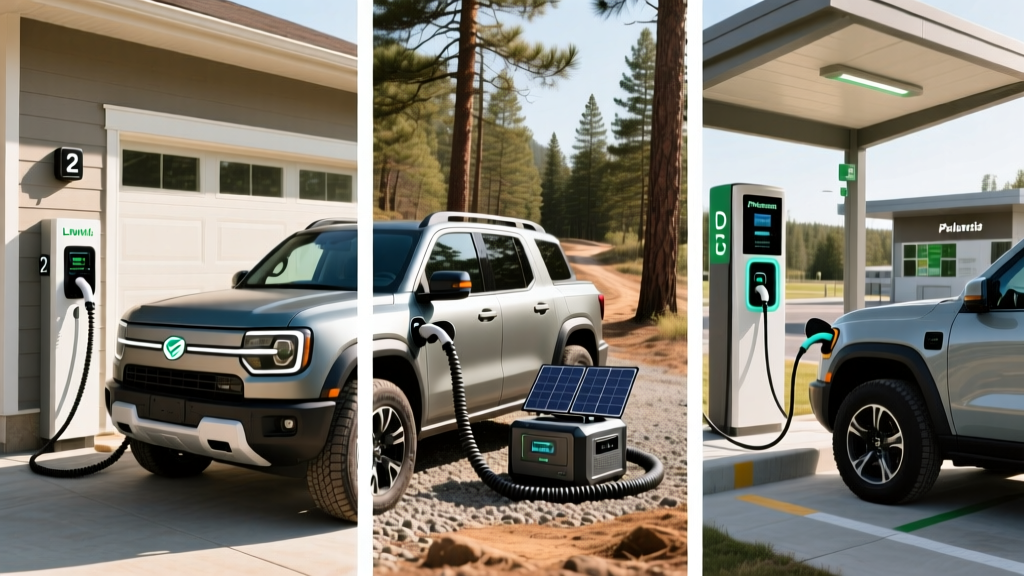
The Ranger XP Kinetic's lack of DC fast charging means trail-side top-ups rely on Level 1 or Level 2 AC infrastructure. Some practical options:
- Portable generator + Level 1: A 2,000W inverter generator can deliver ~1.4 kW to the Ranger via the included Level 1 cord — adding roughly 3–5 miles per hour of runtime. Useful for emergency range extension at remote job sites.
- Campground/RV park 240V outlets: Many RV parks have NEMA 14-50 outlets. With a portable Level 2 EVSE (like the Lectron V-Box or Emporia portable), you can charge at the Ranger's full 3.3 kW rate away from home.
- Worksite 240V outlets: Welder outlets or dryer outlets on job sites can serve as charging points with the right adapter.
Polaris has indicated interest in future accessories for extended range and charging flexibility. Check Polaris's official Ranger XP Kinetic page for the latest accessory announcements.
Frequently Asked Questions
How much does it cost to install a home EV charger for the Polaris Ranger?
Most homeowners pay $1,200–$1,800 total for a Level 2 installation (equipment, electrician labor, and permit). If your electrical panel needs a service upgrade from 100A to 200A, add $1,500–$4,000. Because the Ranger only needs ~3.3 kW, a simple 20-amp/240V circuit keeps costs on the lower end.
How fast will each charging level add range to the Electric Polaris Ranger?
Level 1 (120V) adds roughly 3–5 miles of range per hour. Level 2 (240V) adds roughly 8–12 miles per hour. The Ranger does not support DC fast charging, so public fast-charger networks like Electrify America or Tesla Superchargers are not usable.
Which connector and charger is compatible with my Electric Polaris Ranger?
The Ranger XP Kinetic uses a standard J1772 connector for AC charging. Any Level 1 or Level 2 J1772 charging station is compatible. NACS (Tesla), CCS1, and CHAdeMO connectors are not applicable because the Ranger has no DC fast-charge capability.
How much does charging cost per mile vs. gas for the Polaris Ranger?
Charging at home on an average US electricity rate ($0.17/kWh) costs roughly $0.07 per mile. The gas Ranger XP 1000 at 18 MPG and $3.40/gallon costs about $0.19 per mile. Off-peak utility rates can drop the electric cost to $0.04/mile — an 80% reduction.
What electrical upgrades might I need for a Ranger charger?
You need a dedicated 240V circuit with at least 20 amps of capacity. If your main panel is full or only has 100-amp service, you may need a panel upgrade ($1,500–$4,000). Most homes built after 1990 with 200-amp service can accommodate a Ranger charger without a panel upgrade. Always have a licensed electrician assess your panel before purchasing equipment.
Can I charge the Ranger XP Kinetic from a standard wall outlet?
Yes. The included Level 1 cord plugs into any standard 120V household outlet and will fully charge the 14.9 kWh base model in about 10 hours or the 29.8 kWh Premium/Ultimate in about 20 hours. It's slow but adequate if you drive less than 20 miles per day and can charge overnight.
Does the Electric Polaris Ranger qualify for the federal EV tax credit?
The §30D federal tax credit applies to on-road passenger vehicles meeting MSRP, income, and battery-sourcing requirements per IRS guidelines. Off-road utility vehicles like the Ranger XP Kinetic generally do not qualify for the §30D new clean vehicle credit. Consult a tax professional for your specific situation, and check whether your state offers separate incentives for off-road electric vehicles.
Key Takeaways for Electric Polaris Ranger Owners
- The Ranger XP Kinetic charges exclusively via AC (J1772) — no DC fast charging is available or needed for its use case.
- Level 2 at home is the sweet spot: a full charge of the 29.8 kWh pack takes ~10 hours, perfect for overnight.
- Installation typically costs $1,200–$1,800; panel upgrades are the main variable that pushes costs higher.
- Operating cost is 60–80% lower per mile than the gas Ranger, depending on your electricity rate.
- Any J1772 Level 2 station rated 16A or higher works — there's no need to overspend on a 48A unit for this vehicle alone.