The 2025 Porsche Macan Electric is a performance SUV that demands a charging strategy matching its capabilities. With an EPA-estimated range of up to 308 miles (Macan 4 Electric) and an 800-volt architecture enabling peak DC fast charging at 270 kW, this vehicle rewards owners who invest in proper home charging infrastructure. But maximizing that range — and minimizing charging costs — requires understanding the interplay between battery chemistry, charging levels, and your home's electrical capacity.
This guide covers everything from Level 2 home charger installation to public DC fast charging realities, with specific data for the Macan Electric's 100 kWh (usable) battery pack.
Understanding Electric Macan Range: EPA vs. Real-World
The Macan Electric lineup offers three trims with varying range:
- Macan Electric (base): 288 miles EPA, 335 hp, $78,800 MSRP
- Macan 4 Electric: 308 miles EPA, 402 hp, $84,900 MSRP
- Macan Turbo Electric: 284 miles EPA, 630 hp, $105,300 MSRP
EPA estimates assume mixed driving. Expect 250-270 miles on highway-only trips at 70+ mph, and 220-240 miles in cold weather (below 40°F) due to battery heating demands and reduced regenerative braking efficiency. The Macan's heat pump (standard) mitigates some cold-weather loss compared to resistive heating systems.
Range varies based on driving style, terrain, temperature, and accessory load. Porsche's 800V system prioritizes performance and charging speed over maximum efficiency, resulting in 2.8-3.0 kWh/mile consumption — respectable for a 5,200-lb performance SUV but higher than efficiency-focused rivals like the Tesla Model Y (3.5-3.8 kWh/mile).
Charging Levels Explained: Speed, Cost, and Use Cases
EV charging happens at three levels, each with distinct power delivery (measured in kilowatts, kW) and practical applications. Remember: kW measures charging power (speed), while kWh measures battery energy capacity. The Macan Electric's battery holds 100 kWh usable energy.
| Level | Power (kW) | Voltage/Amps | Miles Added/Hour | 0-100% Time | Best Use Case |
|---|---|---|---|---|---|
| Level 1 | 1.4-1.9 kW | 120V / 12-16A | 4-6 miles | 50-70 hours | Emergency/trickle only |
| Level 2 | 7.2-19.2 kW | 240V / 30-80A | 22-58 miles | 5-14 hours | Daily home charging |
| DC Fast | 50-270 kW | 400-800V DC | 150-800+ miles | 21 min (10-80%) | Road trips, quick top-ups |
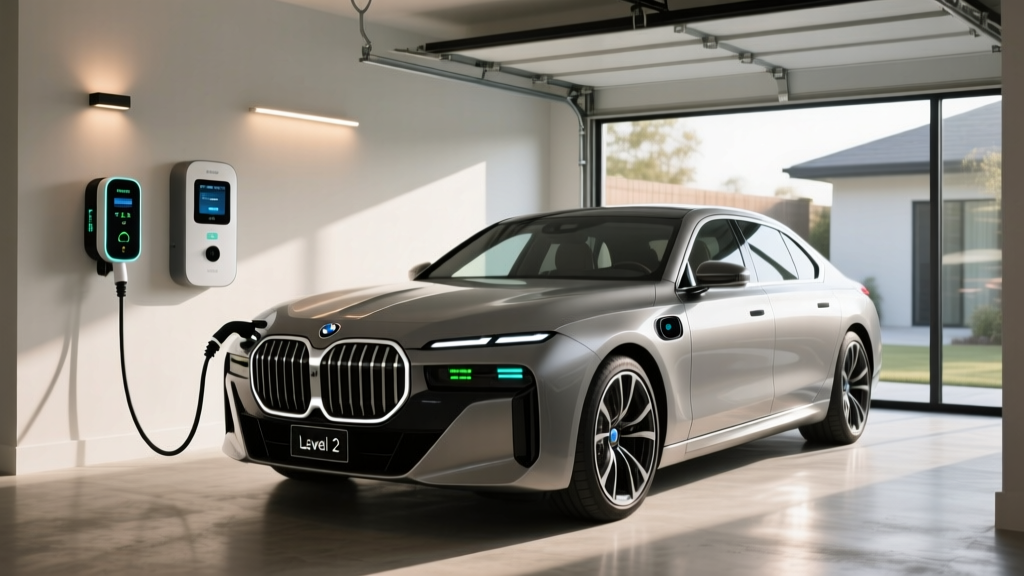
The Macan Electric's onboard charger accepts up to 11 kW on Level 2 (standard) or 22 kW (optional upgrade). At 11 kW, a full charge takes roughly 10 hours; at 22 kW, about 5 hours. Most homes install 40A or 48A circuits, delivering 9.6-11.5 kW — sufficient for overnight charging.
Home Charger Installation: Requirements, Costs, and Gotchas
Installing a Level 2 home charger is the single most impactful upgrade for EV ownership. For the Macan Electric, a properly sized Level 2 unit ensures you wake up to a full battery daily, eliminating range anxiety and public charging dependence.
Electrical Requirements
A Level 2 charger requires a dedicated 240V circuit, similar to an electric dryer or oven. Common configurations:
- 40A circuit: Delivers 9.6 kW (continuous 32A draw). Adequate for overnight charging.
- 48A circuit: Delivers 11.5 kW. Matches the Macan's standard 11 kW onboard charger.
- 60A circuit: Delivers 14.4 kW. Future-proofs for higher-power onboard chargers or dual-EV households.
- 80A circuit: Delivers 19.2 kW. Requires the Macan's optional 22 kW onboard charger and significant panel capacity.
Panel Upgrade Reality Check
Many homes built before 2000 have 100A or 150A electrical panels. Adding a 48A EV circuit may require a panel upgrade to 200A — a $1,500-$3,000 expense. Signs you might need an upgrade:
- Existing panel is 100A or 150A
- Panel has no available breaker slots
- Home already runs high-draw appliances (electric heat, hot tub, double oven)
- Utility service drop is undersized
Some utilities offer "make-ready" programs covering panel upgrades for EV adoption. Check with your provider before assuming full cost.
Installation Cost Breakdown
| Component | Cost Range | Notes |
|---|---|---|
| Level 2 Charger Hardware | $400-$1,200 | Smart chargers with WiFi/app control cost more |
| Electrician Labor | $800-$2,500 | Varies by region, circuit length, and complexity |
| Permit & Inspection | $100-$400 | Required in most jurisdictions; ensures code compliance |
| Panel Upgrade (if needed) | $1,500-$3,000 | 200A upgrade; not always required |
| Total (no panel upgrade) | $1,300-$4,100 | Most installations fall in $2,000-$3,000 range |
| Total (with panel upgrade) | $2,800-$7,100 | Older homes or high-load situations |
Equipment Recommendations
ChargePoint Home Flex
- Power: Up to 12 kW (50A circuit) or 19.2 kW (80A circuit)
- Connector: J1772 (CCS-compatible); NACS adapter available
- Cable Length: 23 feet
- Smart Features: WiFi, app scheduling, energy tracking, Alexa integration
- Price: $699 (12 kW version)
- Best For: Flexibility across amperage; excellent app
Tesla Wall Connector
- Power: Up to 11.5 kW (48A circuit) or 19.2 kW (80A circuit)
- Connector: NACS (Tesla native); J1772 adapter included
- Cable Length: 24 feet
- Smart Features: WiFi, power sharing (multiple units), OTA updates
- Price: $475
- Best For: Tesla owners or those planning NACS adoption; cost-effective
Emporia Level 2 EV Charger
- Power: Up to 11.5 kW (48A circuit)
- Connector: J1772
- Cable Length: 24 feet
- Smart Features: WiFi, app control, solar integration, load management
- Price: $399
- Best For: Budget-conscious buyers; solar panel owners
For the Macan Electric (which uses CCS1 in North America for 2025 models), any J1772 charger works natively. Porsche has announced NACS adoption for 2026+ models, but current owners can use a CCS-to-NACS adapter ($200-$300) at Tesla Superchargers if needed.
Connector Compatibility: NACS, CCS1, and Adapters
The EV charging landscape is consolidating around two primary connectors in North America:
| Connector | Brands Using (2025) | DC Fast Charge Availability | Adapter Needed for Macan? |
|---|---|---|---|
| CCS1 (Combined Charging System) | Porsche, VW, BMW, GM, Ford (legacy), Hyundai/Kia | Electrify America, EVgo, ChargePoint, Ionity | None (native) |
| NACS (North American Charging Standard) | Tesla, Ford (2025+), GM (2025+), Rivian, Volvo, Polestar | Tesla Supercharger network (17,000+ stalls) | CCS-to-NACS adapter (~$250) |
| CHAdeMO | Nissan Leaf (discontinued), Mitsubishi (legacy) | Limited; mostly legacy stations | Not recommended |
The 2025 Macan Electric uses CCS1 natively. Porsche has confirmed NACS adoption starting with 2026 models. Current Macan owners can purchase a third-party CCS-to-NACS adapter (e.g., Lectron, A2Z) to access Tesla Superchargers, though charging speed may be limited to 150 kW on some adapter models.
Public DC Fast Charging: Speeds, Costs, and Curve Reality
The Macan Electric's 800V architecture enables peak DC fast charging at 270 kW — but only under ideal conditions. Understanding the charging curve prevents unrealistic expectations.
Charging Curve Explained
DC fast charging follows a taper curve, not a flat rate:
- 10-20% SoC: Peak 270 kW (if battery is preconditioned and ambient temp is 60-80°F)
- 20-60% SoC: Sustained 200-250 kW
- 60-80% SoC: Tapers to 150-180 kW
- 80-100% SoC: Drops to 50-80 kW (battery protection mode)
DC Fast Charging Costs
Public DC fast charging costs vary dramatically by network and location:
- Electrify America: $0.43-$0.56/kWh (guest rate); $0.36-$0.48/kWh (Pass+ membership, $4/month)
- EVgo: $0.40-$0.52/kWh (guest); $0.34-$0.46/kWh (Plus plan)
- Tesla Supercharger (with adapter): $0.28-$0.40/kWh (varies by location and time-of-use)
At $0.45/kWh average, fully charging the Macan's 100 kWh battery costs $45 — yielding 2.8-3.0 kWh/mile efficiency, or roughly $0.13-$0.15 per mile. Compare this to a gas SUV averaging 22 MPG at $3.50/gallon: $0.16 per mile. DC fast charging narrows the cost advantage, but home charging restores it dramatically.
Cost to Charge: Home vs. Public vs. Gas
| Scenario | Cost per kWh | Cost for Full Charge (100 kWh) | Cost per Mile (3.0 kWh/mi) | Annual Cost (12,000 mi) |
|---|---|---|---|---|
| Home Charging (national avg) | $0.16/kWh | $16.00 | $0.048 | $576 |
| Home Off-Peak (TOU rate) | $0.09/kWh | $9.00 | $0.027 | $324 |
| Public DC Fast (avg) | $0.45/kWh | $45.00 | $0.135 | $1,620 |
| Gas SUV (22 MPG, $3.50/gal) | N/A | N/A | $0.159 | $1,909 |
Home charging on a time-of-use (TOU) rate plan — charging overnight when demand is low — delivers the lowest cost per mile. Many utilities offer EV-specific TOU rates; contact yours to enroll. Even at standard residential rates, home charging costs 60-70% less than gasoline per mile.
Safety, Code Compliance, and Best Practices
EV charger installation must comply with the National Electrical Code (NEC) and local amendments. Key requirements:
- Dedicated Circuit: EV chargers require a dedicated breaker — no sharing with other appliances.
- GFCI Protection: NEC 2020 and later requires ground-fault circuit interrupter protection for outdoor outlets and some indoor installations.
- Outdoor Rating: If installing outside, the charger must be NEMA 4-rated (weatherproof) or housed in a protective enclosure.
- Cable Management: Use a holster or reel to prevent tripping hazards and cable damage.
- Permit & Inspection: Most jurisdictions require an electrical permit and final inspection. Skipping this risks insurance claim denials and code violations.
Always hire a licensed electrician familiar with EV charger installations. Ask for references and verify they understand load calculations, NEC Article 625 (EV charging), and your utility's interconnection requirements.
Frequently Asked Questions
How much does it cost to install a home EV charger for the Macan Electric?
Typical installation ranges from $1,300-$4,100 without a panel upgrade, and $2,800-$7,100 if your home needs a 200A panel upgrade. Most homeowners spend $2,000-$3,000 for a 48A circuit with a smart charger like the ChargePoint Home Flex or Tesla Wall Connector.
How fast will each charging level add range to the Macan Electric?
Level 1 (120V) adds 4-6 miles per hour — impractical for daily use. Level 2 (240V, 48A) adds 35-40 miles per hour, fully charging overnight. DC fast charging adds 150-800+ miles per hour depending on state of charge, with 10-80% taking 21-26 minutes at a 350 kW station.
Which connector is compatible with the 2025 Macan Electric?
The 2025 Macan Electric uses CCS1 natively for both Level 2 and DC fast charging. It can charge at any J1772 Level 2 station (CCS includes J1772) and any CCS-equipped DC fast charger (Electrify America, EVgo, etc.). For Tesla Supercharger access, purchase a CCS-to-NACS adapter ($200-$300).
How much does charging the Macan Electric cost per mile vs. a gas SUV?
Home charging costs $0.03-$0.05 per mile (depending on your electricity rate), while public DC fast charging costs $0.12-$0.15 per mile. A comparable gas SUV (22 MPG, $3.50/gallon) costs $0.16 per mile. Home charging delivers 65-80% savings vs. gasoline.
What electrical upgrades might I need for a Level 2 charger?
If your home has a 100A or 150A electrical panel, you may need a 200A panel upgrade ($1,500-$3,000). Homes with 200A panels typically have sufficient capacity for a 48A EV circuit. An electrician will perform a load calculation to determine if an upgrade is necessary.
Does the Macan Electric qualify for the federal EV tax credit?
As of 2025, the Macan Electric does not qualify for the $7,500 federal tax credit under IRS §30D rules due to battery sourcing requirements and the vehicle's MSRP exceeding the $80,000 SUV cap (base model is $78,800, but destination charges push it over). Always verify current eligibility at IRS.gov, as rules change frequently.
How does cold weather affect the Macan Electric's range and charging speed?
In temperatures below 40°F, expect 15-25% range reduction (220-260 miles instead of 288-308). DC fast charging also slows in cold weather unless the battery is preconditioned. Use the Macan's "preconditioning" feature (via the app or navigation) to warm the battery before arriving at a charger — this can shave 5-10 minutes off charge time.
Final Recommendations for Macan Electric Owners
The Porsche Macan Electric rewards proper charging infrastructure with effortless daily driving and road-trip capability. Prioritize a 48A or 60A Level 2 home installation to unlock overnight charging convenience and minimize public charging dependence. On road trips, leverage the 800V architecture at Electrify America or other 350 kW-capable stations, but plan for 25-minute stops (not the marketing-claimed 21) and avoid charging above 80% unless necessary.
For detailed EPA range and efficiency data, consult fueleconomy.gov. For tax credit eligibility, always verify at IRS.gov before purchase.