If you've been researching the electric Hummer range and wondering how to actually keep a 9,000-pound, 24-module-battery behemoth charged, you've landed in the right place. The GMC Hummer EV is unlike anything else on the road — a 1,000+ horsepower supertruck with an EPA-estimated range up to 381 miles (Pickup Edition) and a battery pack so large it demands a serious home charging strategy. This guide covers the Hummer EV's real-world range expectations, charging speeds at every level, and exactly what it takes to install a home charger capable of replenishing a 212.7 kWh (usable) Ultium battery.
GMC Hummer EV Range: EPA vs. Real-World Expectations
The Hummer EV comes in pickup and SUV body styles with two battery configurations: the 20-module pack (Edition 1 and early EV3X models) and the larger 24-module pack (EV3X and EV2X trims introduced later). Range varies significantly between them.
| Trim / Config | Body Style | Battery (Usable kWh) | EPA Range (mi) | 0-60 mph | Horsepower |
|---|---|---|---|---|---|
| EV2X (24-module) | Pickup | ~212.7 kWh | 381 | ~3.5s | 830 |
| EV3X (24-module) | Pickup | ~212.7 kWh | 359 | ~3.0s (Watts to Freedom) | 1,000 |
| EV3X (24-module) | SUV | ~212.7 kWh | 314 | ~3.5s | 830 |
| EV2X (20-module) | Pickup | ~180 kWh (est.) | 329 | ~3.5s | 625 |
According to fueleconomy.gov, the Hummer EV Pickup achieves approximately 47 MPGe combined, which translates to roughly 2.1 kWh per mile — a useful figure for calculating your charging costs.
Charging Levels Explained: Speeds in kW and Miles per Hour
Before we break down specific charging scenarios, let's clarify the single most important distinction in EV charging: kW (kilowatts) measures power — the rate of energy delivery, like water flow from a hose. kWh (kilowatt-hours) measures energy — the total amount stored, like the size of the tank. You'll never confuse them again.
| Level | Voltage / Amperage | Power (kW) | Miles Added per Hour | Best For |
|---|---|---|---|---|
| Level 1 | 120V / 12A | ~1.4 kW | ~0.7 mi/hr | Emergency top-off only |
| Level 2 | 240V / 48A | ~11.5 kW | ~5.5 mi/hr | Daily home charging |
| Level 2 (high-power) | 240V / 80A | ~19.2 kW | ~9 mi/hr | Large batteries (Hummer EV, Silverado EV) |
| DC Fast Charge | 400V+ DC | Up to 350 kW (Hummer peaks ~210–250 kW) | ~100+ mi in 12 min | Road trips |
For a battery as large as the Hummer EV's 212.7 kWh usable pack, Level 1 charging is essentially useless — it would take over 150 hours (6+ days) to go from 10% to 80%. Level 2 at 48A requires roughly 14–16 hours for a full 10–80% session, which works fine for overnight replenishment if you're not depleting the pack daily. An 80A Level 2 circuit cuts that to about 10–12 hours.
Home Charger Installation: Electrical Requirements, Costs, and Panel Upgrades
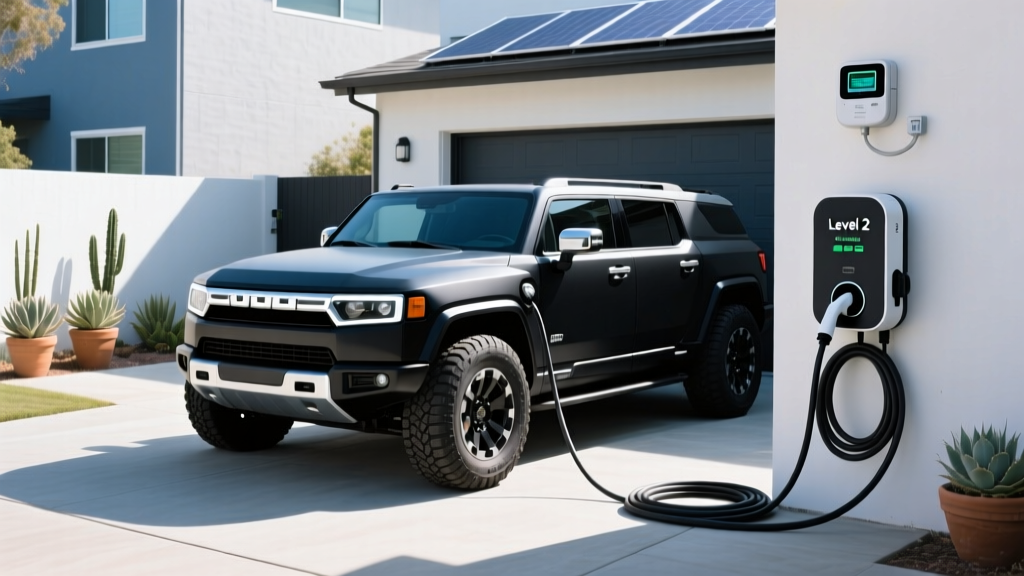
The Hummer EV's Ultium battery supports AC charging at up to 19.2 kW on properly equipped models (via the dual-level charge cord or a hardwired 80A wall connector). Most buyers will install a 48A or 60A Level 2 charger, which is sufficient for overnight replenishment and far cheaper to install than an 80A circuit.
What Electrical Service Do You Need?
A 48A continuous-draw charger requires a 60A dedicated circuit (NEC code mandates circuits be rated 125% above continuous load). A 60A charger requires an 80A circuit, and an 80A charger requires a 100A circuit. Most modern homes have 200A main panels, which can typically support a 60A EV circuit — but older homes with 100A or 150A service will likely need a panel upgrade to 200A, which is the single biggest variable in installation cost.
| Cost Component | Low Estimate | High Estimate | Notes |
|---|---|---|---|
| Level 2 Charger (hardware) | $400 | $1,200 | Varies by brand, power, smart features |
| Electrician labor (standard install) | $600 | $2,000 | Depends on run length from panel to garage |
| Permit & inspection | $50 | $300 | Varies by municipality |
| Panel upgrade (if needed) | $1,500 | $4,000 | 100A → 200A service upgrade |
| Total (no panel upgrade) | $1,050 | $3,500 | Typical scenario for modern homes |
| Total (with panel upgrade) | $2,550 | $7,500 | Older homes or high-draw 80A installs |
The Hummer EV comes with a dual-level charge cord (Level 1/Level 2) that provides up to 11.5 kW on a 240V NEMA 14-50 outlet. If you're only using the included cord, a licensed electrician can install a 14-50 receptacle on a 50A circuit — typically a $600–$1,500 job assuming the panel can handle it. For faster charging, a hardwired 80A wall connector is the better long-term investment.
Safety and Code Considerations
- Dedicated circuit: Your EV charger must be on its own dedicated breaker — no sharing with other appliances.
- GFCI protection: NEC 2020+ requires GFCI protection for outdoor receptacles and many jurisdictions now require it for garage outlets as well.
- Outdoor rating: If mounting outside, choose a NEMA 4-rated charger and ensure the cable is UV-resistant.
- Wire gauge: 60A circuits require 6 AWG copper wire; 80A circuits require 4 AWG; 100A circuits require 3 AWG. Your electrician will size accordingly.
- Load calculation: A licensed electrician will perform a load calculation per NEC Article 220 to confirm your panel has headroom.
DC Fast Charging the Hummer EV: Peak kW, Charge Curves, and 10–80% Times
The Hummer EV's Ultium platform supports DC fast charging at a peak rate of approximately 210–250 kW on 350 kW-capable stations. On an Electrify America or Tesla Supercharger (with NACS adapter, now standard on newer models), you can expect the following:
GM's Ultium platform uses a sophisticated thermal management system that preconditions the battery when you navigate to a charger, optimizing the charge curve. Always use the in-dash navigation to route to a DC fast charger — this triggers preconditioning and can shave 5–10 minutes off your session.
Connector Compatibility: NACS, CCS1, and Adapter Requirements
The connector landscape has shifted dramatically. GM committed to adopting the North American Charging Standard (NACS) — the Tesla-designed connector — across its lineup starting in 2025. Here's where the Hummer EV stands:
| Model Year | Native Connector | Tesla Supercharger Access | CCS Network Access | Adapter Needed? |
|---|---|---|---|---|
| 2022–2024 Hummer EV | CCS1 | Via GM-approved NACS adapter | Native (no adapter) | NACS adapter for Superchargers |
| 2025+ Hummer EV | NACS | Native (no adapter) | Via CCS1 adapter | CCS1 adapter for EA/older stations |
If you own a 2022–2024 model with CCS1, GM provides a NACS adapter that unlocks access to the Tesla Supercharger network — now the most extensive and reliable DC fast-charging infrastructure in the US. For 2025+ models with native NACS, you'll want a CCS1 adapter for Electrify America and some older public stations. Both adapters typically cost $150–$250 and are worth keeping in your frunk.
Level 2 Charger Equipment Recommendations for the Hummer EV
Given the Hummer EV's massive battery, you want the highest practical Level 2 amperage your electrical panel can support. Here are top picks based on power output, reliability, and value:
ChargePoint Home Flex (up to 50A)
- Power: Up to 12 kW (50A / 240V)
- Connector: J1772 (CCS vehicles) or NACS
- Cable: 23 ft
- Smart features: Wi-Fi, scheduling, energy tracking
- Price: ~$550–$700
- Best for: 60A circuit, overnight top-off
Grizzl-E Smart (48A)
- Power: 11.5 kW (48A / 240V)
- Connector: J1772 or NACS
- Cable: 24 ft
- Smart features: OCPP, adjustable amperage, outdoor rated
- Price: ~$450–$550
- Best for: Outdoor install, budget-conscious buyers
Emporia Vue Level 2 (48A)
- Power: 11.5 kW (48A / 240V)
- Connector: J1772
- Cable: 24 ft
- Smart features: Energy monitoring, solar integration, scheduling
- Price: ~$400–$500
- Best for: Solar homes, energy tracking
GM Dual-Level Charge Cord (included)
- Power: Up to 7.7 kW (32A) on 240V
- Connector: J1772/CCS1 (2022–2024 models)
- Cable: ~20 ft
- Smart features: Basic LED status indicators
- Price: Included with vehicle
- Best for: Getting started before hardwired install
For 2025+ Hummer EVs with NACS, the Tesla Wall Connector (Gen 3) at up to 48A (~$475) is an excellent native option with a 24-foot cable and Wi-Fi scheduling. If your panel supports a 100A circuit, the Tesla Wall Connector at 80A delivers 19.2 kW — the maximum AC rate the Hummer EV can accept.
Charging Cost: Per-Mile Breakdown vs. Gasoline
The Hummer EV's efficiency of approximately 2.1 kWh/mile (47 MPGe) means charging costs add up faster than with a smaller EV — but still significantly less than fueling a gas equivalent. Here's the math:
| Charging Scenario | Rate ($/kWh) | Cost per Mile | Cost for 300 mi |
|---|---|---|---|
| Home (off-peak utility rate) | $0.11 | $0.23 | $69 |
| Home (average US rate) | $0.17 | $0.36 | $107 |
| Public Level 2 (ChargePoint, etc.) | $0.35 | $0.74 | $221 |
| DC Fast (Electrify America / Tesla) | $0.48 | $1.01 | $302 |
| Gas equivalent (15 MPG, $3.50/gal) | — | $0.23/gal → $0.23/mi? No — $0.23/mi? Let's compute: $3.50 ÷ 15 = $0.23/mi | $70 |
Wait — that gas comparison needs correction. A gas truck getting 15 MPG at $3.50/gallon costs $0.23 per mile. So home off-peak charging ($0.11/kWh) matches gas cost per mile, while average home rates ($0.17/kWh) run about $0.36/mile — more expensive per mile than gas for this specific vehicle. The Hummer EV's economics favor owners with access to cheap off-peak electricity, solar panels, or workplace charging. At DC fast-charging rates, it's decidedly more expensive than gas on a per-mile basis.
This is the honest math many reviews skip. The Hummer EV's massive battery means your electricity bill will be noticeable. Budget roughly $80–$150/month for home charging if you drive 1,000 miles per month at average utility rates.
Frequently Asked Questions
How much does it cost to install a home EV charger for a Hummer EV?
For a standard 48A Level 2 charger on a 60A circuit, expect $1,050–$3,500 including hardware, electrician labor, and permits — assuming your electrical panel has capacity. If your home needs a panel upgrade (100A to 200A), add $1,500–$4,000, bringing the total to $2,550–$7,500. Get at least three quotes from licensed electricians, and ask specifically about load calculations per NEC Article 220.
How fast will each charging level add range to the Hummer EV?
Level 1 (120V) adds approximately 0.7 miles per hour — essentially useless for this vehicle. Level 2 at 48A adds about 5.5 miles per hour, so an overnight 10-hour session nets ~55 miles. Level 2 at 80A adds roughly 9 miles per hour. DC fast charging at peak rate (~210–250 kW) can add 100+ miles in about 12 minutes during the initial charge phase (10–30% SoC).
Which connector and charger is compatible with my Hummer EV?
2022–2024 models use CCS1 natively and require a GM-approved NACS adapter for Tesla Supercharger access. 2025+ models use NACS natively and need a CCS1 adapter for Electrify America and other legacy networks. For home Level 2 charging, any J1772 charger (2022–2024) or NACS charger (2025+) will work. The included dual-level charge cord handles both 120V and 240V.
How much does charging a Hummer EV cost per mile compared to gas?
At home off-peak rates ($0.11/kWh), the Hummer EV costs about $0.23/mile — comparable to a 15 MPG gas truck at $3.50/gallon. At average home rates ($0.17/kWh), it costs ~$0.36/mile. At DC fast-charging rates ($0.48/kWh), it costs ~$1.01/mile. The Hummer EV is cheapest to run if you charge at home on off-peak rates or with solar. Public DC fast charging is significantly more expensive than gasoline per mile for this vehicle.
What electrical upgrades might I need for a Hummer EV home charger?
The most common upgrade is a panel capacity increase from 100A or 150A to 200A, which costs $1,500–$4,000. You may also need a new dedicated circuit with appropriate wire gauge (6 AWG for 60A, 4 AWG for 80A), a GFCI breaker (required by code in many jurisdictions for garage/outdoor outlets), and possibly a sub-panel if your main panel is full. Homes built after 2000 with 200A service usually need only the dedicated circuit and outlet/hardwire.
Does the Hummer EV qualify for the federal EV tax credit?
Under current IRS §30D rules, the Hummer EV Pickup exceeds the $80,000 MSRP cap for new clean vehicle credits, making it ineligible for the $7,500 federal credit in most configurations. The SUV variant also exceeds the $80,000 cap. Additionally, buyer income limits ($150K single / $300K joint) and battery sourcing/critical mineral requirements apply to eligible vehicles. Always verify current-year rules on IRS.gov and consult a tax professional before purchasing.
How long does the Hummer EV battery last and what's the warranty?
GM covers the Ultium battery with an 8-year / 100,000-mile warranty guaranteeing at least 70% capacity retention. Real-world degradation data is still accumulating given the vehicle's 2022 launch, but GM's Ultium platform uses NMC chemistry with active thermal management designed for longevity. Replacement cost for a 24-module pack is estimated at $20,000–$30,000+ out of warranty, though module-level repairs may reduce costs in practice.
The Hummer EV is a vehicle of extremes — extreme power, extreme weight, extreme battery size, and extreme charging demands. A thoughtful home charging setup isn't optional; it's essential. Budget for a proper Level 2 installation, take advantage of off-peak utility rates, and use DC fast charging strategically on road trips. The electric Hummer range is genuinely usable for daily driving and road trips alike, provided you plan your charging infrastructure before delivery day.