What You Need to Charge an Electric Ford Ranger at Home and on the Road
The electric Ford Ranger — Ford's anticipated midsize electric pickup built on the next-generation EV platform — promises the utility truck buyers demand with the efficiency of battery-electric propulsion. But owning any electric truck hinges on one practical question: how will you charge it? A large battery pack (estimated 85–100 kWh usable based on Ford's EV architecture) means Level 1 charging from a standard wall outlet will take days, making a proper Level 2 home setup essential for daily use.
This guide walks through every charging scenario for the electric Ford Ranger: what each level delivers, what your home electrical system needs, which connectors you'll encounter, how much charging actually costs per mile, and which equipment earns our recommendation for truck owners who need reliability and speed.
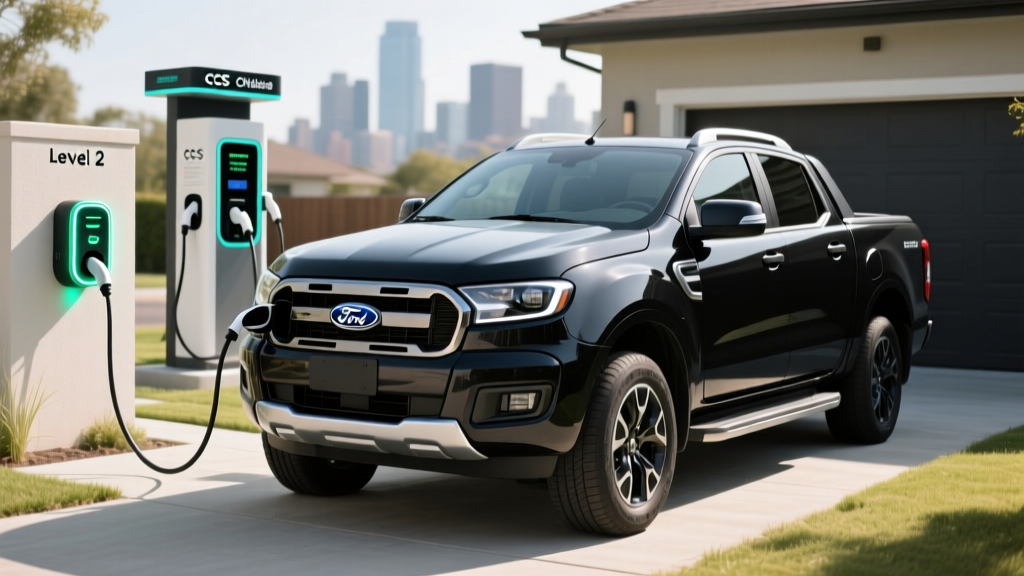
Charging Levels Explained: Speeds, Range Added, and When to Use Each
There are three charging tiers available to electric Ford Ranger owners. Each serves a different purpose, and understanding the real-world math behind them prevents unpleasant surprises.
| Level | Voltage / Amps | Power Output (kW) | Miles of Range Added Per Hour | Best Use Case |
|---|---|---|---|---|
| Level 1 | 120V / 12A | ~1.4 kW | 3–5 mi/hr | Emergency top-ups, overnight trickle |
| Level 2 (Home) | 240V / 32–48A | 7.7–11.5 kW | 22–35 mi/hr | Daily home charging, overnight full charge |
| Level 2 (Public) | 240V / 40–80A | 9.6–19.2 kW | 28–55 mi/hr | Workplace, shopping centers, hotels |
| DC Fast Charging | 400–800V DC | 50–250+ kW | 150–500+ mi/hr (peak) | Road trips, highway corridors |
Real-world context for the electric Ford Ranger: Assuming a ~95 kWh usable battery and ~2.5 mi/kWh efficiency (typical for a midsize electric pickup), a full Level 1 charge from 10% would take roughly 60+ hours — essentially impractical as a primary charging method. A 48A Level 2 home charger delivering 11.5 kW can replenish that same battery in approximately 8–9 hours, ideal for overnight charging. On a DC fast charger rated at 175+ kW, you can expect a 10–80% charge in roughly 30–40 minutes, though the charge curve tapers significantly above 80% State of Charge (SoC) to protect battery health.
Home Charger Installation: Electrical Requirements, Costs, and Panel Upgrades
Installing a Level 2 home charger is the single most impactful upgrade an electric Ford Ranger owner can make. But costs vary dramatically based on your home's existing electrical infrastructure.
Electrical Requirements for Level 2 Charging
A Level 2 charger requires a dedicated 240V circuit — the same voltage as your electric dryer or oven. The most common configurations:
- 32A circuit (7.7 kW): Requires a 40A breaker (NEC code mandates 125% overhead for continuous loads). Sufficient for most daily driving under 60 miles.
- 40A circuit (9.6 kW): Requires a 50A breaker. The sweet spot for most EV owners — balances charge speed with panel capacity.
- 48A circuit (11.5 kW): Requires a 60A breaker. Ideal for large-battery trucks like the electric Ranger that benefit from faster overnight replenishment.
Panel upgrade reality: Many homes built before 2000 have 100A or 150A main panels that may already be near capacity. Adding a 50–60A EV circuit could require a panel upgrade to 200A, which is a significant additional cost. Have a licensed electrician perform a load calculation before committing to a charger amperage.
| Cost Component | Low Estimate | High Estimate | Notes |
|---|---|---|---|
| Level 2 Charger (Equipment) | $350 | $750 | Hardwired or NEMA 14-50 plug; smart WiFi models cost more |
| Electrician Labor (standard install) | $500 | $1,500 | Depends on distance from panel to garage; conduit runs add cost |
| Permit & Inspection | $50 | $300 | Required in most jurisdictions; varies by municipality |
| Electrical Panel Upgrade (if needed) | $1,500 | $4,000 | 200A service upgrade for older homes with insufficient capacity |
| Additional Materials (conduit, wiring, GFCI) | $100 | $500 | Long wire runs or outdoor installations increase material costs |
| Total (no panel upgrade) | $1,000 | $3,050 | Most homeowners fall in the $1,200–$2,000 range |
| Total (with panel upgrade) | $2,500 | $7,050 | Older homes may require this investment |
Pro tip: Some utilities offer rebates of $250–$1,000 for Level 2 charger installation, particularly if you agree to off-peak charging schedules. Check with your local utility before scheduling the install. The federal Alternative Fuel Vehicle Refueling Property Credit (IRS Form 8911) may cover up to 30% of home charging equipment and installation costs (capped at $1,000), subject to income and census-tract eligibility — consult a tax professional for your specific situation.
Connector Compatibility: NACS, CCS1, and What the Electric Ranger Uses
Ford made a decisive move in 2023 by adopting the North American Charging Standard (NACS) — originally developed by Tesla — for all new EVs starting with the 2025 model year. The electric Ford Ranger is expected to ship with a native NACS charge port, giving it direct access to Tesla's Supercharger network (the largest and most reliable DC fast-charging network in North America) without an adapter.
| Connector Type | Used By | DC Fast Charge Max | Adapter Needed for Electric Ranger? |
|---|---|---|---|
| NACS (Tesla) | Tesla (all years), Ford (2025+), GM (2025+), Rivian (2025+), many others | Up to 350+ kW | No — native port (expected) |
| CCS1 (Combined Charging System) | Legacy non-Tesla EVs (Hyundai, VW, BMW pre-2025) | Up to 350 kW | Yes — NACS-to-CCS adapter for CCS stations |
| CHAdeMO | Nissan Leaf, Mitsubishi (legacy/discontinued) | Up to 100 kW | Not recommended — network is shrinking |
Practical adapter strategy: While the electric Ranger's native NACS port covers Tesla Superchargers and the growing number of NACS-equipped public stations, you'll still encounter CCS1 connectors at Electrify America, EVgo, and other legacy networks. Ford provides a NACS-to-CCS adapter (or offers one as an accessory) — keep it in the truck at all times. The CCS-to-NACS adapter typically supports up to 250 kW DC throughput, which covers virtually all public fast chargers currently deployed.
Cost to Charge: Home vs. Public vs. Gas — The Per-Mile Math
The economic case for the electric Ford Ranger depends heavily on where and when you charge. Here's the realistic cost breakdown for 2026.
| Scenario | Rate | Cost for 95 kWh Fill | Cost Per Mile (est. 2.5 mi/kWh) |
|---|---|---|---|
| Home — Off-Peak (utility TOU rate) | $0.08–$0.12/kWh | $7.60–$11.40 | $0.03–$0.05/mi |
| Home — Standard Rate (national avg.) | $0.16/kWh | $15.20 | $0.06/mi |
| Public Level 2 (ChargePoint, workplace) | $0.20–$0.35/kWh | $19.00–$33.25 | $0.08–$0.13/mi |
| DC Fast Charging (Electrify America, EVgo) | $0.35–$0.55/kWh | $33.25–$52.25 | $0.13–$0.21/mi |
| Tesla Supercharger (average 2026) | $0.28–$0.40/kWh | $26.60–$38.00 | $0.11–$0.15/mi |
| Gas Equivalent (25 MPG combined, $3.40/gal) | — | $12.92 (equivalent energy) | $0.14/mi |
The bottom line: Home off-peak charging makes the electric Ranger roughly 65–75% cheaper per mile than a comparable gas-powered Ranger. Even public DC fast charging is cost-competitive with gasoline on a per-mile basis, though the savings shrink considerably. If you can install a Level 2 charger at home and use time-of-use (TOU) rates, the annual fuel savings for a driver covering 15,000 miles/year can reach $1,200–$1,800 compared to the gas Ranger.
Charging Time Examples: What to Expect with a ~95 kWh Battery
Charging times depend on the battery's state of charge, ambient temperature, and the charger's actual sustained output — not just its peak rating. The charge curve tapers significantly above 80% SoC to protect battery longevity, and cold batteries accept charge more slowly until preconditioned.
| Charging Scenario | 10–80% Time (est.) | Notes |
|---|---|---|
| Level 1 (120V / 1.4 kW) | ~48 hours | Emergency use only; not viable as primary method |
| Level 2 Home (240V / 48A / 11.5 kW) | ~6 hours | Ideal overnight charge; wake up to full battery daily |
| Level 2 Public (240V / 80A / 19.2 kW) | ~3.5 hours | Useful at workplace or during extended shopping stops |
| DC Fast (175 kW peak, sustained ~120 kW avg) | ~35–40 minutes | Road-trip charging; precondition battery via nav for best speeds |
| DC Fast (250+ kW peak, sustained ~160 kW avg) | ~28–32 minutes | Requires V3/V4 Supercharger or equivalent CCS station |
Recommended Level 2 Home Chargers for the Electric Ford Ranger
Not all Level 2 chargers are equal. For a large-battery electric truck, you need reliable high-amperage output, a long cable for truck-length reach, and smart features for off-peak scheduling. Here are our top picks for Ranger owners:
1. ChargePoint Home Flex (NACS)
- Power Output: Up to 11.5 kW (48A) on a 60A circuit; adjustable down to 16A for smaller circuits
- Connector: Native NACS (also available in J1772 with adapter)
- Cable Length: 23 feet — sufficient for most garage truck parking configurations
- Smart Features: WiFi-connected, app-based scheduling for TOU rates, Alexa integration, energy tracking
- Price: ~$550–$650
- Why it works for the Ranger: Flexible amperage settings let you match your panel's capacity without overspending on electrical upgrades.
2. Tesla Wall Connector (NACS)
- Power Output: Up to 11.5 kW (48A) on a 60A circuit
- Connector: Native NACS — no adapter needed for the electric Ranger
- Cable Length: 24 feet
- Smart Features: WiFi firmware updates, load sharing (two units on one circuit), power-sharing for multi-EV households
- Price: ~$475
- Why it works for the Ranger: Best value in the NACS ecosystem. Seamless Supercharger integration and proven reliability. Load sharing is ideal if you also own a second EV.
3. Emporia Level 2 EV Charger
- Power Output: Up to 11.5 kW (48A) on a 60A circuit
- Connector: J1772 (NACS adapter included) or native NACS version
- Cable Length: 24 feet
- Smart Features: Deep energy monitoring (pairs with Emporia home energy monitor), solar-aware charging, TOU scheduling, load management
- Price: ~$400–$500
- Why it works for the Ranger: Best option for homes with solar panels — charge directly from excess solar production. The energy monitoring provides granular cost tracking.
Safety, Code, and Installation Best Practices
EV charging involves sustained high-current draw — hours at a time, every day. Cutting corners on installation creates fire risk and may void your homeowner's insurance. Here's what code and common sense require:
- Dedicated circuit: Your Level 2 charger must have its own dedicated breaker — never share a circuit with other appliances. The NEC (National Electrical Code) requires continuous loads to be rated at 125% of the circuit breaker, which is why a 48A charger needs a 60A breaker.
- GFCI protection: Outdoor installations and some jurisdictions require GFCI (Ground Fault Circuit Interrupter) breakers for EV circuits. Modern hardwired chargers often include built-in GFCI protection, which can eliminate the need for a GFCI breaker at the panel (and avoid nuisance tripping issues common with older GFCI breakers).
- NEMA 14-50 vs. hardwired: A NEMA 14-50 outlet offers portability (take the charger when you move), but many electricians now recommend hardwiring for 48A+ circuits. NEC 2023/2026 revisions require GFCI breakers for receptacles used for EV charging, which adds $100–$200 and can cause tripping issues. Hardwired installations bypass this requirement.
- Outdoor rating: If your charger is mounted outside (carport, driveway), ensure the unit carries a NEMA 4 or IP65 weather rating. All three chargers recommended above are outdoor-rated.
- Permit and inspection: Most municipalities require an electrical permit for EV charger installation. The inspection ensures the work meets code — don't skip this step. Unpermitted work can complicate home sales and insurance claims.
Frequently Asked Questions
How much does it cost to install a home EV charger for the electric Ford Ranger?
Most homeowners spend $1,200–$2,000 for a standard Level 2 installation (equipment + electrician + permit) when no panel upgrade is needed. Homes with older 100A electrical panels may require a $1,500–$4,000 panel upgrade to support a 48A–60A EV circuit, bringing the total to $2,500–$7,000. Always get a load calculation from a licensed electrician first.
How fast will each charging level add range to the electric Ranger?
Level 1 (120V) adds roughly 3–5 miles per hour — impractical for daily use with a large truck battery. Level 2 (240V / 48A) adds approximately 25–35 miles per hour, enough for a full overnight charge. DC fast charging at 175+ kW can add 150–250+ miles in a 30-minute session (10–80% SoC), though speeds taper above 80%.
Which connector does the electric Ford Ranger use?
The electric Ford Ranger is expected to use the NACS (North American Charging Standard) connector natively, providing direct access to Tesla Superchargers and the growing NACS public charging network. For legacy CCS1 stations (Electrify America, EVgo), a NACS-to-CCS adapter is required — Ford offers this as an accessory.
How much does charging cost per mile compared to gas?
Home off-peak charging costs approximately $0.03–$0.05 per mile — roughly 65–75% less than a gas-powered Ranger at 25 MPG and $3.40/gallon ($0.14/mi). Even public DC fast charging at $0.35–$0.55/kWh ($0.13–$0.21/mi) is competitive with gasoline, though the savings narrow considerably.
What electrical upgrades might I need for a Level 2 charger?
If your home has a 200A panel with available capacity, you likely need only a new dedicated 50A–60A breaker and wiring run. Homes with 100A or 150A panels, or panels already near capacity (common with electric HVAC, water heaters, and dryers), may require a panel upgrade to 200A. A licensed electrician's load calculation will determine this definitively.
Can I charge the electric Ranger with solar panels?
Yes. Pairing a solar-aware charger like the Emporia Level 2 with a home solar array lets you direct excess solar production to the truck. A typical 8 kW home solar system produces roughly 30–40 kWh per day in good conditions — enough to add 75–100 miles of range daily, effectively making your commute free after the solar payback period.
Do I need to precondition the battery before DC fast charging?
Yes — preconditioning is critical for achieving advertised DC fast-charge speeds, especially in cold weather. When you navigate to a charging station using the Ranger's built-in navigation, the battery thermal management system will warm (or cool) the battery to its optimal charging temperature. Arriving at a fast charger without preconditioning can reduce peak charge rates by 30–50% in cold conditions.
Sources: Ford Ranger specifications, IRS Alternative Fuel Vehicle Refueling Property Credit, U.S. Department of Energy / fueleconomy.gov. Specifications for the electric Ford Ranger are based on Ford's announced EV platform architecture and may be updated upon official release. Always confirm current specs with your dealer.