Charging the Electric Dodge Charger Daytona: What Owners Need to Know
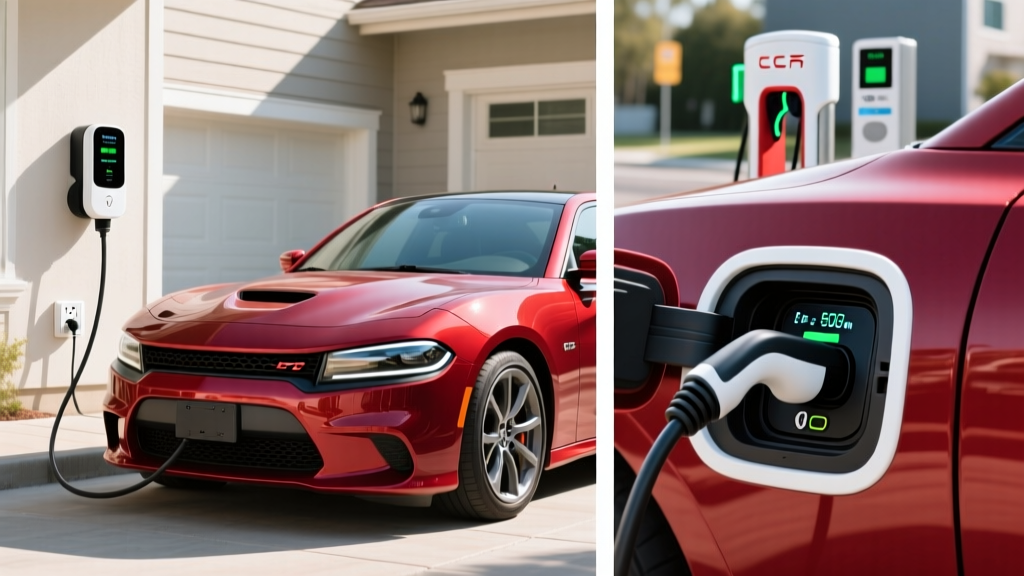
The electric Dodge Charger Daytona (Scat Pack and R/T trims) marks a radical shift for Dodge's muscle-car loyalists. Built on Stellantis's STLA Large platform, the Charger Daytona packs a 100.5 kWh usable battery (NMC chemistry) and EPA-rated range up to 317 miles on the R/T trim, dropping to roughly 260 miles on the higher-output Scat Pack. Those are big numbers — but they mean nothing if you can't efficiently recharge. This guide covers exactly how to charge the electric Dodge Charger at home, what you'll pay for public DC fast charging, and which connectors and equipment you need for 2026's evolving network.
| Spec | R/T (AWD) | Scat Pack (AWD) |
|---|---|---|
| Usable Battery | 100.5 kWh (NMC) | 100.5 kWh (NMC) |
| EPA Range | 317 mi | 260 mi |
| Peak DC Fast Charge | ~200 kW | ~200 kW |
| 10–80% DC Time | ~28 min | ~28 min |
| Level 2 Onboard Charger | 11.5 kW (48A) | 11.5 kW (48A) |
| Connector | CCS1 (NACS adapter available) | CCS1 (NACS adapter available) |
| Horsepower | 496 hp | 670 hp |
| 0–60 mph | 4.7 sec | 3.3 sec |
| Base MSRP | ~$51,990 | ~$59,990 |
Charging Levels Explained: Speeds, kW, and Miles Per Hour
EV charging is measured in kilowatts (kW), which is the rate of power delivery — not to be confused with kilowatt-hours (kWh), which is the total energy stored in your battery. A useful analogy: kW is how fast the hose fills the pool; kWh is the pool's total capacity. Here's how each level translates for the electric Dodge Charger's 100.5 kWh pack.
| Level | Voltage / Power | Miles of Range Per Hour | 0–100% Time | Best Use Case |
|---|---|---|---|---|
| Level 1 | 120V / 1.4 kW | ~4–5 mi/hr | 72+ hours | Emergency / overnight trickle |
| Level 2 (Home) | 240V / 11.5 kW | ~35–40 mi/hr | ~9 hours | Daily home charging |
| DC Fast (Peak) | ~200 kW | ~700+ mi/hr (peak) | 10–80% in ~28 min | Road trips |
Level 1 is functionally useless for daily use on a 100.5 kWh pack — you'd add only ~40 miles overnight. Level 2 is the backbone of EV ownership, fully replenishing the Scat Pack in roughly 9 hours. DC fast charging is essential for road trips but should be limited to 10–80% SoC; the charge curve tapers sharply above 80% to protect battery longevity, dropping from peak 200 kW down to under 40 kW in the final stretch.
Home Level 2 Installation: Electrical Requirements, Panel Upgrades, and Real Costs
Installing a Level 2 home charger is the single biggest infrastructure decision for any Charger Daytona owner. The vehicle's 11.5 kW onboard charger accepts up to 48 amps, which requires a dedicated 60-amp circuit (NEC code mandates charging circuits be rated at 125% of continuous load). That means 240V/60A on a dedicated breaker.
What Your Electrical Panel Needs
Modern homes with a 200-amp main panel usually have sufficient spare capacity for a 60A EV circuit. Older homes with 100A or 150A service may require a panel upgrade to 200A — a significant but one-time cost. Before committing, request a load calculation from a licensed electrician; this determines whether your existing panel can handle the EV circuit alongside HVAC, electric range, and dryer loads.
| Component | Low End | High End | Notes |
|---|---|---|---|
| Level 2 Charger Hardware | $400 | $750 | 48A smart charger (e.g., ChargePoint, Emporia) |
| Electrician Labor | $500 | $1,500 | Varies by run length, wall type, conduit |
| Permit & Inspection | $75 | $300 | Required in most jurisdictions |
| Panel Upgrade (if needed) | $1,500 | $3,500 | 100A → 200A service upgrade |
| Total (no panel upgrade) | $975 | $2,550 | Typical for modern homes |
| Total (with panel upgrade) | $2,475 | $6,050 | Older homes / high-load panels |
Safety and Code Considerations
- Dedicated circuit: NEC 625 requires EVSE to be on its own breaker — no sharing with other outlets.
- GFCI protection: Required for outdoor installations and some indoor jurisdictions under 2023/2026 NEC revisions.
- NEMA 14-60 vs. hardwired: A NEMA 14-60 outlet gives portability; hardwired units allow full 48A continuous (some plug-in units cap at 40A for safety margins).
- Outdoor rating: If your charger mounts outside, ensure NEMA 4 (weatherproof) rating and UV-resistant cabling.
- Cable management: 25-foot cables cover most garage-to-driveway scenarios; measure your actual run before ordering.
Connector Compatibility: CCS1, NACS, and the Tesla Supercharger Question
The 2026 Dodge Charger Daytona ships with a CCS1 (Combined Charging System) inlet. However, with Tesla opening its Supercharger network to non-Tesla vehicles and the industry shifting toward the NACS connector, Dodge has confirmed a NACS adapter will be available for the Charger Daytona — allowing access to Tesla's 17,000+ Superchargers via adapter.
| Connector | Native / Adapter | Network Access |
|---|---|---|
| CCS1 | Native (built-in) | Electrify America, EVgo, ChargePoint DC, Ionity (EU) |
| NACS (Tesla) | Adapter required | Tesla Supercharger (via Magic Dock or adapter) |
| CHAdeMO | Not supported | Largely discontinued in US — avoid |
| J1772 (Level 2) | Native (CCS includes J1772) | All public Level 2 stations |
If you plan to rely on Tesla Superchargers for road trips, purchase the OEM-approved NACS adapter (~$200–$250) before your first trip. Third-party adapters exist but may not support full 200 kW peak rates or may void warranty claims if they cause inlet damage. For home Level 2 charging, any J1772 plug works natively — no adapter needed.
Charging Cost: $/kWh Scenarios and Cost Per Mile vs Gas
The Charger Daytona Scat Pack achieves roughly 2.6–2.8 kWh/mile (approximately 90–100 MPGe combined per fueleconomy.gov). That efficiency figure, combined with your local electricity rate, determines your real cost per mile.
| Scenario | $/kWh | Cost Per Mile | Full Charge Cost (100.5 kWh) |
|---|---|---|---|
| Home Off-Peak (utility TOU) | $0.09 | $0.24 | $9.05 |
| Home Standard Rate | $0.16 | $0.43 | $16.08 |
| Public Level 2 (ChargePoint/EVgo) | $0.30 | $0.81 | $30.15 |
| DC Fast (Electrify America) | $0.48 | $1.30 | $48.24 |
| Tesla Supercharger (avg) | $0.35 | $0.95 | $35.18 |
For comparison, a gas Dodge Charger Scat Pack (6.4L HEMI, ~18 MPG combined) burning fuel at $3.40/gallon costs roughly $0.19 per mile — meaning home EV charging at off-peak rates actually undercuts gasoline. Even at standard residential rates, the EV's cost per mile is competitive, and you gain the convenience of starting every morning with a full "tank." Public DC fast charging, however, is the most expensive option — reserve it for road trips, not daily use.
Equipment Recommendations: Best Level 2 Chargers for the Charger Daytona
To maximize the Daytona's 11.5 kW onboard charger, you need a 48-amp Level 2 EVSE on a 60A circuit. Here are three proven units that match the Charger's specs.
Emporia Vue / Emporia Level 2 Charger
- Power: 48A / 11.5 kW (240V)
- Cable: 24 ft
- Smart Features: Wi-Fi, scheduling, energy monitoring, solar integration
- Connector: J1772 (NACS version available)
- Price: ~$400–$450
- Verdict: Best value — full 48A output, energy dashboard pairs well with home solar.
ChargePoint Home Flex
- Power: Up to 50A / 12 kW (adjustable down)
- Cable: 23 ft
- Smart Features: App scheduling, Alexa, utility demand-response
- Connector: J1772 (NACS plug option)
- Price: ~$550–$700
- Verdict: Most flexible amperage settings — ideal if your panel can't support full 60A.
Grizzl-E Smart
- Power: 40A / 9.6 kW (240V)
- Cable: 24 ft
- Smart Features: OCPP-compatible, app control, overload protection
- Connector: J1772
- Price: ~$450–$550
- Verdict: Rugged, Canadian-built, excellent for cold climates and outdoor installs. Caps at 40A — slightly underutilizes the Daytona's 48A capability.
Any of these units will serve the electric Dodge Charger well. The Emporia and ChargePoint fully utilize the 11.5 kW onboard charger; the Grizzl-E sacrifices ~15% charge speed for durability and a lower circuit requirement (50A breaker).
Real-World Charging Times for the 100.5 kWh Battery
Manufacturer-stated 10–80% DC fast-charge times assume ideal conditions: battery preconditioned to ~95°F, ambient temperature moderate, and a charger capable of sustaining peak output. In practice, expect the following for the Charger Daytona's 100.5 kWh pack:
- 10–80% on a 200 kW DC charger: ~28–32 minutes (charge curve peaks around 175–200 kW up to ~40% SoC, then tapers to 80–100 kW through 60%, and further drops to ~50 kW by 80%).
- 0–100% on Level 2 (11.5 kW): ~9 hours (sufficient for overnight replenishment).
- 10–80% on a 50 kW DC charger: ~90 minutes (avoid these older stations on road trips).
- Cold-weather impact: At 20°F, DC fast-charge times can increase 20–35% if the battery isn't preconditioned. Use the Charger's navigation-based preconditioning feature (set your charger as a destination) to warm the pack before arrival.
The Charger Daytona's battery thermal management system is robust, but the ~100 kWh pack's sheer size means even "fast" charging requires patience compared to smaller-battery EVs. Plan road-trip stops around 25–35 minute sessions — roughly one meal break or rest stop.
Federal Tax Credits and Incentives for Home Charger Installation
The federal Alternative Fuel Vehicle Refueling Property Credit (IRS §30C, separate from the §30D vehicle credit) covers 30% of home EV charger equipment and installation costs, up to $1,000. Eligibility requires installation in a qualifying census tract (generally rural or low-income areas per the IRS guidelines). Check your address against the IRS census-tract tool before assuming eligibility.
Many utilities also offer rebates of $250–$750 for Level 2 charger installation, and some provide time-of-use (TOU) rate plans that slash overnight charging costs to $0.06–$0.10/kWh. Contact your utility before installation — some rebates require pre-approval or specific charger models.
Frequently Asked Questions
How much does it cost to install a home EV charger for the Dodge Charger Daytona?
Expect $975–$2,550 for a typical install (48A charger, electrician, permit) in a home with a 200A panel. If your panel needs upgrading from 100A to 200A, add $1,500–$3,500. The federal §30C credit may offset up to $1,000 if you're in an eligible census tract.
How fast will each charging level add range to the electric Dodge Charger?
Level 1 (120V) adds ~4–5 miles per hour — impractical for daily use. Level 2 (240V/48A) adds ~35–40 miles per hour, fully recharging overnight. DC fast charging at peak 200 kW adds 10–80% in roughly 28 minutes, though real-world conditions and the charge curve taper extend this to 30–35 minutes.
Which connector does the electric Dodge Charger use, and can I use Tesla Superchargers?
The Charger Daytona ships with a CCS1 inlet. A Dodge-approved NACS adapter enables access to Tesla Superchargers. CHAdeMO is not supported. For home Level 2 charging, any standard J1772 plug works natively.
How much does charging the Dodge Charger Daytona cost per mile vs gas?
At home off-peak rates ($0.09/kWh), the Scat Pack costs roughly $0.24/mile to charge. A gas Charger Scat Pack at 18 MPG and $3.40/gallon costs ~$0.19/mile. At standard residential rates ($0.16/kWh), the EV costs ~$0.43/mile — slightly more than gas. The real savings come from off-peak TOU plans and avoiding public DC fast chargers for routine use.
What electrical upgrades might I need for a home charger?
You'll need a dedicated 60A/240V circuit for a 48A Level 2 charger. Homes with 200A panels usually accommodate this without issue. Homes with 100A or 150A service may need a panel upgrade ($1,500–$3,500). A licensed electrician should perform a load calculation to determine your panel's spare capacity before installation.
Does the Charger Daytona precondition its battery for faster DC charging?
Yes. When you navigate to a DC fast charger using the built-in navigation system, the thermal management system warms or cools the battery to optimal temperature before arrival, reducing charge time by 15–30% in extreme temperatures. Always use nav-routing for road-trip charging stops.
Sources: EPA fueleconomy.gov, IRS §30C Credit Guidelines, Stellantis/Dodge official specifications.