Why Your Electric Dodge Charger Customization Starts at the Charger
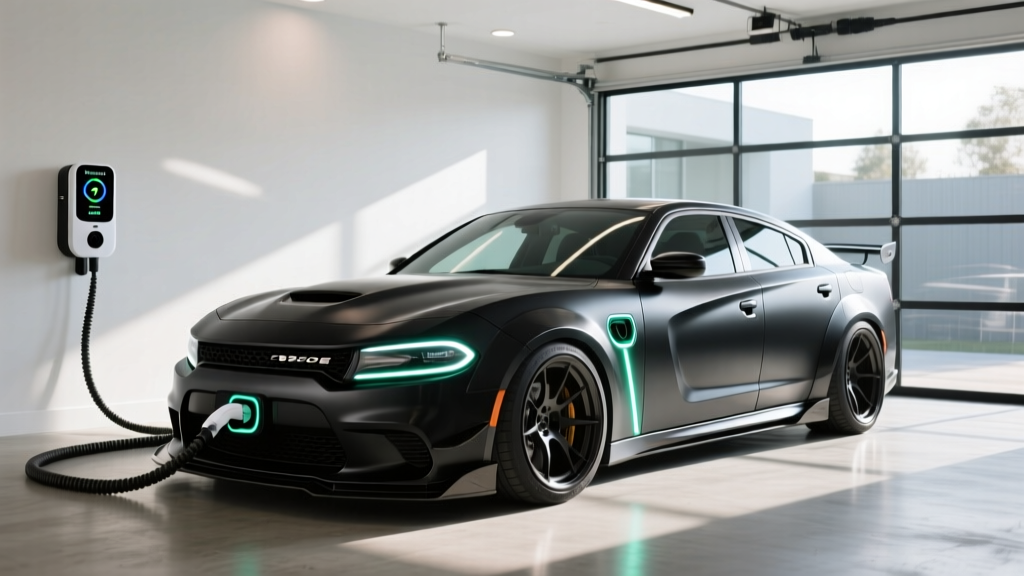
The 2025–2026 Dodge Charger Daytona EV (Stellantis STLA Large platform) isn't a typical commuter EV. With a 100.5 kWh usable battery pack, 400-volt architecture, and up to 670 horsepower on the Scat Pack trim, this muscle car demands a charging strategy that matches its performance ambitions. Whether you're outfitting a garage for daily top-offs or planning road-trip DC fast-charging logistics, your electric Dodge Charger customization is incomplete without a deliberate charging setup.
This guide covers exactly what the Charger Daytona needs: home Level 2 installation costs, real-world charging speeds at each level, connector compatibility as the industry shifts to NACS, and the per-mile cost versus the gas V8 it replaces.
Charging Levels Explained: Speeds, kW, and Range Added Per Hour
Before selecting equipment, understand the three charging tiers available to Charger Daytona owners. Power is measured in kW (kilowatts) — the rate of energy flow — while battery capacity is measured in kWh (kilowatt-hours) — the total energy stored. Confusing these two is the most common EV mistake.
| Level | Voltage / Amps | Power (kW) | Miles of Range Added Per Hour | Typical Use Case |
|---|---|---|---|---|
| Level 1 | 120V / 12A | ~1.4 kW | ~4–5 mi/hr | Emergency / overnight trickle |
| Level 2 (Home) | 240V / 40–48A | 9.6–11.5 kW | ~28–35 mi/hr | Daily home charging |
| DC Fast Charge | 400V+ architecture | Peak ~175 kW | ~150–180 mi in 10 min (10–80% in ~32 min) | Road trips, highway corridors |
At Level 1, a full recharge of the 100.5 kWh pack would take roughly 72 hours — essentially useless except for maintaining charge on a parked vehicle. Level 2 at 11.5 kW delivers a full charge in about 9–10 hours, ideal for overnight replenishment. DC fast charging peaks around 175 kW on the Charger Daytona's 400V platform, but remember that peak rate is not sustained rate: charging speed tapers significantly above 80% State of Charge (SoC) to protect battery health. Expect a 10–80% session in roughly 32 minutes under optimal thermal conditions, per Stellantis specifications.
Home Level 2 Installation: Electrical Requirements and Cost Breakdown
A Level 2 home charger is the backbone of any practical EV ownership experience. For the Charger Daytona's large 100.5 kWh battery, a 48-amp charger on a dedicated 60-amp circuit is the optimal setup — it delivers 11.5 kW and fills the pack overnight.
Electrical Requirements
- Circuit: Dedicated 60-amp, 240V breaker (supports continuous 48A draw per NEC 80% rule)
- Wire gauge: 6 AWG copper (THHN in conduit or NM-B depending on run)
- Panel capacity: Minimum 200-amp main service recommended; older homes with 100-amp panels will likely need a service upgrade
- GFCI protection: NEC 2020 and later requires GFCI for EV outlets; hardwired chargers may bypass this requirement depending on local code
- Permit: Required in nearly all US jurisdictions for new 240V circuits; inspection ensures code compliance
Installation Cost Breakdown
| Component | Low End | High End | Notes |
|---|---|---|---|
| Level 2 Charger (Equipment) | $350 | $750 | 40A–48A smart charger, NACS or J1772 |
| Electrician Labor | $500 | $1,500 | Depends on panel-to-garage distance, wall type |
| Materials (wire, conduit, breaker) | $150 | $400 | Longer runs and conduit increase cost |
| Permit & Inspection | $50 | $250 | Varies by municipality |
| Panel Upgrade (if needed) | $1,500 | $4,000 | 100A → 200A service; not always required |
| Total (no panel upgrade) | $1,050 | $2,900 | Most typical installs fall in $1,200–$2,000 |
| Total (with panel upgrade) | $2,550 | $6,900 | Older homes (pre-2000) more likely to need this |
Before hiring an electrician, check your main panel's amperage rating (printed on the main breaker) and available breaker slots. If you have a 200-amp panel with open slots and the garage is within 50 feet, expect the lower end of the cost range. Homes built before the 1990s often have 100-amp service — a panel upgrade becomes necessary and adds $1,500–$4,000.
Connector Compatibility: NACS, CCS, and What the Charger Daytona Uses
The 2025 Dodge Charger Daytona ships with the CCS1 (Combined Charging System) connector — the current industry standard for non-Tesla EVs. However, Stellantis has announced that future model years will transition to the NACS (North American Charging Standard / Tesla) connector, following Ford, GM, Rivian, and others.
| Connector | Charger Daytona Status | Network Access | Adapter Needed? |
|---|---|---|---|
| CCS1 | Standard on 2025 models | Electrify America, EVgo, ChargePoint DC stations | No — native port |
| NACS (Tesla) | Expected on future model years | Tesla Supercharger network (20,000+ stalls) | CCS-to-NACS adapter (~$200) for current models to access Superchargers where permitted |
| CHAdeMO | Not compatible | Largely deprecated in North America | N/A — avoid |
| J1772 (Level 2 AC) | Compatible via standard inlet | All public Level 2 stations | No — native for AC charging |
For home Level 2 charging, most chargers use a J1772 plug that connects to the Charger Daytona's J1772/CCS combo inlet. If you purchase a NACS-equipped home charger (like the Tesla Wall Connector), you'll need a NACS-to-J1772 adapter for the current CCS-equipped Charger Daytona. Check Dodge's official Charger Daytona page for model-year-specific connector updates.
Cost to Charge: Home, Public, and Per-Mile vs. Gas
One of the strongest arguments for electrifying a muscle car is fuel cost savings — especially when the alternative is a supercharged 6.2L Hemi V8 averaging 16 MPG combined on premium fuel.
| Scenario | Rate | Cost for Full 100.5 kWh Charge | Cost Per Mile (est. 280 mi) |
|---|---|---|---|
| Home — Off-Peak (utility time-of-use) | $0.09/kWh | $9.05 | $0.032/mi |
| Home — Standard Residential Avg | $0.16/kWh | $16.08 | $0.057/mi |
| Public Level 2 (ChargePoint, etc.) | $0.25–$0.35/kWh | $25.13–$35.18 | $0.090–$0.126/mi |
| DC Fast Charge (Electrify America) | $0.35–$0.55/kWh | $35.18–$55.28 | $0.126–$0.197/mi |
| Gas Charger (5.7L V8, 19 MPG combined) | $3.40/gal premium | — | $0.179/mi |
| Gas Charger (6.2L Supercharged, 16 MPG) | $3.40/gal premium | — | $0.213/mi |
Home charging at off-peak rates delivers fuel costs at roughly one-sixth the per-mile cost of the supercharged gas Charger. Even at public DC fast-charging rates, the EV is competitive with or cheaper than premium gasoline. The EPA rates the Charger Daytona R/T at approximately 96 MPGe combined — reference data available at fueleconomy.gov.
Recommended Level 2 Chargers for the Charger Daytona
With a 100.5 kWh battery, you want a 48-amp charger to minimize overnight charge time. Here are three proven options that fit an electric Dodge Charger customization plan:
ChargePoint Home Flex
- Power Output: Up to 11.5 kW (48A at 240V)
- Connector: J1772 (compatible with Charger Daytona CCS inlet for AC charging)
- Cable Length: 23 feet
- Smart Features: Wi-Fi, app scheduling, Alexa integration, energy tracking
- Price:~$550
- Best For: Owners wanting flexible amperage settings (can be configured from 16A to 48A based on circuit capacity)
Emporia Level 2 EV Charger
- Power Output: Up to 11.5 kW (48A at 240V)
- Connector: J1772
- Cable Length: 24 feet
- Smart Features: Real-time energy monitoring, solar integration, app control, load management
- Price:~$400
- Best For: Budget-conscious buyers with solar panels; best value-per-kW on the market
Tesla Wall Connector (J1772 version)
- Power Output: Up to 11.5 kW (48A at 240V)
- Connector: J1772 (non-Tesla version released 2024)
- Cable Length: 24 feet
- Smart Features: Wi-Fi updates, power sharing between two units, sleek design
- Price:~$475
- Best For: Multi-EV households (power-sharing feature splits available amperage between two vehicles)
For the Charger Daytona specifically, I recommend the ChargePoint Home Flex for its adjustable amperage — if your home's electrical panel can't support a full 60A circuit, you can dial the charger down to 32A or 40A without replacing hardware.
Safety, Code, and Installation Considerations
EV charging involves sustained high-current draw — far more demanding than a dryer or oven. Cutting corners creates fire risk. Follow these non-negotiable requirements:
- Dedicated circuit: Your Level 2 charger must have its own breaker — never share a circuit with other appliances.
- NEC 80% rule: A 48A continuous load requires a 60A breaker. A 40A charger needs a 50A breaker. Never exceed 80% of breaker capacity for continuous loads.
- Outdoor rating: If your charger is mounted outside or in an unsealed garage, ensure it carries a NEMA 4 (weatherproof) rating. All three chargers above are rated for outdoor use.
- GFCI protection: Required by NEC 2020+ for receptacle-based EV charging (NEMA 14-50 outlets). Hardwired installations may not require a separate GFCI breaker, as many chargers have built-in ground-fault protection — confirm with your electrician and local inspector.
- Wire gauge and run length: For runs over 50 feet from panel to charger, your electrician may upsize to 4 AWG wire to reduce voltage drop. Factor this into material costs.
Frequently Asked Questions
How much does it cost to install a home EV charger for the Dodge Charger Daytona?
Most installations with a 200-amp panel and a short wire run cost between $1,200 and $2,000 (equipment + electrician + permit). If your home needs a panel upgrade from 100A to 200A service, add $1,500–$4,000. Always get at least two quotes from licensed electricians.
How fast will each charging level add range to the Charger Daytona?
Level 1 (120V) adds roughly 4–5 miles per hour — only useful for maintaining charge. Level 2 (240V, 48A) adds approximately 30–35 miles per hour, fully recharging the 100.5 kWh battery in about 9–10 hours. DC fast charging at 175 kW can add roughly 150 miles in 10 minutes under optimal conditions, with a 10–80% session taking approximately 32 minutes.
Which connector and charger is compatible with my Charger Daytona?
The 2025 Charger Daytona uses a CCS1 connector for DC fast charging and a J1772 inlet for Level 2 AC charging. Any J1772-equipped Level 2 home charger is compatible. For Tesla Supercharger access, you'll need a CCS-to-NACS adapter, and even then access depends on Tesla's open-network policy at specific stations.
How much does charging cost per mile compared to gas?
Home charging at the US average residential rate of $0.16/kWh costs about $0.057 per mile in the Charger Daytona. The gas-powered Charger with a 5.7L V8 costs roughly $0.179/mile on premium fuel, and the supercharged 6.2L costs about $0.213/mile. Home charging saves $0.12–$0.16 per mile — that's $1,800–$2,400 per year at 15,000 miles driven.
What electrical upgrades might I need before installing a Level 2 charger?
Homes with 100-amp electrical service typically need a panel upgrade to 200 amps ($1,500–$4,000). You may also need: a new dedicated 60A breaker and available panel slots, upgraded wire (6 AWG or 4 AWG for long runs), and a permit. Homes built after 2005 usually have 200A service and sufficient capacity — but always get a professional load calculation.