Understanding how to charge efficiently is the single biggest factor in maximizing your electric car range. Whether you're plugging in at home, using public networks, or planning a road trip, the charging method you choose directly impacts how many miles you'll actually get from your battery.
This guide breaks down charging levels, installation requirements, costs, and equipment with exact numbers — no vague promises about "fast charging" or "long range." You'll learn the difference between kW (power) and kWh (energy), why your EPA-estimated range rarely matches real-world driving, and how to set up home charging that actually works for your lifestyle.
Charging Levels Explained: Speed, Power, and Range Added
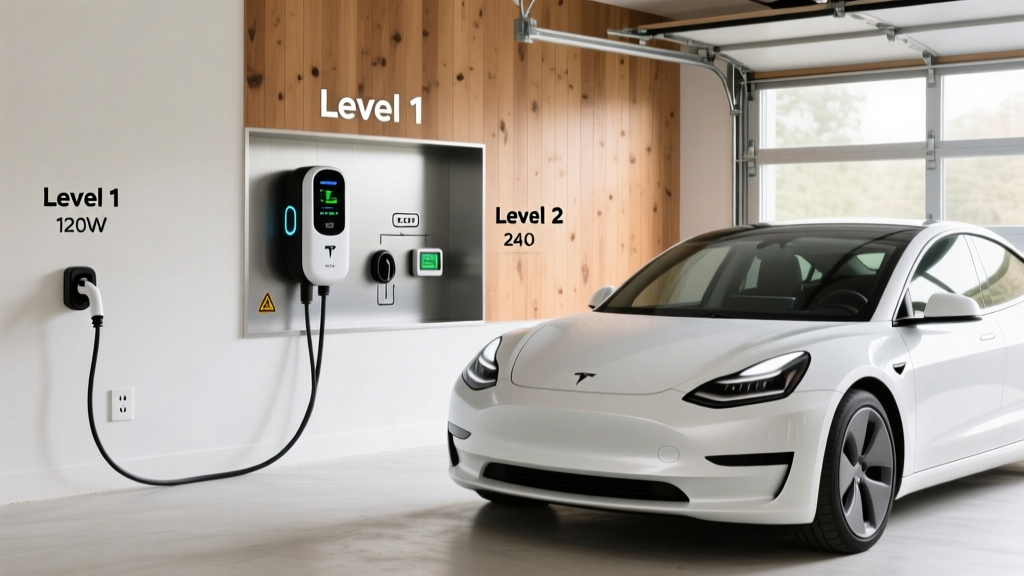
EV charging happens at three distinct levels, each with different power requirements and speeds. The key metric is kilowatts (kW) — this measures charging power, not energy capacity. Your battery stores energy in kilowatt-hours (kWh). Think of kW as how fast water flows into a tank, and kWh as how much water the tank holds.
| Level | Voltage | Power (kW) | Miles Added/Hour | Typical Use Case |
|---|---|---|---|---|
| Level 1 | 120V AC | 1.4-1.9 kW | 3-5 miles | Overnight trickle, emergency backup |
| Level 2 | 240V AC | 3.3-19.2 kW | 12-75 miles | Home daily charging, workplace, public |
| DC Fast Charging | 400-800V DC | 50-350 kW | 150-1,000+ miles | Road trips, rapid top-ups |
Level 1: The Baseline
Every EV comes with a Level 1 cord that plugs into a standard 120V household outlet. At 1.4-1.9 kW, you'll add roughly 3-5 miles of range per hour. For a 75 kWh battery (like the Tesla Model Y Long Range), a full charge from empty takes 40-50 hours. Level 1 works if you drive under 40 miles daily and can charge overnight, but it's impractical for most owners.
Level 2: The Daily Driver
Level 2 requires a 240V circuit — the same voltage as your electric dryer or oven. At 7.2-11.5 kW (typical home setups), you'll add 25-45 miles per hour. That same 75 kWh battery charges in 7-10 hours, perfect for overnight replenishment. Most public chargers at shopping centers, workplaces, and hotels are Level 2.
DC Fast Charging: Road Trip Essential
DC fast chargers bypass your car's onboard charger and feed high-voltage direct current straight to the battery. At 150-350 kW, modern EVs can add 200-300 miles in 20-30 minutes. However, charging speed isn't constant — it peaks at low state of charge (SoC) and tapers above 80% to protect battery health. A 10-80% charge might take 18-25 minutes, but 80-100% can take just as long.
Real-World Electric Car Range vs. EPA Estimates
Your EPA-estimated range is measured under controlled conditions that rarely match real driving. Here's what actually affects your electric car range:
- Highway speeds: Aerodynamic drag increases exponentially above 60 mph. Expect 15-25% range loss at 75-80 mph vs. the EPA test cycle.
- Cold weather: Battery chemistry slows down, and cabin heating draws power. At 20°F, range drops 20-40% depending on the vehicle and whether it has a heat pump.
- Terrain: Mountain driving with sustained climbs can reduce range 30% or more. Regenerative braking helps on descents but rarely recovers all lost energy.
- HVAC usage: Air conditioning and heating can draw 2-5 kW continuously, cutting range 10-20% in extreme temperatures.
For example, the 2026 Hyundai Ioniq 5 has an EPA range of 303 miles (Long Range RWD with 84 kWh battery). In real-world highway driving at 70 mph in 40°F weather, expect 220-250 miles before needing to charge. Always plan road trips using 70-80% of the EPA number to account for variables.
Home Charger Installation: Requirements and Costs
Installing a Level 2 home charger involves electrical work that varies significantly based on your home's existing infrastructure. Here's what determines the final cost:
Electrical Requirements
A typical Level 2 charger needs a dedicated 240V circuit rated for 40-60 amps. This delivers 9.6-14.4 kW of charging power. The circuit must be hardwired or use a NEMA 14-50 outlet (the same as a large RV or welder).
Panel Upgrade Considerations
If your home has a 100-amp electrical panel (common in homes built before 2000), adding a 40-amp EV circuit may exceed your panel's capacity. An electrician will perform a load calculation considering your existing appliances (HVAC, water heater, dryer, oven). If you're near capacity, you'll need a panel upgrade to 200 amps — a major expense.
| Component | Cost Range | Notes |
|---|---|---|
| Level 2 Charger Equipment | $400-$800 | 40-48A smart charger with 25-foot cable |
| Electrician Labor | $500-$2,000 | Depends on distance from panel, conduit runs |
| Permit and Inspection | $100-$400 | Required by most jurisdictions |
| Panel Upgrade (if needed) | $1,500-$3,500 | 100A to 200A service upgrade |
| Total (no panel upgrade) | $1,000-$3,200 | Most homes with 200A panels |
| Total (with panel upgrade) | $2,500-$6,700 | Older homes with 100A service |
Get at least three quotes from licensed electricians. Ask specifically about load calculations and whether your panel can handle the additional circuit. Some utilities offer rebates of $300-$1,000 for home charger installation — check with your provider before starting work.
Connector Compatibility: NACS, CCS1, and CHAdeMO
Not all EVs use the same charging connector. As of 2026, three main standards exist in North America:
| Connector Type | Brands Using It | Notes |
|---|---|---|
| NACS (Tesla) | Tesla, Ford, GM, Rivian, Volvo, Polestar, others (2025+) | Smaller, lighter connector; access to Tesla Supercharger network |
| CCS1 | Hyundai, Kia, BMW, VW, most legacy brands (pre-2025) | Combined Charging System; larger connector |
| CHAdeMO | Nissan Leaf (older models) | Legacy standard; being phased out |
Starting in 2025, most automakers transitioned to the NACS connector, giving non-Tesla EVs access to the Tesla Supercharger network (now rebranded as the Tesla Charging network). If you drive a CCS1-equipped vehicle, you can purchase a NACS adapter for $200-$300 to use Tesla chargers. CHAdeMO vehicles have limited public charging options and are not recommended for new buyers.
For home Level 2 charging, most chargers come with a J1772 connector (the AC charging standard). Tesla vehicles include a J1772 adapter in the glovebox. Non-Tesla EVs with NACS connectors need a J1772-to-NACS adapter for home charging — verify compatibility with your charger manufacturer.
Charging Cost Per Mile: EV vs. Gas
One of the biggest advantages of electric vehicles is lower fuel costs, but the savings depend on your electricity rates and charging habits. Here's how charging costs break down:
| Scenario | Cost per kWh | Cost per Mile (3.5 mi/kWh EV) | Annual Fuel Cost (12,000 miles) |
|---|---|---|---|
| Home Off-Peak (overnight) | $0.08-$0.12 | $0.023-$0.034 | $276-$408 |
| Home Standard Rate | $0.15-$0.20 | $0.043-$0.057 | $516-$684 |
| Public Level 2 | $0.25-$0.40 | $0.071-$0.114 | $852-$1,368 |
| DC Fast Charging | $0.35-$0.60 | $0.100-$0.171 | $1,200-$2,052 |
| Gas Vehicle (28 MPG, $3.50/gal) | N/A | $0.125 | $1,500 |
Home charging on off-peak rates delivers the lowest cost per mile — typically 70-80% less than a comparable gas vehicle. Public DC fast charging narrows the gap, and frequent use can make EV fuel costs approach gas prices. For maximum savings, install a home charger and take advantage of time-of-use rates from your utility.
Equipment Recommendations: Best Home Chargers for 2026
Choosing a Level 2 charger involves balancing power output, cable length, smart features, and price. Here are three proven options across different budgets:
ChargePoint Home Flex (Best Overall)
- Power: Up to 12 kW (50A circuit)
- Connector: J1772 (NACS adapter available)
- Cable Length: 23 feet
- Smart Features: WiFi, scheduling, energy tracking, Alexa integration
- Price: $699
- Why it works: Adjustable amperage (16-50A) fits your electrical capacity; excellent app and reliability
Emporia Level 2 EV Charger (Budget Pick)
- Power: Up to 11.5 kW (48A circuit)
- Connector: J1772
- Cable Length: 24 feet
- Smart Features: WiFi, scheduling, solar integration, energy monitoring
- Price: $399
- Why it works: Lowest-cost smart charger with solid build quality; great for solar homes
Wall Connector (Tesla Ecosystem)
- Power: Up to 11.5 kW (48A circuit)
- Connector: NACS native (J1772 adapter included)
- Cable Length: 24 feet
- Smart Features: WiFi, power sharing (multiple units), over-the-air updates
- Price: $475
- Why it works: Seamless Tesla integration; can share power between two chargers on one circuit
All three chargers require hardwiring or a NEMA 14-50 outlet. Hardwired installations are safer and allow higher amperage (plug-in outlets are limited to 40A by code). Choose a charger rated for outdoor use (NEMA 4 rating) if you'll install it outside.
Safety and Code Requirements
EV charger installation must comply with the National Electrical Code (NEC) and local building codes. Key requirements include:
- Dedicated circuit: Your EV charger must have its own circuit — no sharing with other appliances
- GFCI protection: Outdoor installations require ground-fault circuit interrupter protection (built into most modern chargers)
- Proper wire gauge: 6 AWG copper wire for 50A circuits; 4 AWG for 60A circuits
- Conduit and junction boxes: Required for exposed wiring runs; protects against physical damage
- Permit and inspection: Most jurisdictions require a permit ($100-$400) and final inspection to ensure code compliance
Never attempt a DIY installation unless you're a licensed electrician. Improper wiring can cause fires, damage your vehicle, or void your home insurance. A licensed electrician will pull permits, handle inspections, and provide a warranty on their work.
Charging Time Examples: 10-80% for Common Battery Sizes
Charging speed isn't linear — it peaks at low state of charge and tapers as the battery fills. Here are real-world 10-80% charging times for popular EVs:
- Tesla Model Y Long Range (75 kWh battery): 250 kW peak, 10-80% in ~25 minutes at a V3 Supercharger
- Hyundai Ioniq 5 (84 kWh battery): 233 kW peak, 10-80% in ~18 minutes at a 350 kW charger (800V architecture)
- Ford Mustang Mach-E Extended Range (91 kWh battery): 150 kW peak, 10-80% in ~45 minutes at a 150 kW charger
- Chevrolet Bolt EV (65 kWh battery): 55 kW peak, 10-80% in ~60 minutes at a 50 kW charger
These times assume optimal battery temperature (preconditioned) and a charger capable of delivering the vehicle's peak rate. In cold weather or at chargers with lower power output, add 20-50% to these times. Always plan road trip stops around 10-80% charges — pushing to 100% wastes time due to severe tapering.
Frequently Asked Questions
How much does it cost to install a home EV charger?
Most homes with a 200-amp electrical panel pay $1,000-$3,200 for a Level 2 charger installation (equipment + electrician + permit). Older homes with 100-amp panels may need a panel upgrade, pushing costs to $2,500-$6,700. Get multiple quotes and check for utility rebates before starting work.
How fast will each charging level add range?
Level 1 (120V) adds 3-5 miles per hour. Level 2 (240V, 7.2-11.5 kW) adds 25-45 miles per hour. DC fast charging (150-350 kW) can add 200-300 miles in 20-30 minutes, but speed tapers significantly above 80% state of charge.
Which connector/charger is compatible with my EV?
Tesla vehicles and most 2025+ models from Ford, GM, Rivian, and others use the NACS connector. Older non-Tesla EVs typically use CCS1. Check your vehicle's charging port or owner's manual. For home Level 2 charging, most EVs use the J1772 connector (Tesla includes an adapter; NACS vehicles need a J1772-to-NACS adapter).
How much does charging cost per mile vs gas?
Home charging on off-peak rates costs $0.02-$0.04 per mile — about 70-80% less than a gas vehicle at $3.50/gallon and 28 MPG ($0.125/mile). Public DC fast charging costs $0.10-$0.17 per mile, narrowing the savings gap. For maximum cost advantage, charge at home overnight.
What electrical upgrades might I need?
If your home has a 100-amp electrical panel, you'll likely need an upgrade to 200 amps ($1,500-$3,500) to safely add a 40-50 amp EV circuit. An electrician will perform a load calculation to determine if your existing panel can handle the additional load. Homes built after 2000 typically have 200-amp service and won't need upgrades.
Maximizing your electric car range starts with understanding charging fundamentals: choose the right level for your needs, install proper home infrastructure, and plan road trips around 10-80% charging windows. With a Level 2 home charger and off-peak electricity rates, you'll enjoy the lowest cost per mile and the convenience of a full battery every morning.