If you're shopping for the electric car longest range models — vehicles like the Lucid Air Grand Touring (516 miles EPA), Tesla Model S Long Range (402 miles EPA), or the Chevrolet Silverado EV 4WT (450 miles EPA) — you've likely noticed a common thread: massive battery packs. These long-range EVs typically carry 100 kWh to 118 kWh of usable energy, and that changes the charging equation entirely compared to a 60 kWh compact EV.
A bigger battery means more miles between stops, but it also means longer fill-up times if your charging setup isn't matched to the pack. Plugging a 112 kWh Lucid Air into a standard 120V outlet would take over a week to go from 10% to 80%. This guide breaks down exactly how to charge long-range EVs efficiently at home and on the road, with hard numbers on speed, cost, and installation.
Charging Levels Explained: Speeds for 100+ kWh Batteries
EV charging falls into three tiers. Understanding the difference between kW (power — how fast energy flows) and kWh (energy — how much the battery holds) is essential. Think of kW as the width of a hose and kWh as the size of the bucket. Long-range EVs have very large buckets, so you need a wide hose.
| Level | Voltage / Amps | Power (kW) | Miles of Range Added Per Hour | 10–80% Time (100 kWh pack) |
|---|---|---|---|---|
| Level 1 | 120V / 12A | ~1.4 kW | 3–5 mi/hr | Not practical (~70+ hours) |
| Level 2 (basic) | 240V / 32A | 7.7 kW | 22–28 mi/hr | ~9–10 hours |
| Level 2 (high-power) | 240V / 48A | 11.5 kW | 33–42 mi/hr | ~6–7 hours |
| Level 2 (max home) | 240V / 80A | 19.2 kW | 55–70 mi/hr | ~4–5 hours |
| DC Fast (typical public) | 400V–800V | 150–250 kW | 500–900 mi/hr (peak) | ~25–35 minutes |
| DC Fast (ultra-fast) | 800V+ | 300–350 kW | 1,000+ mi/hr (peak) | ~15–20 minutes |
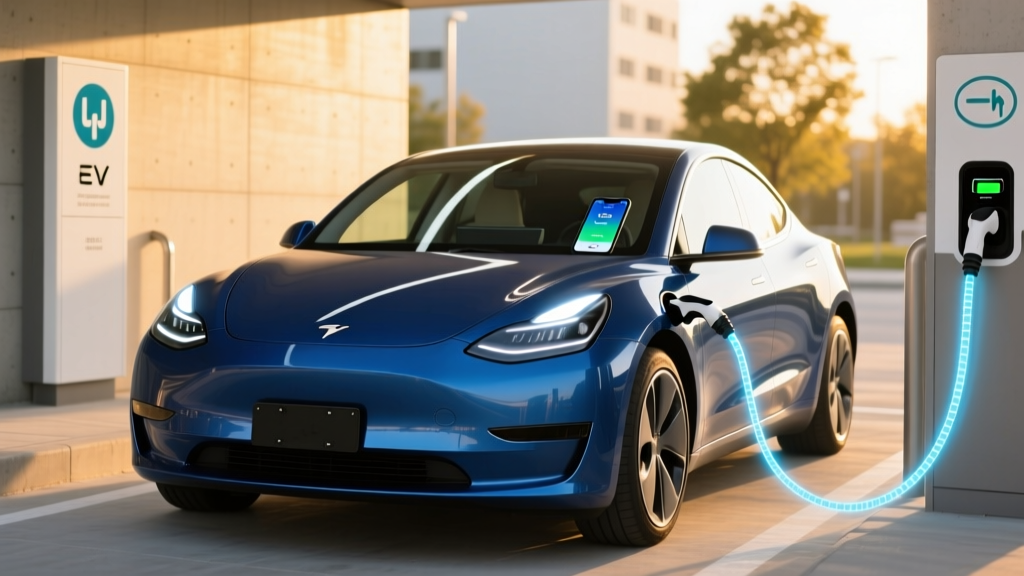
Real-world caveat: DC fast charging doesn't sustain peak power for the full session. A Lucid Air Grand Touring can peak at ~300 kW on a compatible charger but tapers significantly above 60% State of Charge (SoC). Expect the 10–80% average to be closer to 180–200 kW sustained. Similarly, the Tesla Model S Long Range peaks around 250 kW on V3 Superchargers, averaging ~170 kW over a 10–80% session that takes roughly 27 minutes.
Home Charging Installation: Electrical Requirements and Costs
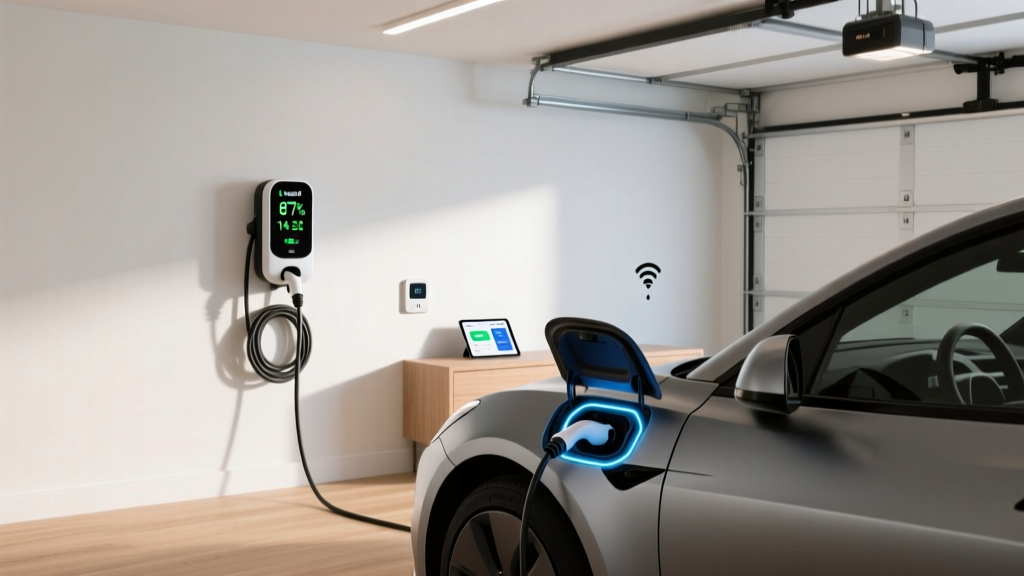
For long-range EVs, a Level 2 home charger is non-negotiable. Most owners of 100+ kWh vehicles target a 48A or 60A circuit to achieve overnight replenishment. Here's what your electrician will evaluate:
Electrical Panel Capacity
A 48A charger requires a dedicated 60A breaker (NEC code requires circuits rated at 125% of continuous load). A 60A charger needs a 75A breaker. Your home's electrical panel must have enough spare capacity to support this alongside existing loads like HVAC, electric range, and dryer.
Panel upgrade reality: Many homes built before 2000 have 100A or 125A service. Adding a 60A EV circuit to a fully loaded 100A panel may require a service upgrade to 200A, which is a significant cost factor. Homes with 200A service and spare breaker slots usually accommodate a Level 2 charger without a panel upgrade.
| Component | Low Estimate | High Estimate | Notes |
|---|---|---|---|
| Level 2 Charger (hardwired, 48A) | $400 | $750 | Smart Wi-Fi-enabled units |
| Electrical permit | $50 | $250 | Varies by municipality |
| Electrician labor (standard install) | $500 | $1,500 | Short run, panel nearby |
| Electrician labor (complex run) | $1,500 | $3,500 | Long conduit run, wall penetration |
| Panel upgrade (if needed) | $1,500 | $4,000 | 100A to 200A service upgrade |
| Total (no panel upgrade) | $950 | $6,000 | Most homes: $1,200–$2,500 |
| Total (with panel upgrade) | $2,450 | $10,000 | Older homes with 100A service |
Code and Safety Requirements
- Dedicated circuit: Your EV charger must have its own breaker — no sharing with other appliances.
- GFCI protection: Required for outdoor installations and many indoor garages per NEC 2023/2026 updates. Hardwired units often include built-in GFCI.
- NEMA 14-50 vs. hardwired: A NEMA 14-50 receptacle (50A) allows portability but limits you to 40A continuous charging. Hardwired 60A or 80A circuits deliver more power and avoid receptacle wear concerns.
- Outdoor rating: If mounted outside, the unit must carry a NEMA 4 or IP65 rating for weather resistance.
Connector Compatibility: NACS, CCS1, and CHAdeMO in 2026
The connector landscape has shifted dramatically. By 2026, the North American Charging Standard (NACS) — originally Tesla's proprietary connector — has become the dominant standard. Most new long-range EVs now ship with NACS charge ports natively, while older CCS1-equipped vehicles may need adapters.
| Brand / Model | Native Connector | CCS Adapter Needed? | CHAdeMO? |
|---|---|---|---|
| Tesla Model S / Model X | NACS | No (CCS adapter available) | No |
| Lucid Air | CCS1 | No | No (NACS adapter available) |
| Rivian R1T / R1S | NACS | No (legacy CCS adapter included) | No |
| Cadillac Lyriq / Escalade IQ | NACS | No | No |
| Ford F-150 Lightning (extended) | NACS | No | No |
| Chevrolet Silverado EV | NACS | No | No |
| Hyundai Ioniq 5 / Kia EV9 (long-range) | NACS (2026 MY) | CCS adapter for older stations | No |
| BMW iX / i7 | CCS1 | No | No (NACS adapter available) |
| Mercedes EQS | CCS1 | No | No (NACS adapter available) |
Adapter note: Tesla sells a CCS-to-NACS adapter (~$175) for accessing non-Tesla DC fast chargers. Ford, Rivian, and GM provide NACS adapters for their CCS-legacy vehicles. If you're buying a used 2023–2024 EV with CCS1, verify adapter availability from the manufacturer before relying solely on the Supercharger network. For Level 2 home charging, all vehicles use the standard J1772 connector (or NACS, which includes J1772 signaling).
Charging Cost Per Mile: Home vs. Public vs. Gas
Long-range EV owners often drive more miles — the range enables it. That makes cost-per-mile a critical ownership metric. Here's a realistic breakdown using a 100 kWh battery vehicle averaging 3.0 miles per kWh (a reasonable efficiency figure for large EVs like the Model S or Lucid Air).
| Scenario | Cost per kWh | Cost per Gallon (equiv.) | Cost per Mile |
|---|---|---|---|
| Home Level 2 (national avg. residential) | $0.16/kWh | $4.80/gal equiv. | $0.053/mi |
| Home Level 2 (off-peak TOU rate) | $0.08/kWh | $2.40/gal equiv. | $0.027/mi |
| Home Level 2 (California peak) | $0.35/kWh | $10.50/gal equiv. | $0.117/mi |
| Public Level 2 (ChargePoint, EVgo) | $0.25–$0.40/kWh | $7.50–$12.00/gal equiv. | $0.083–$0.133/mi |
| DC Fast (Tesla Supercharger avg.) | $0.30–$0.40/kWh | $9.00–$12.00/gal equiv. | $0.100–$0.133/mi |
| DC Fast (Electrify America) | $0.35–$0.55/kWh | $10.50–$16.50/gal equiv. | $0.117–$0.183/mi |
| Gas vehicle (25 MPG, $3.50/gal) | — | $3.50/gal | $0.140/mi |
| Gas vehicle (25 MPG, $4.50/gal) | — | $4.50/gal | $0.180/mi |
Key takeaway: Home charging on off-peak rates delivers fuel costs at roughly one-fifth the price of gasoline. Even at peak California rates, EV charging at home undercuts most gas vehicles. Public DC fast charging, however, can approach or exceed gas costs — it's a convenience premium, not a savings strategy. For long-range EV owners, maximizing home charging is the economic play.
According to fueleconomy.gov, the 2025 Lucid Air Grand Touring achieves 146 MPGe combined (23 kWh/100 mi), while the Tesla Model S Long Range posts 120 MPGe combined (28 kWh/100 mi). These efficiency figures directly determine your cost per mile — more efficient vehicles save more even on expensive electricity.
Best Level 2 Home Chargers for Long-Range EVs (2026 Picks)
When you're refilling a 100+ kWh battery overnight, charger power output and reliability matter enormously. Here are our top picks for long-range EV owners, all supporting the J1772/NACS Level 2 standard:
ChargePoint Home Flex (NACS version)
- Power: Up to 19.2 kW (80A on hardwired 100A circuit) / 12 kW on 60A circuit
- Connector: NACS (also available in J1772)
- Cable length: 23 ft
- Smart features: Wi-Fi, scheduling, Alexa integration, energy dashboard
- Price: ~$650–$750
- Best for: Maximum home charging speed for Lucid Air, Silverado EV, and other 19.2 kW-capable vehicles
Tesla Wall Connector (NACS)
- Power: Up to 11.5 kW (48A on 60A circuit)
- Connector: NACS native
- Cable length: 24 ft
- Smart features: Wi-Fi, over-the-air updates, power sharing (pair two units on one circuit), load management
- Price: ~$475
- Best for: Tesla owners wanting a reliable, well-integrated unit at a strong price
Emporia Vue Level 2 Charger
- Power: Up to 11.5 kW (48A) / configurable down to 32A
- Connector: J1772 (NACS adapter included for 2026 models)
- Cable length: 24 ft
- Smart features: Energy monitoring, solar integration, time-of-use scheduling, whole-home panel integration
- Price: ~$400
- Best for: Budget-conscious buyers who want energy monitoring and solar-aware charging
Grizzl-E Smart (United Chargers)
- Power: Up to 11.5 kW (48A) / dip-switch adjustable to 40A, 32A, 24A, 16A
- Connector: J1772 (NACS version available)
- Cable length: 24 ft
- Smart features: OCPP-compatible, load balancing, durable aluminum enclosure, -40°F rated
- Price: ~$500–$550
- Best for: Cold-climate and outdoor installations where durability matters
DC Fast Charging Strategy for Long-Range EV Road Trips
Long-range EVs shine on road trips because they minimize stops. But when you do stop, charging speed determines whether it's a 15-minute break or a 45-minute wait. Here's how to optimize:
Preconditioning is mandatory. Before arriving at a DC fast charger, your battery needs to be at optimal temperature (typically 85–95°F for NMC chemistry). Tesla navigation routes through Superchargers automatically trigger preconditioning. For non-Tesla EVs, use the vehicle's built-in navigation to route to the charger — this activates thermal prep. Without preconditioning, peak charge rates can drop by 30–50% in cold weather.
Understand the charge curve. Lithium-ion batteries accept charge fastest between 10% and 50% SoC, then progressively taper. A Lucid Air might pull 300 kW at 15% SoC but drop to 80 kW by 75%. For road trips, charge from 10% to 65–70% and move on — the last 10–15% takes disproportionately long.
Choose 350 kW chargers when available. Networks like Electrify America, EVgo, and Ionity (in Europe) deploy 350 kW CCS/NACS stations. Even if your EV can't accept the full 350 kW, these chargers can sustain higher rates longer than 150 kW units. The Chevrolet Silverado EV and Hyundai Ioniq 5 (with 800V architecture) can accept 350 kW peaks, completing 10–80% in roughly 18 minutes.
Federal Tax Credits and Incentives for Home Charging Equipment
The IRS §30C Alternative Fuel Vehicle Refueling Property Credit covers up to 30% of home EV charger equipment and installation costs, capped at $1,000. This credit applies to both the charger hardware and the electrician's labor for the dedicated circuit.
Key eligibility requirements for 2026:
- The charger must be installed at your primary residence in the United States.
- The property must be in an eligible census tract (generally non-urban or lower-income areas — check the IRS locator tool).
- The credit is non-refundable but can offset your federal tax liability.
- Both Level 2 hardwired chargers and NEMA 14-50 receptacle installations qualify.
For the EV itself, the §30D Clean Vehicle Credit offers up to $7,500 for new EVs meeting battery-sourcing and critical-mineral requirements, subject to MSRP caps ($55,000 for sedans, $80,000 for SUVs/trucks/vans) and buyer income limits ($150,000 single / $300,000 joint). Many long-range EVs exceed these MSRP caps — the Lucid Air Grand Touring at $125,600 MSRP does not qualify, while a properly trimmed Ford F-150 Lightning or Chevrolet Silverado EV may. Always verify current-year rules with a tax professional.
Frequently Asked Questions
How much does it cost to install a home EV charger?
Most homes with 200A electrical service and a nearby panel spend $1,200 to $2,500 total (charger + electrician + permit) for a 48A Level 2 installation. Homes requiring a panel upgrade from 100A to 200A service can see total costs of $3,000 to $10,000. Get at least two quotes from licensed electricians and confirm they have EV charger installation experience.
How fast will each charging level add range?
Level 1 (120V) adds 3–5 miles per hour — essentially useless for 100+ kWh batteries. Level 2 at 48A (11.5 kW) adds 33–42 miles per hour, enough to refill most long-range EVs overnight in 7–9 hours. DC fast charging at 250 kW adds the equivalent of 500–900 miles per hour at peak, delivering a 10–80% charge in 20–35 minutes depending on the vehicle.
Which connector/charger is compatible with my EV?
For 2026 models, most American-market long-range EVs use NACS natively (Tesla, Rivian, Ford, GM, Hyundai/Kia). European luxury brands (BMW, Mercedes, Porsche, Lucid) still use CCS1 but offer NACS adapters. All Level 2 home chargers use either a NACS plug or J1772 plug — both deliver identical power, just different physical connectors. Check your vehicle's charge port before buying a charger.
How much does charging cost per mile vs. gas?
At the national average residential rate of $0.16/kWh, a long-range EV averaging 3 mi/kWh costs about $0.053 per mile — roughly one-third the cost of a 25 MPG gas car at $3.50/gallon ($0.14/mi). Off-peak home rates can drop EV fuel costs below $0.03/mi. Public DC fast charging at $0.35–$0.55/kWh narrows the gap to $0.12–$0.18/mi, comparable to or slightly above gas.
What electrical upgrades might I need?
The most common upgrade is a 200A panel service for older homes with 100A or 125A panels. If your panel is full (no spare breaker slots), you may need a sub-panel or a load-management device that dynamically reduces charger power when other appliances cycle on. Some utilities offer incentives or rebates for panel upgrades paired with EV charger installation — check with your local provider. A licensed electrician can perform a load calculation to determine if your current panel supports a 60A or 80A EV circuit without an upgrade.