The Real Numbers Behind Electric Car Charging Time
Search "how long does it take to charge an EV" and you'll get answers ranging from 20 minutes to 50 hours — all technically correct, all practically useless without context. Electric car charging time depends on three variables: your battery's usable capacity (measured in kWh, or kilowatt-hours, the energy stored), the power delivery rate of your charger (measured in kW, or kilowatts, the speed of delivery), and your vehicle's onboard charge acceptance curve.
Conflating kW and kWh is the single most common mistake in EV charging discussions. Think of it like filling a bucket: kWh is the bucket's size, and kW is the diameter of the hose. A 75 kWh battery charged at 11.5 kW (a typical Level 2 home charger) takes roughly 6.5 hours from empty. That same battery on a 250 kW DC fast charger can go from 10% to 80% in about 18–25 minutes — but only because the car throttles the charge rate as the battery fills to protect cell health.
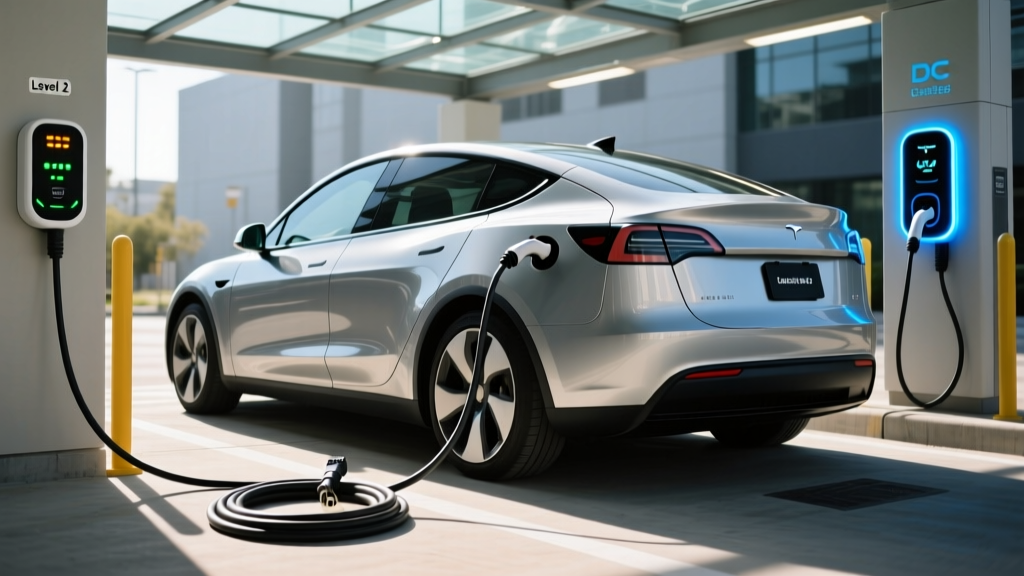
Charging Levels: Speeds, Range Added, and Real-World Times
Every EV sold in the U.S. charges across one or more of three standardized levels. Here's what each actually delivers in practice — not the marketing peak, but sustained real-world output.
| Level | Voltage / Amperage | Power (kW) | Miles of Range per Hour | Typical Use Case |
|---|---|---|---|---|
| Level 1 | 120V / 12A | 1.4 kW | 3–5 mi/hr | Overnight trickle; emergency top-up |
| Level 2 | 240V / 32–48A | 7.7–11.5 kW | 25–44 mi/hr | Home daily charging; workplace |
| DC Fast (Level 3) | 400–800V DC | 50–350 kW | 150–1,000+ mi/hr (peak) | Road trips; highway corridors |
Charging Time Examples: 10% to 80% by Battery Size
Most EV owners charge between 10% and 80% state of charge (SoC) for daily use — charging beyond 80% slows dramatically as the battery management system (BMS) tapers current to protect cell longevity. Here's what that looks like across common battery sizes:
- 40 kWh battery (e.g., base Nissan LEAF): Level 2 at 7.7 kW ≈ 4 hours; 50 kW DCFC ≈ 45 min
- 75 kWh battery (e.g., Tesla Model Y Long Range): Level 2 at 11.5 kW ≈ 4.5 hours; 250 kW DCFC ≈ 22 min (with preconditioning)
- 84 kWh battery (e.g., Hyundai Ioniq 5): Level 2 at 10.9 kW ≈ 5 hours; 350 kW DCFC ≈ 18 min on 800V architecture
- 100 kWh battery (e.g., Ford F-150 Lightning Extended Range): Level 2 at 11.5 kW ≈ 6 hours; 150 kW DCFC ≈ 40 min
Notice the DC fast charge times are for 10–80% only. Charging from 80–100% on a DC fast charger can take as long as the 10–80% segment because the charge curve tapers sharply. This is why road-trip strategy favors shorter, more frequent stops between 10–80% rather than one long stop to full.
Home Charger Installation: Electrical Requirements and Real Costs
Level 2 home charging is where most EV owners do 80–90% of their charging. But the sticker price of the charger itself is only part of the equation. Installation costs vary wildly depending on your home's electrical panel, the distance from panel to charger location, and local permitting requirements.
Electrical Requirements for Level 2 Charging
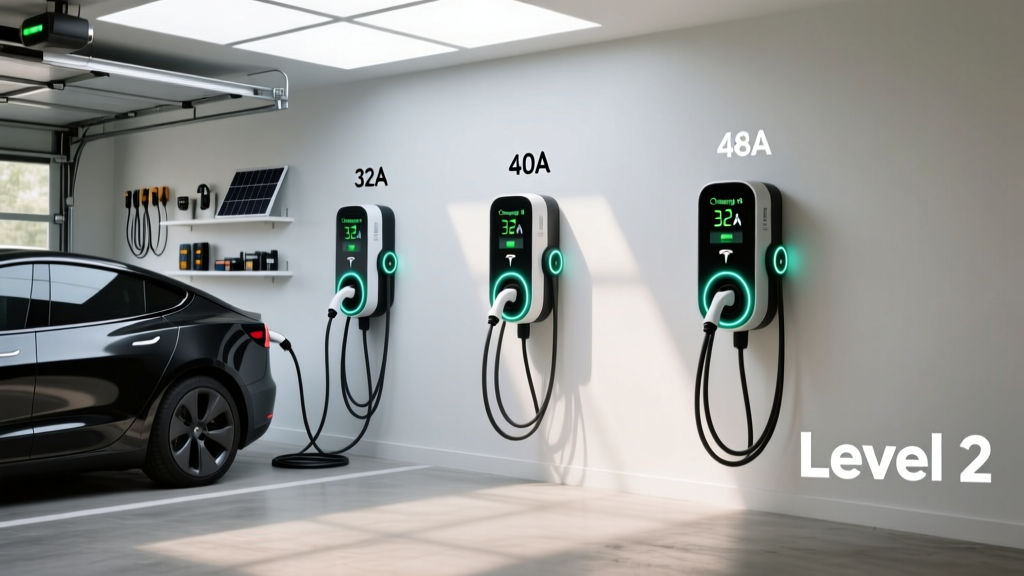
A Level 2 charger requires a dedicated 240V circuit — the same voltage your electric dryer or oven uses. The amperage determines your charging speed:
- 32A circuit (40A breaker): Delivers 7.7 kW. Requires a NEMA 14-50 outlet or hardwired connection with 8 AWG copper wire.
- 40A circuit (50A breaker): Delivers 9.6 kW. Requires 6 AWG copper wire.
- 48A circuit (60A breaker): Delivers 11.5 kW. Requires 4 AWG copper wire and must be hardwired (no plug — NEC code requires hardwiring for circuits over 50A).
Your home's electrical panel must have enough spare capacity to support the new circuit. Most modern 200A panels can accommodate a 40–60A EV circuit without issue. Older homes with 100A or 150A service may require a panel upgrade to 200A, which adds $1,500–$3,500 to the project.
Installation Cost Breakdown
| Component | Budget Scenario | Typical Scenario | Complex Scenario |
|---|---|---|---|
| Level 2 Charger (Equipment) | $300–$400 | $400–$650 | $500–$750 |
| Electrician Labor | $300–$500 | $500–$1,200 | $1,200–$2,500 |
| Permit & Inspection | $50–$150 | $100–$300 | $150–$400 |
| Panel Upgrade (if needed) | $0 | $0 | $1,500–$3,500 |
| Total Installed Cost | $650–$1,050 | $1,000–$2,150 | $3,350–$7,150 |
The "budget scenario" assumes your panel has spare capacity, the charger mounts on a wall directly adjacent to the panel (short wire run), and your locality has modest permit fees. The "complex scenario" reflects older homes needing a panel upgrade, long conduit runs (garage on the opposite side of the house from the panel), and higher-cost jurisdictions. Always get at least two quotes from licensed electricians and confirm they pull a permit — unpermitted work can void homeowner's insurance claims and cause problems at resale.
Connector Compatibility: NACS, CCS, and CHAdeMO Explained
The EV charging connector landscape has consolidated significantly since 2024, when Ford, GM, Rivian, Volvo, and most major automakers announced adoption of Tesla's North American Charging Standard (NACS) for their North American vehicles. By the 2026 model year, NACS is the dominant connector for new EVs sold in the U.S., though CCS1 remains common on vehicles sold between 2019 and 2024.
| Connector | Brands Using It (2026 Models) | Max DCFC Power | Adapter Needed? |
|---|---|---|---|
| NACS (J3400) | Tesla (all), Ford, GM, Rivian, Volvo, Polestar, Mercedes, Hyundai/Kia (select 2026+), Toyota, BMW | Up to 350 kW | No — native on new vehicles. CCS-to-NACS adapters available (~$200–$300) for CCS-equipped cars. |
| CCS1 | Legacy EVs (2019–2024): VW ID.4, Hyundai Ioniq 5 (pre-2026), Kia EV6 (pre-2026), BMW i4, most Stellantis | Up to 350 kW | NACS-to-CCS adapter needed for Tesla Superchargers. Many CCS networks still operational. |
| CHAdeMO | Nissan LEAF (discontinued), Mitsubishi Outlander PHEV (older) | Up to 100 kW (typically 50 kW) | CHAdeMO stations declining. No reliable adapter to NACS/CCS for DCFC. |
For Level 2 home and public AC charging, all vehicles use the J1772 connector (or NACS, which handles both AC and DC in a single port on Tesla and newer adopters). If you own a CCS-equipped vehicle and want to charge at Tesla Superchargers, you'll need a NACS-to-CCS adapter — Tesla and third-party manufacturers sell these for $200–$300. Confirm adapter compatibility with your specific model year before purchasing.
Level 2 Home Charger Recommendations: What to Buy in 2026
Not all Level 2 chargers are equal. The critical specs are maximum power output (kW), cable length, connector type, smart features (Wi-Fi scheduling, load management), and whether the unit is hardwired or plug-in. Here are proven picks across budgets:
Best Overall: ChargePoint Home Flex
- Power: Up to 11.5 kW (48A) — configurable down to 16A
- Connector: J1772 (NACS adapter included with select bundles)
- Cable: 23 feet
- Smart Features: Wi-Fi, Alexa, scheduled charging, energy tracking, load sharing between two units
- Installation: Hardwired or NEMA 14-50 plug
- Price: ~$550–$650
Why: Flexible amperage means you can install it on a 40A or 60A circuit depending on your panel capacity. UL-listed, Energy Star certified.
Best Value: Emporia Level 2 EV Charger
- Power: Up to 11.5 kW (48A)
- Connector: J1772 (NACS version available)
- Cable: 24 feet
- Smart Features: Wi-Fi, app scheduling, solar integration, real-time energy monitoring
- Installation: Hardwired or NEMA 14-50
- Price: ~$350–$400
Why: Lowest-cost 48A smart charger on the market. Pairs with Emporia Vue energy monitor for whole-home load management — ideal for homes near panel capacity limits.
Premium Pick: Tesla Wall Connector
- Power: Up to 11.5 kW (48A)
- Connector: NACS native (J1772 adapter available)
- Cable: 24 feet
- Smart Features: Wi-Fi, power sharing between units, over-the-air updates, integrates with Tesla app
- Installation: Hardwired only
- Price: ~$475
Why: Best-in-class for NACS-native vehicles. Sleek design. Power-sharing feature lets you install two units on a single 60A circuit — useful for two-EV households.
Best for Outdoor Install: Grizzl-E Smart
- Power: Up to 10 kW (40A)
- Connector: J1772 or NACS
- Cable: 24 feet
- Smart Features: Wi-Fi, OCPP protocol, adjustable amperage
- Installation: Hardwired or NEMA 14-50
- Price: ~$450–$550
Why: IP67-rated enclosure, -40°F to +122°F operating range, built in Canada for harsh winters. Best choice for driveway or carport installations without a garage.
Safety and Code Requirements
The National Electrical Code (NEC) governs EV charger installations. Key requirements your electrician must follow:
- Dedicated circuit: Your EV charger must have its own breaker — no sharing with other outlets or appliances.
- GFCI protection: NEC 2020 and later requires ground-fault circuit interrupter protection for all EV charging outlets (hardwired units typically have GFCI built in).
- Continuous load derating: EV charging is classified as a continuous load, meaning the circuit must be rated for 125% of the charger's maximum draw. A 48A charger requires a 60A breaker.
- Outdoor rating: Outdoor installations require NEMA 4-rated (weatherproof) enclosures and connectors rated for wet locations.
- Wire gauge: Must match circuit amperage — undersized wire is a fire hazard and will fail inspection.
Cost to Charge: Home vs. Public vs. Gas
The economics of EV charging depend on your electricity rate, which varies by utility, time of day, and state. Here's a realistic comparison using a mid-size EV with 3.5 miles per kWh efficiency (typical for a Tesla Model Y or Hyundai Ioniq 5) versus a comparable 28 MPG gas vehicle on $3.40/gallon regular unleaded.
| Charging Scenario | Rate ($/kWh) | Cost per Mile | Annual Cost (12,000 mi) |
|---|---|---|---|
| Home — Off-Peak (Time-of-Use) | $0.08–$0.12 | $0.023–$0.034 | $275–$410 |
| Home — Standard Rate (no TOU) | $0.14–$0.18 | $0.040–$0.051 | $480–$615 |
| Public Level 2 (ChargePoint, etc.) | $0.25–$0.49 | $0.071–$0.140 | $855–$1,680 |
| DC Fast Charging (EA, EVgo, Tesla) | $0.30–$0.55 | $0.086–$0.157 | $1,030–$1,885 |
| Gas Vehicle (28 MPG, $3.40/gal) | — | $0.121 | $1,455 |
The takeaway is stark: home off-peak charging costs 70–80% less per mile than gasoline. Even standard-rate home charging undercuts gas by 55–65%. But exclusive reliance on DC fast charging erases most of the cost advantage — and accelerates battery degradation due to sustained high-current heat exposure. According to fueleconomy.gov, most EV owners who charge primarily at home report fuel costs of $500–$650 annually versus $1,400–$1,800 for a comparable gas vehicle.
Understanding the DC Fast Charging Curve
Marketing materials advertise "up to 350 kW" charging, but no EV sustains peak rate for the entire session. The DC fast charging curve is nonlinear: the battery accepts maximum current at low states of charge, then progressively tapers as SoC and cell temperature rise.
A typical charging session on a 250 kW-capable vehicle at a 350 kW charger looks like this:
- 10–30% SoC: Near-peak rate (200–250 kW) — fastest segment
- 30–60% SoC: Moderate taper (150–200 kW)
- 60–80% SoC: Significant taper (80–130 kW)
- 80–100% SoC: Dramatic taper (20–50 kW) — why you skip this on road trips
This is why the industry measures DC fast charging time as 10–80%, not 0–100%. The average sustained rate over a 10–80% session is typically 60–70% of the advertised peak. A vehicle rated for "up to 250 kW" will average roughly 150–175 kW over a real-world session.
Frequently Asked Questions
How much does it cost to install a home EV charger?
Most homeowners spend between $1,000 and $2,150 for a professionally installed Level 2 charger, including equipment ($350–$650), electrician labor ($500–$1,200), and permits ($100–$300). Homes needing a 200A electrical panel upgrade can see total costs reach $3,500–$7,000. Always get itemized quotes and ensure your electrician pulls a permit.
How fast will each charging level add range?
Level 1 (120V) adds 3–5 miles of range per hour. Level 2 (240V) adds 25–44 miles per hour depending on amperage. DC fast charging adds 150–1,000+ miles per hour at peak rates, but sustained rates taper as the battery fills. For daily driving, Level 2 overnight charging replenishes 200+ miles in 8 hours — enough for virtually any commute.
Which connector/charger is compatible with my EV?
For 2026 model-year vehicles, most new EVs use the NACS (J3400) connector. Vehicles from 2019–2024 typically use CCS1. The Nissan LEAF uses CHAdeMO. Check your vehicle's charge port or owner's manual. For home Level 2 charging, all non-Tesla EVs use J1772; Teslas use NACS. Adapters are available for cross-compatibility at public DC fast chargers.
How much does charging cost per mile vs. gas?
Home off-peak charging costs $0.02–$0.03 per mile — roughly 75–80% less than a 28 MPG gas car at $3.40/gallon ($0.12/mile). Standard-rate home charging runs $0.04–$0.05/mile. Public DC fast charging at $0.35–$0.55/kWh costs $0.09–$0.16/mile, which approaches or exceeds gas costs depending on fuel prices.
What electrical upgrades might I need?
If your home has a 200A electrical panel with available breaker slots, you likely need no upgrade beyond the dedicated 240V circuit. Homes with 100A or 150A panels, or panels that are near capacity (common with electric heating, AC, and appliances), may need a panel upgrade to 200A. An electrician can perform a load calculation to determine your panel's remaining capacity. Some utilities offer rebates or free upgrades for EV adopters.
Can I charge my EV with solar panels?
Yes, but indirectly. Solar panels feed your home's electrical system; your EV charger draws from that system. If you generate excess solar during the day, you can schedule charging to coincide with peak production (many smart chargers support solar-aware scheduling). Systems like the Emporia charger paired with a home energy monitor can prioritize solar surplus for EV charging, effectively reducing your per-mile cost toward zero during sunny months.