Why Your Home Charging Setup Matters More Than Your EV's Range
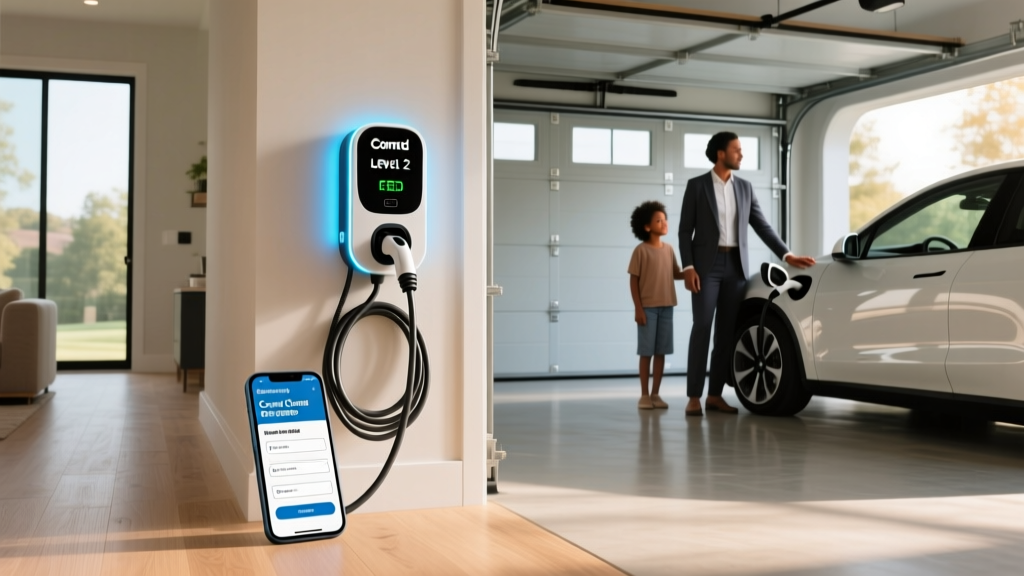
The single biggest quality-of-life upgrade in EV ownership isn't a longer-range battery — it's a proper home charging station. Over 80% of EV charging happens at home, and the difference between plugging into a standard 120V wall outlet and a dedicated 240V Level 2 station is the difference between adding 4 miles of range overnight versus waking up to a full battery every morning.
This guide covers every decision point for installing an electric car charging station home setup in 2026: charging levels and real-world speeds, electrical requirements and panel upgrades, connector compatibility across every major brand, true cost-per-mile versus gasoline, and specific charger recommendations with pricing.
Before we get into the details, one critical distinction that trips up new EV owners: kW (kilowatts) measures power — the rate at which energy flows into your battery, like water pressure from a hose. kWh (kilowatt-hours) measures energy — the total capacity stored in your battery, like gallons in a tank. A 60 kWh battery charged at 10 kW takes roughly 6 hours. Confusing these two is the most common EV literacy mistake; we'll use them precisely throughout.
Charging Levels Explained: Speeds, Times, and Real-World Range Added
There are three charging levels available to EV owners. Each serves a different use case, and understanding the actual miles-per-hour added is essential for planning your home setup.
| Level | Voltage | Max Power (kW) | Miles of Range Added/Hour | 10–80% Time (60 kWh Battery) | Best For |
|---|---|---|---|---|---|
| Level 1 | 120V AC | 1.4–1.9 kW | 3–5 mi/hr | ~40–50 hours (not practical) | PHEVs, emergency backup, low-mileage drivers |
| Level 2 | 240V AC | 3.3–19.2 kW | 12–75 mi/hr | ~3.5–9 hours | Daily home charging, overnight top-ups |
| DC Fast Charging | 400–800V DC | 50–350 kW | 150–1,200+ mi/hr | ~18–45 minutes | Road trips, quick top-ups away from home |
A few real-world caveats on these numbers:
- Level 1 is adequate for plug-in hybrids with small batteries (10–20 kWh) that can fully recharge overnight. For a full BEV with a 75+ kWh battery, Level 1 is essentially an emergency trickle — you'd need multiple days for a full charge.
- Level 2 at 48A (11.5 kW) is the sweet spot for most homes with a NEMA 14-50 outlet or hardwired connection. A vehicle like the Hyundai Ioniq 5 (77.4 kWh usable battery) will go from 10% to 80% in about 5.5 hours at this rate — perfect for overnight charging.
- DC fast charging speeds are peak, not sustained. A charger rated at 250 kW may only deliver that rate between 10–30% state of charge before tapering. The Hyundai Ioniq 5 peaks at 240 kW on an 800V architecture and reaches 10–80% in roughly 18 minutes under ideal conditions, but expect 25–30 minutes in cold weather or at crowded stations where power is shared.
Home Installation Requirements: Electrical Specs, Panel Upgrades, and Permits
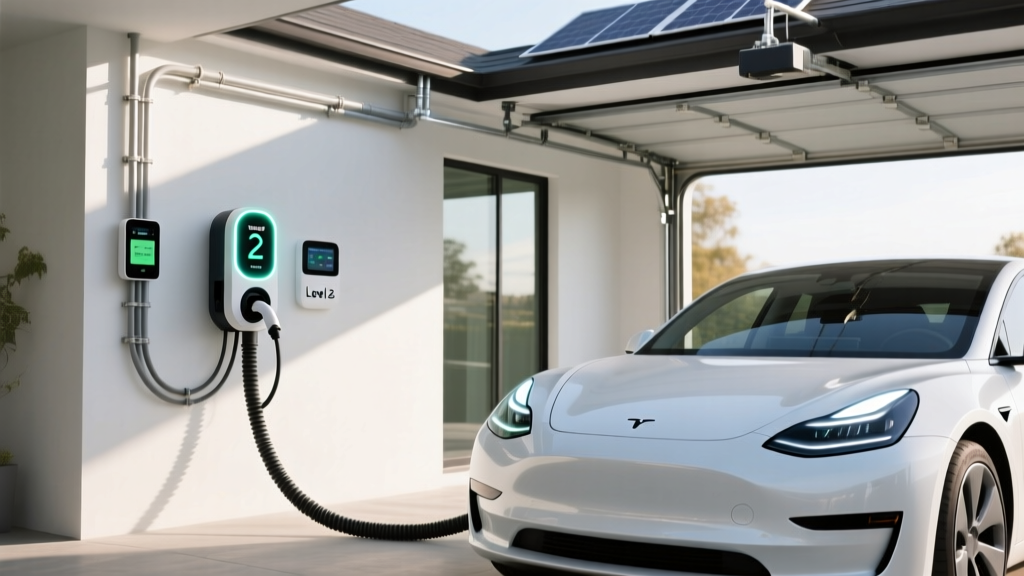
Most Level 2 home charging stations require a dedicated 240V circuit, similar to what powers an electric dryer or oven. Here's what the installation actually involves:
Electrical Specifications
- Standard setup: 240V, 40A or 48A dedicated circuit (NEMA 14-50 receptacle or hardwired)
- Breaker sizing: The National Electrical Code (NEC) requires the breaker to be rated at 125% of the continuous load. A 48A charger needs a 60A breaker; a 40A charger needs a 50A breaker.
- Wire gauge: 6 AWG copper for 48A/60A circuits; 8 AWG for 40A/50A circuits (varies by run length and local code)
- Hardwired vs. plug: Hardwired installations support higher amperage (48A–80A) and avoid the NEC 80% derating rule that limits plug-in units to 40A continuous on a 50A breaker. Hardwired is generally recommended for dedicated EV circuits.
Panel Upgrade: The Hidden Cost for Older Homes
If your home has a 100A electrical panel (common in homes built before 2000), adding a 48A EV circuit may exceed your panel's capacity. A licensed electrician will perform a load calculation to determine if your panel can handle the additional draw. If it can't, you'll need a panel upgrade to 200A — a significant added expense.
Some newer solutions like the Span smart panel or load-management devices (e.g., Emporia Load Management) can avoid a full panel upgrade by dynamically reducing EV charging when other appliances are running. This is worth asking your electrician about.
Permits and Inspections
Most jurisdictions require an electrical permit for a new 240V circuit. The permit ensures the work is inspected and meets NEC code. Skipping permits can void home insurance claims and create problems at resale.
How Much Does It Cost to Install a Home EV Charger?
Installation costs vary enormously depending on your home's electrical infrastructure, the distance from your panel to the charging location, and local labor rates. Here's a realistic breakdown:
| Component | Simple Install (Panel Nearby) | Standard Install (Moderate Run) | Complex Install (Panel Upgrade Needed) |
|---|---|---|---|
| Level 2 Charger (Equipment) | $350–$700 | $350–$700 | $350–$700 |
| Electrician Labor | $300–$600 | $600–$1,200 | $1,200–$2,500 |
| Permit Fee | $50–$150 | $50–$200 | $100–$300 |
| Panel Upgrade (if needed) | $0 | $0 | $1,500–$3,500 |
| Conduit/Wire/Materials | $50–$150 | $150–$400 | $200–$500 |
| Total Estimated Cost | $750–$1,600 | $1,150–$2,500 | $3,350–$7,500 |
Federal incentive: The IRS §30D tax credit applies to vehicles, not chargers, but the Residential Clean Energy Credit (§25D) expired for standalone charger equipment at the end of 2025. Some utilities and states still offer rebates — check with your local provider and the AFDC state incentive database for current programs in your area.
Connector Compatibility: NACS, CCS1, CHAdeMO, and What You Need
The connector landscape has consolidated significantly since Tesla opened its Supercharger network and the North American Charging Standard (NACS) was adopted industry-wide. Here's where things stand in 2026:
| Connector | Brands Using It (New Vehicles) | Home Charger Availability | Adapter Needed? |
|---|---|---|---|
| NACS (J3400) | Tesla, Ford, GM, Rivian, Volvo, Polestar, Mercedes, Nissan (new), Honda (new) | Widely available — Tesla Wall Connector, ChargePoint, Emporia, Grizzl-E | CCS-to-NACS adapters available (~$150–$250) for older CCS vehicles |
| CCS1 | Hyundai, Kia, BMW, VW, legacy models from Ford/GM pre-2025 | Available — ChargePoint, JuiceBox, Emporia (some models) | NACS-to-CCS adapter needed at Tesla Superchargers |
| CHAdeMO | Nissan Leaf (legacy, discontinued 2025), Mitsubishi Outlander PHEV | Limited — few home chargers support CHAdeMO DC | No practical home adapter; CHAdeMO is being phased out |
Key takeaway: If you're buying a new EV in 2026, it almost certainly uses NACS. Buy a NACS-compatible Level 2 home charger. If you own a CCS-equipped vehicle from 2022–2025, you can either install a CCS home charger or use a NACS charger with a CCS-to-NACS adapter (sold by Tesla and third parties).
Charging Cost Per Mile: Home vs. Public vs. Gasoline
One of the strongest economic arguments for EVs is lower fueling cost — but the savings depend heavily on where you charge. Here's a realistic cost-per-mile comparison:
| Charging Scenario | Avg. Cost | Cost/Mile (4 mi/kWh EV) | Annual Cost (12,000 mi) |
|---|---|---|---|
| Home (national avg. electricity, ~$0.16/kWh) | $0.16/kWh | $0.040 | $480 |
| Home (off-peak TOU rate, ~$0.09/kWh) | $0.09/kWh | $0.023 | $270 |
| Public Level 2 (avg. ~$0.30/kWh) | $0.30/kWh | $0.075 | $900 |
| DC Fast Charging (avg. ~$0.42/kWh) | $0.42/kWh | $0.105 | $1,260 |
| Gasoline car (28 MPG combined, $3.40/gal) | $3.40/gal | $0.121 | $1,457 |
The math is clear: home charging on off-peak rates saves roughly $1,187/year versus gasoline for a typical driver covering 12,000 miles. Even at national average electricity rates, home charging costs less than a third of gasoline per mile.
However, exclusive reliance on DC fast charging narrows the gap significantly — at $0.42/kWh, you're saving only about $200/year versus gas. This is why a home charging station isn't just a convenience; it's central to the EV ownership economics.
Best Home EV Chargers for 2026: Specific Picks With Specs and Prices
These recommendations are based on power output, reliability, smart features, cable length, and connector support. All prices reflect MSRP as of early 2026.
Best Overall: ChargePoint Home Flex (NACS)
- Power: Up to 12 kW (50A) on a 60A circuit, adjustable down to 16A
- Connector: NACS (J3400) native; CCS adapter included in box
- Cable length: 23 feet
- Smart features: Wi-Fi, app scheduling, Alexa/Google integration, energy tracking
- Price: ~$549
- Hardwired or plug: Both supported (NEMA 14-50 plug included)
Best Value: Emporia Vue Level 2 Charger
- Power: Up to 11.5 kW (48A)
- Connector: NACS or J1772 (select at purchase)
- Cable length: 24 feet
- Smart features: Wi-Fi, app control, integrates with Emporia Vue energy monitor for whole-home load tracking
- Price: ~$399
- Hardwired or plug: Hardwired recommended for 48A; NEMA 14-50 available
Best for Durability: Grizzl-E Smart (United Chargers)
- Power: Up to 10 kW (40A)
- Connector: NACS or J1772
- Cable length: 24 feet
- Smart features: OCPP-compatible, app control, firmware updates
- Price: ~$449
- Built for: Outdoor installation, extreme cold (rated to -40°F), aluminum enclosure
Best for Tesla Owners: Tesla Wall Connector (Gen 4)
- Power: Up to 11.5 kW (48A)
- Connector: NACS native
- Cable length: 24 feet
- Smart features: Wi-Fi, over-the-air updates, Power-Share (load balancing with two units on one circuit)
- Price: ~$450
- Note: Works with any NACS-equipped vehicle, not just Tesla
Safety, Code, and Installation Best Practices
EV charging involves sustained high-current draw — often 8+ hours at full amperage. This is more demanding than most household appliances and requires proper installation to avoid fire risk.
Non-Negotiable Safety Requirements
- Dedicated circuit: Your EV charger must be on its own dedicated breaker — never shared with other outlets or appliances.
- Proper breaker sizing: Continuous loads (3+ hours) must be limited to 80% of breaker rating. A 50A breaker supports 40A continuous; a 60A breaker supports 48A.
- GFCI protection: NEC 2020 and later requires GFCI protection for outdoor receptacles. Hardwired EV chargers with built-in ground-fault protection may satisfy this requirement — confirm with your local inspector.
- Outdoor rating: If mounting outside, ensure the charger is NEMA 4 rated (weatherproof). All chargers listed above are outdoor-rated.
- Cable management: Use a holster or retractable mount to keep the cable off the ground and prevent tripping hazards and connector damage.
- Never use extension cords: Standard household extension cords are not rated for sustained EV charging loads and create a serious fire hazard.
Always hire a licensed electrician for the 240V circuit installation. Per the National Electrical Code (NEC), this work requires a permit and inspection in virtually all US jurisdictions. DIY electrical work on 240V circuits is dangerous and may invalidate your homeowner's insurance.
Frequently Asked Questions
Can I just plug my EV into a regular wall outlet?
Yes, using the Level 1 cord that comes with most EVs. However, Level 1 adds only 3–5 miles of range per hour. For a 60 kWh battery, a full charge from empty takes 35–45 hours. Level 1 works for PHEVs with small batteries or BEV owners who drive under 30 miles daily and can top up over multiple nights. For anything beyond that, a Level 2 station is strongly recommended.
What if my electrical panel is full or too small?
A licensed electrician can perform a load calculation. Options include: (1) upgrading to a 200A panel ($1,500–$3,500), (2) installing a smart load-management device that throttles EV charging when other heavy loads are active, or (3) using a lower-amperage charger (e.g., 32A instead of 48A) to stay within your panel's capacity. Option 2 often costs $200–$500 and avoids a full panel upgrade.
Do I need a smart charger, or is a "dumb" charger fine?
A smart charger with Wi-Fi and app control lets you schedule charging during off-peak hours (saving money on time-of-use electricity plans), monitor energy usage, and receive firmware updates. If your utility offers TOU rates, a smart charger pays for its price premium within months. A non-smart charger is fine if you're on a flat-rate plan and just want simplicity.
How long does a Level 2 charger take to fully charge my EV?
It depends on battery size and charger amperage. A 77 kWh battery (like the Hyundai Ioniq 5 Long Range) charging at 11.5 kW (48A) goes from 10% to 100% in about 7 hours. A 10–80% charge takes roughly 5.5 hours. Most EV owners charge between 20–80% daily to preserve battery longevity, which means a typical overnight session takes 3–5 hours.
Will installing a home charger increase my home's value?
Studies from Zillow and Realtor.com have shown homes with EV charging infrastructure sell at a modest premium (1–3%) in markets with high EV adoption. A properly permitted, hardwired Level 2 station is viewed as a modern home upgrade — similar to a renovated electrical system. Keep your permit documentation and charger warranty for potential buyers.