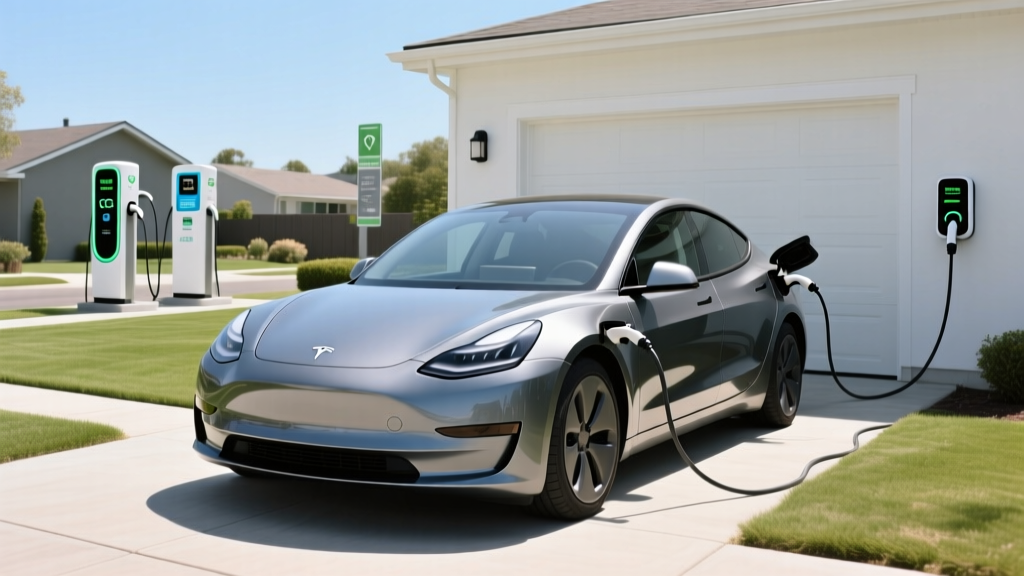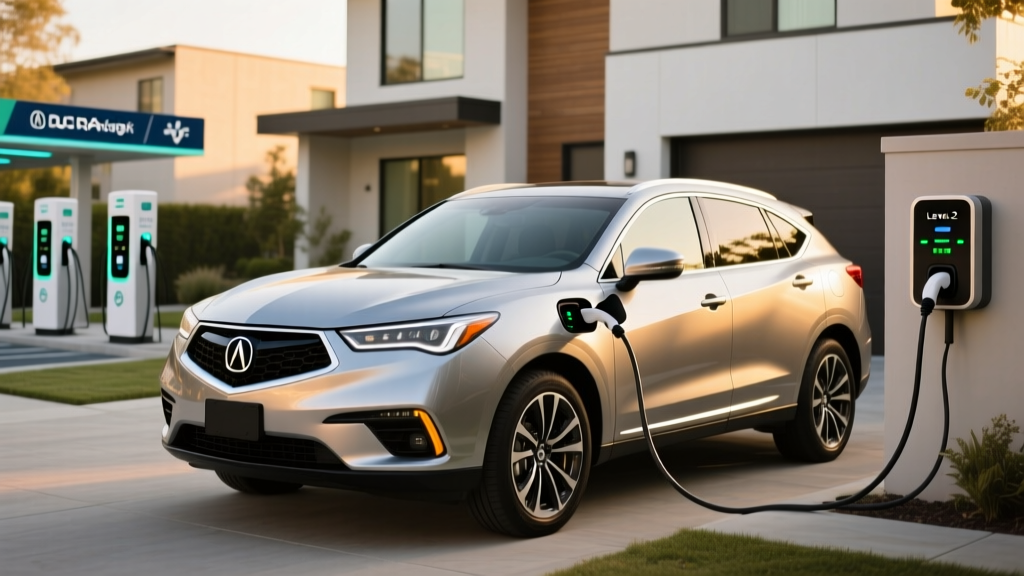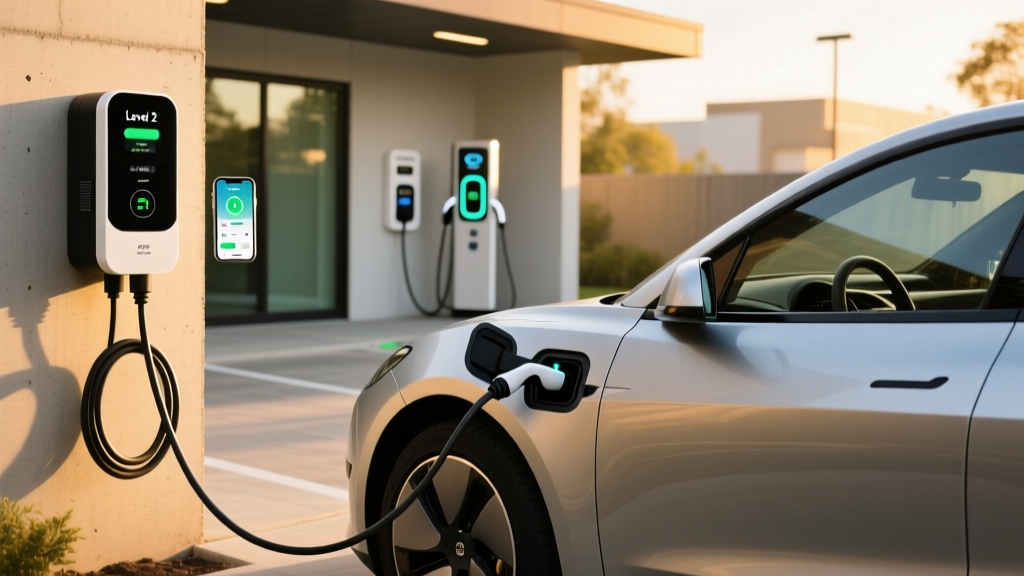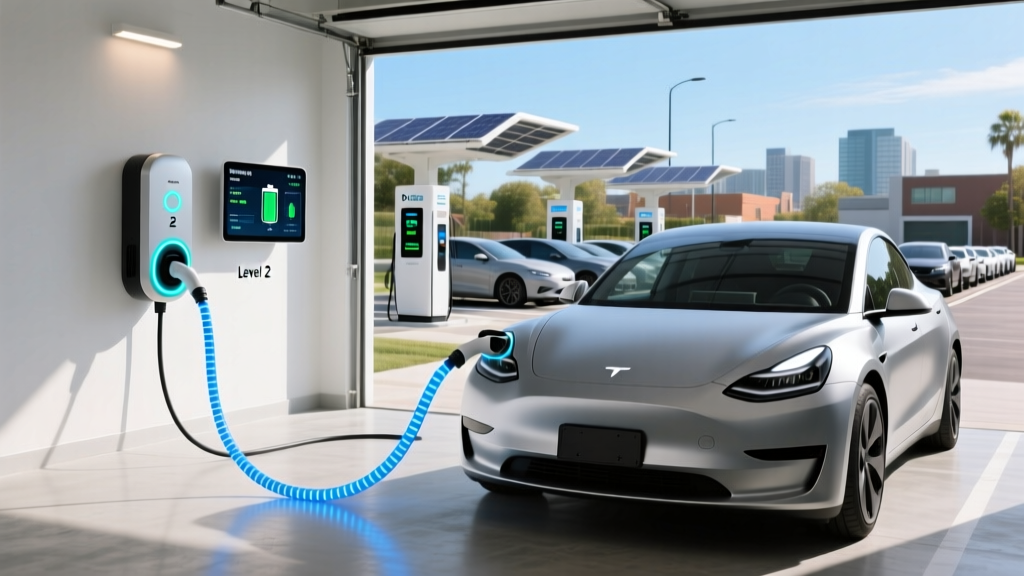
The phrase electric car charging lanes used to conjure images of sparse highway rest stops with a single, broken CCS plug. In 2026, the reality looks dramatically different: Tesla's Supercharger network is open to most non-Tesla EVs via NACS adapters, Electrify America and EVgo have deployed thousands of 350 kW stalls, and home Level 2 charging remains the cheapest, most convenient "lane" of all. But navigating these options requires understanding three things most buyers get wrong: the difference between kW and kWh, what your home electrical panel can actually support, and how real-world charging curves affect your road-trip time.
Understanding the Three Charging Lanes: Level 1, Level 2, and DC Fast
Before you buy a charger or plan a road trip, internalize this distinction: kW (kilowatts) measures power — the rate at which energy flows into your battery. kWh (kilowatt-hours) measures energy — the total capacity of your battery, like gallons in a gas tank. A 75 kWh battery charged at 7.7 kW takes roughly 10 hours from empty; that same battery at a 150 kW DC fast charger might reach 80% in 25–30 minutes.
| Charging Level | Voltage / Amperage | Power Output (kW) | Miles of Range Added Per Hour | Typical Use Case |
|---|---|---|---|---|
| Level 1 (Standard Outlet) | 120V / 12A | 1.4 kW | 3–5 miles | Overnight top-up, PHEVs, emergencies |
| Level 2 (Home / Workplace) | 240V / 32–48A | 7.7–11.5 kW | 25–44 miles | Daily home charging, workplace, shopping centers |
| DC Fast Charging (Public) | 400–800V DC | 50–350 kW | 150–1,200+ miles (theoretical) | Road trips, highway corridors, quick top-ups |
A few real-world caveats: Level 2 speeds depend on both the charger and your vehicle's onboard charger. The Hyundai Ioniq 5 accepts up to 10.9 kW on Level 2, but a 48A charger can deliver up to 11.5 kW — so you'll only see 10.9 kW max. DC fast charging speeds taper significantly above 80% state of charge (SoC) to protect battery health; the "peak" kW rating only applies between roughly 10–50% SoC on most vehicles. That's why manufacturers and the EPA quote 10–80% charge times rather than 0–100%.
Home Level 2 Installation: What It Really Costs
Home Level 2 charging is the most economical lane for daily use, but installation costs vary wildly based on your home's electrical infrastructure. Here's the honest breakdown:
| Component | Low Estimate | High Estimate | Notes |
|---|---|---|---|
| Level 2 Charger (Equipment) | $350 | $700 | 32A–48A smart Wi-Fi chargers |
| Electrician Labor | $300 | $1,200 | Depends on panel proximity, wall type, conduit run |
| Electrical Permit | $50 | $250 | Varies by municipality |
| Panel Upgrade (if needed) | $1,500 | $4,000+ | Required if panel is 100A or maxed out; 200A upgrade typical |
| Total (no panel upgrade) | $700 | $2,150 | Most homes with 200A service |
| Total (with panel upgrade) | $2,200 | $6,150+ | Older homes with 100A or 150A panels |
Electrical Requirements: What Your Panel Can Handle
A 48-amp Level 2 charger requires a dedicated 60-amp circuit (the National Electrical Code mandates that continuous loads not exceed 80% of circuit capacity, so 48A continuous needs a 60A breaker). This draws up to 11.5 kW at 240V. If your home has a 200-amp main panel with available headroom, installation is straightforward: an electrician runs conduit from the panel to your garage or exterior wall, installs the breaker, and mounts the charger.
If your home has a 100-amp or 150-amp panel — common in homes built before 1990 — adding a 60A circuit may max out your panel's capacity, triggering a mandatory upgrade to 200A service. This is the single biggest cost surprise for new EV owners. A panel upgrade involves replacing the main breaker panel and potentially the service entrance wire from the utility, which requires coordination with your local utility company and can take 2–6 weeks depending on permitting and utility scheduling.
A practical alternative: install a 32-amp charger on a 40-amp circuit. This delivers 7.7 kW (roughly 30 miles of range per hour), which is sufficient for overnight charging of nearly any EV, and requires less panel headroom. Some smart chargers, like the Enel X JuiceBox or Emporia Vue-linked ChargePoint, can be software-configured to draw less amperage, giving you flexibility without a panel upgrade.
Safety and Code Considerations
Any licensed electrician should follow these non-negotiable requirements:
- Dedicated circuit: The charger must have its own breaker — never shared with other appliances.
- GFCI protection: NEC 2023 and later require ground-fault circuit interrupter protection for outdoor receptacles and EV supply equipment. Many hardwired chargers have built-in GFCI; plug-in units require a GFCI breaker.
- NEMA 14-50 vs. hardwired: A NEMA 14-50 receptacle (the same as an electric dryer outlet) allows portability — you can unplug the charger and take it when you move. Hardwired installations are slightly cheaper, eliminate a potential failure point (the receptacle), and are preferred for outdoor mounts.
- Outdoor rating: If your charger is mounted outside or in an unenclosed carport, it must be rated NEMA 4 (weatherproof). All major chargers listed below meet this standard.
- Permit and inspection: Skipping the permit to save $100 is a false economy — it can void your homeowner's insurance in the event of an electrical fire and may be flagged during a home sale.
Connector Compatibility: NACS, CCS1, and CHAdeMO in 2026
The connector landscape has consolidated dramatically since Ford, GM, Rivian, Hyundai, and most other automakers adopted the North American Charging Standard (NACS) — originally Tesla's proprietary connector — starting in the 2025 model year. Here's where things stand for 2026 vehicles:
| Connector Type | Compatible Brands (2026) | Adapter Needed? |
|---|---|---|
| NACS (Tesla) | Tesla (all), Ford (2025+), GM (2025+), Rivian (2025+), Hyundai/Kia (2025+), Volvo/Polestar (2025+), BMW (2026+), Mercedes (2026+) | None for new vehicles; 2024 and older CCS vehicles need a CCS-to-NACS adapter ($150–$250) for Supercharger access |
| CCS1 | Legacy vehicles (pre-2025), some 2026 Stellantis models, Volkswagen ID.4 (2024 and earlier) | NACS-to-CCS adapter needed for Supercharger use; native CCS at Electrify America, EVgo, ChargePoint stations |
| CHAdeMO | Nissan Leaf (discontinued after 2025), Mitsubishi Outlander PHEV (legacy) | Limited adapter options; CHAdeMO infrastructure declining |
For home Level 2 charging, the connector situation is simpler: all Level 2 chargers sold in North America use a J1772 plug, which fits all non-Tesla EVs. Tesla vehicles include a J1772-to-NACS adapter in the glovebox, or you can purchase a Tesla Wall Connector with a native NACS plug. If you own a 2025+ NACS-equipped Ford, GM, or Hyundai, you'll need to confirm whether your home charger has a J1772 or NACS plug — most third-party chargers still ship with J1772, and your vehicle's adapter handles the rest.
Charging Time: Real-World Examples for Common Battery Sizes
Charge time depends on battery capacity (kWh), charging power (kW), and the charge curve — the rate at which charging slows as the battery fills. Here are realistic 10–80% times for popular 2026 EVs, based on manufacturer data and independent testing:
| Vehicle | Battery (kWh usable) | Level 2 (11.5 kW) | DC Fast (Peak kW) | DC Fast 10–80% Time |
|---|---|---|---|---|
| Tesla Model Y Long Range | 75 kWh (NMC) | ~4.5 hours | 250 kW (V3 Supercharger) | ~25 minutes |
| Hyundai Ioniq 5 (Long Range AWD) | 77.4 kWh (NMC) | ~4.6 hours | 240 kW (800V architecture) | ~18 minutes |
| Ford F-150 Lightning (Extended Range) | 131 kWh (NMC) | ~8 hours | 150 kW | ~41 minutes |
| Chevrolet Equinox EV (3RS) | 85 kWh (NMC) | ~5.2 hours | 150 kW | ~32 minutes |
| BMW i4 eDrive40 | 81.5 kWh (NMC) | ~5 hours | 205 kW | ~28 minutes |
Understanding the charge curve: Peak kW is sustained only between roughly 10–40% SoC for most NMC batteries. Above 50%, the rate tapers; above 80%, it drops sharply to protect battery longevity. This is why you'll see a Tesla Model Y peak at 250 kW but average closer to 130 kW over a full 10–80% session. LFP (lithium iron phosphate) batteries, used in some Tesla Model 3 Standard Range and BYD vehicles, have a flatter charge curve and can sustain higher rates to higher SoC — but they also have lower energy density, meaning heavier batteries for the same range.
Cost to Charge: Home vs. Public vs. Gas
The economic case for EVs hinges on this comparison. Electricity prices vary by region, but the math consistently favors home charging over public DC fast charging, and both over gasoline for most drivers.
| Charging Scenario | Rate ($/kWh) | Vehicle Efficiency (kWh/100mi) | Cost Per Mile | Annual Cost (12,000 mi) |
|---|---|---|---|---|
| Home (national avg. residential) | $0.16 | 30 kWh/100mi | $0.048 | $576 |
| Home (off-peak time-of-use) | $0.09 | 30 kWh/100mi | $0.027 | $324 |
| Public Level 2 (ChargePoint, EVgo) | $0.25–$0.49 | 30 kWh/100mi | $0.075–$0.147 | $900–$1,764 |
| DC Fast (Electrify America, Supercharger) | $0.35–$0.55 | 30 kWh/100mi | $0.105–$0.165 | $1,260–$1,980 |
| Gasoline (25 MPG combined, $3.40/gal) | $3.40/gallon | 4 gal/100mi | $0.136 | $1,632 |
| Gasoline (35 MPG combined, $3.40/gal) | $3.40/gallon | 2.86 gal/100mi | $0.097 | $1,164 |
The takeaway: home charging on an off-peak rate is 3–5x cheaper per mile than gasoline. Even public DC fast charging at $0.50/kWh is roughly comparable to a 25 MPG gas car — and most EV owners do 80–90% of their charging at home. The break-even point shifts if you rely entirely on public DC fast charging and live in a high-electricity-rate state (California, Massachusetts, Connecticut), where rates can exceed $0.35/kWh residential. In those cases, time-of-use plans that drop rates to $0.08–$0.12/kWh overnight are essential to the economics.
For the latest electricity rate data by state, the U.S. Energy Information Administration publishes monthly residential averages.
Equipment Recommendations: Best Home Level 2 Chargers for 2026
After testing dozens of Level 2 chargers across multiple homes and vehicles, these are the units we recommend based on reliability, smart features, cable management, and value. All models below are UL-listed (a critical safety certification) and support both J1772 and NACS (via included or optional adapters).
ChargePoint Home Flex (NACS or J1772)
- Power Output: Up to 50A (12 kW) on a 60A circuit; configurable down to 16A via app
- Cable Length: 23 feet
- Smart Features: Wi-Fi, Alexa/Google integration, scheduling, energy tracking, utility demand-response programs
- Connector: Available in NACS or J1772 at purchase
- Price: ~$599 (J1772), ~$649 (NACS)
- Best For: Most buyers — flexible amperage avoids panel upgrades, excellent app
Tesla Wall Connector (Gen 3)
- Power Output: Up to 48A (11.5 kW) on a 60A circuit
- Cable Length: 24 feet
- Smart Features: Wi-Fi, over-the-air updates, power-sharing (link multiple units on one circuit), load management
- Connector: Native NACS; J1772 adapter included for non-Tesla vehicles
- Price: ~$475
- Best For: Tesla owners or multi-EV households (power-sharing is excellent for two-car garages)
Emporia Level 2 EV Charger
- Power Output: Up to 48A (11.5 kW) on a 60A circuit
- Cable Length: 24 feet
- Smart Features: Wi-Fi, integrates with Emporia Vue home energy monitor, solar-aware charging, time-of-use optimization
- Connector: J1772 (NACS adapter available separately)
- Price: ~$399
- Best For: Budget-conscious buyers, solar-panel owners who want to charge only on excess solar production
Grizzl-E Smart (United Chargers)
- Power Output: Up to 40A (9.6 kW) on a 50A circuit
- Cable Length: 24 feet
- Smart Features: Wi-Fi, OCPP-compatible (works with utility programs), extreme cold rating (-40°F)
- Connector: J1772 or NACS at purchase
- Price: ~$499
- Best For: Cold-climate owners (built in Canada, rated for extreme temperatures), outdoor installations
A note on amperage selection: don't automatically buy the highest-amp charger. If your panel has limited headroom, a 32A charger (7.7 kW, requiring a 40A circuit) is a perfectly practical choice. You'll add roughly 30 miles of range per hour — enough to fully recharge a 300-mile EV overnight. The ChargePoint Home Flex and Emporia both allow software-based amperage adjustment, so you can start at 32A and increase later if you upgrade your panel.
The Public Charging Lane: Networks, Reliability, and Trip Planning
Public DC fast charging in 2026 is significantly more reliable than in 2022–2023, when broken chargers and payment failures plagued networks like Electrify America. Tesla's Supercharger network — now open to most NACS-equipped vehicles — remains the gold standard for uptime (above 98% in most markets). Electrify America has deployed next-generation 350 kW chargers with integrated payment screens and CCS1/NACS dual cables. EVgo and ChargePoint have expanded highway corridor coverage, though reliability still varies by station.
For trip planning, the best approach in 2026:
- Tesla Supercharger network: Use the Tesla app or your vehicle's built-in navigation (Ford, GM, Rivian, and Hyundai all have native Supercharger routing in their 2025+ infotainment systems).
- Non-Tesla networks: A Better Routeplanner (ABRP) remains the most accurate trip planner, incorporating your specific vehicle's charge curve, elevation, temperature, and real-time station status.
- Payment: Most networks now support Plug & Charge (ISO 15118), where the charger identifies your vehicle and bills your account automatically — no app or RFID card required. Confirm your vehicle supports this; most 2024+ EVs do.
For official range and efficiency data to plan your trips, the EPA's fueleconomy.gov database provides standardized kWh/100mi figures for every EPA-certified EV.
Tax Credits and Incentives for Home Charging Equipment
The federal Alternative Fuel Vehicle Refueling Property Credit (IRS Form 8911) covers 30% of the cost of home EV charging equipment and installation, up to $1,000. This credit is separate from the §30D new-vehicle tax credit and applies to both the charger hardware and the electrician's labor.
Key eligibility requirements for 2026:
- The charger must be installed at your primary residence in the United States.
- The property must be located in an eligible census tract (the IRS provides a lookup tool; most residential areas qualify, but high-income urban census tracts may be excluded).
- The credit is non-refundable — it reduces your tax liability to zero but does not generate a refund beyond that.
- Equipment must be new and placed in service during the tax year.
Some states and utilities stack additional incentives on top: California's utility programs (PG&E, SCE, SDG&E) offer $250–$500 rebates for smart charger purchases; New York's NYSERDA provides up to $500; Colorado offers a state tax credit of up to $500. Check with your local utility and state energy office for current programs — these change annually.
Frequently Asked Questions
How much does it cost to install a home EV charger?
For most homes with a 200-amp electrical panel, a Level 2 charger installation costs between $700 and $2,150, including the charger ($350–$700), electrician labor ($300–$1,200), and permit ($50–$250). If your home needs a panel upgrade from 100A to 200A service, add $1,500–$4,000+ to that total. Always get at least two quotes from licensed electricians and confirm they pull the required permit.
How fast will each charging level add range?
Level 1 (120V standard outlet) adds 3–5 miles per hour — adequate for plug-in hybrids with 30–40 miles of electric range, but impractical for full EVs. Level 2 (240V, 32–48A) adds 25–44 miles per hour, fully recharging most EVs overnight. DC fast charging (50–350 kW) can add 100–250+ miles in 15–30 minutes, though speeds taper above 80% SoC. Your vehicle's onboard charger limits Level 2 speed; its battery architecture and thermal management limit DC fast speed.
Which connector/charger is compatible with my EV?
If you bought a 2025 or newer EV from Tesla, Ford, GM, Hyundai, Kia, Rivian, Volvo, or BMW, your vehicle uses the NACS connector for DC fast charging and a NACS or J1772 inlet for Level 2. For home charging, any J1772 Level 2 charger will work with all EVs (Tesla includes an adapter; 2025+ NACS vehicles typically include a J1772 adapter). For public DC fast charging, check whether your vehicle has NACS or CCS1 and use the appropriate network — Tesla Superchargers for NACS, Electrify America/EVgo for CCS1. CHAdeMO is effectively discontinued for new vehicles.
How much does charging cost per mile vs gas?
At the 2026 national average residential electricity rate of $0.16/kWh and a typical EV efficiency of 30 kWh/100mi, home charging costs roughly $0.048 per mile — about 65% less than a 25 MPG gas car at $3.40/gallon ($0.136/mile). Off-peak electricity rates of $0.09/kWh drop that to $0.027/mile. Public DC fast charging at $0.45/kWh costs roughly $0.135/mile — comparable to gasoline. The economic advantage of EVs is greatest when you charge at home, especially on time-of-use plans.
What electrical upgrades might I need?
The most common upgrade is a panel capacity increase from 100A or 150A to 200A service, which costs $1,500–$4,000+ depending on your utility's requirements and whether new service entrance wire is needed. Less commonly, older homes with knob-and-tube or aluminum wiring may need a circuit upgrade. Homes with 200A panels that are already near capacity (common if you have electric heat, an electric dryer, and an electric oven) may need a load calculation by the electrician to confirm a 60A circuit is feasible. Alternatives include installing a lower-amperage charger (32A on a 40A circuit), using a smart panel load-management device (like the Emporia Vue or Span smart panel), or using a "smart" charger that dynamically reduces draw when other appliances are running.
Navigating electric car charging lanes in 2026 comes down to one practical hierarchy: install a Level 2 home charger for daily use (it's the cheapest and most convenient lane by a wide margin), use DC fast charging for road trips, and treat public Level 2 as a convenience for apartment dwellers and workplace top-ups. Start with a load calculation from a licensed electrician, choose a UL-listed smart charger matched to your panel's capacity, and take advantage of the $1,000 federal installation credit. The upfront investment — typically $700–$2,150 for a straightforward install — pays for itself within 1–3 years through fuel savings alone.