The Real Cost to Charge an EV: What Buyers Actually Pay
If you're researching an electric vehicle, the sticker price and EPA range get most of the attention. But the ongoing electric car charging cost — what you actually pay per mile to keep the battery full — is where EVs either deliver on their promise or quietly disappoint. The answer depends almost entirely on where and how you charge.
A homeowner charging overnight on off-peak utility rates might pay $0.04 per mile. That same driver relying exclusively on 350 kW DC fast chargers on road trips could pay $0.15 per mile or more — approaching what a 30 MPG gas car costs at $3.50/gallon. The spread is enormous, and understanding it before you buy is the difference between an EV that saves you thousands and one that breaks even.
This guide breaks down charging costs across every level (home Level 1, home Level 2, public Level 2, and DC fast charging), shows you what installation actually costs in 2026, and gives you the exact numbers to compare against your current gas spend.
Charging Levels Explained: Speed, Power, and Miles per Hour
Before calculating cost, you need to understand the three charging levels and how fast each one adds range. This is where the distinction between kW (kilowatts — the rate of power delivery, like water pressure from a hose) and kWh (kilowatt-hours — the total energy stored in your battery, like gallons in a tank) matters most. Your charger's kW rating determines how quickly it fills your battery's kWh capacity.
| Level | Voltage | Power (kW) | Miles of Range Added per Hour | Best For |
|---|---|---|---|---|
| Level 1 (120V) | 120V AC | 1.0–1.4 kW | 3–5 mi/hr | Overnight top-ups, PHEVs, low-mileage drivers |
| Level 2 (240V) | 240V AC | 3.3–19.2 kW | 12–75 mi/hr | Daily home charging, workplace, shopping centers |
| DC Fast Charging | 400–800V DC | 50–350 kW | 150–1,200+ mi/hr (peak) | Road trips, highway corridors, quick top-ups |
A few real-world anchors: a Tesla Model Y Long Range (75 kWh usable battery, ~320 mi EPA range) charging on a 48-amp Level 2 home station (11.5 kW) will go from 20% to 80% in roughly 4.5 hours — perfect for overnight. That same vehicle at a 250 kW Supercharger will hit 10–80% in about 22 minutes. But at a 50 kW CHAdeMO station, you're looking at over an hour for the same 10–80% session.
DC fast charging speeds are never linear. Your vehicle's battery management system (BMS) throttles the charge rate as the battery fills — a concept called the charge curve. A charger rated at 350 kW might only deliver that peak between 10–30% state of charge (SoC), then taper to 150 kW by 50%, and drop below 50 kW past 80%. This is why manufacturers quote 10–80% times rather than 0–100%.
Electric Car Charging Cost by Location: $/kWh Scenarios
Electricity pricing varies dramatically depending on where you plug in. Here's what EV owners actually encounter across the major charging scenarios in 2026:
| Scenario | Typical $/kWh | Cost per Mile (3.5 mi/kWh EV) | Notes |
|---|---|---|---|
| Home — Off-Peak (Time-of-Use rate) | $0.08–$0.14 | $0.023–$0.040 | Best-case daily charging; requires TOU plan |
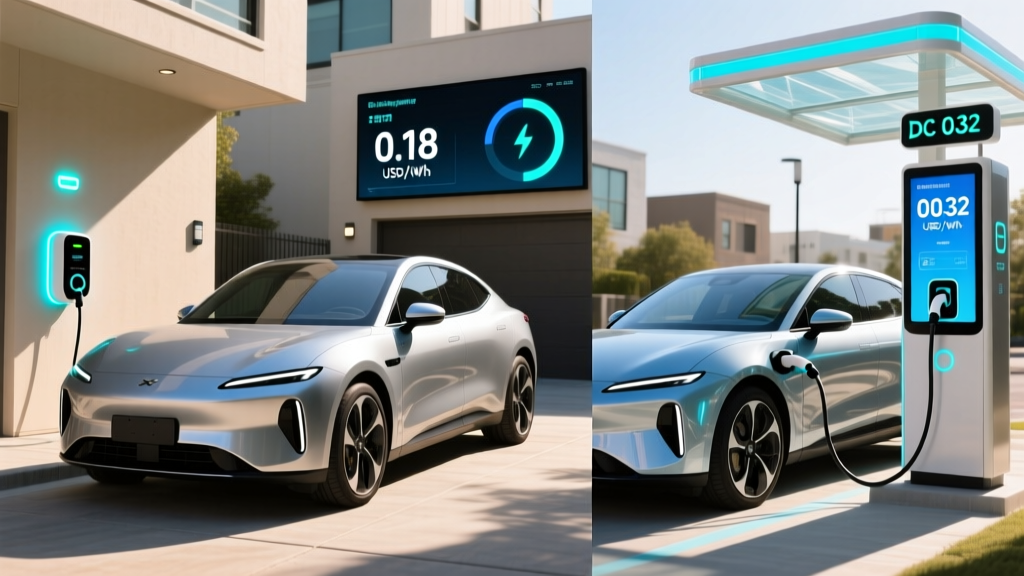
| Home — Standard Residential Rate | $0.14–$0.20 | $0.040–$0.057 | National avg ~$0.17/kWh (EIA, 2025 data) |
| Home — Peak / Summer Afternoon | $0.25–$0.45 | $0.071–$0.129 | Avoid charging during these windows |
| Public Level 2 (workplace, retail) | $0.20–$0.49 | $0.057–$0.140 | Some free at workplaces or with membership |
| DC Fast — Electrify America / EVgo | $0.35–$0.55 | $0.100–$0.157 | Idle fees add cost if you don't unplug promptly |
| DC Fast — Tesla Supercharger (peak) | $0.30–$0.50 | $0.086–$0.143 | Off-peak Supercharging can drop to $0.20–$0.28 |
| DC Fast — Tesla Supercharger (off-peak) | $0.20–$0.28 | $0.057–$0.080 | Available at select stations with TOU pricing |
For context, the average US residential electricity rate sits around $0.17/kWh according to the U.S. Energy Information Administration. But that average masks enormous state-level variation: Louisiana averages under $0.11/kWh while California and Hawaii push past $0.30/kWh for standard residential service.
Cost per Mile: EV vs Gas
To make the comparison concrete, here's how the electric car charging cost per mile stacks up against gasoline for a typical midsize vehicle:
| Vehicle / Scenario | Energy Cost | Efficiency | Cost per Mile |
|---|---|---|---|
| EV — Home off-peak ($0.12/kWh) | $0.12/kWh | 3.5 mi/kWh | $0.034 |
| EV — Home standard ($0.17/kWh) | $0.17/kWh | 3.5 mi/kWh | $0.049 |
| EV — DC fast charger ($0.45/kWh) | $0.45/kWh | 3.5 mi/kWh | $0.129 |
| Gas car — 30 MPG at $3.40/gal | $3.40/gal | 30 MPG | $0.113 |
| Gas car — 25 MPG at $3.40/gal | $3.40/gal | 25 MPG | $0.136 |
The takeaway: home-charged EVs cost roughly one-third to one-half what a comparable gas car costs per mile. But if you rely exclusively on DC fast charging at highway rates, the cost advantage narrows significantly — and in some markets with expensive electricity, it can vanish entirely.
How Much Does It Cost to Install a Home EV Charger?
This is the question that stops many prospective EV buyers cold. The answer ranges from $0 (if you already have a 240V outlet near your parking spot) to $5,000+ (if your home needs a full panel upgrade). Here's the realistic breakdown for a typical 48-amp Level 2 home charging station installation in 2026:
| Component | Low End | Typical | High End | Details |
|---|---|---|---|---|
| Level 2 EVSE Equipment | $250 | $500 | $750 | 40–48A smart charger (ChargePoint, Emporia, Wallbox) |
| Electrician Labor | $400 | $800 | $1,500 | Depends on run length from panel to garage/carport |
| Electrical Permit | $50 | $150 | $300 | Varies by municipality; some jurisdictions waive for EVSE |
| Materials (conduit, wire, breaker) | $100 | $250 | $500 | Longer runs and outdoor installations cost more |
| Panel Upgrade (if needed) | $1,500 | $2,500 | $4,000 | 100A → 200A service; common in pre-1990 homes |
| Total (no panel upgrade) | $800 | $1,700 | $3,050 | Most homeowners fall in this range |
| Total (with panel upgrade) | $2,300 | $4,200 | $7,050 | Older homes with 100A or 60A service |
Electrical Requirements: What Your Home Needs
A 48-amp Level 2 charger requires a 60-amp dedicated circuit on a 240V line (the National Electrical Code requires circuits to be rated at 125% of the continuous load — so 48A × 1.25 = 60A circuit). This uses the same type of wiring and breaker as an electric oven or dryer.
Key installation considerations:
- Panel capacity: Your electrician will perform a load calculation per NEC Article 220. If your existing panel is near capacity (common with electric heating, A/C, and an electric dryer already drawing from a 100A panel), you'll need a service upgrade to 200A before adding a 60A EV circuit.
- NEMA 14-50 outlet vs hardwired: A NEMA 14-50 receptacle gives you flexibility to unplug and take your charger if you move, but it requires a GFCI breaker in many jurisdictions (adding $100–$200). Hardwired installations avoid the GFCI requirement and are often preferred by electricians for reliability.
- Outdoor rating: If your parking spot is outside, you need a NEMA 4-rated (weatherproof) enclosure and outdoor-rated cable. Most quality Level 2 chargers are rated for outdoor use, but the junction box and connector holster need weather protection.
- Wi-Fi connectivity: Smart chargers with Wi-Fi let you schedule charging during off-peak hours, monitor energy use, and in some cases participate in utility demand-response programs that pay you for reducing load during grid peaks.
Do You Qualify for the Home Charger Tax Credit?
The federal §30C Alternative Fuel Vehicle Refueling Property Credit covers 30% of the cost of home EV charging equipment and installation, up to $1,000. However, this credit has specific eligibility requirements including that the equipment must be placed in service in a qualifying census tract (generally low-income or non-urban areas). Check the IRS guidelines or consult a tax professional to confirm your eligibility — this credit is not universally available.
Which Connector and Charger Is Compatible with My EV?
The connector landscape has consolidated significantly since 2024, but you still need to know what your vehicle uses before buying a home charger or planning public charging stops.
| Connector Type | Brands Using It (Native) | Adapter Availability |
|---|---|---|
| NACS (Tesla / SAE J3400) | Tesla (all models), Ford, GM, Rivian, Volvo, Polestar, Hyundai, Kia, BMW, Mercedes-Benz, Subaru, Lucid, Fisker | CCS-to-NACS adapters available from Ford, GM, and third parties (~$200–$300) |
| CCS1 (Combo) | VW, Audi, Porsche (Taycan), Honda (Prologue), some remaining Stellantis models | NACS-to-CCS adapters available; CCS infrastructure still widespread |
| CHAdeMO | Nissan Leaf (legacy); no new 2026 US models use CHAdeMO | CHAdeMO-to-NACS adapters extremely limited; network shrinking |
For home Level 2 charging, the connector situation is simpler: all Level 2 EVSEs use the J1772 connector (or NACS, which incorporates J1772 signaling for Level 2 AC). If you buy a NACS-equipped vehicle from Ford, GM, or Rivian, you'll either receive a J1772 adapter in the box or can purchase one for $50–$100. Most home chargers sold in 2026 offer both J1772 and NACS plug options at the point of purchase.
Level 2 Home Charger Recommendations for 2026
Based on power output, reliability, smart features, and value, these are the home chargers we recommend for different budgets and needs:
Emporia Vue Level 2 EV Charger
Power: 48A / 11.5 kW (240V)
Connector: J1772 (NACS adapter included)
Cable length: 24 ft
Smart features: Wi-Fi, energy monitoring, solar integration, TOU scheduling
Price: ~$399
Best for: Budget-conscious buyers who want full smart features and solar-aware charging.
ChargePoint Home Flex (2nd Gen)
Power: 50A / 12 kW (240V)
Connector: J1772 or NACS (select at purchase)
Cable length: 24 ft
Smart features: Wi-Fi, Alexa/Google integration, flexible amperage (16–50A dip-switch), detailed app
Price: ~$549
Best for: Homeowners who want adjustable amperage to match their circuit capacity.
Tesla Wall Connector
Power: 48A / 11.5 kW (240V)
Connector: NACS native (J1772 adapter available)
Cable length: 24 ft
Smart features: Wi-Fi, OTA updates, power sharing (link multiple units on one circuit), load management
Price: ~$420
Best for: Tesla owners and NACS-adopting EV buyers who want a clean, reliable unit with multi-charger support.
One critical note: your charger's maximum amperage should never exceed 80% of your circuit breaker rating. A 60A breaker supports a maximum 48A continuous load. If your electrician installs a 50A breaker, you need a charger set to 40A or lower. Mismatching these is a fire hazard and a code violation.
DC Fast Charging: Real-World Times and Costs on the Road
For road trips and highway driving, DC fast charging is essential. But the advertised peak kW rating of a charger rarely tells the full story. Here's what real 10–80% sessions look like for common 2026 EVs:
| Vehicle | Battery (kWh usable) | Peak Charge Rate (kW) | Charger Required | 10–80% Time | Approx. Cost (at $0.45/kWh) |
|---|---|---|---|---|---|
| Tesla Model Y Long Range | 75 kWh | 250 kW | 250+ kW Supercharger | ~22 min | $23.60 |
| Hyundai Ioniq 5 | 77.4 kWh | 240 kW | 350 kW station | ~18 min | $24.40 |
| Chevrolet Equinox EV | 85 kWh | 190 kW | 200+ kW station | ~28 min | $26.80 |
| Ford F-150 Lightning (Extended) | 131 kWh | 210 kW | 250+ kW station | ~41 min | $41.30 |
| BMW iX xDrive50 | 105.2 kWh | 200 kW | 250+ kW station | ~34 min | $33.10 |
Several factors compress or extend these times in practice:
- Battery preconditioning: Vehicles like the Tesla Model Y and Hyundai Ioniq 5 will warm or cool the battery to optimal temperature when you navigate to a charger. Without preconditioning, cold batteries (< 50°F) can charge at half the peak rate, doubling your session time.
- Charger power sharing: At stations with paired stalls (common at Electrify America and older Supercharger sites), plugging into a stall adjacent to another charging vehicle may split the available power, reducing your peak kW.
- State of charge at arrival: If you arrive at 15% rather than 10%, the session is slightly faster. If you arrive at 5%, the BMS may limit the initial charge rate to protect the battery, adding a few minutes.
- Ambient temperature: In sub-freezing weather without preconditioning, expect 10–80% times to increase by 30–50%. This is the single biggest variable most EV buyers underestimate.
Charging Cost Optimization: Practical Strategies That Save Real Money
The gap between the cheapest and most expensive way to charge an EV is wider than most buyers realize. Here are the strategies that move the needle:
1. Enroll in your utility's Time-of-Use (TOU) plan. Most utilities now offer TOU rates that drop electricity to $0.06–$0.12/kWh during overnight hours (typically 9 PM – 6 AM). If you're paying $0.25/kWh on a standard plan and switch to TOU, you can cut your home charging cost by more than half. Your smart charger's scheduling feature automates this — set it to start charging at 10 PM and wake up to a full battery at the cheapest rate.
2. Use your automaker's free charging credits strategically. Many 2026 EVs include complimentary DC fast charging — Hyundai/Kia often bundle 2 years of free Electrify America sessions, and Tesla periodically offers free Supercharger miles. Use these credits for expensive road-trip DC charging and keep your daily charging at home on cheap utility rates.
3. Avoid DC fast charging above 80% unless necessary. The charge curve tapers sharply past 80%, meaning you'll spend nearly as long charging from 80–100% as you did from 10–80% — while paying premium DC rates. Plan your stops to arrive at 10–15% and leave at 80%, then top off at home overnight.
4. Check for utility EV rebate programs. Many utilities offer $250–$500 rebates for installing a Level 2 home charger, and some provide discounted EV-specific meters that isolate your charging load from the rest of your home, qualifying it for the lowest TOU tier. Contact your utility's EV program page before scheduling your electrician.
Frequently Asked Questions
How much does it cost to fully charge an EV at home?
For a typical 75 kWh battery (Tesla Model Y, Ford Mustang Mach-E) at the US average residential rate of $0.17/kWh, a full 0–100% charge costs about $12.75. On an off-peak TOU rate of $0.10/kWh, that same charge drops to $7.50. For larger batteries like the F-150 Lightning Extended Range (131 kWh), expect $22.25 at average rates or $13.10 off-peak.
Is it cheaper to charge an EV at home or at a public station?
Home charging is almost always cheaper. Residential electricity averages $0.17/kWh while public Level 2 stations charge $0.20–$0.49/kWh and DC fast chargers run $0.35–$0.55/kWh. The exception: free workplace charging or complimentary retail Level 2 stations (still offered at some Costco, Target, and municipal locations) beat any home rate.
What electrical upgrades might I need for a home charger?
If your home has a 200-amp electrical panel with available capacity, you likely need only a new 60-amp breaker and a wire run to your parking spot — typically $800–$2,000 installed. Homes with 100-amp service (common in houses built before 1990) or panels already near capacity from electric heating, A/C, dryers, and ovens may require a panel upgrade to 200A, adding $1,500–$4,000 to the project. Your electrician will perform a NEC Article 220 load calculation to determine this before pulling a permit.
Can I charge my EV with a regular 120V outlet?
Yes — this is Level 1 charging, and it delivers roughly 3–5 miles of range per hour at 1.0–1.4 kW. For a plug-in hybrid with 30 miles of electric range, overnight Level 1 charging is usually sufficient. For a full BEV with a 300-mile battery, Level 1 adds only ~35 miles over an 8-hour night — adequate only if your daily driving stays under 30 miles and you have no access to 240V charging.
Does frequent DC fast charging damage the battery?
Modern battery management systems are designed to handle regular DC fast charging, and studies from Idaho National Laboratory and real-world fleet data show that the impact on long-term degradation is smaller than early concerns suggested. That said, exclusive reliance on DC fast charging (zero Level 2 sessions) may accelerate degradation by 2–5% over 100,000 miles compared to predominantly Level 2 charging. For optimal battery longevity, use DC fast charging for road trips and Level 2 for daily needs.
How fast will each charging level add range to my EV?
Level 1 (120V) adds 3–5 miles per hour. Level 2 (240V, 48A) adds 30–40 miles per hour for most EVs — enough to fully recharge overnight. DC fast charging at 150+ kW can add 150–250 miles in a 20-minute session, depending on your vehicle's peak charge rate and battery size. Always check your specific vehicle's onboard charger rating for Level 2 — some vehicles (like the base Chevy Equinox EV) accept only 11.5 kW even on a 19.2 kW station.
How much does charging cost per mile compared to gas?
At home on average US electricity rates ($0.17/kWh), an efficient EV achieving 3.5 miles per kWh costs about $0.049 per mile. A comparable 30 MPG gas car at $3.40/gallon costs $0.113 per mile — more than double. However, DC fast charging at $0.45/kWh pushes EV cost to $0.129/mile, slightly above the gas car. Home charging access is the single biggest factor in whether an EV saves you money on fuel.