If you've just ordered an EV or plug-in hybrid, the first hardware question is usually about the electric car charging cable itself: which plug fits, how fast it charges, and what you need at home to make it work. The terminology can trip up even seasoned car buyers, because an EV "cable" isn't one thing — it spans a 120-volt cord that trickles in a few miles per hour, a 240-volt wall unit that refills overnight, and a hardwired DC fast-charger tether that adds 200 miles in twenty minutes. This guide untangles each cable type, the connectors on the ends, and the real costs of getting set up at home in 2026.
The three electric car charging cable levels, explained
Every EV sold in the U.S. ships with or supports three charging tiers. The difference between them is power (measured in kilowatts, or kW) — the rate at which energy flows into the battery (which is measured in kilowatt-hours, or kWh). Think of kW as the width of a hose and kWh as the size of the bucket. Here's what each tier delivers in the real world, not just the spec sheet.
| Level | Voltage / Amps | Max Power (kW) | Miles of range per hour | Typical use case |
|---|---|---|---|---|
| Level 1 (portable cord) | 120V / 12A | ~1.4 kW | 3–5 mi/hr | Overnight top-up, PHEVs, emergencies |
| Level 2 (home / workplace) | 240V / 32–48A | 7.7–11.5 kW | 25–44 mi/hr | Daily home charging, destination charging |
| DC Fast Charging | 400–800V DC | 50–350 kW | ~180–1,200 mi/hr* | Road trips, quick top-ups |
*Miles-per-hour figures for DCFC are averaged across a 10–80% session; peak rate only holds for a portion of the curve before tapering above ~60% State of Charge.
Connector compatibility: which electric car charging cable fits your EV?
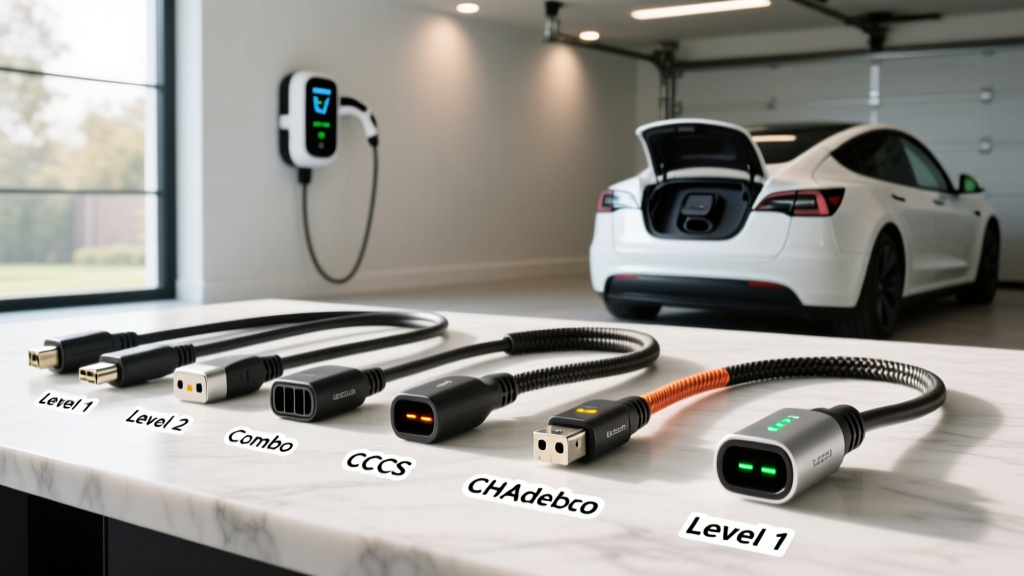
The plug on the end of the cable matters as much as the power behind it. North America has largely consolidated around the North American Charging Standard (NACS), but CCS1-equipped vehicles are still common, and CHAdeMO lingers on older Nissan Leaf and Mitsubishi Outlander PHEV models. Here's the 2026 landscape.
| Connector | Brands using it natively | Adapter situation |
|---|---|---|
| NACS (Tesla-style) | Tesla, Ford, GM, Rivian, Volvo, Polestar, Mercedes, Fisker, Lucid (newer) | Legacy CCS vehicles can use a CCS-to-NACS adapter (~$200–$250) for Supercharger access |
| CCS1 (Combo) | Hyundai, Kia, VW, BMW, Stellantis (most), Honda Prologue | NACS-to-CCS adapters available; many OEMs include one with 2025–2026 vehicles |
| CHAdeMO | Nissan Leaf (legacy), Mitsubishi Outlander PHEV | No practical adapter; network is shrinking — plan routes around CCS/NACS |
For Level 2 home charging, the J1772 plug is still the universal standard on the vehicle side. NACS-equipped EVs ship with a J1772-to-NACS adapter in the glovebox, so any home wall connector with a J1772 cable works out of the box. Tesla's Wall Connector natively uses NACS but can be set to J1772 output via firmware for multi-EV households.
Home installation: electrical requirements and real costs
The most common question I hear from new EV owners: how much does it cost to install a home EV charger? The honest answer is a range, because it depends on your electrical panel, the distance from the panel to the garage, and local permit fees. Here's the breakdown for a typical 48-amp Level 2 installation on a dedicated 60-amp circuit.
| Line item | Low end | High end | Notes |
|---|---|---|---|
| Level 2 charger (hardware) | $350 | $700 | 40A–48A smart charger, 18–25 ft cable |
| Electrician labor | $600 | $1,800 | Depends on run length, conduit, drywall work |
| Permit & inspection | $75 | $350 | Varies by municipality |
| Electrical panel upgrade (if needed) | $1,500 | $4,000 | Required if panel is 100A or has no spare slots |
| Total (no panel upgrade) | $1,025 | $2,850 | Most single-family homes fall here |
| Total (with panel upgrade) | $2,525 | $6,850 | Older homes, 1970s–1990s builds |
What electrical upgrades might I need?
A 48-amp Level 2 charger requires a dedicated 60-amp, 240-volt circuit (NEC code requires circuits to be rated 125% above continuous load, so 48A × 1.25 = 60A). If your main service panel is 200 amps with open breaker slots and the run to your garage is under 50 feet, expect the lower end of the cost range. Homes with 100-amp service, full panels, or a garage on the opposite side of the house from the panel may need a panel upgrade, a sub-panel, or a longer conduit run — all of which push costs higher.
Some utilities offer rebates of $250–$500 for Level 2 installations, and the federal Residential Clean Energy Credit covers 30% of charger hardware and installation costs (capped at $1,000) through 2032 for homes in eligible census tracts. Check your utility and AFDC for current state incentives, which vary by jurisdiction.
How fast will each charging level add range? Real charge-time examples
Spec sheets quote peak kW, but charging curves taper significantly as the battery fills. Here's what 10–80% sessions actually look like for three representative EVs with common battery sizes.
| Vehicle (battery) | Level 1 (1.4 kW) | Level 2, 48A (11.5 kW) | DCFC at rated peak |
|---|---|---|---|
| Chevrolet Equinox EV (85 kWh usable) | ~45 hours | ~5.2 hours | ~22 min (peak 150 kW) |
| Hyundai Ioniq 5 (77.4 kWh, 800V) | ~41 hours | ~4.8 hours | ~18 min (peak 240 kW) |
| Tesla Model Y LR (75 kWh) | ~40 hours | ~4.6 hours | ~20 min (peak 250 kW) |
Notice the pattern: Level 2 is the workhorse for daily life. A full overnight session at 11.5 kW adds roughly 300+ miles — more than any EV's daily consumption. DCFC is a road-trip tool, not a daily one, and repeated DC fast charging accelerates battery wear slightly compared to Level 2.
Cost to charge: home vs public vs gas, per mile
The economics of EV ownership hinge on where you plug in. Below is a cost-per-mile comparison using a mainstream EV efficiency of 3.0 miles/kWh (roughly 112 MPGe) and a gas car averaging 28 MPG combined.
| Scenario | $/kWh | Cost per mile | vs. gas at $3.40/gal |
|---|---|---|---|
| Home, off-peak utility rate | $0.13 | $0.043 | 65% cheaper |
| Home, standard rate (no TOU) | $0.18 | $0.060 | 50% cheaper |
| Public Level 2 (ChargePoint, EVgo L2) | $0.30 | $0.100 | 17% cheaper |
| DC fast charging (Electrify America, Tesla) | $0.48 | $0.160 | 32% more expensive |
| Gasoline baseline (28 MPG) | — | $0.121 | — |
Home charging on a time-of-use plan is where EVs win decisively. Public DC fast charging, by contrast, has crossed the gas-equivalence line in many markets — so road-trippers should budget accordingly and prioritize free or discounted charging at hotels and workplaces.
Recommended Level 2 electric car charging cables and wall connectors
Not every wall connector is equal. Cable length, smart features, and whether the unit is hardwired or plug-in (NEMA 14-50) all affect daily usability. Here are four units I'd recommend in 2026 based on reliability, output, and connector flexibility.
Tesla Wall Connector (Gen 4)
- Power: 11.5 kW (48A) on a 60A circuit
- Cable length: 24 ft
- Connector: NACS native; J1772 adapter included
- Smart features: Wi-Fi, OTA updates, load sharing (pair up to 6 units on one circuit), Power Sharing
- Price: ~$475
Best for: Tesla and NACS-adopting households; best-in-class cable length.
ChargePoint Home Flex
- Power: Up to 12 kW (50A) adjustable down to 16A for panel-constrained homes
- Cable length: 23 ft
- Connector: J1772 (works with all EVs via adapter)
- Smart features: App scheduling, utility demand-response, Alexa, energy tracking
- Price: ~$550 (NEMA 14-50) / ~$600 (hardwired)
Best for: Multi-EV households and homes with limited panel capacity (amp-adjustable).
Emporia Level 2 EV Charger
- Power: 11.5 kW (48A)
- Cable length: 24 ft
- Connector: J1772
- Smart features: Integrated energy monitoring, solar-aware charging with Emporia Vue panel
- Price: ~$400
Best for: Budget-conscious buyers and solar-panel owners who want to charge only on excess production.
Grizzl-E Smart
- Power: 10 kW (40A)
- Cable length: 24 ft
- Connector: J1772
- Smart features: OCPP-compatible, works with utility apps; no cloud dependency
- Price: ~$450
Best for: Cold-climate and outdoor installs — IP67 rated, built in Canada, -40°C tested.
Safety, code, and installation best practices
A Level 2 electric car charging cable pulls continuous load for hours — longer than almost any other appliance in your home. That means shortcuts are expensive mistakes. Insist on these items, regardless of which electrician you hire:
- Dedicated circuit: Never share the EV circuit with other loads. NEC 625 requires a dedicated branch circuit for EVSE.
- GFCI protection: 2023 NEC and later require GFCI on 240V EV circuits in garages and all outdoor locations. Many older panels need a GFCI breaker ($75–$150) added.
- Hardwired vs. plug-in: Hardwired units avoid the NEMA 14-50 receptacle failure mode (loose connections under continuous load) and are preferred for 48A+ installations.
- Outdoor rating: If the charger mounts outside, confirm IP55 minimum (IP65+ preferred) and a cable management hook to keep the cord off wet ground.
- Permit and inspection: Unpermitted installs can void homeowner's insurance coverage on electrical fires. The inspection usually takes 15 minutes and confirms wire gauge, breaker size, and grounding.
Have a licensed electrician perform a load calculation on your panel before committing to a 48A unit. In some cases, a 32A (7.7 kW) charger on a 40A circuit delivers 90% of the practical benefit with zero panel work.
Frequently asked questions
How much does it cost to install a home EV charger?
For a 48-amp Level 2 wall connector on a 60-amp dedicated circuit, expect $1,025–$2,850 all-in (hardware, electrician, permit) if your panel has capacity. Add $1,500–$4,000 if a panel upgrade is required. The federal Residential Clean Energy Credit covers 30% of install cost up to $1,000 in eligible census tracts through 2032.
How fast will each charging level add range?
Level 1 (120V) adds 3–5 miles per hour — fine for PHEVs, too slow for most BEVs. Level 2 (240V, 48A) adds 30–44 miles per hour depending on vehicle efficiency. DC fast charging averages 180–1,200 miles per hour during a 10–80% session but tapers sharply above 80% State of Charge.
Which connector and electric car charging cable is compatible with my EV?
For Level 2 home charging, all EVs accept J1772 — NACS-equipped vehicles use the included J1772-to-NACS adapter. For DC fast charging, check whether your EV uses NACS (Tesla, Ford, GM, Rivian, Volvo, Polestar), CCS1 (Hyundai, Kia, VW, BMW, Stellantis), or CHAdeMO (older Nissan Leaf). Adapters exist for most cross-combinations in 2026.
How much does charging cost per mile vs gas?
Home off-peak charging averages $0.043/mile — roughly 65% cheaper than gas at $3.40/gallon in a 28 MPG vehicle. Standard-rate home charging is about 50% cheaper. Public DC fast charging, at $0.48/kWh, actually costs more per mile than gasoline for most vehicles.
What electrical upgrades might I need?
A 48A Level 2 charger needs a dedicated 60A/240V circuit. Homes with 200A service and open panel slots usually need no upgrade. Homes with 100A service, full panels, or long conduit runs may need a panel upgrade ($1,500–$4,000), a sub-panel, or to step down to a 32A charger on a 40A circuit.
Can I use a NEMA 14-50 outlet instead of hardwiring?
Yes, but only for chargers rated 40A or below. A 14-50 receptacle under continuous 40A+ load is prone to thermal loosening over time. Most EV safety advocates and electricians now recommend hardwired installations for any 48A unit.
Does frequent DC fast charging damage the battery?
Exclusively using DCFC accelerates degradation slightly — expect ~15–20% capacity loss over 150,000 miles vs. ~10–12% for mostly Level 2 charging. Modern thermal management systems mitigate this substantially. For daily use, Level 2 is both cheaper and gentler on the pack.