If you're shopping for an EV or just brought one home, you've already noticed that not all chargers are created equal. The phrase "electric car charger types" covers a sprawling landscape—from a standard wall outlet trickling 1.4 kW to a 350 kW DC fast charger that can add 200 miles of range in 20 minutes. Understanding the differences isn't academic; it determines how long you'll sit at a charger, what your electrical panel needs to support, and how much you'll pay per mile.
This guide breaks down every charger type available to US EV owners in 2026, the connectors you'll encounter, real installation costs, and the actual dollars-per-mile math versus gasoline. No marketing fluff—just the numbers you need to make decisions.
Charging Levels: Level 1, Level 2, and DC Fast Charging
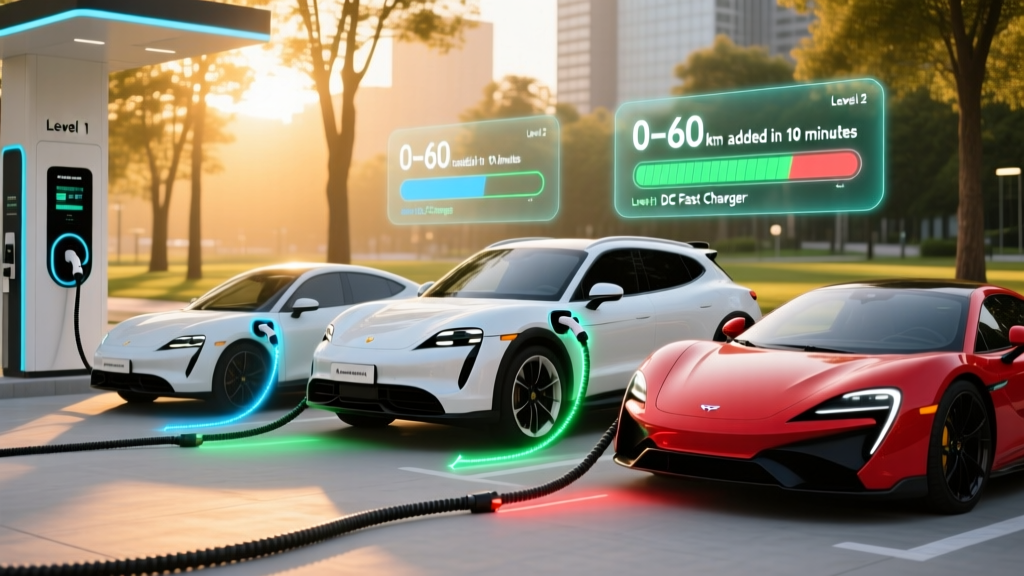
Every EV sold in the US charges via one of three levels. The critical distinction: kW (kilowatts) measures power—how fast energy flows into your battery. kWh (kilowatt-hours) measures energy—the total capacity of your battery. Think of kW as the width of a hose and kWh as the size of the bucket. A wider hose (higher kW) fills the bucket (kWh) faster.
| Level | Voltage | Power (kW) | Miles of Range Added Per Hour | Typical Use Case |
|---|---|---|---|---|
| Level 1 | 120V AC | 1.2–1.9 kW | 3–5 miles/hr | Overnight top-ups, PHEVs, low-mileage drivers |
| Level 2 | 240V AC | 3.3–19.2 kW | 12–75 miles/hr | Home daily charging, workplaces, public destinations |
| DC Fast Charging | 400–800V DC | 50–350 kW | 150–1,000+ miles/hr (peak) | Road trips, rapid top-ups, commercial fleets |
Level 1: The Outlet You Already Have
Every EV ships with a mobile charging cord that plugs into a standard 120V household outlet (NEMA 5-15). At roughly 1.4 kW continuous (12 amps on a 15-amp circuit), you'll recover about 4 miles of range per hour. For a plug-in hybrid with 30 miles of electric range, an overnight session is usually sufficient. For a battery-electric vehicle with an 80 kWh battery, a full Level 1 charge takes 50+ hours—making it practical only as a backup or for drivers covering fewer than 30 miles daily.
Level 2: The Home Charging Standard
Level 2 runs on 240V—the same voltage as your electric dryer—and this is where most daily EV charging happens. A typical home Level 2 setup delivers 7.7 kW (32 amps on a 40-amp circuit) to 11.5 kW (48 amps on a 60-amp circuit). At 7.7 kW, a 75 kWh battery (like the Hyundai Ioniq 5 or Tesla Model Y) charges from 10% to 80% in roughly 7 hours—perfect for overnight replenishment. Higher-amperage units at 11.5 kW or 19.2 kW (requiring a 100-amp circuit) cut that to 5 hours or 3 hours respectively, but the electrical infrastructure cost rises accordingly.
DC Fast Charging: Road-Trip Speed
DC fast chargers (DCFC) bypass the vehicle's onboard charger and push direct current straight into the battery at much higher power. Modern stations range from 50 kW legacy units to 350 kW ultra-fast chargers. However—and this is critical—peak kW is not sustained kW. Most EVs exhibit a charging curve: they accept peak power only between roughly 10% and 40% state of charge (SoC), then taper progressively to protect battery health. A vehicle rated for 250 kW peak might average only 130–150 kW across a full 10–80% session.
For example, the Hyundai Ioniq 5 (84 kWh usable, 800V architecture) peaks at roughly 240 kW on a compatible 350 kW charger and averages around 180 kW, achieving a 10–80% charge in approximately 18 minutes under ideal conditions. The Tesla Model Y (75 kWh, 400V) peaks at about 250 kW on a V3 Supercharger and averages around 150 kW, completing 10–80% in roughly 25–28 minutes. Cold batteries or high SoC will extend these times substantially.
Connector Types: NACS, CCS1, and CHAdeMO
The physical plug your EV uses determines which public chargers you can access without an adapter. As of 2026, the North American market has largely consolidated around NACS, but legacy connectors remain in service.
| Connector | AC Level 2? | DC Fast? | Vehicles Using It (Native) | Adapter Availability |
|---|---|---|---|---|
| NACS (Tesla / J3400) | Yes | Yes | Tesla (all), Ford, GM, Rivian, Hyundai, Kia, BMW, Mercedes, Volvo, and most 2025+ models | CCS→NACS adapters widely available ($200–$300) |
| CCS1 (Combo) | Yes (via J1772 upper) | Yes | Pre-2025 GM, Ford, Hyundai, Kia, VW, BMW models; many 2024 and earlier EVs | NACS→CCS adapters available from Tesla and third parties |
| CHAdeMO | No (separate J1772 port for AC) | Yes | Nissan Leaf (legacy); Mitsubishi Outlander PHEV (older) | Very limited; CHAdeMO stations declining |
| J1772 | Yes | No | All non-Tesla EVs for AC Level 1/2 (pre-NACS adoption) | NACS-to-J1772 adapters included with many new EVs |
If you're buying a 2025 or 2026 model-year EV, it almost certainly has a NACS port. If you own a 2023 or 2024 model with CCS1, you can purchase a NACS adapter (such as the official Ford or Tesla CCS-to-NACS adapter, typically $200–$300) to access Tesla Superchargers. CHAdeMO infrastructure is shrinking—Nissan Leaf owners should plan around CCS and NACS networks for road trips.
Home EV Charger Installation: Requirements and Real Costs
How much does it cost to install a home EV charger? The honest answer ranges from $500 for a simple setup in a newer home to $4,000+ if your electrical panel needs upgrading. Here's what drives the price.
Electrical Requirements
A standard Level 2 home charger drawing 7.7 kW requires a dedicated 240V, 40-amp circuit (the charger itself runs at 32 amps—electrical code requires circuits rated at 125% of continuous load). Higher-power units drawing 11.5 kW need a 60-amp circuit. The charger must be hardwired or plugged into a NEMA 14-50 or 6-50 receptacle installed by a licensed electrician.
Panel Upgrade: The Hidden Cost
Many homes built before 2000 have 100-amp or 125-amp main electrical panels. Adding a 40-amp or 60-amp EV circuit may push total load beyond 80% of panel capacity, requiring an upgrade to a 200-amp panel. Panel upgrades typically cost $1,500–$3,000 depending on your utility, local permitting, and whether a new meter base or service drop is needed. Always have an electrician perform a load calculation before committing to a charger circuit.
| Component | Low-End Cost | High-End Cost | Notes |
|---|---|---|---|
| Level 2 Charger Equipment | $300 | $700 | 32A–48A smart chargers; basic units from ~$200 |
| Electrician Labor (circuit run + outlet/hardwire) | $300 | $1,200 | Depends on distance from panel, wall type, conduit |
| Permit & Inspection | $50 | $300 | Required by most jurisdictions; varies by municipality |
| Electrical Panel Upgrade (if needed) | $1,500 | $3,000 | 100A→200A upgrade; not all homes require this |
| Total (no panel upgrade) | $650 | $2,200 | Most common scenario for homes with 200A panels |
| Total (with panel upgrade) | $2,150 | $5,200 | Older homes with 100A–125A service |
Some utilities offer rebates of $200–$500 for Level 2 charger installation, and certain states provide additional incentives. Check with your local utility and the Alternative Fuels Data Center for current programs in your area.
Level 2 Home Charger Recommendations (2026)
Not all Level 2 chargers deliver the same experience. Here are widely available units we've tested, with the specs that matter.
ChargePoint Home Flex
- Power Output: Up to 12 kW (50 amps) — configurable down to 16A for lower-capacity circuits
- Connector: NACS (J3400) native; J1772 version also available
- Cable Length: 23 feet
- Smart Features: Wi-Fi, app scheduling, Alexa integration, energy tracking
- Price: ~$550–$650
- Best For: Flexible amperage settings; works with nearly any circuit from 20A to 60A
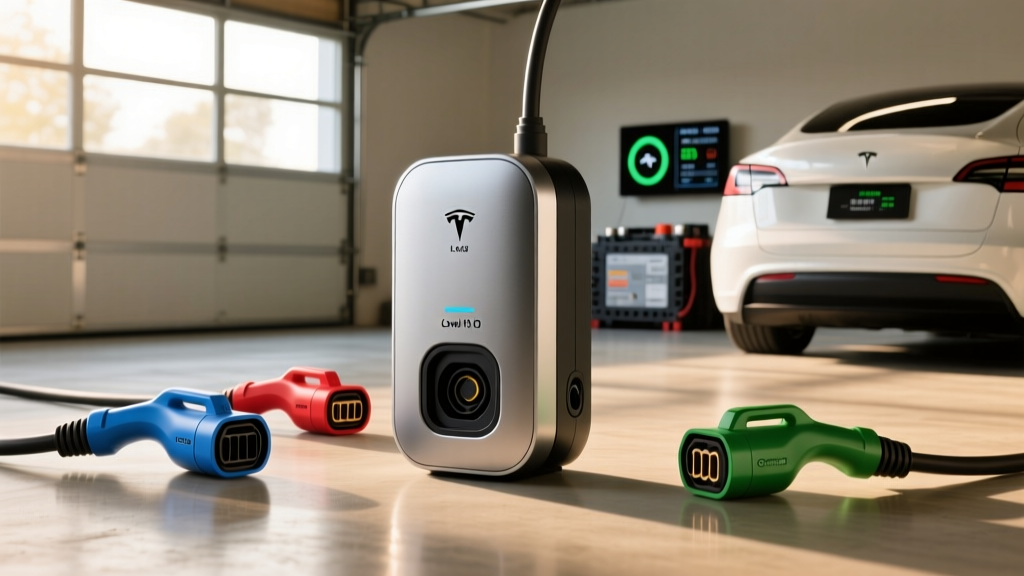
Wall Connector (Tesla, Gen 4)
- Power Output: Up to 11.5 kW (48 amps)
- Connector: NACS native
- Cable Length: 24 feet
- Smart Features: Wi-Fi, over-the-air updates, power sharing (link multiple units on one circuit), access control
- Price: ~$420–$480
- Best For: Tesla owners and NACS-equipped EVs; cleanest integration with Tesla vehicles
Emporia Vue Level 2 Charger
- Power Output: Up to 11.5 kW (48 amps)
- Connector: J1772 (NACS adapter available)
- Cable Length: 24 feet
- Smart Features: Wi-Fi, app scheduling, integrates with Emporia energy monitoring, solar-aware charging
- Price: ~$350–$400
- Best For: Budget-conscious buyers; solar-home integration
Grizzl-E Smart
- Power Output: Up to 10 kW (40 amps)
- Connector: J1772 (NACS adapter included with newer shipments)
- Cable Length: 24 feet
- Smart Features: Wi-Fi, OCPP-compatible, adjustable amperage, rugged aluminum enclosure
- Price: ~$450–$550
- Best For: Outdoor installs in harsh climates; -40°F rated
All of these chargers are UL-listed or ETL-listed, which your electrician and permitting office will require. Avoid uncertified import chargers sold on marketplace sites—they may not pass inspection and can void homeowner's insurance coverage in the event of an electrical fire.
Cost to Charge: Per-Mile Math vs. Gasoline
How much does charging cost per mile vs gas? The answer depends heavily on where and when you charge. Here's the real math for a typical EV averaging 3.0 miles per kWh (roughly 112 MPGe, comparable to a Hyundai Ioniq 5 or Tesla Model Y).
| Charging Scenario | Average $/kWh | Cost Per Mile (at 3.0 mi/kWh) | Equivalent Gas MPG at $3.50/gal |
|---|---|---|---|
| Home, off-peak utility rate | $0.09–$0.13 | $0.03–$0.04 | 88–117 MPG |
| Home, standard residential rate | $0.14–$0.18 | $0.05–$0.06 | 58–70 MPG |
| Public Level 2 (workplace, retail) | $0.20–$0.35 | $0.07–$0.12 | 29–50 MPG |
| DC Fast Charging (Electrify America, Tesla Supercharger) | $0.30–$0.55 | $0.10–$0.18 | 19–35 MPG |
| Gasoline baseline (28 MPG combined, $3.50/gal) | — | $0.125 | 28 MPG |
The takeaway: home charging on an off-peak rate is 3–4x cheaper per mile than gasoline. Public DC fast charging at peak rates can approach or exceed the per-mile cost of a fuel-efficient gas car. The economics strongly favor home charging. If you can't charge at home, a PHEV may be a more cost-effective choice unless your employer or apartment complex offers subsidized Level 2 access.
For authoritative efficiency data on specific models, the EPA's fueleconomy.gov provides kWh/100mi ratings for every EV sold in the US, which you can convert to miles-per-kWh for your own cost calculations.
Safety, Electrical Code, and Permit Essentials
EV charging draws sustained high current for hours—unlike most household loads. This makes proper installation non-negotiable.
- Dedicated circuit: Your Level 2 charger must have its own circuit breaker, not shared with other appliances. A 40A charger needs a dedicated 50A breaker; a 48A charger needs a dedicated 60A breaker.
- GFCI protection: The 2023 National Electrical Code (NEC) requires GFCI protection for all EV receptacles (NEMA 14-50 or 6-50) in garages and outdoor locations. Hardwired chargers are exempt from the GFCI requirement in most jurisdictions, which is one reason many electricians prefer hardwiring.
- Outdoor rating: If your charger is mounted outside, both the unit and any receptacle must be rated for wet locations (NEMA 4 or IP65). Look for chargers explicitly rated for outdoor use and operating temperatures down to at least -22°F (-30°C) if you live in a cold climate.
- Permit and inspection: Nearly all US jurisdictions require an electrical permit for new 240V circuits. The inspection ensures proper wire gauge, breaker sizing, grounding, and GFCI compliance. Skipping the permit risks failed insurance claims and code violations when selling your home.
- Wire gauge: A 50A circuit requires 6 AWG copper wire; a 60A circuit requires 4 AWG. Longer runs (over 50 feet from panel) may require upsizing to account for voltage drop. Your electrician will calculate this.
Frequently Asked Questions
How fast will each charging level add range to my EV?
Level 1 adds roughly 3–5 miles per hour. Level 2 at 7.7 kW adds about 25–30 miles per hour; at 11.5 kW, roughly 38–45 miles per hour. DC fast charging can add 100–250 miles in 15–25 minutes depending on the vehicle's peak charge rate and battery size. These figures assume a vehicle efficiency of approximately 3.0 miles per kWh. Less efficient vehicles (large SUVs, trucks) will see fewer miles per hour at each level.
Which connector or charger is compatible with my EV?
Check your vehicle's charge port. If it's a 2025 or 2026 model from Tesla, Ford, GM, Hyundai, Kia, Rivian, BMW, or most other major brands, it uses NACS (J3400). Older models (2024 and earlier non-Tesla) typically use CCS1 or, for Nissan Leaf, CHAdeMO. For home Level 2 charging, match your charger's connector to your vehicle's port—or use an adapter. Most NACS-equipped vehicles can use J1772 Level 2 chargers with a simple adapter (often included with the vehicle).
What electrical upgrades might I need for a home charger?
The most common upgrade is a new 240V circuit from your panel to your garage or parking spot. If your home has a 200-amp panel with sufficient spare capacity, this is straightforward ($300–$1,200 for the electrician's work). If your panel is 100–125 amps or already near capacity, you may need a panel upgrade to 200 amps ($1,500–$3,000). Some utilities now offer "managed charging" programs that allow you to install a charger without a panel upgrade by automatically throttling charge rate during peak household demand—ask your utility about this option.
Can I use a regular outlet to charge my EV?
Yes, but slowly. A standard 120V outlet provides Level 1 charging at roughly 1.4 kW, adding 3–5 miles of range per hour. This works for PHEVs and for BEV owners who drive fewer than 30–40 miles per day and can charge for 10–12 hours overnight. For higher-mileage drivers or larger batteries, Level 2 is strongly recommended. Never use an extension cord for EV charging—overheating and fire risk are significant.
Is DC fast charging bad for my battery?
Occasional DC fast charging has minimal impact on battery health. However, exclusive reliance on DCFC (daily or near-daily) can accelerate degradation slightly compared to Level 2 charging. Most modern EVs use active thermal management to mitigate heat during fast charging. For daily use, Level 2 home charging is ideal; reserve DC fast charging for road trips. Battery warranties typically guarantee 70% capacity retention for 8 years or 100,000 miles, per fueleconomy.gov and manufacturer specifications.