The 30C Electric Car Charger Tax Credit: What You Can Actually Claim
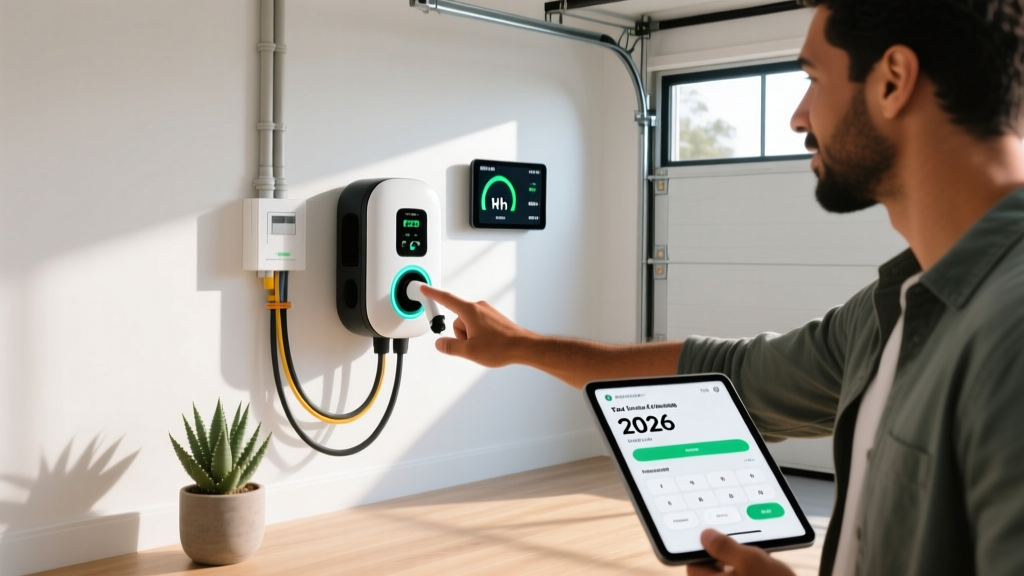
Buying an EV is only half the equation. The other half — reliable, affordable home charging — is where the federal government steps in with the Alternative Fuel Vehicle Refueling Property Credit (Internal Revenue Code §30C). If you install a qualified home EV charger in 2026, you can claim 30% of the total hardware and installation cost, up to $1,000, on your federal tax return.
This is not the same as the §30D new-vehicle credit (which covers the car itself). The §30C credit specifically covers charging equipment — the wall connector, electrical panel work, wiring, conduit, permits, and electrician labor. It applies to both homeowners and renters who install qualified equipment at their primary residence.
§30C Charger Tax Credit Eligibility Checklist (2026)
- Credit amount: 30% of equipment + installation, capped at $1,000 per tax year
- Eligible property: Your primary or secondary residence located in the United States
- Qualified equipment: Level 2 EV charging equipment (240V) that meets NEC and applicable safety standards
- Placed in service: Equipment must be installed and operational by December 31, 2026 (current provision expiration — verify with IRS §30C guidance)
- Income limits: Unlike §30D, the §30C credit currently has no adjusted gross income cap
- Nonrefundable: The credit can reduce your tax liability to zero but won't generate a refund beyond that
- Documentation: Retain receipts for equipment, electrician labor, permits, and any panel upgrades directly tied to the charger circuit
Real-world example: You spend $2,800 total on a Level 2 wall connector and professional installation. Your §30C credit = 30% × $2,800 = $840. Spend $3,400 or more and you hit the $1,000 cap. Consult a tax professional to confirm eligibility for your specific filing situation — incentive rules are subject to legislative change.
Charging Levels Explained: Speeds, Costs, and What You Need
Before choosing equipment, understand the three charging tiers. The critical distinction: kW (kilowatts) measures power — how fast energy flows. kWh (kilowatt-hours) measures energy — how much your battery holds. Think of kW as the width of a hose and kWh as the size of the bucket.
| Level | Voltage | Power (kW) | Miles Added/Hour | Typical Use |
|---|---|---|---|---|
| Level 1 | 120V AC | 1.0–1.4 kW | 3–5 mi/hr | Overnight top-ups, PHEVs, low-mileage drivers |
| Level 2 | 240V AC | 3.3–19.2 kW | 14–75 mi/hr | Home daily charging, workplace, public destinations |
| DC Fast | 200–800V DC | 50–350 kW | 150–1,000+ mi/hr | Road trips, highway corridors, commercial fleets |
Charging Time Examples by Battery Size
Real charging times depend on your vehicle's onboard charger (for AC) or peak DC acceptance rate. Here are representative 10–80% State of Charge (SoC) times:
- 60 kWh battery (e.g., base Nissan LEAF, Chevrolet Bolt EV): Level 2 at 7.2 kW ≈ 6 hours; at 11.5 kW ≈ 3.7 hours; DC fast at 50 kW ≈ 50 minutes
- 77 kWh battery (e.g., Ford Mustang Mach-E Extended Range): Level 2 at 11.5 kW ≈ 4.7 hours; DC fast at 150 kW ≈ 28 minutes (10–80%)
- 100 kWh battery (e.g., Tesla Model S, Rivian R1T Max Pack): Level 2 at 11.5 kW ≈ 6.1 hours; at 19.2 kW ≈ 3.6 hours; DC fast at 250 kW ≈ 25 minutes (10–80%)
Charge-curve reality: DC fast charging doesn't sustain peak kW. A vehicle rated for 250 kW peak may only hold that rate from roughly 10–30% SoC, then taper progressively. Expect the 10–80% session to average 40–60% of the advertised peak rate. This is why manufacturer-stated "10–80% in X minutes" is more useful than peak kW alone.
How Much Does It Cost to Install a Home EV Charger?
This is the question that stops most prospective EV buyers. The honest answer: it depends heavily on your home's electrical panel, the distance from panel to charger location, and local labor rates. Here's the full breakdown.
| Cost Component | Low End | High End | Notes |
|---|---|---|---|
| Level 2 Charger (hardware) | $350 | $750 | 32A–48A smart Wi-Fi units; premium models up to $1,000 |
| Electrician labor | $500 | $2,000 | Depends on run length, conduit type, wall penetrations |
| Permit & inspection | $50 | $300 | Varies by municipality; some jurisdictions waive for simple installs |
| Electrical panel upgrade (if needed) | $1,500 | $4,000 | 100A → 200A service upgrade; common in pre-1990 homes |
| Materials (conduit, wire, breaker) | $100 | $500 | Longer runs and underground conduit increase cost |
| Total (no panel upgrade) | $1,000 | $3,550 | Most homes with 200A service fall in $1,500–$2,500 range |
| Total (with panel upgrade) | $2,500 | $7,550 | Older homes or those adding solar + EV simultaneously |
What Electrical Upgrades Might You Need?
Most Level 2 chargers draw between 32A and 48A on a 240V circuit. The National Electrical Code (NEC) requires that continuous loads (anything running 3+ hours) use only 80% of a circuit's rated capacity. That means:
- A 40A charger needs a 50A breaker and 6 AWG copper wire
- A 48A charger needs a 60A breaker and 4 AWG copper wire
- A 32A charger needs a 40A breaker and 8 AWG copper wire
Panel capacity check: Your electrician will perform a load calculation (NEC Article 220). If your home has a 100A main panel and you're already running central AC, an electric oven, and an electric dryer, adding a 48A EV circuit may exceed capacity. A panel upgrade to 200A service is the standard solution — and it qualifies toward your §30C credit since it's directly required for the charger installation.
Homes built after 2000 typically have 200A service and adequate spare breaker slots. Homes built before 1990 often have 100A or even 60A service and may need the full upgrade. Budget accordingly and get at least two electrician quotes.
Connector Compatibility: NACS, CCS1, and CHAdeMO
The North American charging connector landscape has consolidated significantly since 2023, when Ford, GM, Rivian, Volvo, and most major automakers committed to adopting the North American Charging Standard (NACS) — originally developed by Tesla. By 2026, the vast majority of new EVs sold in the U.S. ship with a native NACS charge port.
| Connector | AC Level 2 | DC Fast | Vehicles Using It (2026) | Adapter Needed? |
|---|---|---|---|---|
| NACS (Tesla / SAE J3400) | Yes | Yes | Tesla (all), Ford, GM, Rivian, Volvo, Polestar, Mercedes, BMW, Hyundai/Kia (new models) | CCS → NACS adapters available for legacy chargers |
| CCS1 (Combo) | Yes (J1772 upper) | Yes | Older VW ID.4, older BMW i4/iX, Stellantis models, some pre-2025 EVs | NACS → CCS1 adapter needed at Tesla Superchargers |
| CHAdeMO | No (uses J1772 for AC) | Yes | Nissan LEAF (all years), Mitsubishi Outlander PHEV (legacy) | CHAdeMO → CCS/NACS adapters limited and expensive |
| J1772 | Yes (AC only) | No | All non-Tesla EVs for AC Level 1/2 (pre-2025 models) | J1772 → NACS adapter included with most new NACS vehicles |
For home Level 2 charging in 2026: Most new wall connectors ship with a NACS plug. If you own a pre-transition CCS1 vehicle, you'll either use a J1772-to-CCS adapter (typically included with your car) or choose a wall connector with a J1772 connector and use a J1772-to-NACS adapter when you upgrade vehicles later.
See the SAE J3400 standard documentation for the formal NACS specification adopted across the industry.
Level 2 Home Charger Recommendations for 2026
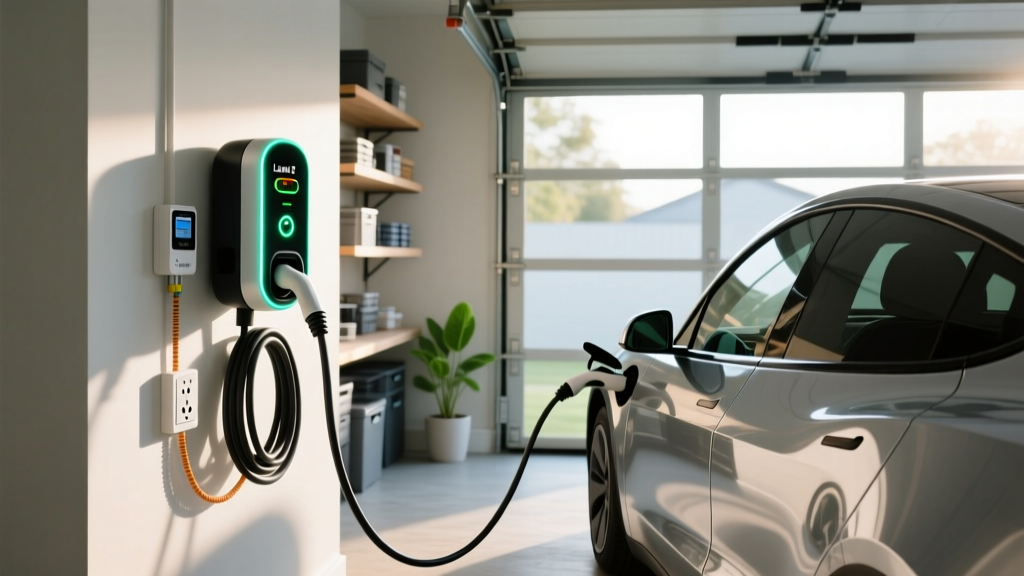
Here are four proven units that cover different budgets and electrical setups. All are Wi-Fi-enabled for scheduling, energy monitoring, and utility demand-response programs.
Tesla Wall Connector (Gen 4)
- Power: Up to 11.5 kW (48A on 60A circuit)
- Connector: Native NACS; J1772 adapter available
- Cable length: 24 ft
- Smart features: Wi-Fi scheduling, over-the-air updates, load sharing (pair two units on one circuit), Powerwall integration
- Price: ~$475 (hardware only)
- Best for: Tesla owners and NACS-equipped EVs; cleanest integration with Tesla ecosystem
ChargePoint Home Flex (2nd Gen)
- Power: Configurable 16A–50A (3.8–12 kW); adjustable via DIP switches to match your circuit
- Connector: Available in NACS or J1772
- Cable length: 23 ft
- Smart features: Wi-Fi, Alexa/Google Home, detailed app with cost tracking, utility demand-response compatible
- Price: ~$550–$650
- Best for: Multi-EV households, renters who may move the unit, users wanting flexible amperage
Emporia Level 2 EV Charger
- Power: Up to 11.5 kW (48A)
- Connector: J1772 (NACS adapter available)
- Cable length: 24 ft
- Smart features: Wi-Fi, integrates with Emporia Vue energy monitor for whole-home load tracking, solar-aware scheduling
- Price: ~$399
- Best for: Budget-conscious buyers with solar panels; best value in smart Level 2 hardware
Grizzl-E Smart (United Chargers)
- Power: Up to 10 kW (40A)
- Connector: J1772 or NACS
- Cable length: 24 ft
- Smart features: Wi-Fi, OCPP-compatible (works with many utility programs), extreme cold rated to -40°F
- Price: ~$549
- Best for: Cold-climate installations, outdoor mounting, Canadian and northern U.S. owners
Cost to Charge: EV vs Gas Per-Mile Economics
The financial case for home charging is overwhelming — if you have access to it. Here's what the numbers look like across common charging scenarios in 2026.
| Charging Scenario | Avg Cost/kWh | Cost to Add 200 Miles* | Cost Per Mile |
|---|---|---|---|
| Home Level 2 (national avg residential rate) | $0.16/kWh | $9.60 | $0.048 |
| Home Level 2 (off-peak TOU rate) | $0.08/kWh | $4.80 | $0.024 |
| Public Level 2 (networks like ChargePoint, EVgo) | $0.25–$0.40/kWh | $15.00–$24.00 | $0.075–$0.12 |
| DC Fast Charging (Electrify America, Tesla Supercharger) | $0.32–$0.55/kWh | $19.20–$33.00 | $0.096–$0.165 |
| Gasoline comparison (28 MPG avg, $3.40/gal) | — | $24.29 | $0.121 |
*Based on an EV averaging 3.0 miles/kWh (≈100 MPGe), representative of mid-size crossovers like the Hyundai IONIQ 5, Tesla Model Y, and Ford Mustang Mach-E. See fueleconomy.gov for model-specific efficiency data.
The bottom line: Home charging at off-peak rates delivers fuel costs roughly 80% lower than gasoline per mile. Even public DC fast charging is competitive with or cheaper than gas for most vehicles. The break-even point where DC fast charging exceeds gas costs occurs above ~$0.42/kWh — which some premium urban chargers do exceed during peak hours.
Safety, Code, and Installation Best Practices
EV charging is a high-draw, long-duration electrical load. Cutting corners on installation creates fire risk and may void your homeowner's insurance. Here's what code-compliant installation requires:
- Dedicated circuit: Your Level 2 charger must be on its own dedicated breaker — no shared circuits with appliances, lighting, or outlets
- GFCI protection: NEC 2020 and later (Article 625) requires Ground Fault Circuit Interrupter protection for all EV charging outlets. Hardwired units typically include internal GFCI; plug-in units require a GFCI breaker
- Outdoor rating: If mounted outside, the charger must carry a NEMA 4 or NEMA 4X rating (weatherproof). All units listed above meet this standard
- Plug vs. hardwire: A NEMA 14-50 outlet (50A, 240V) offers portability — you can unplug and take the charger when you move. Hardwired installations eliminate the outlet as a failure point and may allow higher amperage (some 60A hardwired setups). Discuss with your electrician
- Permit and inspection: Nearly all jurisdictions require a permit for new 240V circuits. The inspection verifies wire gauge, breaker sizing, grounding, and GFCI compliance. Do not skip this step — unpermitted work can complicate home sales and insurance claims
- Cable management: Use a wall-mounted cable organizer or retractable reel to prevent tripping hazards and connector damage. Never let the cable rest on the ground where vehicles can drive over it
Always hire a licensed electrician familiar with NEC Article 625 (Electric Vehicle Charging System Equipment). Ask whether they've completed EV charger installations before — the load-calculation and continuous-duty requirements differ from standard appliance circuits.
Frequently Asked Questions
Can I claim the electric car charger tax credit if I rent my home?
Yes. The §30C credit is available to both homeowners and tenants who install qualified charging equipment at their primary U.S. residence. You'll need your landlord's permission for any electrical modifications, and the equipment must be permanently installed (not a portable unit you plug into an existing outlet).
Does a standard 120V outlet qualify for the tax credit?
Technically, Level 1 charging equipment can qualify under §30C if it's newly purchased qualified property. However, the credit is most valuable when applied to a Level 2 installation, where the combined hardware and electrician costs are high enough to approach the $1,000 cap. A $200 Level 1 cordset would yield only a $60 credit.
How fast will a Level 2 charger add range to my EV overnight?
A 48A (11.5 kW) Level 2 charger adds approximately 35–45 miles of range per hour of charging in a typical mid-size EV. Over an 8-hour overnight session, that's 280–360 miles — enough to fully replenish even the largest consumer EV batteries. A 32A (7.7 kW) unit adds roughly 23–28 miles per hour, yielding 185–225 miles overnight.
Do I need a panel upgrade for a Level 2 charger?
Not always. If your home has a 200A main panel with available breaker slots and your electrician's load calculation shows sufficient headroom, you can add a 50A or 60A EV circuit without upgrading. Homes with 100A service, or 200A panels already near capacity (electric heat, AC, dryer, oven, water heater), frequently need an upgrade. Budget $1,500–$4,000 for this work if required — and include it in your §30C credit calculation.
Can I install a Level 2 charger myself?
While some jurisdictions allow homeowner electrical work with a permit, a 240V/50A+ circuit is not a beginner project. Errors in wire sizing, torque specifications, or grounding can cause overheating and fire. Most manufacturers' warranties also require professional installation for coverage. The labor cost ($500–$2,000) is a small fraction of the total risk reduction.
Is the §30C charger credit refundable?
No. The §30C credit is nonrefundable — it can reduce your federal tax liability to zero but will not generate a refund beyond what you owe. If your total tax liability is less than $1,000, you can only claim up to the amount you owe. The credit cannot be carried forward to future tax years under current rules. Confirm specifics with a qualified tax professional and review IRS Publication 8911.
Will my utility offer a special EV charging rate?
Many utilities now offer Time-of-Use (TOU) plans with off-peak rates as low as $0.05–$0.10/kWh for overnight charging (typically 10 PM – 6 AM). Contact your utility or check the Department of Energy EV charging resources for programs in your area. Smart chargers can automatically schedule sessions during off-peak windows.