Buying an electric car charger for home is the single highest-impact upgrade most EV owners make. Over 80% of EV charging happens at home, according to the U.S. Department of Energy, which means your daily driving experience—and your per-mile fuel cost—hinges on the equipment you install in your garage or driveway. But the market is crowded, the electrical requirements are non-negotiable, and the difference between a well-planned install and a costly mistake can run into the thousands.
This guide cuts through the noise with exact numbers: charging speeds in kW (power) and miles added per hour, real installation cost breakdowns including panel upgrades, connector compatibility for every major EV brand on sale in 2026, and specific charger recommendations with pricing. Whether you drive a Tesla Model Y, a Hyundai Ioniq 5, a Ford F-150 Lightning, or a Chevrolet Equinox EV, you'll know exactly what to buy, what your electrician needs to do, and what you'll pay.
Charging Levels Explained: Speeds, kW, and Real-World Range Added
Before picking hardware, you need to understand the three charging levels available to EV owners. The critical distinction: kW (kilowatts) measures power—how fast energy flows into your car. kWh (kilowatt-hours) measures energy—the total capacity of your battery. Think of kW as the width of the hose and kWh as the size of the bucket. A wider hose (more kW) fills the bucket faster.
| Level | Voltage | Max Power (kW) | Miles of Range Added Per Hour | Typical Use Case |
|---|---|---|---|---|
| Level 1 | 120V AC | 1.2–1.9 kW | 3–5 miles | Overnight top-up; PHEVs; low daily mileage |
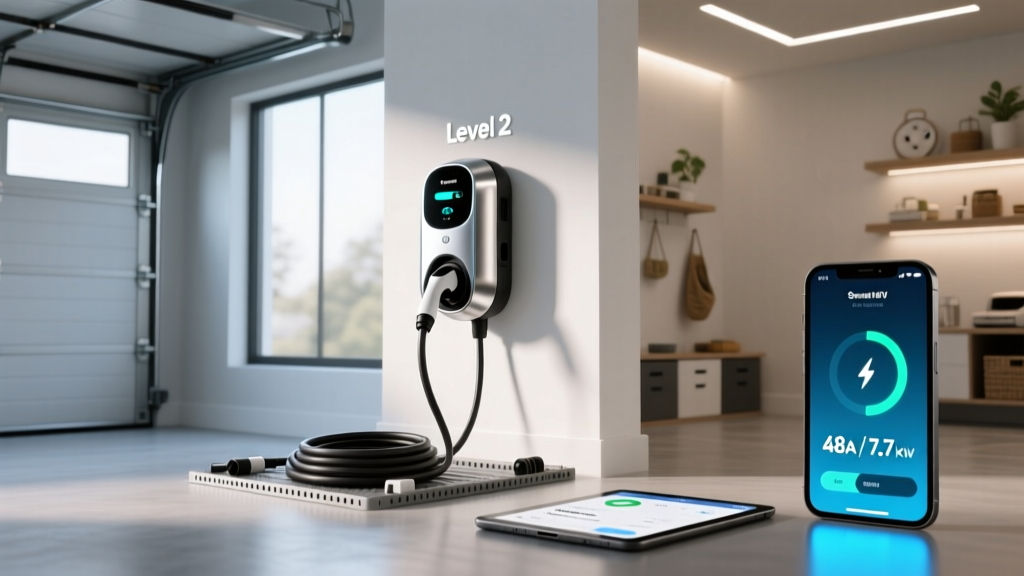
| Level 2 | 240V AC | 7.2–19.2 kW | 20–60+ miles | Primary home charging; daily use for BEVs |
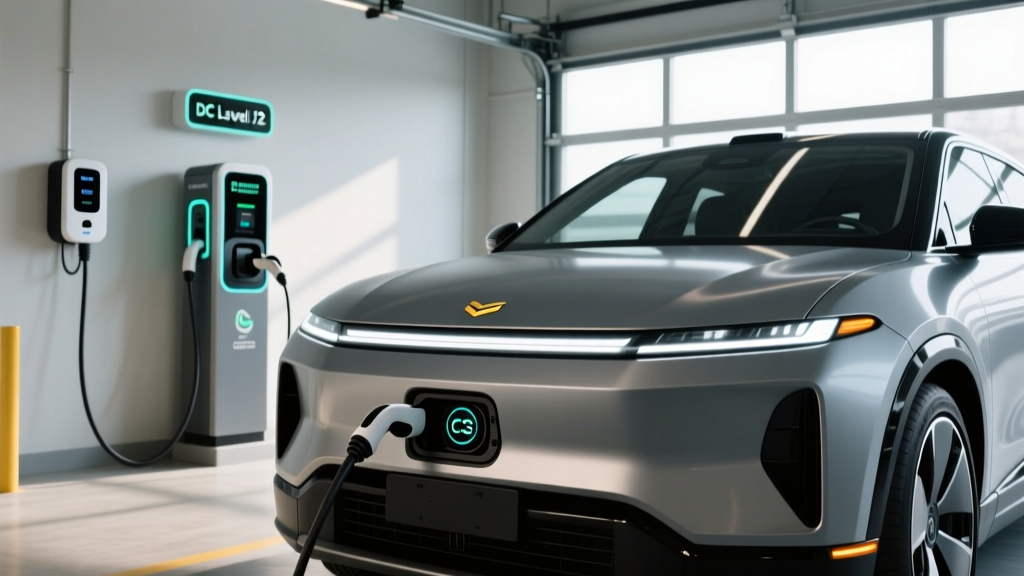
| DC Fast Charging | 400–800V DC | 50–350 kW | 150–1,000+ miles (equivalent rate) | Road trips; public stations; not for home |
For most battery-electric vehicle (BEV) owners, a Level 2 home charger is the standard. A typical BEV with a 75–100 kWh battery driven 30–40 miles daily needs roughly 10–15 kWh replenished overnight—easily handled by a 7.2 kW or 11.5 kW Level 2 unit in 2–3 hours. Level 1 is viable for plug-in hybrids (PHEVs) with smaller 10–20 kWh batteries, or BEV owners who drive under 20 miles per day and can leave the car plugged in for 12+ hours.
DC fast charging uses direct current at public stations and cannot be installed at a typical residence due to the enormous power requirements (often 50+ kW). Reserve DCFC for road trips—frequent reliance on it accelerates battery degradation and costs significantly more per kWh than home charging.
How Much Does It Cost to Install a Home EV Charger?
The total installed cost of a home Level 2 EV charger varies enormously depending on your home's electrical panel, the distance from the panel to the charger location, and local permit fees. Here's a realistic breakdown based on 2026 national averages:
| Cost Component | Low End | Typical | High End |
|---|---|---|---|
| Level 2 Charger Equipment | $300 | $500–$700 | $1,200 |
| Electrician Labor (240V circuit, 40–60A) | $400 | $800–$1,500 | $3,000 |
| Electrical Permit | $50 | $100–$250 | $500 |
| Panel Upgrade (100A → 200A service) | $0 (not needed) | $1,500–$3,000 | $5,000+ |
| Total (no panel upgrade) | $750 | $1,400–$2,450 | $4,700 |
| Total (with panel upgrade) | $2,250 | $2,900–$5,450 | $9,700+ |
When Will You Need a Panel Upgrade?
Homes built before the 1990s often have 100-amp electrical service. Adding a 40-amp or 50-amp dedicated EV circuit to an already-loaded 100A panel may exceed its capacity—especially if you run central air, an electric dryer, and an electric oven simultaneously. A licensed electrician will perform a load calculation (per NEC Article 220) to determine if your panel can handle the additional draw. If not, upgrading to 200A service typically costs $1,500–$3,000, though complex situations with long conduit runs or utility transformer upgrades can push costs higher.
Homes with existing 200A service and moderate electrical loads rarely need an upgrade. Many newer homes (post-2010) were built with EV charging in mind and may even have a pre-installed 240V outlet in the garage.
Electrical Requirements for a Level 2 Charger
A standard Level 2 home charger requires:
- Voltage: 240V AC (same as your electric dryer or oven)
- Amperage: A dedicated circuit rated for 20% more than the charger's continuous draw. A 40A charger needs a 50A breaker; a 32A charger needs a 40A breaker.
- Wiring: Typically 6 AWG copper for 50A circuits, 8 AWG for 40A circuits (varies by run length and local code)
- GFCI Protection: The 2023 NEC (and continued 2026 adoption) requires GFCI protection for EV receptacles in garages. Many hardwired chargers have built-in GFCI, which avoids nuisance tripping that can occur with GFCI breakers on receptacles.
- Outdoor Rating: If installing outside, the charger must carry a NEMA 4 or NEMA 4X rating for weather resistance. The circuit wiring must also be rated for wet locations.
Connector Compatibility: NACS, CCS, and CHAdeMO in 2026
The EV connector landscape has shifted dramatically. As of 2026, the North American Charging Standard (NACS), originally developed by Tesla, has been adopted by virtually every major automaker for new vehicles sold in the U.S. Here's where each brand stands:
| Connector | Brands Using It (2026 Models) | Adapter Needed for Home Charging? |
|---|---|---|
| NACS (Tesla connector) | Tesla (all models), Ford, GM, Rivian, Volvo, Polestar, Mercedes-Benz, Nissan (Ariya), Honda (Prologue), Hyundai/Kia (2025+ models), BMW, Lucid | None if charger has NACS plug; CCS chargers need a CCS-to-NACS adapter (~$100–$200) |
| CCS1 (Combo) | Older Hyundai/Kia (pre-2025), VW ID.4 (2024 and earlier), Stellantis/Chrysler, some legacy models still on the road | None if charger has CCS plug; NACS chargers need a NACS-to-CCS adapter (~$150–$250) |
| CHAdeMO | Nissan Leaf (legacy, discontinued in U.S. after 2024); Mitsubishi Outlander PHEV (older model years) | CHAdeMO chargers are rare; adapters limited and expensive |
Bottom line for 2026 buyers: If you're purchasing a new EV, it almost certainly uses NACS. Buy a NACS-equipped home charger, or buy a CCS charger with a NACS adapter. If you own an older CCS-equipped EV (say, a 2023 VW ID.4 or 2023 Hyundai Ioniq 5), you'll either buy a CCS charger or use a NACS-to-CCS adapter on a NACS charger. For public DC fast charging, the expanding Tesla Supercharger network now serves NACS-equipped non-Tesla EVs natively, while CCS vehicles can use Electrify America, EVgo, and ChargePoint networks.
2026 Equipment Recommendations: Top Home Level 2 Chargers
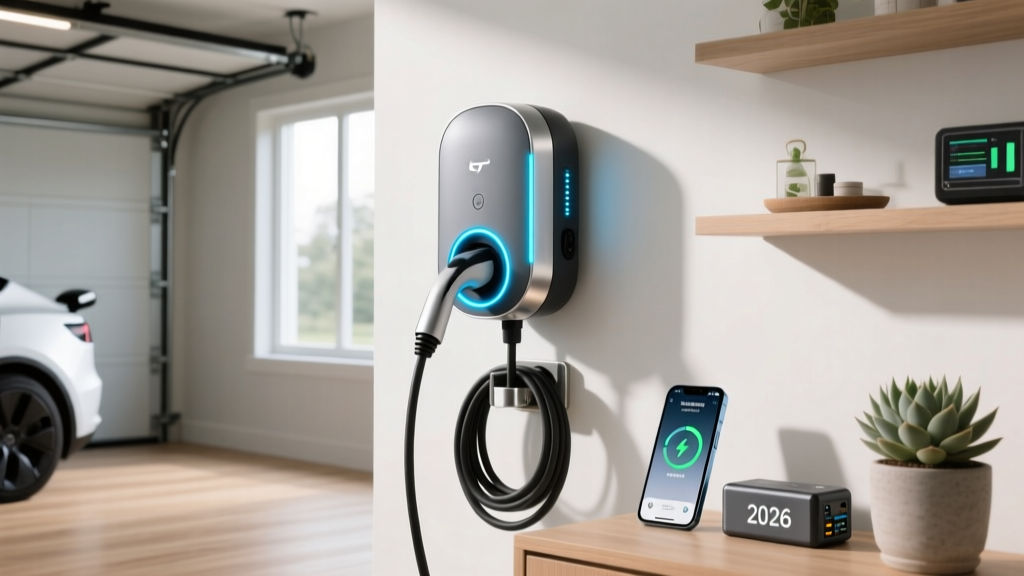
The following chargers represent the best options across different budgets and feature sets in 2026. All are UL-listed (or ETL-listed to UL standards), support Wi-Fi connectivity for scheduling and monitoring, and are available in NACS or CCS configurations.
ChargePoint Home Flex
Power: Up to 12 kW (50A circuit) — adjustable down to 16A for lower-capacity panels
Connector: NACS or CCS (select at purchase)
Cable Length: 23 feet
Smart Features: Wi-Fi, app scheduling, Alexa/Google Home, energy tracking, load sharing (two units on one circuit)
Price: ~$550–$650
Best For: Most EV owners; flexible amperage accommodates older panels
Tesla Wall Connector (Gen 4)
Power: Up to 11.5 kW (48A continuous on 60A circuit)
Connector: NACS native
Cable Length: 24 feet
Smart Features: Wi-Fi, over-the-air updates, Tesla app integration, Power Sharing (up to 6 units on one circuit), built-in GFCI
Price: ~$420–$475
Best For: Tesla owners and any NACS-equipped EV; excellent value
Grizzl-E Smart
Power: Up to 10 kW (40A on 50A circuit)
Connector: NACS or CCS (J1772 with adapter included)
Cable Length: 24 feet
Smart Features: Wi-Fi, OCPP-compatible, adjustable amperage, extreme cold rated (-40°F)
Price: ~$400–$500
Best For: Cold-climate owners; rugged outdoor installations; budget-conscious buyers
Emporia Level 2 EV Charger
Power: Up to 11.5 kW (48A on 60A circuit)
Connector: NACS or J1772
Cable Length: 24 feet
Smart Features: Wi-Fi, real-time energy monitoring, solar integration, time-of-use scheduling, load management with Emporia Vue panel monitor
Price: ~$350–$400
Best For: Solar panel owners; energy monitoring enthusiasts; best value for 48A output
What Does Home Charging Cost Per Mile vs. Gasoline?
The economics of home EV charging depend on your local electricity rate, whether you can access time-of-use (TOU) pricing, and your vehicle's efficiency. Here are representative scenarios for 2026:
| Scenario | Rate ($/kWh) | Vehicle Efficiency (kWh/100 mi) | Cost Per Mile | Equivalent Gas Price at 30 MPG |
|---|---|---|---|---|
| Home — Off-Peak TOU Rate | $0.08 | 30 kWh/100 mi (e.g., Tesla Model 3) | $0.024 | $0.72/gallon |
| Home — Average U.S. Residential | $0.17 | 30 kWh/100 mi | $0.051 | $1.53/gallon |
| Home — High-Cost State (CA, HI, MA) | $0.30 | 30 kWh/100 mi | $0.090 | $2.70/gallon |
| Public Level 2 (ChargePoint, etc.) | $0.25–$0.49 | 30 kWh/100 mi | $0.075–$0.147 | $2.25–$4.41/gallon |
| DC Fast Charging (Electrify America) | $0.35–$0.55 | 30 kWh/100 mi | $0.105–$0.165 | $3.15–$4.95/gallon |
| Gas Vehicle (30 MPG combined) | $3.40/gallon national avg. | $0.113 | — | |
The data is clear: home charging, especially on off-peak TOU rates, delivers fuel costs 50–80% lower than gasoline per mile. Even at high residential rates in expensive states, home EV charging remains cheaper per mile than a 30 MPG gas car at current fuel prices. Public DC fast charging narrows or eliminates the savings—which is exactly why a home charger is the keystone of economical EV ownership.
For a driver covering 12,000 miles annually at the national average residential rate ($0.17/kWh) in a vehicle averaging 30 kWh/100 mi, annual home charging costs approximately $612. The same miles in a 30 MPG gas vehicle at $3.40/gallon costs $1,360—a yearly savings of roughly $748, or $3,740 over five years. (Source: fueleconomy.gov)
Charging Time Examples: How Long to Charge Common EV Batteries
Charge times depend on three factors: battery capacity (kWh), charger power output (kW), and the state of charge (SoC) range. EVs charge fastest between roughly 10% and 50% SoC, then taper significantly above 80% to protect battery health. Here are real-world Level 2 home charging estimates:
| Vehicle | Usable Battery (kWh) | 7.2 kW Charger (32A) | 11.5 kW Charger (48A) |
|---|---|---|---|
| Tesla Model 3 Long Range | 75 kWh | ~7.3 hours | ~4.6 hours |
| Hyundai Ioniq 5 (Long Range) | 77.4 kWh | ~7.5 hours | ~4.7 hours |
| Ford F-150 Lightning (Extended) | 131 kWh | ~12.7 hours | ~8.0 hours |
| Chevrolet Equinox EV | 85 kWh | ~8.3 hours | ~5.2 hours |
| Toyota bZ4X | 64 kWh | ~6.2 hours | ~3.9 hours |
| BMW iX xDrive50 | 105.2 kWh | ~10.2 hours | ~6.4 hours |
For overnight charging (8–10 hours available), a 7.2 kW charger handles most sedans and crossovers with batteries under 85 kWh. Owners of large-battery trucks and SUVs (F-150 Lightning Extended Range, Rivian R1T Max Pack) should strongly consider a 48A/11.5 kW installation to ensure full overnight replenishment, especially if daily driving exceeds 60 miles.
Safety, Permits, and Electrical Code Essentials
EV charging places a sustained, high-current load on your home's electrical system—unlike any other appliance that cycles on and off. Safety and code compliance are not optional:
- Dedicated circuit: Your EV charger must be on its own dedicated breaker. Sharing a circuit with other loads is a code violation and a fire risk.
- Permitting: Virtually all jurisdictions require an electrical permit for a new 240V circuit. The permit ensures an inspector verifies the work meets NEC (National Electrical Code) standards. Expect $50–$500 depending on your municipality.
- GFCI protection: The NEC requires ground-fault protection for EV charging receptacles. Hardwired chargers with internal GFCI satisfy this requirement without a GFCI breaker, which can nuisance-trip under sustained high-current EV loads.
- NEMA 14-50 receptacle considerations: If using a plug-in charger on a 14-50 outlet, use an industrial-grade receptacle (Hubbell, Bryant, or Cooper—not a $10 big-box store unit). Cheap receptacles have been linked to melting under continuous EV charging loads. Some jurisdictions now require EV-grade receptacles.
- Outdoor installations: Use a charger rated NEMA 4 or 4X. Ensure conduit and junction boxes are rated for wet locations. Install at least 18 inches above grade per NEC clearance requirements.
- Utility notification: Some utilities require or recommend notification before installing an EV charger, especially for panel upgrades. Many offer rebates ($250–$1,000) for Level 2 installations or TOU rate enrollment—check with your provider.
Always hire a licensed electrician. EV charging involves sustained loads at 80% of breaker capacity for hours at a time—improper wire sizing, loose connections, or undersized breakers create serious fire hazards. (Source: NFPA / National Electrical Code)
Frequently Asked Questions
Can I use a regular 120V outlet to charge my EV?
Yes, but slowly. Level 1 charging at 120V delivers 1.2–1.9 kW, adding roughly 3–5 miles of range per hour. For a 75 kWh battery, a 10%–80% charge takes 35–45 hours—impractical for BEVs with daily driving over 20 miles. Level 1 works well for PHEVs with 10–20 kWh batteries (4–8 hours overnight) or as an emergency backup for BEVs.
Do I need a Tesla Wall Connector if I own a Tesla?
The Tesla Wall Connector is an excellent choice for Tesla owners (and now any NACS-equipped EV) at a competitive price (~$420–$475). However, third-party NACS chargers like the ChargePoint Home Flex or Emporia Level 2 offer comparable performance with additional features like energy monitoring or load sharing. You are not locked into Tesla's hardware.
Will a home EV charger increase my electric bill significantly?
Expect an increase proportional to your driving. At the national average rate of $0.17/kWh, driving 12,000 miles per year in a vehicle averaging 30 kWh/100 mi adds roughly $612 annually—or about $51/month—to your electric bill. This replaces approximately $1,360 in annual gasoline costs, yielding net savings of ~$748/year. Enrolling in a TOU rate plan and charging during off-peak hours (typically 10 PM–6 AM) can cut the electricity cost by 40–60%.
Are there tax credits or rebates for home EV charger installation?
The federal Alternative Fuel Vehicle Refueling Property Credit (§30C) was extended and modified under the Inflation Reduction Act. For 2026, it covers up to 30% of home charging equipment and installation costs, capped at $1,000, but is subject to census-tract eligibility requirements (the property must be in a qualifying low-income or non-urban census tract). Many utilities and states also offer separate rebates of $250–$1,000 for Level 2 charger purchases. Check IRS.gov for current §30C rules and your utility's rebate portal.
Can I install two EV chargers in my garage?
Yes, but it requires either two dedicated 240V circuits (doubling the electrical load and potentially requiring a panel upgrade) or a load-sharing system. Chargers like the Tesla Wall Connector and ChargePoint Home Flex support load sharing—two units on a single 60A or 80A circuit that dynamically split available current. This is the most cost-effective approach for two-EV households.
What if I rent my home or live in a condo?
Renters need landlord permission for any electrical modification. For condos and apartments, the growing availability of shared Level 2 charging in parking structures is expanding access. Some states (California, Colorado, Florida, and others) have "right to charge" laws that prevent HOAs from unreasonably blocking EV charger installations. Portable Level 2 chargers that plug into existing 240V dryer outlets (NEMA 14-50 or 14-30) are an option if your landlord permits use of an existing outlet—though a dedicated circuit is always safer.