Why Electric Boat Range Keeps Coming Up in EV Conversations
If you've searched "electric boat range" lately, you're not alone. Marine electrification is accelerating, with companies like X Shore, Candela, and Brunswick's Avata pushing lithium-powered hulls into the mainstream. But here's the thing most marine marketing glosses over: the same battery, charging, and electrical-infrastructure questions that EV buyers face apply to electric boats — often with fewer public charging options and higher costs per kWh.
This guide uses electric boat range as a lens to explain EV charging fundamentals that matter whether you're plugging in a Tesla Model Y or a 20-foot electric day cruiser. We'll cover charging levels, home installation realities, connector compatibility, equipment picks, and the math behind cost-per-mile versus gasoline — all grounded in 2026 specs and real-world numbers.
Charging Levels Explained: kW, Miles Per Hour, and Real Charging Times
The single most important distinction in EV (and electric boat) charging: kW (kilowatts) is power — how fast energy flows. kWh (kilowatt-hours) is energy — how much the battery holds. A 75 kWh battery charged at 7.2 kW takes roughly 10 hours from empty. A 40 kWh boat battery at 3.3 kW takes about 12 hours. The math is the same; only the scale changes.
| Level | Voltage | Power (kW) | Miles of EV Range / Hour | Typical Use Case |
|---|---|---|---|---|
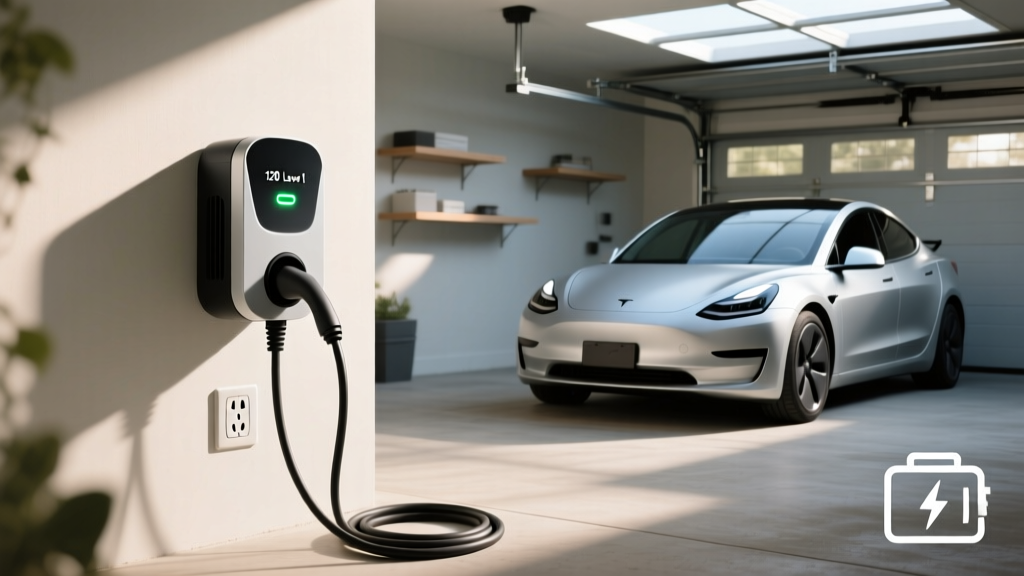
| Level 1 | 120V AC | 1.2–1.9 kW | 3–5 mi/hr | Overnight top-off, PHEVs, trickle charging boats in storage |
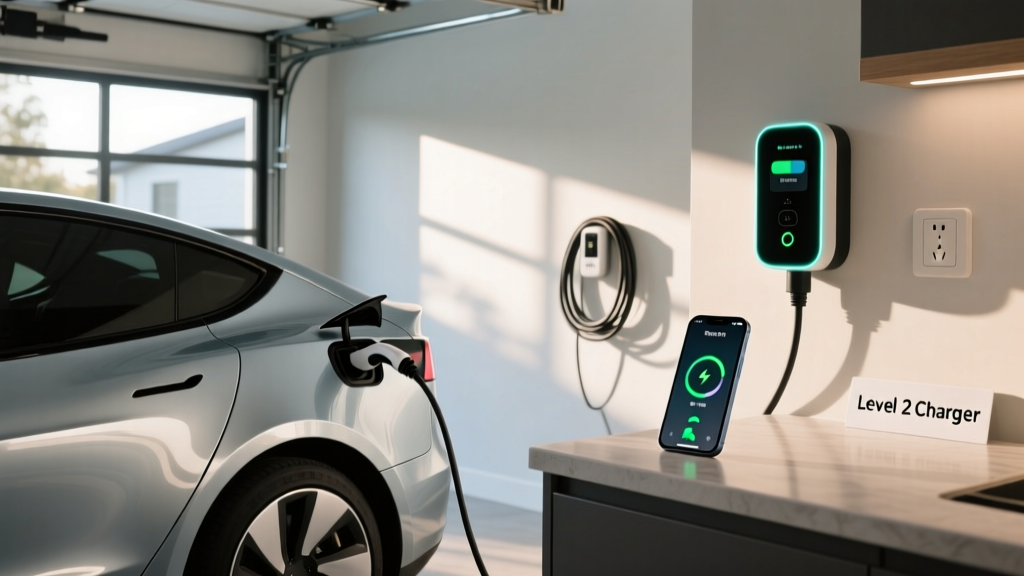
| Level 2 | 240V AC | 3.3–19.2 kW | 12–70 mi/hr | Home daily charging, marina shore power, workplace |
| DC Fast | 400–800V DC | 50–350 kW | 150–1,000+ mi/hr (peak) | Road trips, highway corridors — not yet available for most boats |
Real-world charging reality: A 2026 Hyundai Ioniq 5 with its 84 kWh battery peaks at ~240 kW on a 350 kW DC fast charger, reaching 10–80% in about 18 minutes. But sustained average power is closer to 150 kW because the charge curve tapers sharply above 80% SoC. Expect a full 10–80% session to deliver roughly 210 real-world highway miles (EPA sticker: 305 mi), not the theoretical maximum.
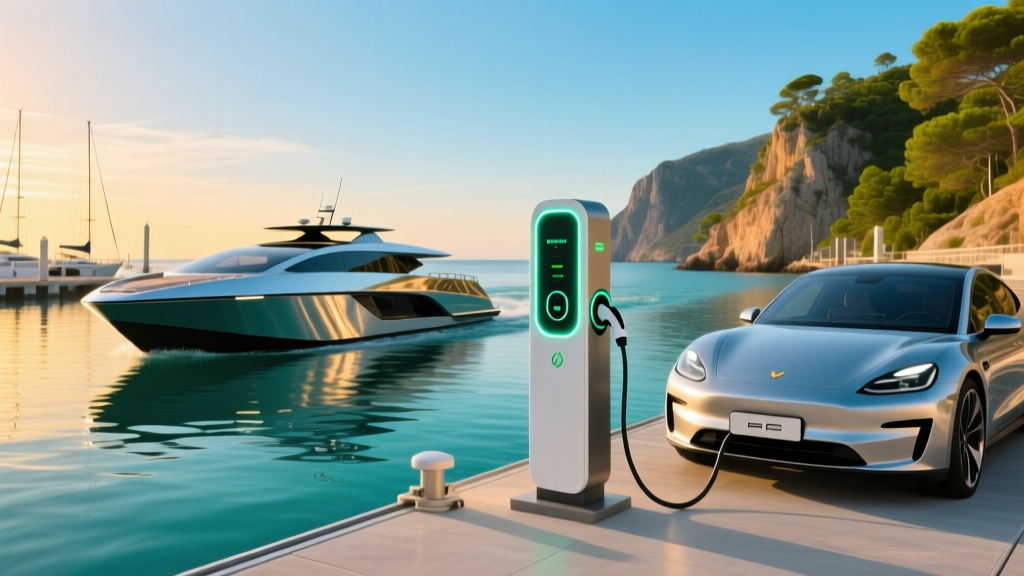
Electric boats rarely access DC fast charging. Most rely on Level 2 shore power (typically 3.3–7.2 kW via marine-grade connectors), meaning a full charge for a 40 kWh X Shore Eelex 8000 takes 6–12 hours at the dock — comparable to overnight Level 2 EV charging at home.
Home EV Charger Installation: Electrical Requirements, Costs, and Panel Upgrades
Installing a Level 2 home charger is the single biggest ownership upgrade an EV buyer makes. It's also where electric-boat owners face the steepest learning curve, since marina electrical infrastructure varies wildly.
Electrical Requirements for a Standard Level 2 Home Charger
- Voltage: 240V (same as a clothes dryer or electric range)
- Amperage: 40A circuit for a 32A continuous charger; 60A circuit for a 48A charger (NEC requires circuits rated at 125% of continuous load)
- Wire gauge: 6 AWG copper for 40A; 4 AWG for 60A (longer runs may require upsizing)
- Dedicated circuit: Required — no sharing with other appliances
- GFCI protection: Required for outdoor installations per NEC 2023/2026 code
- Outdoor rating: NEMA 4 or NEMA 4X enclosure if mounted outside
Panel Upgrade: The Hidden Cost
Many homes built before 2000 have 100A electrical panels. Adding a 40–60A EV circuit may exceed available capacity, especially if you already run electric heat, a dryer, and an oven. A panel upgrade to 200A typically costs $1,500–$3,500 before the charger install even begins. Homes with 200A panels usually have headroom, but a licensed electrician must perform a load calculation to confirm.
| Component | Low End | High End | Notes |
|---|---|---|---|
| Level 2 charger (equipment) | $350 | $750 | Smart Wi-Fi models cost more; dumb chargers are cheaper |
| Electrician labor (standard install) | $500 | $1,500 | Depends on run length from panel to garage/driveway |
| Permit and inspection | $50 | $250 | Varies by municipality; some waive EV permit fees |
| Electrical panel upgrade (if needed) | $1,500 | $3,500 | 100A → 200A service upgrade |
| Total (no panel upgrade) | $900 | $2,500 | Most homes with 200A panels fall in this range |
| Total (with panel upgrade) | $2,400 | $6,000 | Older homes, long wire runs, conduit requirements |
Federal incentive note: The IRS Residential Clean Energy Credit (IRC §25C) may cover up to 30% of charger equipment and installation costs, capped at $1,000 per year. Eligibility depends on your tax situation — consult a tax professional. Some utilities also offer rebates of $200–$500 for smart charger installations.
Connector Compatibility: NACS, CCS1, CHAdeMO, and Marine Plugs
The EV charging connector landscape has consolidated significantly since 2024, when Ford, GM, Rivian, and most major automakers committed to the North American Charging Standard (NACS), originally developed by Tesla. By 2026, NACS is the dominant connector for new EVs sold in North America. CCS1 remains on many 2022–2025 models, and CHAdeMO is effectively legacy (Nissan Leaf being the last major holdout).
| Connector | Used By (2026 Models) | Adapter Available? | Notes |
|---|---|---|---|
| NACS (Tesla) | Tesla (all), Ford, GM, Rivian, Hyundai, Kia, Volvo, Polestar, others | N/A — native | Smaller, lighter plug; access to Supercharger network |
| CCS1 | Legacy 2022–2025 VW ID.4, BMW i4, some Stellantis models | CCS-to-NACS adapters ($200–$400) | Being phased out on new models |
| CHAdeMO | Nissan Leaf (discontinued after 2025 model year) | Limited availability | Effectively legacy; fewer public stations support it |
| J1772 (Level 1/2) | All EVs (with NACS adapter if needed) | Included with most NACS vehicles | Standard for AC Level 2; marine shore power uses similar but distinct plugs |
Electric boats use entirely different connectors — typically marine-grade shore power plugs (NEMA L6-30, Marinco, or proprietary marine connectors). You cannot plug an electric boat into a Tesla Supercharger or a ChargePoint station. This is one reason electric boat range remains more constrained than EV range: marine charging infrastructure is marina-specific and far less standardized.
Cost to Charge: Per-Mile Math and How It Compares to Gas
The economics of EV charging depend heavily on where and when you charge. Here's how common scenarios break down for a typical 2026 EV getting 3.5 miles per kWh (roughly the efficiency of a Tesla Model Y or Hyundai Ioniq 5):
| Scenario | $/kWh | Cost Per Mile | Notes |
|---|---|---|---|
| Home, off-peak (utility time-of-use rate) | $0.09–$0.14 | $0.03–$0.04 | Cheapest option; most EV owners charge overnight |
| Home, standard residential rate | $0.14–$0.20 | $0.04–$0.06 | National average ~$0.17/kWh per EIA data |
| Public Level 2 (ChargePoint, EVgo, etc.) | $0.25–$0.49 | $0.07–$0.14 | Varies wildly by network and location |
| DC Fast Charging (Electrify America, Tesla Supercharger) | $0.35–$0.65 | $0.10–$0.19 | Peak rates in high-demand corridors can exceed $0.65/kWh |
| Gasoline equivalent (28 MPG avg at $3.40/gal) | N/A | $0.12 | For comparison; varies by vehicle MPG and local fuel price |
At home off-peak rates, an EV costs roughly one-quarter what a gas car costs per mile. Even at DC fast charging rates, most EVs match or beat gasoline on a per-mile basis. Electric boats, by contrast, often charge at marina shore-power rates of $0.20–$0.50/kWh with no off-peak discount, making their per-nautical-mile cost higher than an EV's per-road-mile cost.
Charging Time Examples: Common EV Battery Sizes
How long does a full session actually take? Here are real-world estimates for popular 2026 EVs at various charging levels:
| Vehicle | Battery (kWh usable) | Level 2 (11.5 kW / 48A) | DC Fast (peak kW → avg) | 10–80% DC Time |
|---|---|---|---|---|
| Tesla Model Y Long Range | 75 kWh | ~5.2 hours | 250 kW → ~170 kW avg | ~26 min |
| Hyundai Ioniq 5 (Long Range) | 84 kWh | ~5.8 hours | 240 kW → ~150 kW avg | ~18 min |
| Ford F-150 Lightning (Extended) | 131 kWh | ~9.1 hours | 150 kW → ~110 kW avg | ~41 min |
| Chevrolet Equinox EV | 85 kWh | ~5.9 hours | 150 kW → ~110 kW avg | ~42 min |
Charge curve taper is real. The "peak kW" number manufacturers advertise is not sustained. Most EVs hit peak power between 10–30% SoC, then taper progressively. Above 80% SoC, charging slows dramatically to protect battery health — often dropping below 50 kW. This is why we quote 10–80% times rather than 0–100%. If you're road-tripping, plan to charge to 80% and go; the last 20% can take as long as the first 70%.
Equipment Recommendations: 2026 Home Chargers Worth Buying
After testing dozens of Level 2 chargers across multiple EVs and home electrical setups, here are the units that consistently deliver reliable performance, smart features, and fair pricing in 2026:
Emporia Level 2 Smart Charger
- Power: 48A / 11.5 kW (on 60A circuit)
- Connector: NACS native (J1772 adapter included)
- Cable length: 24 ft
- Smart features: Wi-Fi, app scheduling, solar integration, energy monitoring, TOU rate optimization
- Outdoor rating: NEMA 4
- Price: ~$399
- Best for: Budget-conscious buyers who want full smart features and solar pairing
ChargePoint Home Flex
- Power: Up to 50A / 12 kW (on 60A circuit); configurable down to 16A
- Connector: NACS or J1772 (configurable)
- Cable length: 23 ft
- Smart features: Wi-Fi, app with charge scheduling, Alexa integration, amperage flexibility for older panels
- Outdoor rating: NEMA 4
- Price: ~$599
- Best for: Homes with limited panel capacity — the adjustable amperage lets you dial down to match available headroom
Tesla Wall Connector
- Power: 48A / 11.5 kW (on 60A circuit)
- Connector: NACS native (J1772 adapter sold separately, ~$200)
- Cable length: 24 ft
- Smart features: Wi-Fi, OTA updates, power sharing (link up to 6 units on one circuit), Tesla app integration
- Outdoor rating: NEMA 3R (suitable for covered outdoor use)
- Price: ~$475
- Best for: Tesla owners who want seamless integration; power sharing is excellent for multi-EV households
Safety, Code, and Installation Best Practices
EV charging involves sustained high-current draw — more like running an electric furnace than charging a phone. Cutting corners on installation creates fire risk and may void your homeowner's insurance. Here's what to insist on:
- Permit and inspection: Every jurisdiction requires a permit for new 240V circuits. Skipping this risks failed home inspections when you sell and potential insurance denial in a fire claim.
- Dedicated circuit: Your EV charger must have its own breaker — never shared with a dryer, oven, or HVAC unit.
- GFCI breaker: Required for outdoor receptacles and recommended (sometimes mandated) for hardwired outdoor chargers. Adds ~$50–$80 to the install.
- Hardwired vs. plug-in: Hardwired installations (no plug) are generally more reliable, avoid NEMA 14-50 receptacle overheating issues documented by EV owners, and allow 48A+ charging. Plug-in (NEMA 14-50) offers portability but limits you to 40A continuous and requires a commercial-grade receptacle (~$75–$125 for a Hubbell or Bryant — not the cheap $12 hardware-store ones).
- Wire sizing: Oversizing wire for long runs (over 50 ft from panel) prevents voltage drop and heat buildup. Your electrician should calculate this.
- Surge protection: A whole-panel surge protector ($150–$300 installed) safeguards your charger and vehicle from grid transients — especially valuable in storm-prone regions.
Electric Boat Range vs EV Range: The Infrastructure Gap
Returning to our keyword: why does electric boat range matter to EV buyers? Because it illustrates the infrastructure advantage EVs enjoy. A 2026 Tesla Model Y Long Range offers an EPA-estimated 320 miles of range and access to over 60,000 public charging points in the U.S., including 7,000+ Tesla Supercharger stations. A comparable electric boat like the X Shore Eelex 8000 offers roughly 50 nautical miles of range at cruising speed with a 126 kWh battery — and essentially zero public fast-charging infrastructure on open water.
According to Alternative Fuels Data Center data, the U.S. now has over 70,000 public EV charging ports. Marine charging infrastructure isn't tracked in the same databases because it barely exists at scale. This is the core reason electric boat range remains a niche concern while EV range has crossed the mainstream adoption threshold.
If you're considering both an EV and an electric boat, the charging advice converges on one point: invest in robust Level 2 home infrastructure. A 200A panel with a 60A dedicated circuit for your car and proper marine shore-power wiring at your dock will serve both — but plan the electrical budget accordingly.
Frequently Asked Questions
How much does it cost to install a home EV charger?
A standard Level 2 home charger installation costs $900–$2,500 if your electrical panel has sufficient capacity. If you need a panel upgrade from 100A to 200A, total costs range from $2,400–$6,000. Equipment itself runs $350–$750 for a quality smart charger. Federal tax credits under IRC §25C may cover up to 30% of installation costs (capped at $1,000/year), and many utilities offer additional rebates.
How fast will each charging level add range?
Level 1 (120V) adds 3–5 miles of range per hour — suitable for PHEVs with small batteries but impractical for full EVs. Level 2 (240V) adds 12–70 miles per hour depending on amperage (16A to 80A). DC fast charging adds 150–1,000+ miles per hour at peak power, but real-world sessions are limited by the charge curve taper above 80% SoC. For most EV owners, a 48A Level 2 charger adding ~35 miles per hour fully replenishes overnight.
Which connector/charger is compatible with my EV?
If you bought a new EV in 2025 or 2026, it almost certainly uses the NACS connector (Tesla standard, now adopted by Ford, GM, Hyundai, Kia, Rivian, and others). Older 2022–2024 models from VW, BMW, and Stellantis may use CCS1. Nissan Leaf uses CHAdeMO. For Level 2 home charging, all EVs can use a J1772 plug with the appropriate adapter (usually included with NACS vehicles). Check your owner's manual or the charge port for the exact connector type before buying a charger.
How much does charging cost per mile vs gas?
At home off-peak rates ($0.09–$0.14/kWh), EV charging costs $0.03–$0.04 per mile — roughly one-quarter the cost of gasoline at $3.40/gallon in a 28 MPG car ($0.12/mile). Even at public DC fast charging rates ($0.35–$0.65/kWh), most EVs cost $0.10–$0.19 per mile, competitive with or cheaper than gas. The savings are most dramatic for home charging, which is why Level 2 installation pays for itself within 1–3 years for most drivers. Per fueleconomy.gov, top 2026 EVs achieve 120+ MPGe, translating to significant annual fuel savings.
What electrical upgrades might I need?
The most common upgrade is a panel increase from 100A to 200A ($1,500–$3,500), necessary in older homes that lack spare capacity for a 40–60A EV circuit. Other potential upgrades include: adding a new breaker slot (if your panel is full), running conduit for outdoor installations, upgrading service entrance wire for panel replacements, and installing a whole-home surge protector. A licensed electrician must perform a load calculation (NEC Article 220) to determine your available capacity before committing to a charger amperage.
Can I charge an electric boat with my home EV charger?
No. Electric boats use marine-grade shore power connectors (Marinco, NEMA L6-30, or proprietary plugs) that are physically and electrically incompatible with EV charging equipment. While both use 240V AC in many cases, the connectors, safety certifications (marine UL vs. automotive UL), and grounding requirements differ. You need dedicated marine shore-power infrastructure at your dock, installed by an electrician experienced with marine electrical codes (ABYC standards).
Does the federal EV tax credit cover home charger installation?
Possibly. The IRS Residential Clean Energy Credit (IRC §25C, separate from the §30D vehicle credit) covers 30% of qualified home energy improvements, which can include EV charger equipment and installation, capped at $1,000 per year. Eligibility depends on your tax liability, the charger meeting ENERGY STAR or equivalent requirements, and proper documentation. Consult a tax professional — incentive rules change and have specific requirements that vary by tax year.