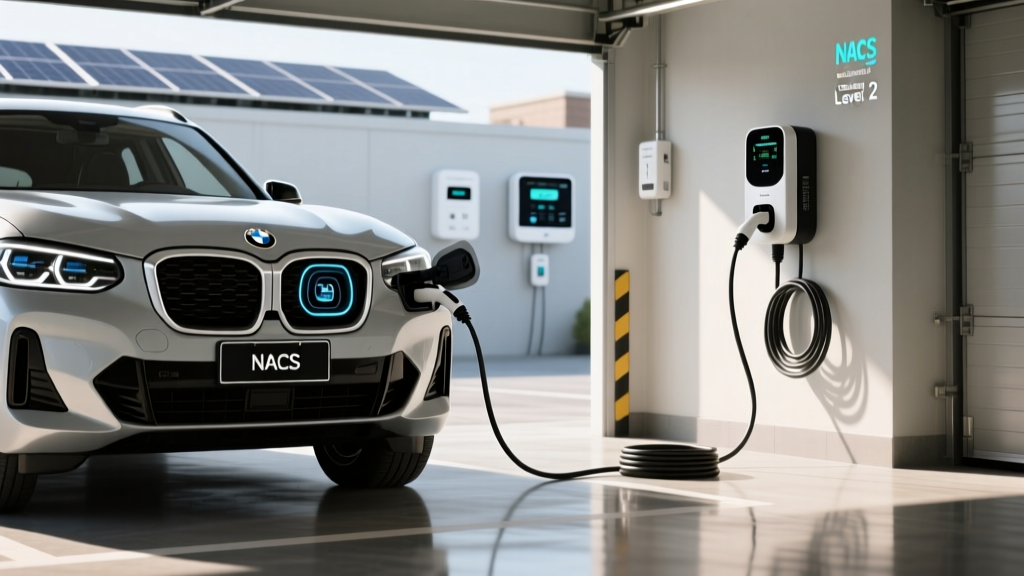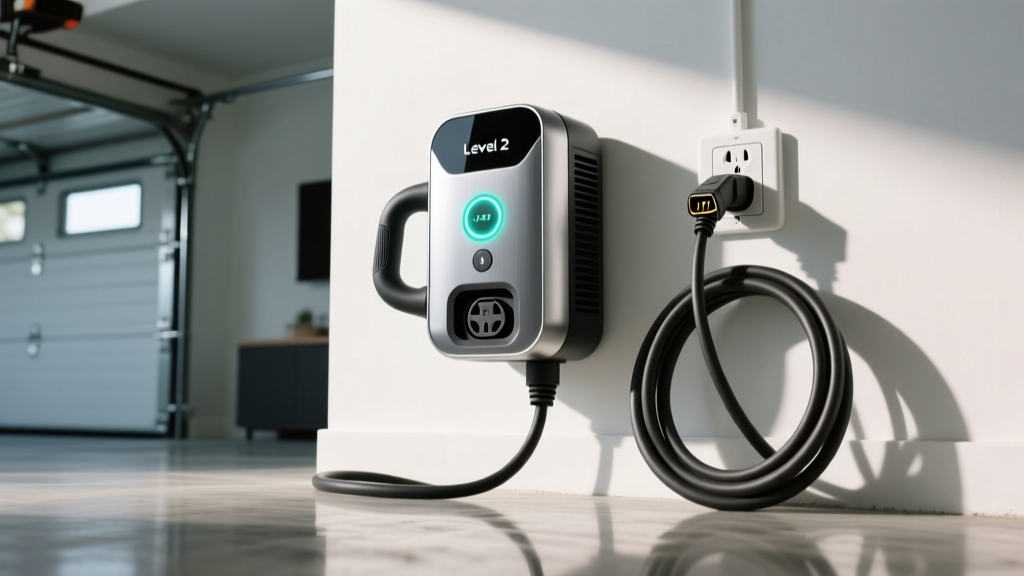
Quick Verdict: What Dom's Charger Actually Delivers
Dom's Charger has carved out a niche in the crowded Level 2 home charging market by undercutting premium brands like ChargePoint and Grizzl-E on price while delivering a respectable 40-amp, 9.6 kW output on a 240V circuit. For EV owners who want reliable overnight charging without paying $600+ for Wi-Fi features they'll rarely use, Dom's Charger occupies a practical middle ground. But budget pricing comes with trade-offs — shorter cable lengths on the base model, a basic app experience, and no load-sharing for multi-charger setups. Here's the full breakdown of what you get, what installation really costs, and how Dom's Charger stacks up against the competition in real-world use.
| Specification | Dom's Charger (Standard) | Dom's Charger (Smart) |
|---|---|---|
| Max Power Output | 9.6 kW (40A / 240V) | 9.6 kW (40A / 240V) |
| Connector | NACS (Tesla) or J1772 (CCS vehicles) | NACS (Tesla) or J1772 (CCS vehicles) |
| Cable Length | 18 ft | 25 ft |
| Wi-Fi / App | No | Yes (scheduling, energy tracking) |
| Outdoor Rating | NEMA 4 (weather-resistant) | NEMA 4 (weather-resistant) |
| Price (MSRP) | $279 | $369 |
| Warranty | 2 years | 3 years |
Understanding Charging Levels: Where Dom's Charger Fits
Before evaluating any home charger, you need to understand the three charging tiers available to EV owners. The distinction between kW (power — how fast energy flows) and kWh (energy — the battery's total capacity) is the single most important concept in EV ownership. A 9.6 kW charger delivers 9.6 kilowatts of power continuously; over one hour, that adds 9.6 kWh of energy to your battery.
| Level | Voltage | Typical Power (kW) | Miles of Range Added Per Hour | Where You'll Find It |
|---|---|---|---|---|
| Level 1 | 120V (standard outlet) | 1.2–1.9 kW | 3–5 miles | Any household outlet; emergency/trickle charging |
| Level 2 | 240V (dryer-style circuit) | 3.3–19.2 kW | 12–75 miles | Home chargers like Dom's; public Level 2 stations |
| DC Fast Charging | 400V–800V DC | 50–350 kW | 150–1,200+ miles (peak) | Highway corridors, Electrify America, Tesla Superchargers |
Dom's Charger operates at Level 2, delivering 9.6 kW on a 40-amp dedicated circuit. For context, that translates to roughly 30–38 miles of range per hour of charging for most mainstream EVs (efficiency varies by vehicle — a Hyundai Ioniq 5 at 3.5 mi/kWh gains more per hour than a GMC Hummer EV at 1.5 mi/kWh).
For a typical 75 kWh battery (like the Tesla Model Y Long Range or Ford Mustang Mach-E Extended Range), Dom's Charger will replenish from 10% to 80% State of Charge in approximately 6.5 to 7.5 hours. That's ideal for overnight charging — plug in at 10 PM, wake up to a full battery by 6 AM. For larger batteries like the Rivian R1T's 128 kWh pack, expect 10–12 hours for the same 10–80% fill.
Home Installation: Electrical Requirements and Real Costs
The charger itself is only part of the equation. Installing a Level 2 charger requires a dedicated 240V circuit — typically 50 amps to safely support a continuous 40-amp draw (the National Electrical Code requires circuits rated at 125% of continuous load). Here's what that actually involves and what it costs.
Electrical Panel Requirements
Your home's electrical panel must have enough spare capacity to add a 50-amp breaker. Most modern homes with 200-amp service can accommodate this without issue. However, older homes with 100-amp panels or panels already near capacity (common in homes with electric ranges, dryers, and HVAC) may need a panel upgrade to 200 amps, which adds $1,500–$3,000 to your project.
A licensed electrician will perform a load calculation per NEC Article 220 to determine if your panel can handle the additional circuit. Don't skip this step — overloading a panel is a fire hazard.
Installation Cost Breakdown
| Component | Low Estimate | High Estimate | Notes |
|---|---|---|---|
| Dom's Charger (Smart model) | $369 | $369 | Fixed MSRP |
| Electrician labor (run 240V line, mount unit) | $350 | $1,200 | Depends on distance from panel to garage/carport |
| 50-amp breaker + wiring (6 AWG copper) | $80 | $200 | Longer wire runs cost more |
| Permit (local jurisdiction) | $50 | $200 | Required in most municipalities for code compliance |
| Panel upgrade (if needed) | $1,500 | $3,000 | Only if existing panel lacks capacity |
| Total (no panel upgrade) | $849 | $1,969 | Typical scenario for most homeowners |
| Total (with panel upgrade) | $2,349 | $4,969 | Older homes or high-load panels |
The federal Residential Clean Energy Credit (IRS Form 5695) covers 30% of EV charger equipment and installation costs up to $1,000 through 2032, which can offset $250–$600 of your total spend. Check irs.gov for current-year eligibility rules, as income and census-tract requirements apply.
Connector Compatibility: Will Dom's Charger Work With Your EV?
The EV charging connector landscape has consolidated significantly since 2024, when Ford, GM, Rivian, and most major automakers adopted the North American Charging Standard (NACS), originally developed by Tesla. Dom's Charger ships in two configurations:
| Connector Type | Dom's Charger Model | Compatible Vehicles (2025–2026 Models) | Adapter Needed? |
|---|---|---|---|
| NACS (Tesla connector) | Dom's Charger NACS | Tesla Model 3/Y/S/X, Ford F-150 Lightning, GM Ultium vehicles (Equinox EV, Blazer EV, Silverado EV), Rivian R1S/R1T (2025+), Hyundai Ioniq 5 (2026+) | No |
| J1772 | Dom's Charger J1772 | Older CCS1 vehicles, pre-2025 models from VW, BMW, Kia, Hyundai, Nissan, Porsche | NACS-to-J1772 adapter (~$150) for newer NACS vehicles |
| CHAdeMO | Not available | Nissan Leaf (legacy) | No Dom's model available; CHAdeMO adapters are rare and expensive |
If you own a 2025 or newer EV from Ford, GM, Rivian, or Hyundai/Kia, you almost certainly need the NACS version of Dom's Charger. If you drive an older CCS1-equipped vehicle (2022–2024 model years from most non-Tesla brands), the J1772 version will plug in directly. Dom's also sells a NACS-to-J1772 adapter for $149 if you want one charger to serve multiple vehicles in a household.
Cost to Charge: Dom's Charger vs. Public Charging vs. Gas
One of the strongest arguments for home Level 2 charging is the per-mile cost advantage. Here's how Dom's Charger at home compares to public DC fast charging and gasoline, based on a midsize EV averaging 3.0 miles per kWh (roughly 112 MPGe combined, per fueleconomy.gov data).
| Charging Scenario | Rate | Cost per kWh | Cost per Mile (at 3.0 mi/kWh) | Cost to Add 200 Miles |
|---|---|---|---|---|
| Home Level 2 (Dom's Charger) — off-peak utility rate | Residential TOU | $0.09–$0.14 | $0.03–$0.047 | $6.00–$9.40 |
| Home Level 2 — standard residential rate | Flat rate | $0.14–$0.18 | $0.047–$0.06 | $9.40–$12.00 |
| Public Level 2 (ChargePoint, EVgo L2) | Per kWh | $0.20–$0.35 | $0.067–$0.117 | $13.40–$23.40 |
| DC Fast Charging (Electrify America, Tesla Supercharger) | Per kWh | $0.30–$0.55 | $0.10–$0.183 | $20.00–$36.60 |
| Gasoline (30 MPG combined, $3.40/gal) | Per gallon | — | $0.113 | $22.67 |
The math is clear: charging at home with Dom's Charger on an off-peak rate costs roughly one-quarter to one-third what you'd pay for gasoline per mile. Even standard-rate home charging undercuts gas by 50%. Public DC fast charging, by contrast, approaches or exceeds gas costs — which is why home charging remains the economic foundation of EV ownership.
Pro tip: If your utility offers a time-of-use (TOU) plan, schedule Dom's Charger (Smart model) to charge between 11 PM and 6 AM when rates are lowest. The Smart model's app supports automated scheduling; the Standard model requires you to manually plug in during off-peak hours or use a smart plug/timer on the circuit.
Equipment Comparison: Dom's Charger vs. the Competition
Dom's Charger doesn't exist in a vacuum. Here's how it stacks up against three established competitors in the 40-amp home charger segment:
| Feature | Dom's Charger Smart | ChargePoint Home Flex | Grizzl-E Smart | Tesla Wall Connector |
|---|---|---|---|---|
| Max Power | 9.6 kW (40A) | 11.5 kW (48A) | 10.0 kW (40A) | 11.5 kW (48A) |
| Cable Length | 25 ft | 25 ft | 24 ft | 24 ft |
| Connector | NACS or J1772 | J1772 (NACS adapter avail.) | J1772 or NACS | NACS (J1772 adapter avail.) |
| Wi-Fi / App | Yes | Yes | Yes | Yes |
| Amperage Adjustable | No (fixed 40A) | Yes (16–48A) | Yes (16–40A) | Yes (12–48A) |
| Load Sharing (2 units) | No | Yes | No | Yes (Power Sharing) |
| Outdoor Rating | NEMA 4 | NEMA 4 | NEMA 4 (IP67) | NEMA 4 |
| Warranty | 3 years | 3 years | 3 years | 4 years |
| Price | $369 | $549 | $449 | $475 |
Where Dom's Charger wins: Price. At $369 for the Smart model, it undercuts the ChargePoint by $180 and the Tesla Wall Connector by $106 while delivering comparable core functionality for single-charger households.
Where Dom's Charger falls short: The fixed 40-amp output means you can't dial it down for older panels (competitors let you set 16A–48A to match your circuit). There's no load-sharing for dual-charger garages, and the 2-year warranty on the Standard model trails the segment standard. If you need 48A charging to maximize vehicles capable of accepting 11.5 kW (like the Tesla Model S or Ford F-150 Lightning with the optional onboard charger), Dom's Charger caps you at 9.6 kW.
Safety, Code, and Installation Best Practices
Level 2 charging involves continuous high-current draw for hours at a time. Cutting corners on installation is a fire risk. Here's what proper installation requires:
- Dedicated circuit: Your Dom's Charger must have its own 50-amp breaker — never share a circuit with other appliances.
- GFCI protection: NEC 2023 and later require ground-fault circuit interrupter protection for outdoor EV charging outlets. Hardwired installations (recommended for Dom's Charger) integrate GFCI at the breaker.
- NEMA 4 rating: Both Dom's Charger models carry a NEMA 4 rating, meaning they resist rain, snow, and hose-directed water. This is sufficient for outdoor mounting in all US climates.
- Wire gauge: 6 AWG copper wire is standard for a 50-amp circuit. Runs longer than 100 feet may require 4 AWG to prevent voltage drop.
- Permit and inspection: Most jurisdictions require an electrical permit for EV charger installation. The inspection ensures your installation meets NEC Article 625 (Electric Vehicle Charging System Equipment). Skipping the permit can void your homeowner's insurance coverage for electrical fires.
Always hire a licensed electrician — not a handyman — for EV charger installation. Ask for experience specifically with EV circuits, as the continuous-load requirements differ from typical appliance wiring.
Real-World Charging Times With Dom's Charger
Spec sheets tell one story; actual charging sessions tell another. Here's what to expect from Dom's Charger at 9.6 kW with popular 2025–2026 EVs, based on usable battery capacity and typical charging efficiency losses (~5%):
| Vehicle | Usable Battery (kWh) | 10–80% Charge Time | Full Charge (0–100%) |
|---|---|---|---|
| Tesla Model Y Long Range | 75 kWh | ~5.8 hours | ~8.2 hours |
| Ford Mustang Mach-E Extended Range | 91 kWh | ~7.0 hours | ~9.9 hours |
| Hyundai Ioniq 5 (2026, NACS) | 84 kWh | ~6.5 hours | ~9.1 hours |
| Chevrolet Equinox EV 3RS | 85 kWh | ~6.6 hours | ~9.3 hours |
| Rivian R1T Dual-Motor (Max Pack) | 141 kWh | ~10.9 hours | ~15.3 hours |
Note that charging slows significantly above 80% State of Charge due to battery management system protections — this is normal and applies to all Level 2 and DC fast charging. For daily driving, charging to 80% (easily achievable overnight with Dom's Charger) is recommended for NMC battery longevity. If your EV has an LFP battery (some Tesla Model 3/Y Standard Range variants), manufacturers recommend periodic 100% charges for cell balancing.
Frequently Asked Questions
How much does it cost to install Dom's Charger at home?
Expect $849–$1,969 total for a typical installation (charger + electrician + permit + wiring) if your electrical panel has spare capacity. If your home needs a panel upgrade from 100A to 200A service, total costs rise to $2,349–$4,969. The federal Residential Clean Energy Credit can reimburse 30% of equipment and installation costs up to $1,000.
How fast will Dom's Charger add range to my EV?
At 9.6 kW, Dom's Charger adds approximately 30–38 miles of range per hour for most mainstream EVs. A 10–80% charge for a 75 kWh battery takes about 5.5–6 hours. Larger batteries (100+ kWh) take 7–11 hours for the same range.
Which Dom's Charger connector do I need — NACS or J1772?
If your EV is a Tesla, a 2025+ Ford, GM, Rivian, or a 2026+ Hyundai/Kia model, you need the NACS version. If you drive a 2022–2024 model from VW, BMW, Kia, Hyundai, or most other non-Tesla brands, you need the J1772 version. Check your vehicle's charge port to confirm.
How much does charging with Dom's Charger cost per mile vs. gas?
At a typical off-peak residential rate of $0.12/kWh and 3.0 miles per kWh efficiency, home charging costs about $0.04 per mile — roughly one-third the cost of gasoline at $3.40/gallon in a 30 MPG vehicle ($0.113/mile). That's a savings of approximately $1,100 per year for a driver covering 15,000 miles.
What electrical upgrades might my home need for Dom's Charger?
You'll need a dedicated 50-amp, 240V circuit with 6 AWG copper wiring. If your panel is 100-amp service or already near capacity, an upgrade to 200-amp service ($1,500–$3,000) may be required. A licensed electrician can perform a load calculation to determine this before installation begins.
Is Dom's Charger safe for outdoor installation?
Yes. Both models carry a NEMA 4 weather-resistance rating, suitable for rain, snow, and dust. Ensure your installation includes GFCI breaker protection as required by NEC 2023+ for outdoor EV charging circuits.