The 'Doms Charger Fast and Furious' Meme Meets Real EV Charging
If you've spent any time in EV forums or social media, you've likely seen the "Doms charger fast and furious" meme — a playful nod to Dominic Toretto's love of speed, applied to the surprisingly passionate world of electric vehicle charging. The joke lands because EV owners genuinely care about how fast their cars charge, and the terminology can feel like navigating a quarter-mile drag strip blindfolded.
But here's the thing: unlike a movie, your charging setup has real physics, real electrical codes, and real costs. This guide cuts through the meme and the marketing to give you exact numbers — kilowatts (kW), kilowatt-hours (kWh), dollars, and minutes — so you can build a charging plan that's actually fast and furious where it counts.
First, the most critical distinction in all of EV ownership: kW (kilowatts) measures power — how fast energy flows into your battery, like water pressure from a hose. kWh (kilowatt-hours) measures energy — the total amount stored, like gallons in a tank. A 60 kWh battery charged at 10 kW takes roughly 6 hours. Confusing these two is the single most common EV literacy mistake, and it leads to bad purchase decisions.
Charging Levels Explained: How Fast Will Each Level Add Range?
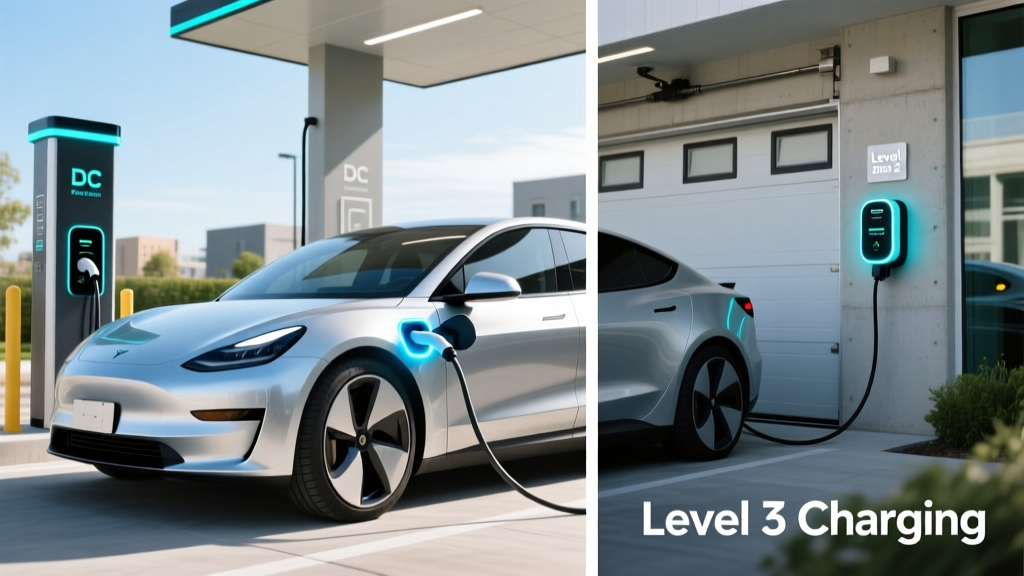
EV charging breaks into three tiers. Each delivers dramatically different speeds, costs, and use cases.
| Level | Voltage | Power (kW) | Miles of Range Added per Hour | Typical Use Case |
|---|---|---|---|---|
| Level 1 | 120V AC | 1.2–1.9 kW | 3–5 miles/hr | Overnight top-off, PHEVs, low-mileage drivers |
| Level 2 | 240V AC | 3.3–19.2 kW | 12–75 miles/hr | Daily home/work charging — the EV owner's workhorse |
| DC Fast Charge | 400–900V DC | 50–350+ kW | 150–1,200+ miles/hr (peak) | Road trips, quick top-ups, commercial fleets |
Real-world context: A 75 kWh battery (like a Tesla Model Y Long Range) charged from 10–80% on a 48-amp Level 2 home charger (11.5 kW) takes roughly 4.5 hours. That same 10–80% session on a 250 kW DC fast charger takes about 20–25 minutes — but only if the vehicle's charge curve supports it. Most EVs peak at their maximum kW rate for only a portion of the session, then taper significantly above 60–70% State of Charge (SoC) to protect battery health.
This charge-curve taper is why a charger's "peak kW" number doesn't tell the full story. A vehicle rated for 250 kW peak might average only 150 kW across a 10–80% session. Always look for sustained charge rates and published 10–80% times, not just the headline peak.
Home EV Charger Installation: Electrical Requirements, Costs, and Panel Upgrades
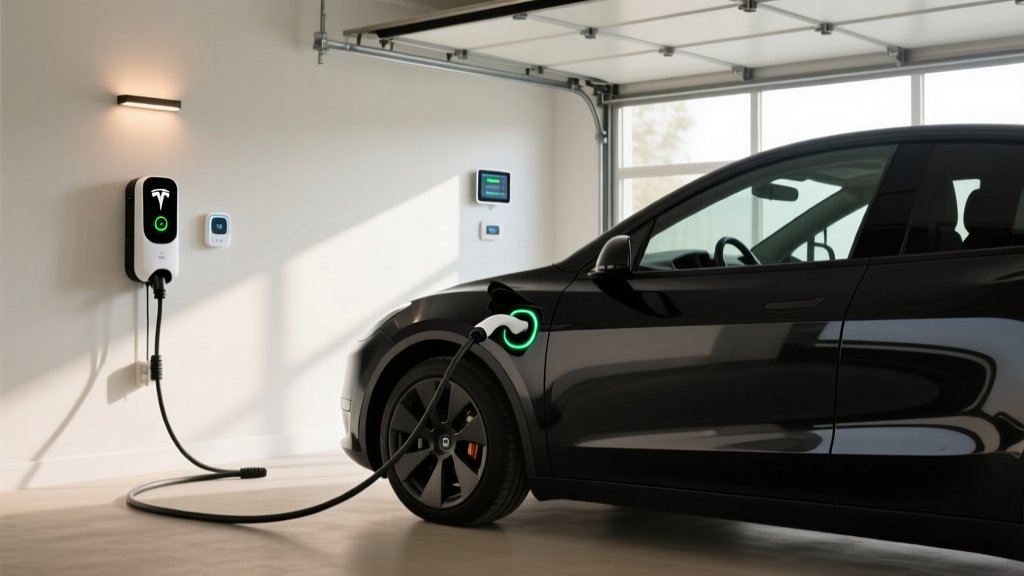
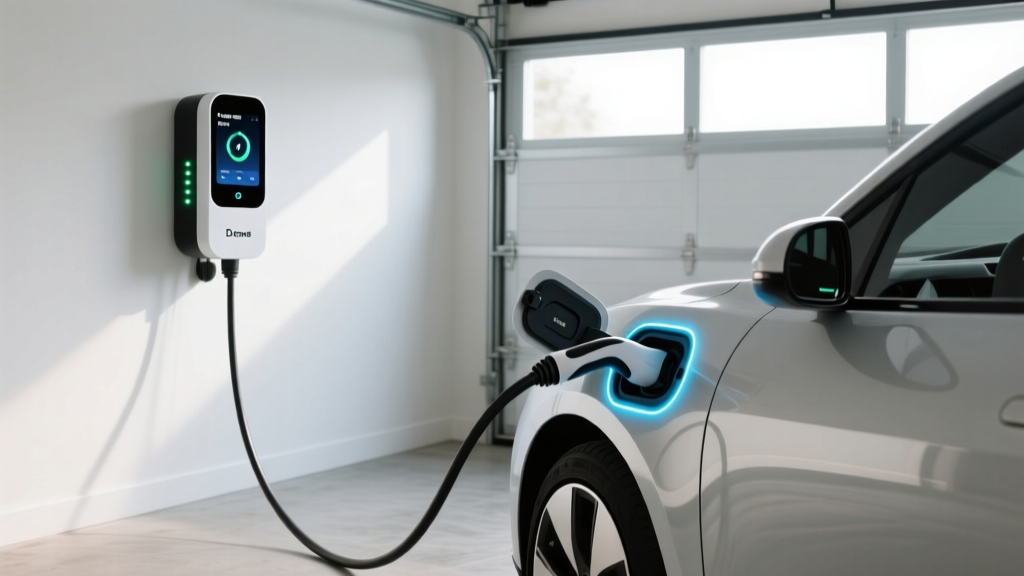
Installing a Level 2 home charger is the single highest-impact upgrade an EV owner can make. But costs vary wildly based on your home's electrical infrastructure.
Core Electrical Requirements
A typical Level 2 home charger requires:
- 240V dedicated circuit (same voltage as your dryer or oven)
- 40-amp to 60-amp breaker (the charger itself usually draws 32A or 48A continuous — NEC code requires the breaker be rated 125% above continuous load, so a 48A charger needs a 60A breaker)
- NEMA 14-50 outlet (for plug-in chargers) or hardwired connection (for higher-amperage units or local code requirements)
- GFCI protection if installed outdoors or in a garage, per NEC 2023/2026 updates
Installation Cost Breakdown
| Component | Simple Install (panel nearby, no upgrade) | Complex Install (long run, panel upgrade) |
|---|---|---|
| Level 2 Charger Equipment | $350–$700 | $350–$700 |
| Electrician Labor | $400–$800 | $1,200–$3,000 |
| Electrical Panel Upgrade (100A → 200A) | N/A | $1,500–$4,000 |
| Permit and Inspection | $50–$200 | $100–$350 |
| Conduit, Wiring, Misc. Materials | $50–$200 | $200–$800 |
| Total Estimated Cost | $850–$1,900 | $3,350–$8,850 |
The panel-upgrade gotcha: Homes built before the 1990s often have 100-amp service panels. Adding a 60A EV circuit to an already-loaded 100A panel can exceed safe capacity, requiring a full panel upgrade to 200A. This is the single largest cost variable. Before buying a charger, have a licensed electrician perform a load calculation on your panel — it's usually free or low-cost as part of a quote.
Some newer homes and many homes built after 2000 already have 200A panels with spare capacity, making installation straightforward and affordable. Always get at least two quotes from licensed, EV-experienced electricians.
Connector Compatibility: NACS, CCS1, and CHAdeMO — What Fits Your EV?
The connector landscape has shifted dramatically since 2023, when Ford, GM, Rivian, Volvo, and most major automakers adopted Tesla's North American Charging Standard (NACS). By 2026, NACS is the dominant connector for new EVs in North America, though legacy CCS1 vehicles remain on the road.
| Connector | Brands Using It (New Vehicles) | Notes |
|---|---|---|
| NACS (Tesla standard) | Tesla, Ford, GM, Rivian, Volvo, Polestar, Mercedes-Benz, BMW, Hyundai, Kia, Lucid, Nissan (new models) | Dominant standard by 2026; smaller and lighter than CCS1 |
| CCS1 | Legacy models (pre-2025 VW ID.4, older Bolt EV, Stellantis legacy) | Still widely supported at public DC stations; adapters available |
| CHAdeMO | Nissan Leaf (discontinued), Mitsubishi Outlander PHEV (older) | Phasing out; limited new infrastructure |
Adapter reality: If you own a CCS1-equipped EV, a CCS-to-NACS adapter ($150–$300) unlocks the Tesla Supercharger network — now the largest and most reliable DC fast-charging network in North America. Tesla also sells a NACS-to-CCS adapter for its owners to use legacy Electrify America and other CCS stations. Always check your vehicle manufacturer's approved adapter list; using an uncertified adapter can void warranty or cause charging faults.
For Level 2 home charging, virtually all non-Tesla EVs use a J1772 connector. Tesla vehicles include a J1772 adapter in the glovebox. Most Level 2 home chargers ship with a J1772 plug, and NACS-equipped home chargers are now widely available from ChargePoint, Wallbox, and Tesla.
Cost to Charge: $/kWh Scenarios and Cost Per Mile vs. Gas
One of the biggest ownership advantages of an EV is fuel cost savings — but the math depends heavily on where and when you charge.
| Charging Scenario | Average $/kWh | Cost Per Mile (at 3.5 mi/kWh efficiency) |
|---|---|---|
| Home, off-peak utility rate (overnight) | $0.08–$0.14 | $0.023–$0.040 |
| Home, standard residential rate | $0.13–$0.20 | $0.037–$0.057 |
| Public Level 2 (workplace, retail) | $0.20–$0.35 | $0.057–$0.100 |
| DC Fast Charging (Electrify America, EVgo, Tesla) | $0.30–$0.55 | $0.086–$0.157 |
| Gasoline (avg. $3.40/gal, 28 MPG combined) | — | $0.121 |
The takeaway: Home off-peak charging is roughly 3–5× cheaper per mile than gasoline. Even DC fast charging is often cheaper than gas on a per-mile basis, though the gap narrows significantly. The real savings come from consistent home charging.
Many utilities now offer time-of-use (TOU) plans that drop electricity rates to $0.06–$0.10/kWh between midnight and 6 AM. Programming your charger to start at midnight can cut your fuel cost to under 3 cents per mile. According to fueleconomy.gov, a 2026 Hyundai Ioniq 6 SE (the most efficient EV on the EPA's list at 140 MPGe combined) costs roughly $550 per year to charge at the national average electricity rate — compared to $1,650+ per year in gasoline for a similarly sized 28 MPG gas sedan.
Charging Time Examples: 10–80% for Common Battery Sizes
Here's how long real charging sessions take for popular 2026 EVs across different charger types. All times assume a 10–80% session, which is the standard fast-charging target (charging above 80% slows dramatically to protect battery health).
| Vehicle (Usable Battery kWh) | Level 2 Home (48A / 11.5 kW) | 150 kW DC Fast | 250–350 kW DC Fast |
|---|---|---|---|
| Tesla Model Y LR (75 kWh) | ~4.5 hours | ~28 min | ~18 min |
| Hyundai Ioniq 5 (77.4 kWh) | ~5 hours | ~30 min | ~18 min (800V architecture) |
| Ford F-150 Lightning Ext. Range (131 kWh) | ~8 hours | ~55 min | ~40 min |
| Chevrolet Equinox EV (85 kWh) | ~5.5 hours | ~35 min | ~25 min |
| BMW iX xDrive50 (105 kWh usable) | ~6.5 hours | ~42 min | ~30 min |
Charge curve reality check: The Hyundai Ioniq 5's 800V architecture allows it to sustain high charge rates longer than most 400V vehicles, making its 10–80% time genuinely close to the peak-kW headline. Vehicles on 400V architectures typically see a sharp taper after 60% SoC. If you road-trip frequently, prioritize vehicles with 800V systems (Hyundai/Kia/Genesis E-GMP platform, Porsche Taycan, Lucid Air) or proven high-sustained-rate batteries (Tesla, GM Ultium).
Best Level 2 Home EV Chargers: Equipment Picks for 2026
Not all Level 2 chargers are created equal. Here are proven units based on reliability, smart features, and real-world performance.
ChargePoint Home Flex (NACS or J1772)
- Power Output: Up to 12 kW (50A) on a 60A circuit, or configurable down to 16A for lower-capacity panels
- Cable Length: 23 feet
- Smart Features: Wi-Fi connected, app scheduling, Alexa integration, energy tracking, TOU rate optimization
- Connector: Available in NACS or J1772
- Price: ~$550–$650
- Best For: Versatility — adjustable amperage means it works even on 30A or 40A circuits if your panel can't support 60A
Tesla Wall Connector (NACS)
- Power Output: Up to 11.5 kW (48A) on a 60A circuit
- Cable Length: 24 feet
- Smart Features: Wi-Fi, over-the-air updates, power sharing (link multiple units on one circuit), Tesla app integration
- Connector: NACS native; J1772 adapter included
- Price: ~$450–$500
- Best For: Tesla owners who want a clean, reliable, no-frills-premium unit
Wallbox Pulsar Plus (J1772 or NACS)
- Power Output: Up to 11.5 kW (48A)
- Cable Length: 25 feet
- Smart Features: Wi-Fi + Bluetooth, app control, solar integration (Eco-Smart mode), load balancing with your home panel
- Connector: J1772 or NACS options
- Price: ~$500–$600
- Best For: Homes with solar panels or those wanting advanced load management
Emporia Vue Level 2 Charger
- Power Output: Up to 11.5 kW (48A)
- Cable Length: 24 feet
- Smart Features: Deep energy monitoring via Emporia Vue panel integration, TOU scheduling, solar-aware charging
- Connector: J1772 (NACS adapter available)
- Price: ~$400–$500
- Best For: Budget-conscious buyers who want detailed energy data
Safety, Electrical Code, and Permit Requirements
EV charging involves sustained high-amperage electrical loads — this is not a DIY project. Here's what code and safety demand:
- Dedicated circuit: Your EV charger must be on its own dedicated breaker — no sharing with other appliances. This prevents overloads and tripped breakers during long charge sessions.
- NEC 125% rule: EV charging is classified as a "continuous load" (running 3+ hours). The breaker must be rated at 125% of the charger's maximum draw. A 48A charger needs a 60A breaker. A 32A charger needs a 40A breaker.
- GFCI protection: The 2023 NEC (and updated 2026 editions) require GFCI protection for outdoor receptacles and many garage installations. Your electrician will determine if a GFCI breaker or outlet is required in your jurisdiction.
- Outdoor rating: If your charger is installed outside (driveway, carport), it must carry a NEMA 4 or NEMA 4X weather-resistance rating. All major chargers listed above meet this standard.
- Permit and inspection: Most US jurisdictions require an electrical permit for a new 240V circuit. The inspection verifies proper wire gauge, breaker sizing, grounding, and GFCI compliance. Permits typically cost $50–$350 depending on your municipality.
- Wire gauge: A 60A circuit requires 6 AWG copper wire (or 4 AWG aluminum). A 40A circuit uses 8 AWG copper. Undersized wire is a fire hazard — always trust your electrician's spec.
Never plug an EV charger into an extension cord, and never use a "cheater" adapter to plug a NEMA 14-50 into a NEMA 10-30 (dryer) outlet without a proper adapter rated for the load. These shortcuts are leading causes of residential EV charging fires.
Frequently Asked Questions
How much does it cost to install a home EV charger?
A straightforward Level 2 installation (short wire run, adequate panel capacity) typically costs $850–$1,900 total including equipment, electrician labor, and permit. If your home needs a 200A panel upgrade, expect $3,350–$8,850. Always get a load calculation from a licensed electrician before committing.
How fast will each charging level add range?
Level 1 (120V) adds 3–5 miles of range per hour. Level 2 (240V, 48A) adds 30–40 miles per hour for most EVs. DC fast charging can add 150–300+ miles in 20–30 minutes depending on the vehicle's charge rate and battery size. See the charging-levels table above for exact figures.
Which connector/charger is compatible with my EV?
For 2026 model-year vehicles, most new EVs use the NACS connector. Older EVs (pre-2025) may use CCS1. The Nissan Leaf used CHAdeMO but is now discontinued. Check your vehicle's charge port, then select a home charger with the matching plug. For Level 2 home charging, J1772 is the universal standard (Tesla includes an adapter).
How much does charging cost per mile vs. gas?
Home off-peak charging costs roughly $0.02–$0.04 per mile. Gasoline at $3.40/gallon for a 28 MPG vehicle costs about $0.12 per mile. That's a 3–6× savings with home EV charging. Even public DC fast charging at $0.35–$0.55/kWh often beats gas on a per-mile basis.
What electrical upgrades might I need?
The most common upgrade is a panel capacity increase from 100A to 200A ($1,500–$4,000). You may also need a new breaker slot, upgraded service wire from the utility, or a sub-panel if your main panel is full. A licensed electrician's load calculation will identify all requirements before work begins.
Can I install a Level 2 charger myself?
Technically, some jurisdictions allow homeowner electrical work with a permit, but EV charging circuits carry sustained high amperage and any error risks fire or voided home insurance. Professional installation by a licensed electrician is strongly recommended and often required by your insurance provider and local code.
Is there a tax credit for home charger installation?
The federal §30D credit covers the vehicle, not the charger. However, the Alternative Fuel Vehicle Refueling Property Credit (IRC §30C) offers up to $1,000 (30% of cost, capped) for home charging equipment installed in eligible census tracts. Check IRS guidelines for current eligibility, as location-based requirements apply. Some states and utilities also offer rebates of $200–$750 for Level 2 equipment.
Building the right home charging setup isn't about going "fast and furious" with the biggest charger you can find — it's about matching your vehicle's onboard charger capacity, your home's electrical infrastructure, and your daily driving needs to a system that delivers reliable, affordable electrons every night. Get the load calculation, pick the right equipment, and let the meme be just a meme.