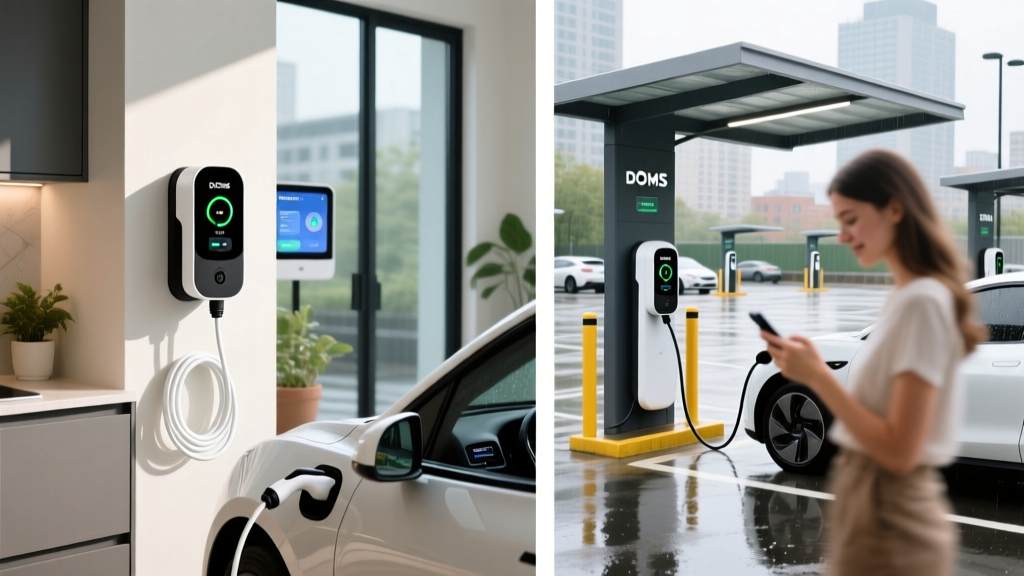
If you have been searching for a DOMS charger solution for your electric vehicle, you are likely encountering a mix of hardware from Gilbarco Veeder-Root's DOMS product line — primarily commercial and retail fuel-site EV charging equipment — alongside broader questions about what you actually need at home. DOMS-branded systems are engineered for retail forecourts, convenience stores, and fleet depots rather than residential garages, but understanding where they fit into the broader EV charging ecosystem is essential before you spend thousands on a home setup or rely on public networks.
This guide clarifies what DOMS chargers are, where they make sense, and how to choose the right home Level 2 equipment, public charging strategy, and connector for your specific EV — with exact numbers for speed, cost, and installation.
What Is a DOMS Charger and Who Makes It?
DOMS is a product family under Gilbarco Veeder-Root, a global fuel-dispensing and retail-site technology company. DOMS hardware and software manage payment processing, media delivery, and charger control at commercial fueling sites that are adding EV charging to existing gas or convenience retail locations. The DOMS platform typically interfaces with DC fast charging dispensers from partners like ABB, Tritium, or Alpitronic, and it handles the payment terminal, loyalty integration, and site management layer.
For a retail site operator, a DOMS-integrated charger means a customer can pull up, tap a credit card on a familiar forecourt terminal, and initiate a 150–350 kW DC fast charge without downloading a proprietary app. For EV drivers, encountering a DOMS-managed charger means a more traditional fueling-style payment experience — but the actual charging hardware is made by a partner manufacturer, not by DOMS itself.
Key takeaway: DOMS chargers are commercial-grade, payment-integrated systems for retail sites. You will not buy a DOMS charger for your home garage. For residential Level 2 charging, you need dedicated home EVSE (Electric Vehicle Supply Equipment) from brands like ChargePoint, Emporia, Grizzl-E, Wallbox, or the OEM-supplied unit from your automaker.
Charging Levels Explained: Speeds in kW and Miles Per Hour
Before choosing any charger — whether you are evaluating a public DOMS-managed DC fast station or a home wall unit — you need clarity on the three charging levels and the critical distinction between kW (power, the rate of charging) and kWh (energy, the battery capacity). Confusing these is the single most common EV literacy gap.
| Level | Voltage | Max Power (kW) | Miles of Range Added Per Hour | Typical Use Case |
|---|---|---|---|---|
| Level 1 | 120V AC | 1.0–1.4 kW | 3–5 miles | Overnight trickle, PHEV top-offs, emergency backup |
| Level 2 | 240V AC | 3.3–19.2 kW | 12–75 miles | Home daily charging, workplace, retail destinations |
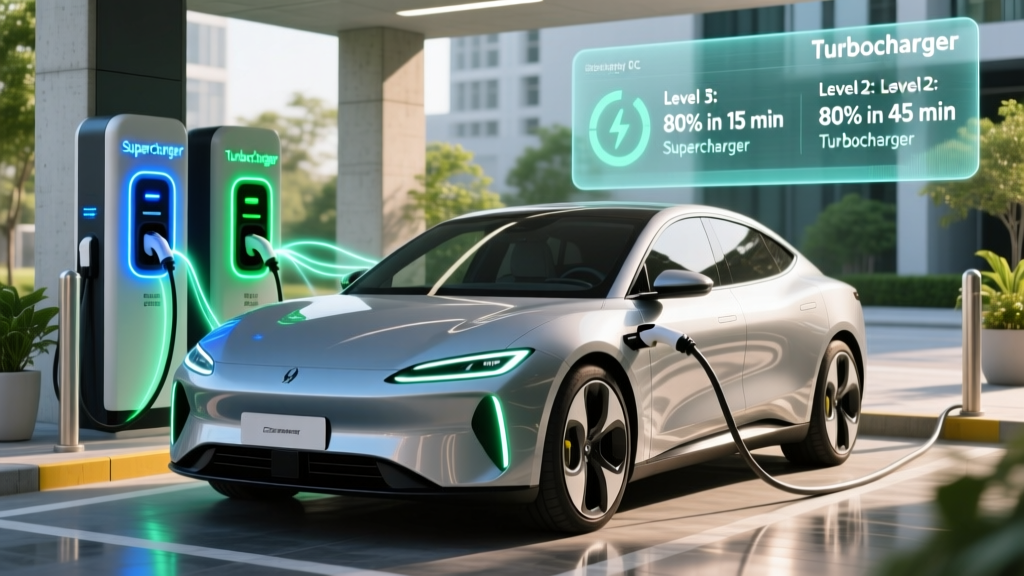
| DC Fast Charging (Level 3) | 400–800V DC | 50–350 kW | 150–1,200+ miles (theoretical) | Highway road trips, public fast-charging stations |
Real-world context: A 19.2 kW Level 2 charger adds roughly 60–75 miles of range per hour on a midsize sedan like the Hyundai Ioniq 6 (which achieves ~4.0 mi/kWh). A 7.7 kW Level 2 charger on the same car adds roughly 30 miles per hour. Most home installations deliver 7.7–11.5 kW, which is sufficient to fully replenish an EV overnight.
DC fast charging speeds are not sustained. A vehicle might accept a peak of 250 kW but taper significantly above 50–60% state of charge (SoC). When we cite "10–80% in 18 minutes," that reflects the real charging curve — not a sustained peak. Always look for 10–80% time, not peak kW, as the meaningful metric.
Home EV Charger Installation: Electrical Requirements and Costs
Installing a home Level 2 charger is the single most impactful upgrade for daily EV ownership. Here is what the electrical work actually entails.
Voltage, Amperage, and Circuit Requirements
A Level 2 charger requires a 240V dedicated circuit, identical to what powers your electric dryer or oven. Common configurations:
- 40-amp circuit / 32-amp continuous charge (7.7 kW) — the most common residential setup; works on most 200-amp panels
- 50-amp circuit / 40-amp continuous charge (9.6 kW) — faster charging; requires adequate panel headroom
- 60-amp circuit / 48-amp continuous charge (11.5 kW) — maximizes most EVs' onboard charger capacity
- 80-amp circuit / 64-amp continuous charge (15.4 kW+) — needed for high-capacity trucks like the Ford F-150 Lightning Extended Range (accepts up to 19.2 kW AC); requires a robust 200A+ panel
The National Electrical Code (NEC) requires that continuous loads (including EV charging) use no more than 80% of a circuit's rated amperage. A 40-amp breaker supports 32 amps of continuous draw. This is not optional — it is code.
Panel Upgrade Considerations
Older homes with 100-amp electrical service may not have capacity for a 40–60 amp dedicated EV circuit. A panel upgrade to 200 amps typically costs $1,500–$3,500 depending on local utility requirements and trenching needs. Some homeowners opt for a smart load-management system (like the Emporia VUE with smart breaker) that monitors total panel draw and throttles the EV charger when other large loads are active, avoiding a panel upgrade entirely.
Installation Cost Breakdown
| Component | Low-End Estimate | High-End Estimate |
|---|---|---|
| Level 2 EVSE hardware (charger unit) | $250 | $750 |
| Electrician labor (240V circuit run, 20–50 ft) | $400 | $1,500 |
| Electrical panel upgrade (if needed) | $1,500 | $3,500 |
| Permit and inspection fees | $50 | $300 |
| Conduit, wiring (6 AWG to 2 AWG copper), junction box | $100 | $500 |
| Total (no panel upgrade) | $800 | $3,050 |
| Total (with panel upgrade) | $2,300 | $6,550 |
Short wire runs from a panel in an attached garage often land in the $800–$1,500 total range. Detached garages, long conduit runs, or homes needing a service upgrade push costs toward the higher end. Always hire a licensed electrician and pull a permit — unpermitted EV charger installations can void home insurance claims and create fire risk.
Safety and Code Requirements
- Dedicated circuit: The EV charger must have its own breaker — no sharing with other outlets
- GFCI protection: NEC 2020+ requires ground-fault circuit-interrupter protection for outdoor receptacles; many hardwired EVSEs have built-in GFCI
- Outdoor rating: If installed outside, the EVSE must carry a NEMA 4 or NEMA 4X enclosure rating for weather resistance
- Hardwired vs. plug: Hardwired units (no NEMA 14-50 plug) eliminate a common failure point and are often preferred for high-amperage installations above 48 amps
Connector Compatibility: NACS, CCS1, and CHAdeMO
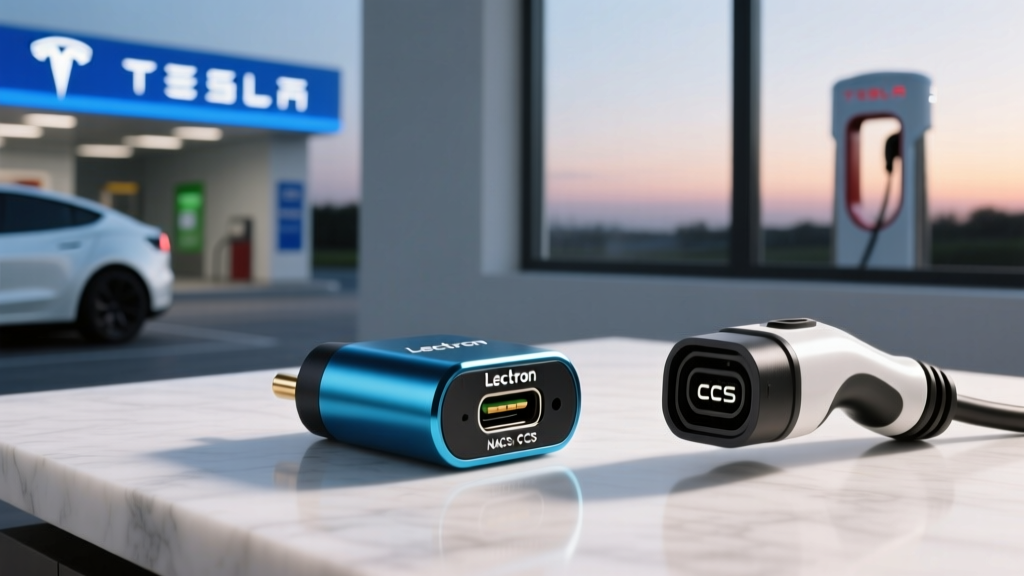
As of 2026, the North American EV charging connector landscape has consolidated significantly around the North American Charging Standard (NACS), originally developed by Tesla and now adopted by nearly every major automaker. Here is where each connector stands:
| Connector | Vehicle Brands (2025–2026 Models) | Public Network Availability | Adapter Needed? |
|---|---|---|---|
| NACS (Tesla plug) | Tesla (all), Ford, GM, Rivian, Volvo, Polestar, Hyundai, Kia, BMW, Mercedes-Benz (new models) | Tesla Supercharger (open to all via adapter or native NACS), growing Electrify America and ChargePoint NACS stalls | CCS-to-NACS adapter (~$150–$200) for CCS-native vehicles at Superchargers |
| CCS1 (Combined Charging System) | Older VW ID.4, pre-2025 Hyundai/Kia, Stellantis, Honda Prologue (older builds), legacy models | Electrify America, EVgo, ChargePoint (majority of existing public DC infrastructure) | NACS-to-CCS adapter for newer NACS vehicles at CCS-only stations |
| CHAdeMO | Nissan Leaf (legacy), Mitsubishi Outlander PHEV (older) | Declining — most networks phasing out CHAdeMO stalls | No adapter available; CHAdeMO vehicles limited to remaining CHAdeMO stations |
For home Level 2 charging: All EVs (regardless of DC connector) use the J1772 plug for AC Level 2 — except Tesla, which uses a proprietary AC plug. However, every Tesla ships with a J1772 adapter, and NACS-equipped home chargers (like the Tesla Wall Connector) now include a Magic Dock or adapter compatibility for non-Tesla J1772 vehicles. When buying a home charger, a universal J1772 connector is the safest bet for multi-EV households.
Cost to Charge: Per kWh and Per Mile vs. Gas
One of the strongest ownership arguments for EVs is fuel cost — but the savings depend heavily on where and when you charge.
| Charging Scenario | Average $/kWh | Cost Per Mile (at 3.5 mi/kWh) | Equivalent Gas Price (at 30 MPG) |
|---|---|---|---|
| Home, off-peak utility rate | $0.08–$0.12 | $0.023–$0.034 | $0.69–$1.02/gallon |
| Home, standard residential rate | $0.14–$0.18 | $0.040–$0.051 | $1.20–$1.53/gallon |
| Public Level 2 (ChargePoint, etc.) | $0.25–$0.45 | $0.071–$0.129 | $2.13–$3.87/gallon |
| DC Fast Charging (Electrify America, EVgo, Tesla) | $0.35–$0.55 | $0.100–$0.157 | $3.00–$4.71/gallon |
At the US average gas price of approximately $3.30/gallon and 27 MPG combined for a typical ICE sedan, the per-mile fuel cost is roughly $0.122. Home-charged EVs undercut that by 60–80%. But exclusive reliance on DC fast charging can make EV fuel costs comparable to or even exceed gas in high-cost states like California.
Pro tip: Many utilities offer time-of-use (TOU) plans with overnight rates as low as $0.05–$0.08/kWh. Pairing a TOU plan with scheduled charging on your Level 2 home charger is the single most effective way to minimize EV operating costs.
Charging Time Examples for Common Battery Sizes
Here is how long common EVs take to charge at different power levels. These figures assume a 10–80% state of charge session (the practical range most drivers use to protect battery health):
- Hyundai Ioniq 5 (77.4 kWh battery, NMC):
- Level 1 (1.4 kW): ~38 hours for 10–80%
- Level 2 at 7.7 kW: ~7 hours for 10–80%
- Level 2 at 11.5 kW: ~4.7 hours for 10–80%
- DC Fast at 250 kW peak: ~18 minutes for 10–80% (800V architecture sustains high rates)
- Tesla Model Y Long Range (~75 kWh usable, NMC):
- Level 2 at 11.5 kW: ~4.5 hours for 10–80%
- DC Fast at 250 kW peak (Supercharger V3): ~22 minutes for 10–80%
- Ford F-150 Lightning Extended Range (131 kWh usable, NMC):
- Level 2 at 11.5 kW: ~8 hours for 10–80%
- Level 2 at 19.2 kW (Ford Charge Station Pro): ~5 hours for 10–80%
- DC Fast at 150 kW peak: ~45 minutes for 10–80%
- Chevrolet Equinox EV (85 kWh usable, NMC):
- Level 2 at 11.5 kW: ~5.2 hours for 10–80%
- DC Fast at 150 kW peak: ~30 minutes for 10–80%
These times assume battery preconditioning — a thermal management process where the EV warms or cools the pack to optimal temperature before arriving at a DC fast charger. Without preconditioning (common when navigating to a non-routed charger), peak charge rates may be cut by 30–50% in cold weather.
Home Level 2 Charger Recommendations: Equipment Compared
While DOMS chargers serve the commercial market, here are the top home Level 2 EVSE options for 2025–2026, selected for reliability, power output, smart features, and value:
Emporia Vue 2 + Emporia Level 2 Charger
- Power output: Up to 48 amps (11.5 kW) on a 60-amp circuit
- Connector: J1772 (universal); NACS version available
- Cable length: 24 ft
- Smart features: Real-time energy monitoring, solar integration, load management via Emporia VUE panel monitor, scheduled charging, utility TOU optimization
- Price: ~$399 (charger) + ~$149 (VUE monitor, optional but recommended)
- Best for: Homes with solar panels or those wanting granular energy data and load management to avoid panel upgrades
ChargePoint Home Flex
- Power output: Configurable 16–50 amps (3.8–12.0 kW) via dip switches
- Connector: J1772 or NACS
- Cable length: 23 ft
- Smart features: Wi-Fi connected, ChargePoint app scheduling, Alexa integration, amperage adjustable to match circuit
- Price: ~$599–$699
- Best for: Multi-vehicle households wanting adjustable amperage; strong app ecosystem
Tesla Wall Connector (Gen 3)
- Power output: Up to 48 amps (11.5 kW) on a 60-amp circuit
- Connector: NACS native; J1772 adapter available
- Cable length: 24 ft
- Smart features: Wi-Fi updates, power sharing (link multiple units on one circuit), Tesla app integration
- Price: ~$475
- Best for: Tesla owners or households with NACS-equipped vehicles; excellent build quality at a competitive price
Grizzl-E Smart
- Power output: Up to 40 amps (9.6 kW) on a 50-amp circuit
- Connector: J1772
- Cable length: 24 ft
- Smart features: OCPP-compatible, app scheduling, extreme cold rated (-40°C), NEMA 4X outdoor rated
- Price: ~$449
- Best for: Cold-climate and outdoor installations; built in Canada for harsh conditions
All four units are EnergyStar-certified or equivalent, carry at minimum a 3-year warranty, and support the hardwired installation method that maximizes safety and amperage.
DOMS Chargers at Public Stations: What EV Drivers Should Know
When you encounter a DC fast charging station managed by a DOMS platform — typically at a gas station, travel center, or convenience store that has added EV charging — here is what to expect:
- Payment: Credit/debit card at the terminal, no app required. This is a significant advantage over networks that demand account creation and app-based payment initiation.
- Power levels: Typically 50–350 kW DC, depending on the dispenser hardware (DOMS manages the payment/control layer, not the power electronics)
- Connector availability: Most DOMS-managed sites now offer both CCS1 and NACS cables, reflecting the 2024–2026 industry transition. Older installations may still be CCS1-only.
- Pricing: Set by the site operator, typically $0.35–$0.55/kWh. Some sites offer idle fees if you remain plugged in after reaching your target SoC.
- Reliability: DOMS-managed sites benefit from the same maintenance infrastructure that keeps fuel dispensers operational — a meaningful advantage over standalone charging locations with limited on-site support.
For road-trip planning, DOMS-managed chargers at major travel centers (Pilot, Flying J, Wawa, Buc-ee's, and similar) are increasingly reliable options, particularly along interstate corridors where fuel-site operators have invested in high-power 350 kW dispensers.
Frequently Asked Questions
How much does it cost to install a home EV charger?
A typical Level 2 home charger installation costs between $800 and $3,050 if your electrical panel has sufficient capacity. This includes the charger unit ($250–$750), electrician labor for a 240V circuit run ($400–$1,500), permit fees ($50–$300), and materials ($100–$500). If your home needs a panel upgrade from 100A to 200A service, add $1,500–$3,500. The federal Alternative Fuel Vehicle Refueling Property Credit (IRS Form 8911) may cover up to 30% of home charging equipment and installation costs (capped at $1,000), subject to census-tract eligibility requirements.
How fast will each charging level add range?
Level 1 (120V) adds 3–5 miles of range per hour — adequate only for plug-in hybrids or emergency trickle charging. Level 2 (240V) adds 12–75 miles per hour depending on amperage and your vehicle's onboard charger capacity — this is the practical daily charging solution for all BEVs. DC fast charging adds 150+ miles in 15–30 minutes at peak rates, but charge-curve taper means 10–80% times are the meaningful metric, not peak kW figures.
Which connector and charger is compatible with my EV?
For home Level 2 charging, all EVs use the J1772 AC connector (Tesla includes an adapter). For DC fast charging, check your vehicle's port: 2025–2026 models from Ford, GM, Rivian, Hyundai, Kia, Volvo, and others have transitioned to NACS. Older CCS1 vehicles can use a CCS-to-NACS adapter (approximately $150–$200) to access Tesla Superchargers. CHAdeMO vehicles (Nissan Leaf, older Mitsubishi) face declining public infrastructure and should plan charging routes carefully.
How much does charging cost per mile compared to gas?
Home charging on an off-peak utility rate ($0.08–$0.12/kWh) costs roughly $0.023–$0.034 per mile — equivalent to paying $0.69–$1.02 per gallon of gas. Standard residential rates ($0.14–$0.18/kWh) bring costs to $0.040–$0.051 per mile. Public DC fast charging ($0.35–$0.55/kWh) costs $0.10–$0.16 per mile, which is comparable to a gas car getting 25–30 MPG at $3.30/gallon. The economic case for EVs is strongest when you can charge at home on a time-of-use plan.
What electrical upgrades might I need for a home charger?
Homes with a 200-amp electrical panel typically support a 40–60 amp dedicated EV circuit without modification. Older homes with 100-amp service may need a panel upgrade ($1,500–$3,500) or a smart load-management system that dynamically throttles the charger when other large appliances draw power. A licensed electrician should perform a load calculation per NEC Article 220 before installation. If your panel is in a detached garage or the circuit run exceeds 50 feet, heavier-gauge wire (and higher material cost) will be required.
Can I use a DOMS charger at home?
No. DOMS chargers are commercial payment-integrated systems designed for retail fuel sites, convenience stores, and fleet depots. They are not sold as residential equipment and require commercial-grade electrical infrastructure, payment processing systems, and site management software. For home use, choose a residential Level 2 EVSE from ChargePoint, Emporia, Tesla, Grizzl-E, Wallbox, or a similar consumer brand.