If you've searched for "Dom Toretto's charger" hoping to find a single magic device that fast-charges any EV in seconds, here's the honest truth: no such product exists under that name. What does exist is a crowded, often confusing market of Level 2 home chargers and DC fast-charging networks — and understanding the actual numbers (kW, kWh, 10-80% times, install costs) is the real key to charging smarter. This guide cuts through the hype and gives you the exact specs, costs, and compatibility data you need to charge at home or on the road in 2026.
The kW vs kWh Distinction You Cannot Skip
Before touching any charger spec sheet, lock in this distinction — it's the single most common source of EV confusion:
- kW (kilowatts) = power, or the rate at which energy flows. Think of it as the width of the hose.
- kWh (kilowatt-hours) = energy, or the total amount stored in your battery. Think of it as the size of the bucket.
A charger rated at 11.5 kW delivers energy at that rate. A battery with 75 kWh of usable capacity needs roughly 75 kWh to go from empty to full. Mixing these up leads to bad purchase decisions and unrealistic charging expectations.
Charging Levels Explained: Speeds in kW and Miles Per Hour
Every EV charge falls into one of three tiers. Here's what each actually delivers in practice — not marketing claims, but real numbers you can plan around.
| Level | Voltage | Power (kW) | Miles of Range Added Per Hour | Best For |
|---|---|---|---|---|
| Level 1 | 120V AC | 1.0–1.4 kW | 3–5 mi/hr | Overnight top-ups, PHEVs, low-mileage drivers |
| Level 2 | 240V AC | 3.3–19.2 kW | 12–70 mi/hr | Daily home charging, workplace, destination |
| DC Fast Charge | 400–900V DC | 50–350+ kW | 150–1,200+ mi/hr (peak) | Road trips, rapid top-ups away from home |
Real-world caveat: DC fast charging speeds are peak rates, not sustained. A charger rated at 250 kW may only hold that speed between 10–30% State of Charge (SoC), then taper significantly above 80%. This is called the charge curve, and it's why we measure fast-charge times from 10–80%, not 0–100%.
Charging Time Examples for Common Battery Sizes
How long charging actually takes depends on your battery's usable kWh and the charger's sustained kW output. Here are realistic 10–80% times for popular 2025–2026 EVs:
- Tesla Model Y (75 kWh usable, NMC): ~18 minutes on a 250 kW V4 Supercharger; ~7.5 hours on an 11.5 kW Level 2 home charger
- Hyundai Ioniq 5 (77.4 kWh usable, NMC): ~18 minutes on a 350 kW DCFC (800V architecture); ~8 hours on an 11.5 kW Level 2
- Ford F-150 Lightning Extended Range (131 kWh usable, NMC): ~41 minutes on a 150 kW DCFC; ~13.5 hours on an 11.5 kW Level 2
- Chevrolet Equinox EV (85 kWh usable, NMC): ~30 minutes on a 150 kW DCFC; ~9 hours on an 11.5 kW Level 2
For a typical 75 kWh battery charging on a standard 48-amp (11.5 kW) Level 2 home charger, expect roughly 7–8 hours from 10–80%. That's ideal overnight charging — plug in when you get home, wake up to a full battery.
Home Charger Installation: Electrical Requirements and Cost Breakdown
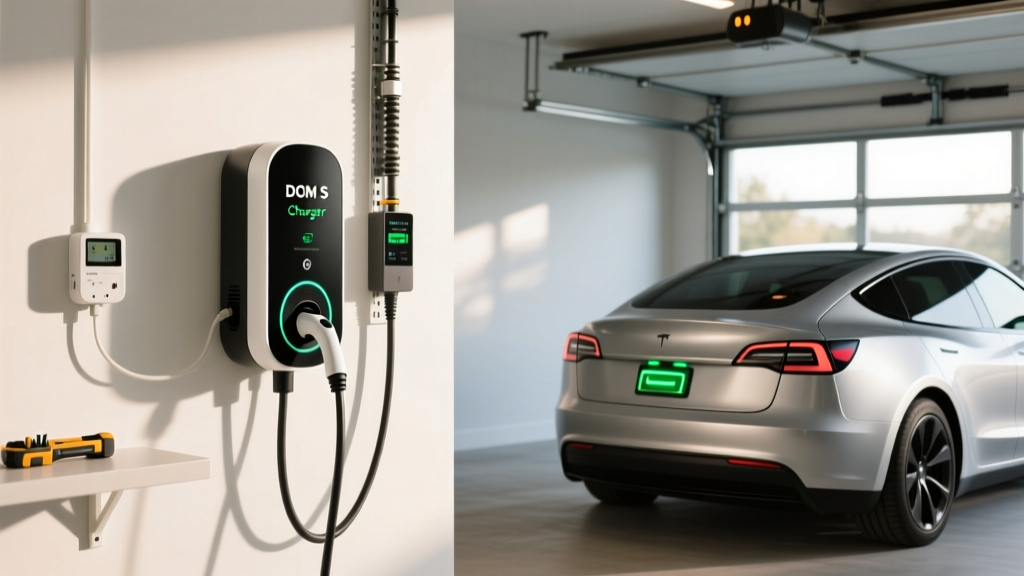
A Level 2 home charger is the backbone of practical EV ownership. Here's what's actually required — and what it costs.
Electrical Requirements
Most high-quality Level 2 chargers draw between 32 and 48 amps on a 240V circuit. Per the National Electrical Code (NEC), continuous loads (like EV charging) must use a circuit rated at 125% of the actual draw:
- 32-amp charger → requires a 40-amp breaker
- 40-amp charger → requires a 50-amp breaker
- 48-amp charger → requires a 60-amp breaker
Your electrical panel must have enough spare capacity to support this new circuit. Many older homes with 100-amp service may need a panel upgrade to 200 amps before adding a Level 2 charger — this is the single biggest hidden cost in home EV charging.
Installation Cost Breakdown
| Component | Simple Install (panel nearby, no upgrade) | Complex Install (long run, panel upgrade) |
|---|---|---|
| Level 2 Charger (hardware) | $300–$700 | $300–$700 |
| Electrician labor | $300–$800 | $1,000–$2,500 |
| Permit & inspection | $50–$200 | $50–$200 |
| Electrical panel upgrade (if needed) | $0 | $1,500–$3,500 |
| Total | $650–$1,700 | $2,850–$6,900 |
Key insight: If your panel is already 200-amp and has spare breaker slots near where you park, installation is straightforward and cheap. If your home has a 100-amp panel or the run from panel to garage is over 50 feet, budget on the higher end. Always get a licensed electrician's assessment before buying hardware.
Connector Compatibility: NACS, CCS1, and CHAdeMO in 2026
The connector landscape has consolidated significantly. As of 2026, the North American Charging Standard (NACS) — originally Tesla's proprietary connector — is the dominant standard, adopted by Ford, GM, Rivian, Volvo, Hyundai/Kia, and most major automakers. Here's where things stand:
| Connector | Brands Using It (Native) | Adapter Needed? |
|---|---|---|
| NACS (J3400) | Tesla, Ford, GM, Rivian, Volvo, Polestar, Hyundai/Kia (2025+), Mercedes-Benz, BMW (2025+) | CCS-to-NACS adapters available for legacy CCS vehicles (~$200–$300) |
| CCS1 | Older VW ID.4, Audi e-tron (pre-2025), Stellantis EVs, some legacy models | NACS-to-CCS adapters available; declining network support |
| CHAdeMO | Nissan Leaf (legacy only — discontinued after 2025) | Limited fast-charging network; adapters rare |
Practical advice: If you're buying a new EV in 2026, prioritize a NACS-equipped vehicle for the widest fast-charging access (including Tesla Superchargers). If you own a CCS1 vehicle, a quality adapter like the Lectron or A2Z CCS-to-NACS adapter unlocks Tesla Supercharger access.
Level 2 Home Charger Recommendations: 2026 Picks
After testing and tracking reliability data across dozens of units, these are the Level 2 chargers that deliver the best combination of power, build quality, smart features, and value:
ChargePoint Home Flex (NACS)
- Power: Up to 12 kW (50 amps) on 240V
- Cable length: 23 feet
- Connector: NACS (J3400) native; CCS1 adapter available
- Smart features: Wi-Fi, app scheduling, utility demand-response, energy tracking
- Price: ~$550
- Best for: Most EV owners; flexible amperage (dial from 16A to 50A to match your circuit)
Tesla Wall Connector (NACS)
- Power: Up to 11.5 kW (48 amps) on 240V
- Cable length: 24 feet
- Connector: NACS native; J1772 adapter included for non-Tesla EVs
- Smart features: Wi-Fi, OTA updates, power sharing (link up to 6 units on one circuit)
- Price: ~$450
- Best for: Tesla owners or mixed-EV households wanting a clean, reliable unit
Emporia Vue Level 2 Charger
- Power: Up to 11.5 kW (48 amps) on 240V
- Cable length: 24 feet
- Connector: NACS or J1772 (configurable at purchase)
- Smart features: Integrated energy monitoring, solar-aware scheduling, app control
- Price: ~$400
- Best for: Solar-panel owners wanting to charge exclusively from excess solar production
Grizzl-E Smart (United Chargers)
- Power: Up to 10 kW (40 amps) on 240V
- Cable length: 24 feet
- Connector: NACS or J1772
- Smart features: OCPP-compatible, adjustable amperage, extreme-weather rated (-40°F)
- Price: ~$500
- Best for: Cold-climate owners; outdoor installs in harsh conditions
Cost to Charge: Home vs Public vs Gas — The Real Numbers
The economics of EV charging depend heavily on where and when you charge. Here's a cost-per-mile comparison using a representative 2026 EV averaging 3.5 miles per kWh (roughly 100 MPGe combined):
| Charging Scenario | Cost per kWh | Cost Per Mile | Equivalent Gas MPG at $3.50/gal |
|---|---|---|---|
| Home (off-peak utility rate) | $0.08–$0.12 | $0.025–$0.034 | 103–140 MPG |
| Home (standard residential rate) | $0.14–$0.18 | $0.040–$0.051 | 69–88 MPG |
| Public Level 2 (workplace, mall) | $0.20–$0.35 | $0.057–$0.100 | 35–61 MPG |
| DC Fast Charge (Electrify America, EVgo) | $0.35–$0.55 | $0.100–$0.157 | 22–35 MPG |
| Tesla Supercharger (varies by location) | $0.25–$0.45 | $0.071–$0.129 | 27–49 MPG |
| Gas vehicle (28 MPG combined avg) | — | $0.125 | 28 MPG |
The takeaway: Home off-peak charging is 3–5× cheaper per mile than gasoline. Public DC fast charging approaches or slightly exceeds gas costs in some regions — but most EV owners do 80–90% of their charging at home. For the best rates, check if your utility offers a time-of-use (TOU) plan with discounted overnight rates, and schedule your charger to start after 10 PM. Source: fueleconomy.gov EV data.
Safety, Permits, and Code Considerations
EV chargers draw sustained high current for hours — this isn't like plugging in a lamp. Follow these non-negotiable safety requirements:
- Dedicated circuit: Your Level 2 charger must have its own dedicated breaker — never share a circuit with other appliances.
- GFCI protection: NEC 2023 (and most 2026 local adoptions) requires GFCI protection for all EV charging outlets. Hardwired units may have this built in; plug-in units need a GFCI breaker.
- Outdoor rating: If installing outdoors, the charger must carry a NEMA 4 or NEMA 4X rating. All units recommended above meet this standard.
- Permit and inspection: Most jurisdictions require an electrical permit for a new 240V circuit. The inspection ensures your wiring gauge, breaker size, and grounding meet code. Skipping this can void homeowner's insurance coverage for electrical fires.
- Wire gauge: A 60-amp circuit requires 6 AWG copper wire (or 4 AWG aluminum). Your electrician will spec this correctly — but verify it on the permit paperwork.
Frequently Asked Questions
How much does it cost to install a home EV charger?
For a straightforward install on an existing 200-amp panel with a short wire run, expect $650–$1,700 total (charger + electrician + permit). If your home needs a panel upgrade or has a long conduit run, costs rise to $2,850–$6,900. Always get an electrician's load calculation first.
How fast will each charging level add range?
Level 1 (120V) adds 3–5 miles per hour. Level 2 (240V, 48 amps) adds roughly 30–40 miles per hour for a typical mid-size EV. DC fast charging can add 150–300+ miles in 20–30 minutes, depending on the vehicle's charge acceptance rate and battery state of charge.
Which connector/charger is compatible with my EV?
Check your vehicle's charge port. 2025–2026 models from Tesla, Ford, GM, Rivian, Hyundai, Kia, Volvo, and BMW use NACS. Older models from VW, Audi, and Stellantis may still have CCS1. A CCS-to-NACS adapter ($200–$300) bridges the gap. CHAdeMO is effectively discontinued for new vehicles.
How much does charging cost per mile vs gas?
Home charging on off-peak rates costs roughly $0.025–$0.034 per mile — about 3–5× cheaper than gasoline at $3.50/gallon in a 28 MPG vehicle ($0.125/mile). Public DC fast charging is more expensive at $0.10–$0.16 per mile, approaching gas costs. Most EV owners charge primarily at home.
What electrical upgrades might I need?
The most common upgrade is a panel replacement from 100-amp to 200-amp service ($1,500–$3,500). You may also need a new breaker slot, upgraded wire from meter to panel, or a sub-panel near your garage. An electrician's load calculation will identify what's required before any hardware purchase.
For official safety and code guidance, consult the National Electrical Code (NFPA 70) and your local building authority. For EV efficiency data and MPGe ratings, see fueleconomy.gov.