If you've been searching for a DOM S charger review before pulling the trigger on a home Level 2 install, you're in the right place. The DOM S (sometimes listed as the "Doms S" wallbox) has been showing up in EV forums and installer recommendations throughout 2025 and into 2026, marketed as a 48-amp, Wi-Fi-enabled, NACS-native home charger at a sub-$500 price point. But specs on a product page only tell half the story. The other half — panel capacity, circuit sizing, permitting, and the real-world charge curve on a 75–100 kWh battery pack — is where most buyers get surprised.
This guide breaks down the DOM S charger in context: what it actually delivers in kW, what your home's electrical system needs to support it, what it costs end-to-end (equipment + electrician + permit), and how it compares against the ChargePoint Home Flex, Emporia Level 2, and Tesla Universal Wall Connector. We'll also walk through the Level 1 / Level 2 / DC Fast hierarchy with real miles-per-hour numbers, connector compatibility across every major EV brand sold in the U.S., and a per-mile cost comparison versus a 27 MPG gas car.
What the DOM S Charger Actually Is (and Isn't)
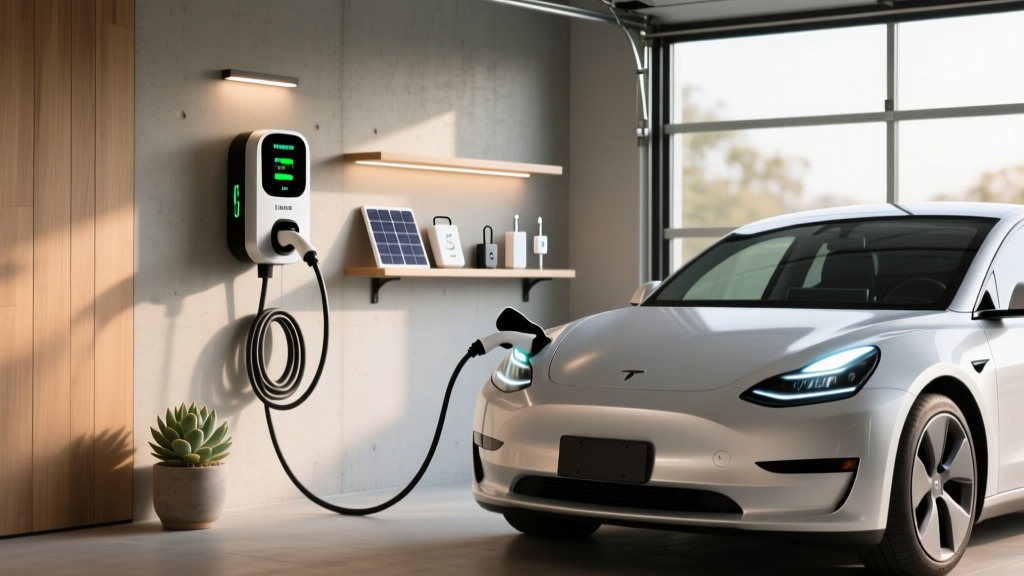
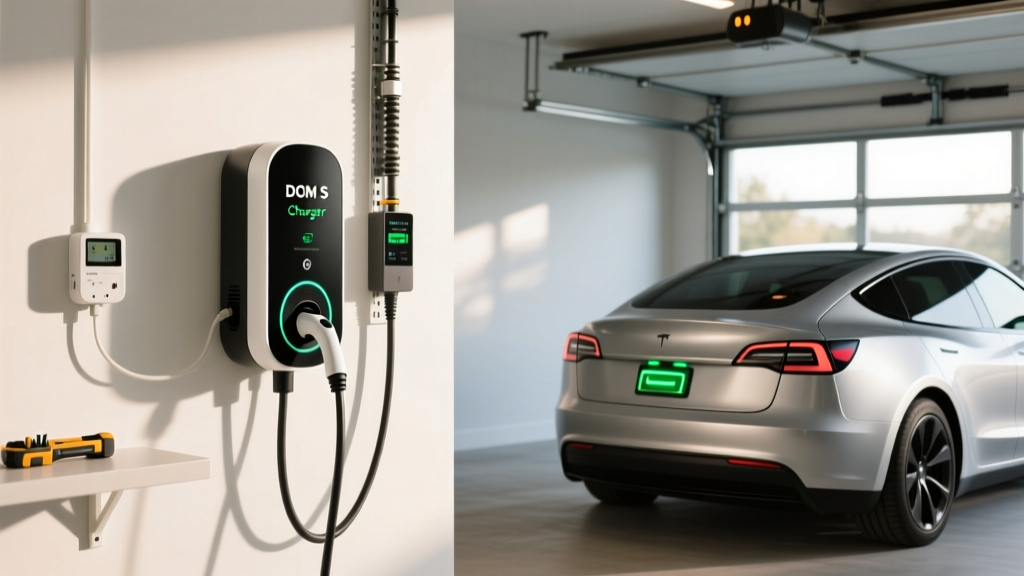
The DOM S is a hardwired or NEMA 14-50 plug-in Level 2 EVSE rated for 48 amps continuous draw on a 60-amp dedicated circuit, delivering up to 11.5 kW of power at 240 volts. It ships with a 24-foot cable, integrated cable management, Wi-Fi connectivity for scheduling and energy monitoring, and — as of the 2026 hardware revision — a native NACS (North American Charging Standard) connector, meaning it plugs directly into Tesla vehicles, the Ford F-150 Lightning, Rivian R1S/R1T, Hyundai Ioniq 5 (2025+), and every other OEM that has adopted NACS for the 2025+ model years.
A few important distinctions before we go further:
- kW (kilowatts) is the power — how fast energy flows into the car at any moment. The DOM S peaks at 11.5 kW.
- kWh (kilowatt-hours) is the energy — the size of the battery being filled. A Hyundai Ioniq 5 has an 84 kWh usable pack; a Tesla Model Y Long Range has about 75 kWh usable.
- These two are never interchangeable. A 48A/11.5 kW charger filling an 84 kWh battery from 10–80% (58.8 kWh added) takes roughly 5.1 hours at sustained peak — not the "3 hours" some marketing implies.
DOM S Charger Quick Specs
| Max power | 11.5 kW (48A @ 240V) |
| Required circuit | 60A dedicated, 240V |
| Connector | NACS (2026 revision); CCS1 adapter available |
| Cable length | 24 ft |
| Connectivity | Wi-Fi 2.4 GHz, app scheduling, energy logging |
| Indoor/outdoor | NEMA 4 rated (indoor/outdoor) |
| MSRP (2026) | $449 (NACS) / $429 (J1772 legacy) |
| Warranty | 3 years |
Level 1 vs Level 2 vs DC Fast: Speeds in kW and Miles Per Hour
Before sizing a home install, understand where each level fits. The table below uses real-world averages for a mid-size crossover EV at roughly 3.0–3.3 mi/kWh efficiency.
| Level | Voltage / Amps | Power (kW) | Miles of Range Added Per Hour | Typical Use Case |
|---|---|---|---|---|
| Level 1 | 120V / 12A | 1.4 kW | 3–5 mi/hr | Overnight trickle; PHEV top-ups |
| Level 2 (32A) | 240V / 32A | 7.7 kW | 23–28 mi/hr | Condo/apartment shared; older panels |
| Level 2 (48A — DOM S class) | 240V / 48A | 11.5 kW | 34–40 mi/hr | Standard home install, daily driving |
| Level 2 (80A) | 240V / 80A | 19.2 kW | 55–65 mi/hr | Heavy daily use; requires 100A circuit + robust panel |
| DC Fast (150 kW peak) | 400V DC | 150 kW | ~300 mi in 20 min (10–80%) | Road trips; away from home |
| DC Fast (350 kW peak) | 800V DC | 350 kW | ~200 mi in 10 min (10–80%) | Ioniq 5, EV6, Taycan-class 800V packs |
Two real-world caveats: (1) DC fast charging peaks at the advertised kW only between roughly 10–40% State of Charge, then tapers. A "150 kW" session averages closer to 80–100 kW over a full 10–80% fill. (2) Cold batteries below ~50°F will throttle charge rates unless preconditioned — expect 30–50% slower speeds in winter without battery preconditioning.
DOM S Real-World Charge Times: 10–80% on Common Battery Sizes
Here's what the 11.5 kW DOM S actually delivers on popular 2026 model-year EVs, assuming a 10–80% session (the sweet spot for daily charging and battery longevity on NMC packs):
| Vehicle | Usable Battery (kWh) | 10–80% Energy Added (kWh) | Time at 11.5 kW Sustained |
|---|---|---|---|
| Tesla Model Y Long Range | 75 | 52.5 | ~4 hr 35 min |
| Ford F-150 Lightning Extended | 131 | 91.7 | ~8 hr 00 min |
| Hyundai Ioniq 5 (2026) | 84 | 58.8 | ~5 hr 05 min |
| Chevrolet Equinox EV | 85 | 59.5 | ~5 hr 10 min |
| BMW iX xDrive50 | 105 | 73.5 | ~6 hr 25 min |
| Toyota RAV4 Prime (PHEV) | 18.1 | 12.7 | ~1 hr 05 min |
For most daily drivers covering 30–50 miles, a DOM S plugged in overnight from 10 PM to 6 AM adds 270–320 miles of range — more than enough to refill any passenger EV from 20% to full by morning. The 48A / 11.5 kW class hits the sweet spot between install cost and utility; stepping up to 80A / 19.2 kW requires a 100A dedicated circuit and often a panel upgrade that rarely pays off for residential use.
Home Installation: Electrical Requirements, Panel Upgrades, and Real Costs
The DOM S at 48 amps continuous requires a 60-amp dedicated 240V circuit per NEC Article 625 (continuous loads must be derated to 80% of breaker rating: 48A × 1.25 = 60A breaker). This is the single biggest variable in your total install price.
What your electrician will check
- Panel capacity: A 200A main panel with at least two adjacent breaker slots and enough spare amperage (after a load calculation per NEC 220.82) to absorb a 60A continuous load. Many homes built before 2000 have 100A or 150A panels that cannot support a 48A EVSE without a service upgrade.
- Wire gauge: 6 AWG copper THHN in conduit, or 4 AWG aluminum for longer runs. For runs over 100 feet, voltage drop may require upsizing to 4 AWG copper.
- Hardwired vs plug: The DOM S supports both. Hardwired is preferred for outdoor installs (no receptacle weathering, no GFCI nuisance trips). NEMA 14-50 plug-in requires a GFCI breaker in most 2026 jurisdictions per NEC 2023 adoption — a $120–$180 adder.
- Permit: Required in virtually every U.S. jurisdiction for new 240V circuits. Expect $75–$250 depending on city/county.
| Component | Low-End | Typical | High-End (Panel Upgrade) |
|---|---|---|---|
| DOM S charger (equipment) | $449 | $449 | $449 |
| Electrician labor (short run, same-wall or garage) | $400 | $800 | $1,400 |
| Wire, conduit, breaker, misc materials | $150 | $300 | $550 |
| Permit + inspection | $75 | $150 | $250 |
| Panel upgrade (100A/150A → 200A) if required | $0 | $0 | $2,500–$4,500 |
| Total installed | $1,074 | $1,699 | $7,149 |
The "high end" scenario — a full panel upgrade — hits roughly 15–20% of U.S. homes, per electrician surveys. If your home already has a 200A panel with spare slots and a clean load calculation, budget $1,300–$2,000 total. If you're in an older home, get a load calculation done before buying equipment. Some utilities offer free or subsidized panel-upgrade programs tied to EV adoption — check with your local provider.
Note: The federal Alternative Fuel Vehicle Refueling Property Credit (IRS Form 8911) covers 30% of home charging equipment and install costs up to $1,000 through 2032, subject to census-tract eligibility. This is separate from the §30D vehicle credit.
Connector Compatibility: NACS, CCS1, and CHAdeMO in 2026
The connector landscape has consolidated dramatically. Here's where each major brand stands for 2026 model-year U.S. vehicles:
| Connector | Brands Using It (2026 MY) | DOM S Compatibility |
|---|---|---|
| NACS (Tesla standard) | Tesla, Ford, GM, Rivian, Hyundai/Kia (2025+), Volvo/Polestar, BMW, Mercedes, Toyota/Subaru, Lucid | Native on 2026 DOM S |
| CCS1 | Legacy VW ID.4 (pre-2025), Stellantis, some Honda/early Nissan Ariya | Via NACS-to-CCS adapter ($150–$200) |
| CHAdeMO | Nissan Leaf (discontinued in U.S. after 2025 MY), Mitsubishi Outlander PHEV | Not supported; CHAdeMO adapters are rare and expensive |
| J1772 (Level 2 legacy) | All non-Tesla EVs pre-2025, most PHEVs | Via NACS-to-J1772 adapter (~$130) or DOM S J1772 SKU |
For any EV purchased new in 2026, the DOM S in NACS trim is a safe default. If you own a 2023–2024 CCS1 vehicle and plan to keep it, buy the NACS-to-CCS adapter from a certified vendor (Tesla, Lectron, or A2Z) — avoid cheap imports that lack thermal monitoring.
Cost to Charge: Home vs Public vs Gas, Per Mile
This is where EV ownership economics become concrete. The numbers below use a 3.2 mi/kWh efficiency average (typical for a crossover EV) and a 27 MPG gas car at $3.40/gallon (EIA 2026 forecast average).
| Scenario | Rate ($/kWh) | Cost Per Mile | Cost for 1,000 Miles |
|---|---|---|---|
| Home, off-peak TOU (utility avg) | $0.12 | $0.038 | $37.50 |
| Home, peak TOU | $0.28 | $0.088 | $87.50 |
| Public Level 2 (ChargePoint, EVgo L2) | $0.35–$0.49 | $0.11–$0.15 | $110–$153 |
| DC Fast (Tesla Supercharger avg) | $0.35 | $0.11 | $109 |
| DC Fast (Electrify America peak) | $0.55 | $0.17 | $172 |
| Gas car, 27 MPG @ $3.40/gal | — | $0.126 | $126 |
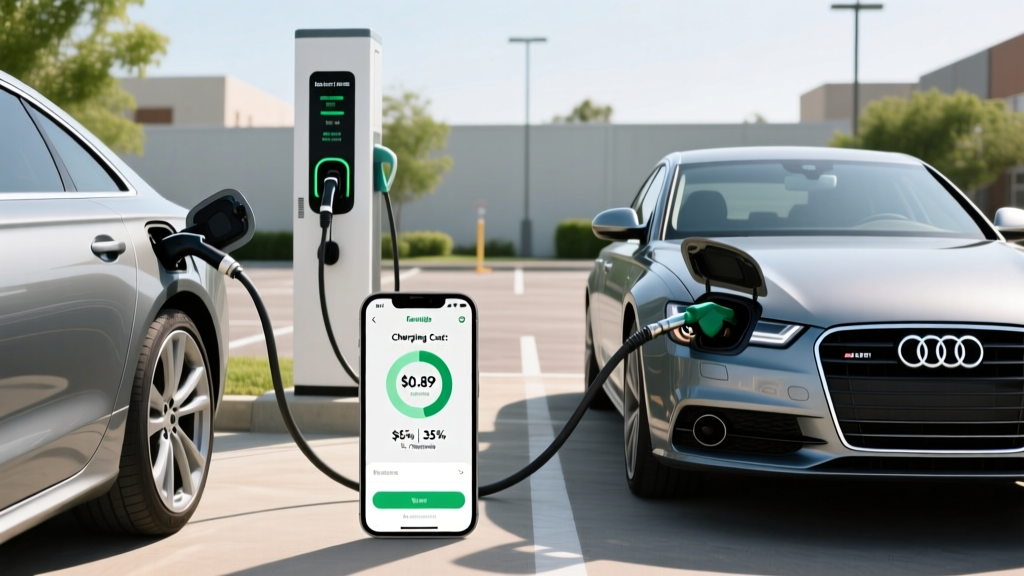
Key takeaway: home off-peak charging is 3.3× cheaper per mile than gas, and even public DC fast charging is roughly cost-parity with gas. The moment you rely exclusively on public DC fast charging, the EV cost advantage erodes — which is why a home Level 2 install like the DOM S is the single highest-ROI decision an EV owner makes. At 12,000 miles/year and off-peak home rates, annual fuel cost is ~$450 versus ~$1,510 for the gas car — a $1,060/year savings that pays back a typical DOM S install in 18–22 months.
Equipment Alternatives: How the DOM S Stacks Up
The DOM S competes in the 48A smart-charger segment against three established players. Here's a functional comparison based on 2026 SKUs and pricing:
DOM S (2026 NACS)
- Power: 11.5 kW / 48A
- Connector: NACS native
- Cable: 24 ft
- Smart features: Wi-Fi scheduling, energy dashboard, load sharing (2-pack)
- Price: $449
- Warranty: 3 years
Tesla Universal Wall Connector
- Power: 11.5 kW / 48A
- Connector: NACS + integrated J1772 adapter (Magic Dock style)
- Cable: 24 ft
- Smart features: Wi-Fi, OTA updates, Powerwall integration, vehicle-authenticated billing
- Price: $599
- Warranty: 4 years
ChargePoint Home Flex (2nd gen)
- Power: 12 kW / 50A (adjustable down to 16A)
- Connector: NACS (2025+ SKU) or J1772
- Cable: 23 ft
- Smart features: Wi-Fi, Alexa, flexible amperage tuning for panel-limited homes
- Price: $649
- Warranty: 3 years
Emporia Vue Level 2
- Power: 11.5 kW / 48A
- Connector: J1772 (NACS adapter included)
- Cable: 24 ft
- Smart features: Whole-home energy monitoring integration, solar-aware scheduling
- Price: $399
- Warranty: 3 years
Verdict: The DOM S at $449 is priced aggressively against the Emporia ($399) and undercuts the Tesla Universal by $150. It loses to the Tesla on warranty length (3 vs 4 years) and ecosystem integration, and to the ChargePoint on adjustable amperage — a genuine advantage if your panel can only spare a 40A or 50A circuit. If you're on a strict budget and have a clean 60A circuit, the DOM S is the best value in the class. If you want the longest warranty and native Tesla ecosystem integration, pay the $150 premium for the Universal Wall Connector.
Safety, Code, and Installation Non-Negotiables
A 60A 240V circuit is serious infrastructure. Do not cut corners here — the consequences range from nuisance breaker trips to electrical fire.
- Dedicated circuit only: The DOM S cannot share a circuit with a dryer, oven, or HVAC unit. NEC 625.40 requires a dedicated branch circuit for EVSE over 40A.
- GFCI considerations: Hardwired EVSE are generally exempt from GFCI requirements in most 2026-adopted jurisdictions; plug-in NEMA 14-50 receptacles typically require a GFCI breaker (~$150 adder) and are prone to nuisance trips with some EVSE. Hardwire when possible.
- Outdoor rating: The DOM S carries a NEMA 4 rating (weather-resistant, hose-down safe). For outdoor installs, confirm your jurisdiction requires an in-use cover for plug-in configurations.
- UL listing: Confirm any EVSE you purchase carries a UL or ETL mark (UL 2594 / UL 2231-1/2). Uncertified imports from marketplace sellers lack independent safety testing and may void homeowner's insurance coverage for related incidents.
- Load management: If your panel is near capacity but you want two EVs charging, the DOM S supports load-sharing with a second DOM S unit — the pair dynamically splits a single 60A circuit. A legitimate alternative to a panel upgrade.
DOM S Charger FAQ
How much does it cost to install a DOM S charger at home?
Equipment is $449. A straightforward install (short wire run, 200A panel with spare capacity) typically totals $1,300–$2,000 including labor, materials, and permit. Homes needing a panel upgrade (100A or 150A → 200A) can see $4,500–$7,100 all-in. Get a load calculation from a licensed electrician before committing.
How fast will the DOM S add range compared to Level 1 or DC fast?
The DOM S at 11.5 kW adds roughly 34–40 miles of range per hour, versus 3–5 miles/hour on a Level 1 120V outlet. DC fast charging at 150 kW adds ~300 miles in 20 minutes but is meant for road trips, not daily use — sustained DC fast charging accelerates battery degradation on NMC packs.
Which connector does the DOM S use, and is it compatible with my EV?
The 2026 DOM S ships with a native NACS connector, compatible with every 2025+ model-year EV sold in the U.S. except legacy Nissan Leaf and Mitsubishi Outlander PHEV (CHAdeMO). For 2023–2024 CCS1 vehicles, a NACS-to-CCS adapter (~$150–$200) is required.
How much does charging cost per mile vs a gas car?
At home off-peak rates ($0.12/kWh), an EV costs ~$0.038/mile versus ~$0.126/mile for a 27 MPG gas car at $3.40/gallon — roughly 3.3× cheaper. Public DC fast charging at $0.35–$0.55/kWh is cost-parity or slightly higher than gas, which is why home charging is the economic foundation of EV ownership.
What electrical upgrades might I need for a 48A charger?
A 48A EVSE requires a 60A dedicated 240V circuit. Homes with 200A panels and spare capacity usually need only the new circuit. Homes with 100A or 150A service, or panels near their load limit, may require a service upgrade to 200A ($2,500–$4,500). A load calculation per NEC 220.82 is the definitive answer — have one performed before purchasing equipment.
Is the DOM S eligible for a federal tax credit?
The charger itself (and installation) may qualify for the Alternative Fuel Vehicle Refueling Property Credit, which covers 30% of home charging equipment and install costs up to $1,000 through 2032. Eligibility depends on your census tract — check IRS guidance and consult a tax professional. This is separate from the §30D vehicle purchase credit.
Can I plug the DOM S into a NEMA 14-50 outlet instead of hardwiring?
Yes, the DOM S offers a 14-50 plug-in SKU. However, most 2026 jurisdictions now require a GFCI breaker on 14-50 receptacles (per NEC 2023), which adds ~$150 and is prone to nuisance trips. Hardwired installs avoid both issues and are generally preferred for reliability and inspection simplicity.
For official efficiency data on any vehicle referenced above, cross-check with fueleconomy.gov. For electrical code specifics, always defer to a licensed electrician familiar with your local jurisdiction's adopted NEC edition — the information here is guidance, not a substitute for professional assessment.