One of the most common questions new Tesla owners ask is whether their car will continue charging during an over-the-air software update. It's a practical concern — you plug in at night, the car begins downloading firmware, and you need to know if you'll wake up with a full battery or a stalled session. The short answer: yes, Tesla typically pauses charging while installing a software update, but the nuances matter. Below, we unpack exactly what happens, then expand into the full EV charging ecosystem — from home Level 2 installation to public DC fast charging — so you have the numbers to plan every session.
Does Tesla Stop Charging When Updating?
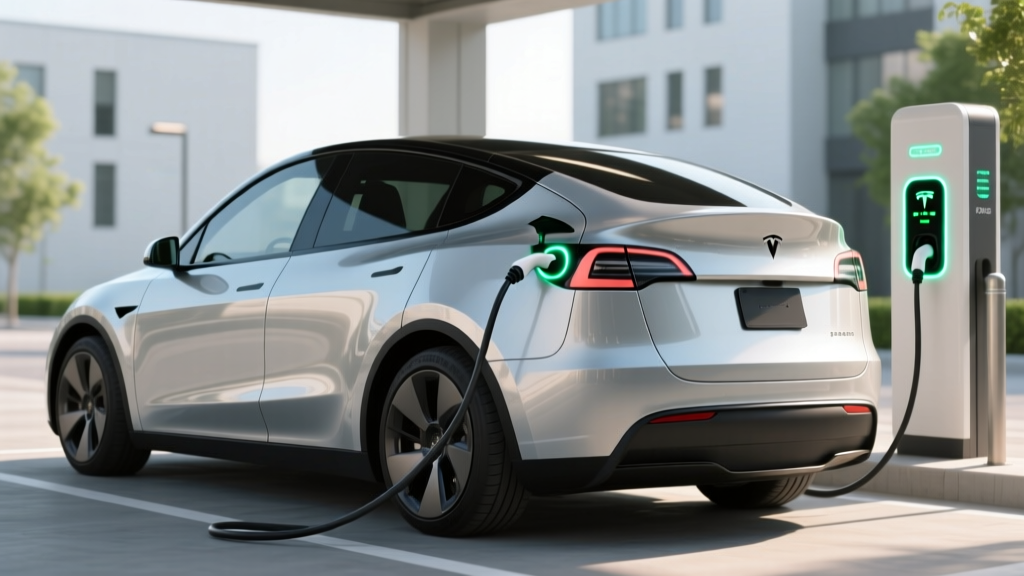
Tesla vehicles handle software updates in two phases: download and install. During the download phase, charging continues normally. The car pulls the update file via Wi-Fi or cellular while electrons flow into the battery. You'll see a download progress bar on the touchscreen, and your charging session proceeds without interruption.
The install phase is different. When the vehicle begins applying the update — which typically takes 20 to 45 minutes depending on the update size — charging pauses. The car's systems reboot, the drivetrain controller goes offline, and the charging contactor opens. Once the installation completes and the car restarts, charging does not automatically resume on most configurations. You may need to manually re-initiate the session via the app or touchscreen, though some recent firmware versions have begun auto-resuming after minor updates.
This behavior isn't unique to Tesla. Most modern EVs — including vehicles from Ford, Hyundai, BMW, and Rivian — will interrupt charging during firmware installations because the battery management system (BMS) and onboard charger must reboot. Understanding how your specific EV handles this is just one piece of the broader charging puzzle.
The Three Charging Levels: Speed, Power, and Real-World Range
Every EV owner needs to internalize the difference between kW (kilowatts) and kWh (kilowatt-hours). kW measures power — the rate at which electricity flows into your car, like water pressure from a hose. kWh measures energy — the total amount stored in your battery, like gallons in a tank. A 60 kWh battery charged at 10 kW will take roughly 6 hours from empty to full. Confusing these two units is the single most common EV literacy gap.
| Level | Voltage | Power (kW) | Miles of Range per Hour | Best Use Case |
|---|---|---|---|---|
| Level 1 | 120V AC | 1.0–1.4 kW | 3–5 mi/hr | Overnight top-ups, PHEVs, emergencies |
| Level 2 | 240V AC | 3.3–19.2 kW | 12–75 mi/hr | Daily home charging, workplace, destinations |
| DC Fast Charge | 400–900V DC | 50–350 kW | 150–1,000+ mi/hr (peak) | Road trips, quick top-ups, commercial fleets |
Level 1: The Trickle Charge
Every EV ships with a mobile connector that plugs into a standard 120V household outlet. At roughly 1.2 kW, you'll add about 4 miles of range per hour. For a 75 kWh battery (like a Tesla Model Y Long Range), a full charge from empty would take over 60 hours. Level 1 works for plug-in hybrids with small batteries (e.g., the Toyota RAV4 Prime's 18.1 kWh pack charges fully overnight) or as a backup when no Level 2 is available.
Level 2: The Daily Workhorse
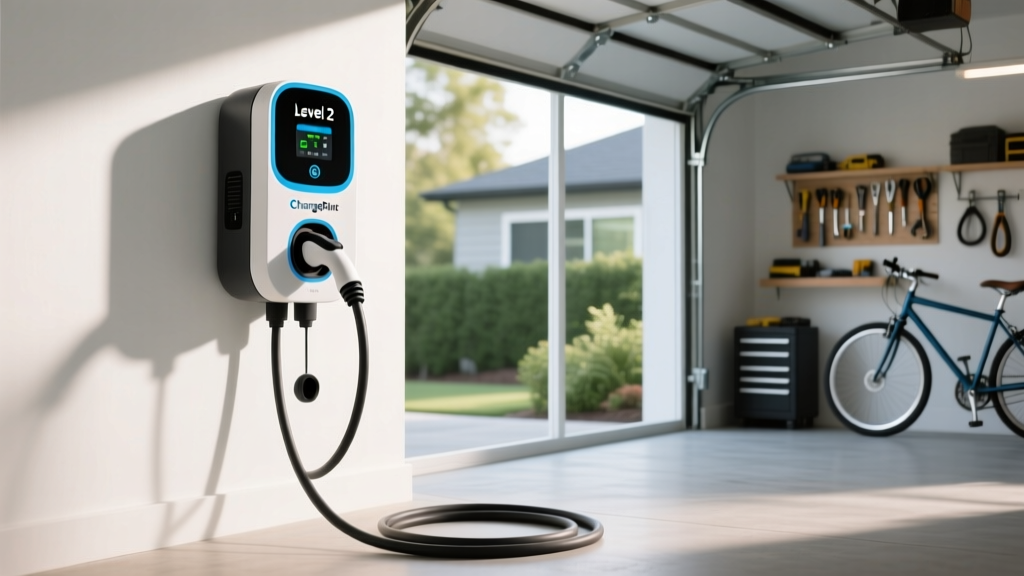
A 240V Level 2 charger — the same voltage as your electric dryer — is the backbone of practical EV ownership. Most home installations deliver 32A to 48A, yielding 7.7 kW to 11.5 kW. At 11.5 kW, a Tesla Model 3 Long Range (82 kWh usable battery) charges from 10% to 80% in roughly 5 hours. At 48A, that same session takes about 6.5 hours. This is the level that makes EV ownership effortless: plug in when you get home, wake up with a full battery every morning.
DC Fast Charging: Road-Trip Speed
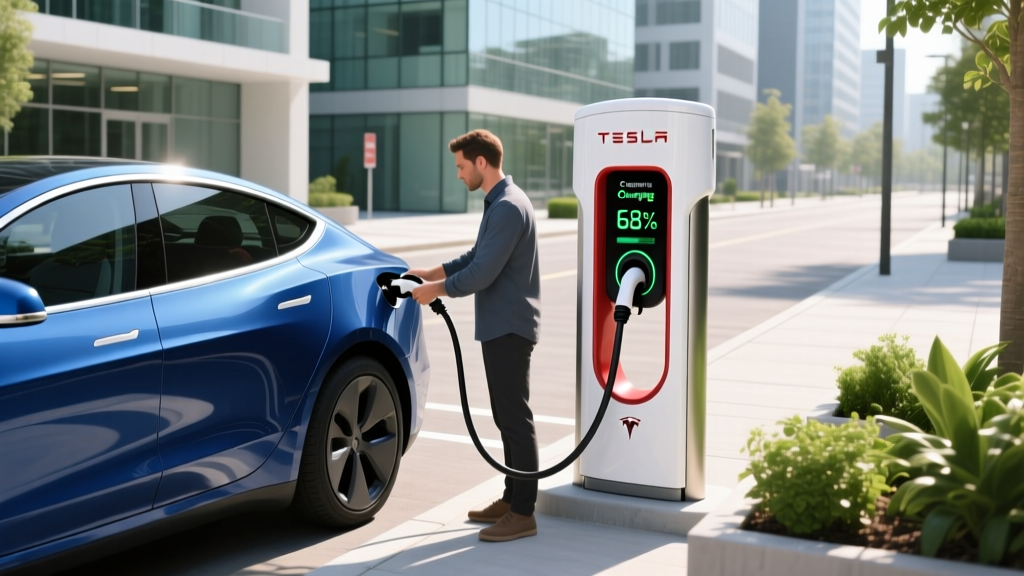
DC fast chargers bypass the car's onboard charger and feed high-voltage DC directly into the battery. Peak rates range from 50 kW at older stations to 350 kW at Electrify America and Tesla V4 Superchargers. But peak kW is not sustained kW. A Hyundai Ioniq 5 with its 800V architecture can peak at 240 kW and charge from 10–80% in approximately 18 minutes. However, the charge curve tapers sharply above 80% SoC to protect battery health — going from 80% to 100% can take as long as the 10–80% session. Always plan road-trip stops to 80%, not 100%.
Home Charger Installation: Costs, Electrical Requirements, and Gotchas
Installing a Level 2 home charger is the single highest-impact upgrade an EV owner can make. But costs vary enormously depending on your home's electrical panel, the distance from panel to charger location, and local permitting requirements.
Electrical Requirements
A typical home Level 2 installation requires a 240V dedicated circuit on a breaker rated for 125% of the charger's continuous draw. For a 48A charger, you need a 60A breaker. For a 40A charger, a 50A breaker suffices. The circuit must use appropriately gauged copper wire (6 AWG for 60A, 8 AWG for 50A) run through conduit where exposed.
Your main electrical panel must have sufficient spare capacity. Most modern homes have 200A service, which typically accommodates a 60A EV circuit without issue. Older homes with 100A or 150A panels may require a panel upgrade to 200A — a significant added cost. Some jurisdictions now allow a load management device (like the Emporia VUE or Tesla Wall Connector with power-sharing) that monitors total home load and throttles the charger if the panel approaches capacity, potentially avoiding a panel upgrade.
Installation Cost Breakdown
| Component | Simple Install | Complex Install |
|---|---|---|
| Level 2 charger (hardware) | $350–$600 | $500–$750 |
| Electrician labor (2–4 hrs simple; 6–12 hrs complex) | $300–$600 | $900–$2,000 |
| Electrical permit | $50–$150 | $100–$300 |
| Conduit, wire, and fittings | $50–$150 | $200–$600 |
| Panel upgrade (if needed) | Not needed | $1,500–$3,500 |
| Total Range | $750–$1,500 | $3,200–$7,150 |
A "simple install" means the electrical panel is adjacent to the garage or exterior wall where the charger mounts — short wire run, no trenching, no panel work. A "complex install" involves long wire runs (50+ feet), running conduit through finished walls or underground, or upgrading the panel. According to the U.S. Department of Energy, most homeowners spend between $1,000 and $2,500 for a complete Level 2 installation.
Safety and Code Requirements
- Dedicated circuit: Your EV charger must be on its own breaker — never shared with other appliances.
- GFCI protection: The 2020 NEC (National Electrical Code) requires GFCI protection for all EV charging outlets. Many hardwired chargers have built-in GFCI, but receptacle-based installs need a GFCI breaker.
- Outdoor rating: If mounting outdoors, ensure the charger carries a NEMA 4 or NEMA 4X rating for weather resistance. The Tesla Wall Connector and ChargePoint Home Flex are both rated for outdoor use.
- Permit and inspection: Virtually all jurisdictions require an electrical permit for a new 240V circuit. Skipping this risks insurance denial in the event of an electrical fire.
Connector Compatibility: NACS, CCS, and CHAdeMO Explained
The connector landscape has shifted dramatically. Tesla's North American Charging Standard (NACS) has become the dominant connector for new EVs starting with the 2025 model year, with Ford, GM, Rivian, Volvo, Hyundai, and others adopting it. CCS1 remains on many 2020–2024 models, and CHAdeMO is essentially legacy (Nissan Leaf being the last holdout).
| Connector | Brands Using It | Adapter Needed? |
|---|---|---|
| NACS (Tesla) | Tesla, Ford, GM, Rivian, Hyundai, Kia, Volvo, Polestar, BMW, Mercedes (new models) | CCS-to-NACS adapter for older CCS vehicles (~$200–$300) |
| CCS1 | Volkswagen ID.4 (pre-2025), older Ford/GM/Hyundai models, BMW i4 (pre-2025) | NACS-to-CCS adapter to use Tesla Superchargers |
| CHAdeMO | Nissan Leaf (all years), Mitsubishi Outlander PHEV (older) | Limited adapters; CHAdeMO stations declining |
If you own a pre-2025 CCS-equipped EV like a Volkswagen ID.4 or Hyundai Ioniq 5 (2022–2024), you can purchase an adapter to access Tesla's Supercharger network, which now numbers over 30,000 stalls in North America. Conversely, new NACS-equipped vehicles from Ford and GM can access Electrify America and other CCS networks using a NACS-to-CCS adapter. Always verify adapter compatibility with your specific model year before purchasing.
Charging Cost Per Mile: EV vs. Gas
Electricity prices vary by region, time of day, and charging location. Here's a realistic breakdown using national averages for 2026:
| Scenario | Rate | Cost per Mile* |
|---|---|---|
| Home Level 2 (off-peak utility rate) | $0.09/kWh | $0.027/mi |
| Home Level 2 (national avg residential) | $0.17/kWh | $0.051/mi |
| Public Level 2 (ChargePoint, EVgo L2) | $0.25–$0.40/kWh | $0.075–$0.12/mi |
| DC Fast Charge (Tesla Supercharger avg) | $0.28–$0.38/kWh | $0.084–$0.114/mi |
| DC Fast Charge (Electrify America peak) | $0.48/kWh | $0.144/mi |
| Gas car (28 MPG combined, $3.40/gal) | $3.40/gal | $0.121/mi |
*Based on a vehicle averaging 3.0 miles per kWh (≈100 MPGe), typical of a Tesla Model Y or Hyundai Ioniq 5.
The math is clear: home charging at off-peak rates delivers fuel costs at roughly one-quarter the price of gasoline. Even public DC fast charging at premium rates is often competitive with or cheaper than gas on a per-mile basis. The savings compound — a driver covering 12,000 miles per year saves between $600 and $1,200 annually by charging at home versus fueling a 28 MPG gas car.
Charging Time Examples: 10–80% for Common Battery Sizes
Battery capacity, measured in kWh, directly determines how long a charging session takes. Here are real-world 10–80% times for popular 2026 EVs at various charging speeds:
| Vehicle (Battery kWh) | Level 2 @ 11.5 kW | DC Fast @ 150 kW (peak) | DC Fast @ 250 kW (peak) |
|---|---|---|---|
| Tesla Model 3 LR (82 kWh) | ~5.0 hrs | ~28 min | ~22 min |
| Tesla Model Y LR (75 kWh) | ~4.5 hrs | ~26 min | ~20 min |
| Hyundai Ioniq 5 (84 kWh) | ~5.1 hrs | ~25 min | ~18 min |
| Ford F-150 Lightning Ext. (131 kWh) | ~8.0 hrs | ~42 min | ~35 min |
| Chevrolet Equinox EV (85 kWh) | ~5.2 hrs | ~30 min | ~24 min |
Remember: these times assume the battery is preconditioned (warmed to optimal charging temperature) and that the charger can sustain its peak rate. In cold weather (below 40°F), charging speeds can drop 30–50% until the battery warms. Tesla's navigation system automatically preconditioning the battery when a Supercharger is set as your destination is a significant real-world advantage.
Recommended Home Chargers: Equipment Picks for 2026
Tesla Wall Connector
Power: Up to 11.5 kW (48A)
Connector: NACS (native Tesla)
Cable length: 24 ft
Smart features: Wi-Fi, OTA updates, power-sharing with second unit, access control
Price: ~$475
Best for: Tesla owners wanting maximum integration and clean aesthetics
ChargePoint Home Flex
Power: Up to 12 kW (50A), configurable down to 16A
Connector: NACS (2025+ models); J1772 with adapter
Cable length: 23 ft
Smart features: Wi-Fi, app scheduling, Alexa integration, flexible amperage
Price: ~$550–$650
Best for: Multi-EV households needing adjustable amperage for older panels
Emporia Level 2 Charger
Power: Up to 11.5 kW (48A)
Connector: J1772 (NACS adapter available)
Cable length: 24 ft
Smart features: Integrated energy monitoring, solar-aware charging, load management
Price: ~$399
Best for: Budget-conscious buyers and solar-panel households wanting energy tracking
Grizzl-E Smart
Power: Up to 10 kW (40A)
Connector: J1772 or NACS (select at purchase)
Cable length: 24 ft
Smart features: OCPP-compatible, adjustable amperage, extreme-weather rated (-40°F)
Price: ~$449
Best for: Cold-climate owners needing rugged outdoor durability
All four chargers above support hardwired or NEMA 14-50 receptacle installation. Hardwired is generally preferred for 48A+ chargers because NEMA 14-50 receptacles are limited to 40A continuous draw under NEC rules — and several utility rebates now require hardwired installations.
Frequently Asked Questions
How much does it cost to install a home EV charger?
A straightforward Level 2 home charger installation — short wire run, adequate panel capacity — typically costs $750 to $1,500 including hardware, electrician labor, and permit. Complex installations involving long conduit runs or a panel upgrade can reach $3,200 to $7,150. The federal Alternative Fuel Vehicle Refueling Property Credit may reimburse up to 30% (max $1,000) if you're in an eligible census tract.
How fast will each charging level add range?
Level 1 (120V) adds roughly 3–5 miles per hour. Level 2 (240V at 48A/11.5 kW) adds about 35–45 miles per hour for an efficient sedan, or 25–35 miles per hour for a heavier SUV or truck. DC fast charging can add 150–300+ miles in 20–30 minutes at peak rates, though the charge curve tapers significantly above 80% SoC.
Which connector/charger is compatible with my EV?
Check your vehicle's charge port. Tesla vehicles use NACS. Most 2025+ non-Tesla EVs (Ford, GM, Hyundai, Kia, Rivian, Volvo) have adopted NACS. Pre-2025 non-Tesla EVs typically use CCS1. The Nissan Leaf uses CHAdeMO. Adapters exist to cross-connect between NACS and CCS networks — verify compatibility with your specific model year before purchasing.
How much does charging cost per mile vs gas?
Home charging at the national average residential rate ($0.17/kWh) costs about $0.05 per mile for a typical EV. Gasoline at $3.40/gallon in a 28 MPG car costs about $0.12 per mile. That's a 58% savings per mile driving on home electricity. Even public DC fast charging at $0.35/kWh ($0.105/mile) undercuts gasoline.
What electrical upgrades might I need?
If your home has a 200A electrical panel with spare breaker slots and the charger mounts nearby, you likely need no upgrades. If your panel is 100A or 150A, or if you're adding a second EV charger, you may need a panel upgrade ($1,500–$3,500) or a load management device ($300–$600) that throttles charging when other high-draw appliances are running. A licensed electrician can assess your panel's spare capacity during a site visit — most offer this evaluation for free or a nominal fee.
Does Tesla stop charging when updating?
During the download phase, charging continues normally. During the install phase (20–45 minutes), charging pauses because the vehicle's systems reboot. After the update completes, you may need to manually resume charging via the app or touchscreen, though some recent firmware versions auto-resume for minor updates. Schedule updates when you have buffer time before your next drive.
Should I precondition my battery before DC fast charging?
Yes. Battery preconditioning warms the cells to the optimal temperature for fast charging (typically 85–95°F internally). In cold weather, an un-preconditioned battery may accept only 30–50% of its peak charge rate. Tesla automatically preconditioning when navigating to a Supercharger; for other EVs, check if your vehicle offers a preconditioning toggle in the app or infotainment system before arriving at the charger.
Sources: U.S. Department of Energy — Home Charging, IRS — Alternative Fuel Vehicle Refueling Property Credit, EPA Fuel Economy. Tax credit eligibility and incentive amounts vary by jurisdiction and are subject to change. Consult a licensed electrician for installation specifics and a tax professional for credit qualification.