If you're shopping for a Tesla Model 3, Model Y, Model S, or Model X, one of the first questions that comes up is practical and urgent: does Tesla come with a charger? The short answer has shifted over the years, and in 2026 the reality is more nuanced than a simple yes or no. Tesla's current policy, what you actually get in the box, and what you'll need to charge efficiently at home are all critical to understand before delivery day.
This guide breaks down exactly what Tesla includes, what charging levels mean in real-world miles and kilowatts, what a proper home installation costs, and which third-party chargers are worth your money — whether you drive a Tesla or any other EV using the now-dominant NACS (North American Charging Standard) connector.
What Tesla Actually Includes in the Box
As of 2026, Tesla does not include a free Mobile Connector in the box with new vehicle deliveries. Tesla discontinued the complimentary Mobile Connector bundle in April 2022 and shifted it to an optional accessory. You can purchase the Tesla Mobile Connector separately for approximately $200 from Tesla's online shop. It includes:
- A 20-foot cable with the NACS (Tesla) vehicle-side connector
- A NEMA 5-15 adapter (standard 120V household outlet) for Level 1 trickle charging
- A NEMA 14-50 adapter (240V outlet) for faster Level 2 charging at up to 32 amps / 7.7 kW
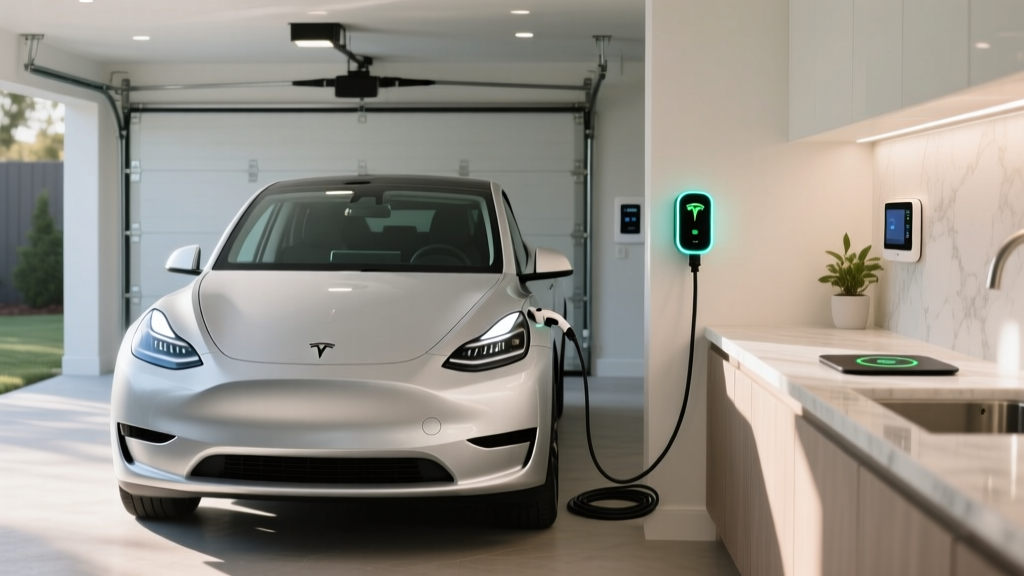
Tesla also sells the Wall Connector (approximately $420) as a dedicated home charging station. This is a hardwired or plug-in Level 2 unit that delivers up to 48 amps (11.5 kW on a 60-amp circuit) and includes a 24-foot cable, Wi-Fi connectivity, and load-sharing capability for multi-unit installations.
Charging Levels Explained: Speed, Power, and Real-World Range
Understanding the three charging levels is essential for any EV owner. Each level delivers different power (kW) and translates to different miles of range added per hour of charging.
| Charging Level | Voltage / Amperage | Power Output | Miles of Range Per Hour | Typical Use Case |
|---|---|---|---|---|
| Level 1 (120V) | 120V / 12A | ~1.4 kW | 3–5 miles/hr | Overnight trickle; emergency top-ups |
| Level 2 (240V) | 240V / 32A–48A | 7.7–11.5 kW | 25–44 miles/hr | Daily home charging; workplace |
| DC Fast Charging | 400V–800V DC | 50–350 kW | 150–1,000+ miles/hr | Road trips; Tesla Superchargers |
Charging Time Examples: 10–80% State of Charge
EV charging slows significantly above 80% to protect battery health — this is called the charge curve taper. Here's how long common Tesla models take from 10% to 80% at various power levels:
- Tesla Model Y Long Range (~75 kWh usable): Level 1 at 1.4 kW — approximately 35 hours. Level 2 at 11.5 kW — roughly 5 hours. DC Fast at 250 kW peak — about 25–30 minutes (sustained average ~170 kW due to taper).
- Tesla Model 3 Long Range (~75 kWh usable): Nearly identical to Model Y times above.
- Tesla Model S (~100 kWh usable): Level 2 at 11.5 kW — roughly 6.5 hours. DC Fast at 250 kW peak — about 30–35 minutes.
For daily driving, Level 2 at home is the practical standard. Most owners plug in overnight and wake up to a full battery. A 48-amp Level 2 charger adds roughly 35–44 miles of range per hour, which covers a typical daily commute in 1–2 hours of charging.
Home Charger Installation: Requirements, Costs, and Electrical Upgrades
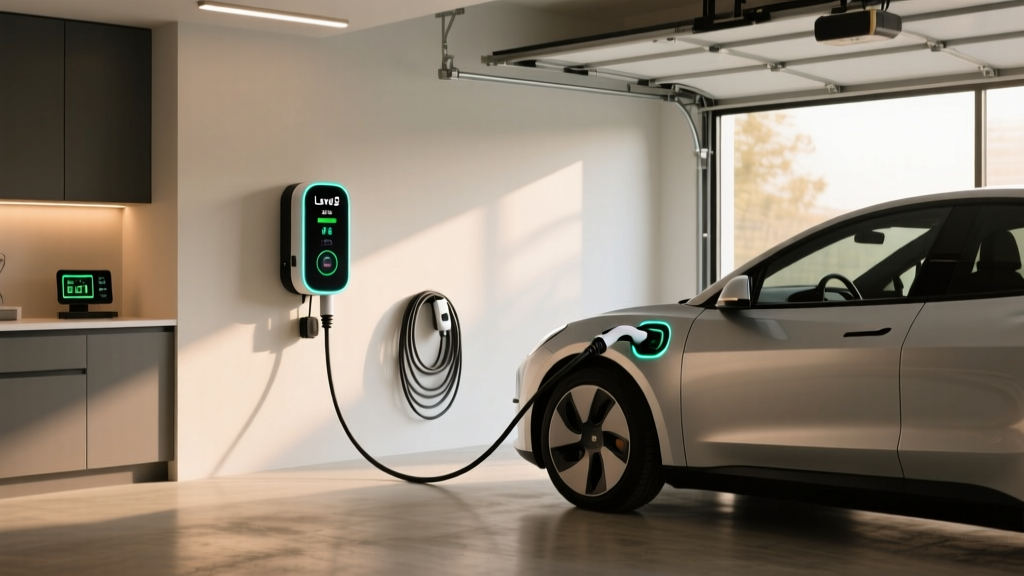
Installing a dedicated Level 2 home charger is the single most impactful upgrade for EV ownership convenience. But the cost varies enormously depending on your home's electrical panel, the distance from panel to charger location, and local permitting requirements.
Electrical Requirements
A standard high-performance Level 2 charger like the Tesla Wall Connector at 48 amps requires a dedicated 60-amp, 240-volt circuit. The National Electrical Code (NEC) requires that continuous loads (like EV charging, which runs for 3+ hours) not exceed 80% of a circuit's rated capacity. So a 60-amp breaker supports 48 amps of continuous draw.
If you opt for a 32-amp charger (like the Tesla Mobile Connector with NEMA 14-50), you need a dedicated 40-amp, 240-volt circuit.
Installation Cost Breakdown
| Cost Component | Simple Install (Panel Nearby) | Complex Install (Long Run / Panel Upgrade) |
|---|---|---|
| Charger equipment (Wall Connector or equivalent) | $350–$500 | $350–$700 |
| Electrician labor (2–4 hrs simple; 6–12 hrs complex) | $300–$800 | $1,000–$3,000 |
| Electrical materials (conduit, wire, breaker) | $100–$300 | $300–$800 |
| Permit and inspection | $50–$200 | $50–$300 |
| Electrical panel upgrade (100A → 200A, if needed) | N/A | $1,500–$4,000 |
| Total estimated cost | $800–$1,800 | $3,200–$8,800 |
Safety and Code Considerations
- Dedicated circuit: Your EV charger must have its own dedicated breaker — never share a circuit with other appliances.
- GFCI protection: NEC 2020 and later require GFCI (Ground Fault Circuit Interrupter) protection for all 240V EV charging outlets. Hardwired chargers like the Tesla Wall Connector have built-in ground fault protection.
- Outdoor rating: If installing outdoors, ensure the charger is rated NEMA 4 (weather-resistant). The Tesla Wall Connector is rated for indoor and outdoor use.
- Permit and inspection: Most jurisdictions require an electrical permit for new 240V circuits. Skipping this can void insurance coverage and cause issues during a home sale.
Connector Compatibility: NACS, CCS, and Adapters
The connector landscape has consolidated dramatically. Tesla's NACS (North American Charging Standard, formally SAE J3400) is now the dominant connector in North America. As of 2025–2026, nearly every major automaker — Ford, GM, Rivian, Hyundai, Kia, BMW, and others — has adopted NACS on new vehicles or provides CCS-to-NACS adapters.
| Connector Type | Brands Using It (2026) | AC Level 2 Charging | DC Fast Charging | Adapter Needed? |
|---|---|---|---|---|
| NACS (Tesla/SAE J3400) | Tesla, Ford, GM, Rivian, Hyundai, Kia, BMW, Mercedes, Volvo | Yes | Yes (Supercharger + open networks) | CCS vehicles need a CCS-to-NACS adapter (~$150–$250) |
| CCS1 | Legacy: older VW, BMW, Hyundai models pre-NACS switch | Yes (via J1772 upper portion) | Yes (Electrify America, EVgo) | Tesla owners need NACS-to-CCS adapter for CCS stations |
| CHAdeMO | Nissan Leaf (legacy); effectively discontinued for new models | No (separate J1772 inlet for AC) | Yes (declining network) | No direct NACS adapter widely available |
If you own a Tesla, you can charge at home with the NACS connector natively. For public DC fast charging, Tesla Superchargers use NACS and are the most reliable network in the US. For non-Tesla DC fast chargers still using CCS1 (like some Electrify America stations), Tesla sells a NACS-to-CCS adapter (~$250).
If you own a non-Tesla EV with a CCS port and want access to Tesla Superchargers (many of which opened to non-Tesla vehicles via the Magic Dock or NACS cable), you'll need a CCS-to-NACS adapter from your automaker or a third-party supplier like Lectron or A2Z.
Cost to Charge: Home vs Public vs Gas
One of the biggest ownership advantages of an EV is lower fueling cost — but the savings depend heavily on where and when you charge. Here's a realistic breakdown using national averages.
| Charging Scenario | Average $/kWh | Cost for 75 kWh Fill (Model Y) | Cost Per Mile (at 3.5 mi/kWh) |
|---|---|---|---|
| Home — off-peak (utility time-of-use rate) | $0.08–$0.14 | $6.00–$10.50 | $0.023–$0.040 |
| Home — standard flat rate | $0.14–$0.20 | $10.50–$15.00 | $0.040–$0.057 |
| Public Level 2 (ChargePoint, workplace) | $0.20–$0.35 | $15.00–$26.25 | $0.057–$0.100 |
| DC Fast Charging (Tesla Supercharger, Electrify America) | $0.28–$0.48 | $21.00–$36.00 | $0.080–$0.137 |
| Gasoline comparison (28 MPG avg at $3.40/gal) | — | — | $0.121 |
According to fueleconomy.gov, the Tesla Model Y Long Range achieves approximately 3.5 miles per kWh (122 MPGe combined). At home off-peak rates, that works out to roughly $0.03 per mile — about one-quarter the cost of gasoline at current prices. Even at DC fast-charger pricing, EV fueling costs are competitive with or cheaper than gas for most vehicles.
The catch: if you rely exclusively on public DC fast charging at premium rates ($0.40+ per kWh), your cost per mile can approach or exceed gasoline. Home charging is where the economics work best.
Best Home Chargers for Tesla and NACS EVs (2026 Picks)
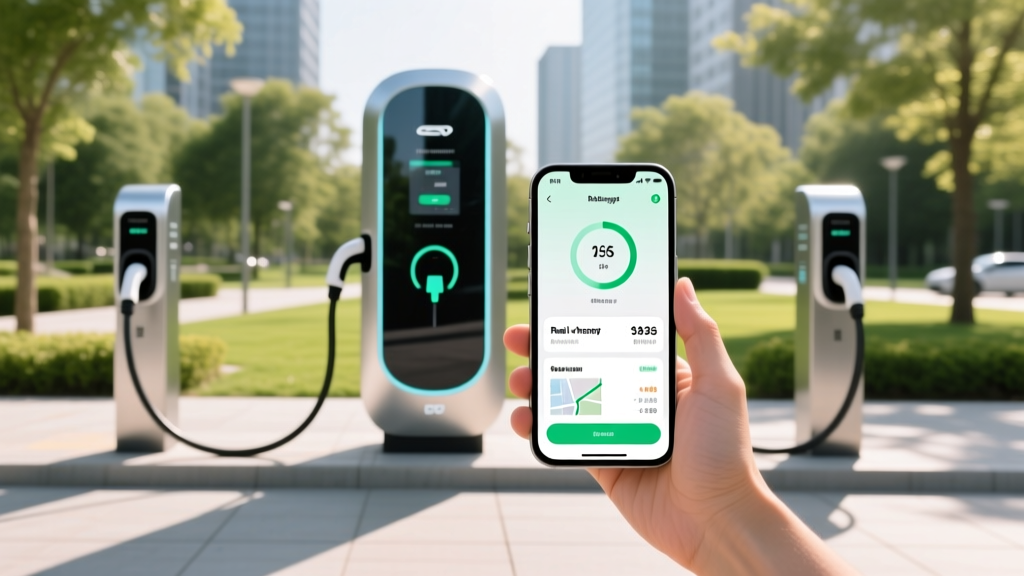
Here are our top recommendations for Level 2 home chargers compatible with Tesla's NACS connector. Each pick includes power output, cable length, smart features, and current pricing.
Tesla Wall Connector (Best for Tesla Owners)
- Power: Up to 11.5 kW (48A on 60A circuit)
- Connector: NACS native, 24-foot cable
- Smart features: Wi-Fi, over-the-air updates, power sharing with other Wall Connectors, access control
- Price: ~$420
- Best for: Tesla-only households; cleanest integration
ChargePoint Home Flex (Best Universal)
- Power: Up to 12 kW (50A on 60A circuit), adjustable down to 16A
- Connector: Available with NACS or J1772; 23-foot cable
- Smart features: Wi-Fi, app scheduling, Alexa/Google integration, energy tracking
- Price: ~$550–$650
- Best for: Multi-EV households with mixed brands
Emporia Vue Level 2 (Best Budget Smart Charger)
- Power: Up to 11.5 kW (48A on 60A circuit)
- Connector: Available with NACS or J1772; 24-foot cable
- Smart features: Wi-Fi, app control, solar integration, energy monitoring, load management
- Price: ~$350–$400
- Best for: Solar homeowners; budget-conscious buyers wanting smart features
All three chargers are UL-listed, rated for indoor/outdoor use, and support hardwired or plug-in (NEMA 14-50) installation. Hardwired installations allow the full 48-amp output; plug-in NEMA 14-50 outlets are limited to 40 amps (32-amp continuous) per NEC rules.
For detailed home charger safety standards, refer to NFPA's National Electrical Code guidelines and always hire a licensed electrician for your installation.
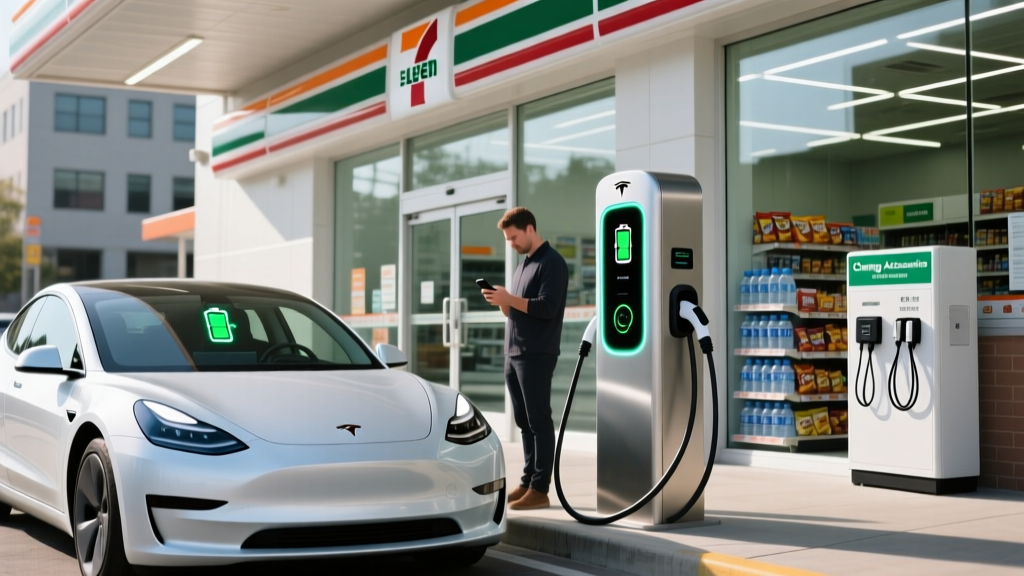
Tesla Supercharger Network and Public Charging
Tesla's Supercharger network remains the gold standard for public DC fast charging. As of 2026, there are over 6,000 Supercharger stations in North America, with most offering V3 stalls (250 kW peak) and an increasing number deploying V4 stalls (up to 350 kW for compatible vehicles).
For a Tesla Model Y or Model 3, a Supercharger session from 10% to 80% typically takes 25–30 minutes, adding roughly 200+ miles of range. The charge curve peaks around 250 kW below 40% state of charge, then tapers progressively — this is why the 10–80% metric matters more than peak kW numbers alone.
Non-Tesla EVs with NACS connectors can now access many Supercharger stations (via the Tesla Supercharger network opening), though availability varies by location and some stalls still require the built-in Magic Dock CCS adapter for non-NACS vehicles.
Frequently Asked Questions
Does Tesla come with a charger when I buy a new car?
No. As of 2026, Tesla does not include the Mobile Connector in the box with new vehicles. You must purchase it separately (~$200) or buy the Wall Connector (~$420) for dedicated home charging. Some dealers may bundle a charger as a promotional incentive, but this is not standard.
How much does it cost to install a home EV charger?
A straightforward Level 2 installation with the electrical panel nearby typically costs $800–$1,800 total (equipment + electrician + permit). Complex installations requiring long conduit runs or a panel upgrade from 100A to 200A can cost $3,200–$8,800. Always get a quote from a licensed electrician before purchasing equipment.
How fast will each charging level add range?
Level 1 (120V) adds 3–5 miles per hour. Level 2 (240V, 48A) adds 35–44 miles per hour — enough for most daily needs overnight. DC fast charging at 250 kW adds 150–200+ miles in 15–20 minutes, though the rate tapers above 80% state of charge.
Which connector is compatible with my Tesla?
All Tesla vehicles use the NACS connector natively. This is the same connector now adopted by Ford, GM, Rivian, Hyundai, and others. For CCS-based public chargers, Tesla sells a NACS-to-CCS adapter (~$250). For home Level 2, any NACS-equipped charger works directly.
How much does charging cost per mile vs gas?
Home charging at off-peak rates costs roughly $0.03–$0.04 per mile for a Tesla Model Y. Gasoline at $3.40/gallon and 28 MPG costs about $0.12 per mile. That's a 3–4x fuel cost advantage for home-charged EVs. Public DC fast charging narrows the gap to roughly $0.08–$0.14 per mile.
What electrical upgrades might I need?
If your home has a 100-amp electrical panel, you may need an upgrade to 200 amps ($1,500–$4,000) to support a 60-amp dedicated EV circuit alongside existing loads. Homes with 200-amp panels generally have sufficient capacity. A licensed electrician must perform a load calculation per NEC Article 220 to determine this. Also verify that your utility meter and service drop can handle the additional load.
For current federal tax incentive information on home charger installation (the §25C Energy Efficient Home Improvement Credit covers up to 30% of charger equipment and installation, max $1,000), consult the IRS or a tax professional, as eligibility depends on your location and income.