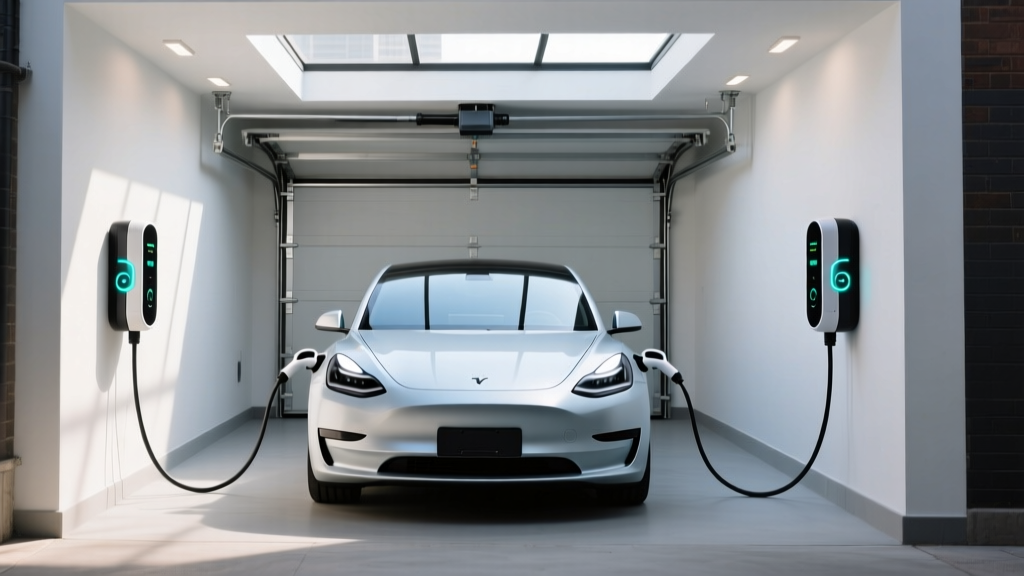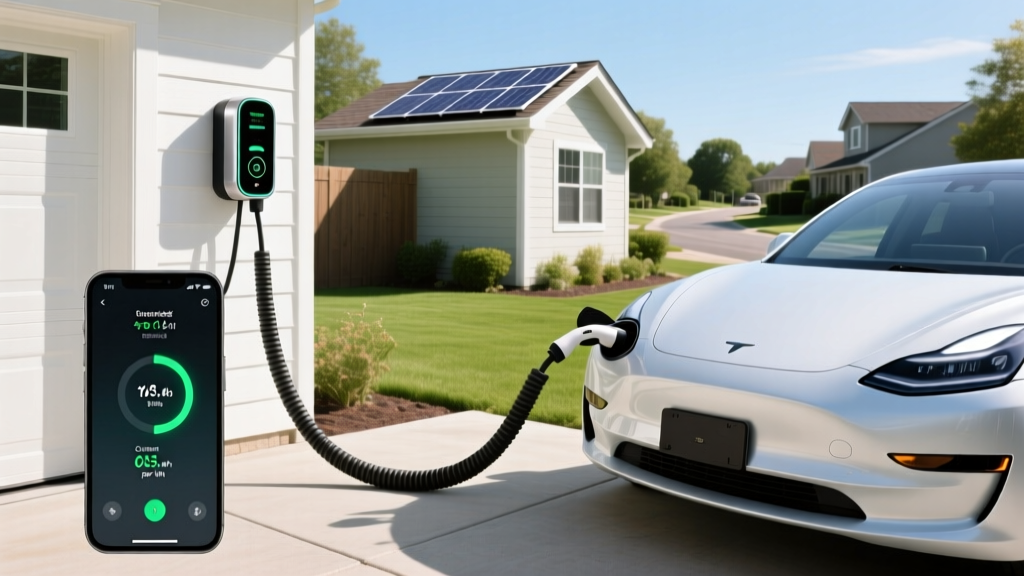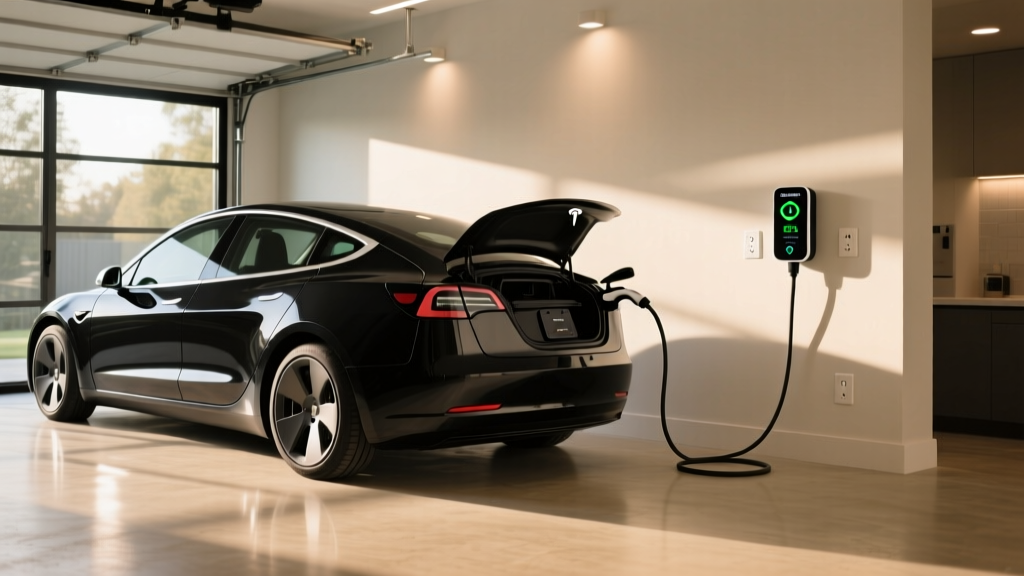
If you're shopping for a Tesla or just took delivery, one of the first practical questions is: does Tesla come with a charger? The short answer is nuanced. Every new Tesla vehicle includes a Mobile Connector (essentially a portable charging cable), but it does not include a dedicated wall-mounted home charging station. Understanding what you get out of the box — and what you'll need to buy or install — is critical to setting up a fast, safe, and cost-effective home charging routine.
This guide walks through exactly what Tesla provides, the three charging levels every EV owner must understand, real installation costs, and our top equipment recommendations for 2026.
What Tesla Actually Includes in the Box
As of 2026, every new Tesla (Model 3, Model Y, Model S, Model X, and the refreshed Model lineup) ships with a Tesla Mobile Connector. This is a portable charging cable roughly 20 feet long with a NACS (North American Charging Standard) connector on the vehicle end and interchangeable plug adapters on the wall end.
Here's what's included and what isn't:
- Included: Tesla Mobile Connector (~20 ft cable), NACS vehicle connector, standard 120V NEMA 5-15 adapter (Level 1), and typically a NEMA 14-50 adapter (240V Level 2) depending on the current packaging.
- Not included: Tesla Wall Connector (dedicated home station, sold separately for ~$425), professional electrical installation, 240V outlet (must already exist in your garage or be installed by an electrician), and public charging adapters.
The Mobile Connector is perfectly functional for home charging if you have the right outlet. But for daily drivers covering 30+ miles, most owners upgrade to a hardwired or plug-in Wall Connector for faster Level 2 speeds.
The Three Charging Levels Explained: Speeds in kW and Miles Per Hour
EV charging falls into three tiers. The critical distinction here is kW (kilowatts), which measures power — the rate at which energy flows into your battery. This is different from kWh (kilowatt-hours), which measures total energy capacity (your battery size). Think of kW as the width of a hose and kWh as the size of the bucket.
| Charging Level | Voltage | Power (kW) | Miles of Range Added Per Hour | Best For |
|---|---|---|---|---|
| Level 1 (Standard Outlet) | 120V AC | 1.0–1.4 kW | 3–5 miles/hr | Overnight top-ups, low-mileage drivers, PHEVs |
| Level 2 (Home/Public AC) | 240V AC | 7.2–19.2 kW | 25–70 miles/hr | Daily home charging, workplace, shopping centers |
| DC Fast Charging | 400–800V DC | 50–350 kW | 150–1,000+ miles/hr (peak) | Road trips, highway corridors, rapid top-ups |
Charging Time Examples for Common Tesla Battery Sizes
Real charging times depend on your battery's usable capacity and the power source. Here are realistic 10–80% charge times for popular 2026 Tesla models:
- Model 3 RWD (57.5 kWh usable, LFP): ~40 hours on Level 1 | ~8 hours on 7.2 kW Level 2 | ~25 minutes on a 250 kW Supercharger (DCFC)
- Model Y Long Range AWD (75 kWh usable, NMC): ~55 hours on Level 1 | ~10 hours on 7.2 kW Level 2 | ~28 minutes on a 250 kW Supercharger
- Model S (100 kWh usable, NMC): ~70+ hours on Level 1 | ~13 hours on 7.2 kW Level 2 | ~35 minutes on a 250 kW Supercharger
Real-world caveat: DC fast charging speeds peak between 10–50% State of Charge (SoC) and taper significantly above 80%. Tesla's onboard charger also limits AC charging to 11.5 kW (48A) on most 2026 models, so a 19.2 kW Wall Connector won't charge a Model 3 any faster than an 11.5 kW unit. Always match your charger to your vehicle's onboard charger limit.
Home Charger Installation: Electrical Requirements, Costs, and Panel Upgrades
Installing a dedicated Level 2 home charger is the single most impactful upgrade for daily EV ownership. But costs vary enormously depending on your home's electrical infrastructure.
Electrical Requirements for Level 2 Charging
A Level 2 home charger requires a 240-volt dedicated circuit, similar to what powers an electric dryer or oven. Common configurations:
- NEMA 14-50 outlet (plug-in): 240V / 50A circuit, delivers up to 40A continuous (9.6 kW). This is the most popular option because the charger can be unplugged and taken with you if you move.
- NEMA 6-50 outlet: 240V / 50A circuit, simpler wiring (no neutral), also delivers up to 40A continuous.
- Hardwired connection: 240V / 60A circuit, delivers up to 48A continuous (11.5 kW). Required for maximum Tesla Wall Connector output. No outlet — the charger wires directly into your panel.
National Electrical Code (NEC) requires that continuous loads (like EV charging, which runs for 3+ hours) use no more than 80% of a circuit's rated capacity. That's why a 50A circuit yields 40A of usable charging current, and a 60A circuit yields 48A.
Do You Need a Panel Upgrade?
This is the make-or-break cost variable. Most homes built after 1990 have a 200A main electrical panel, which can typically support a 50A or 60A EV circuit alongside existing loads. However, if your home has:
- A 100A main panel (common in homes built before 1980)
- Multiple high-draw appliances (electric range, electric dryer, electric HVAC, hot tub)
- Little remaining capacity on the panel after a load calculation
...you may need a panel upgrade to 200A, which costs $1,500–$3,500 before the charger circuit even gets installed. A licensed electrician will perform a load calculation per NEC Article 220 to determine whether your panel can handle the additional circuit. Some homeowners opt for a smart load-management device (like the Emporia Smart EV Charger with load sharing or a Tesla Gateway integration) that throttles charging when other heavy appliances are running, avoiding a panel upgrade entirely.
| Installation Component | Typical Cost Range | Notes |
|---|---|---|
| Level 2 EV Charger Equipment | $350–$700 | Tesla Wall Connector ~$425; ChargePoint Home Flex ~$550; Emporia ~$400 |
| Electrician Labor (outlet or hardwire) | $500–$2,000 | Depends on run length from panel to garage; short runs ~$500, long runs through walls/attic ~$1,500+ |
| Electrical Permit | $50–$300 | Varies by municipality; some jurisdictions bundle with inspection |
| Panel Upgrade (if needed) | $1,500–$3,500 | 100A → 200A upgrade; not required for most modern homes |
| Utility Service Upgrade (rare) | $2,000–$5,000 | Only if utility drop to home is insufficient; uncommon |
| Total (no panel upgrade) | $900–$3,000 | Most homeowners fall in the $1,200–$2,000 range |
| Total (with panel upgrade) | $2,400–$6,500 | Older homes with 100A panels |
Permits, Safety, and Code Requirements
Most jurisdictions require an electrical permit for a new 240V circuit. The work must pass inspection to ensure code compliance. Key safety requirements per the National Electrical Code (NEC):
- Dedicated circuit: Your EV charger must have its own breaker — it cannot share a circuit with other outlets or appliances.
- GFCI protection: NEC 2020 and later requires Ground Fault Circuit Interrupter protection for all EV charging outlets (120V and 240V). Hardwired chargers typically have built-in GFCI.
- Outdoor rating: If your charger is installed outside (driveway, carport), the unit must carry a NEMA 4 or IP-rated weatherproof enclosure, and the receptacle needs a weatherproof cover.
- Cable management: For wall-mounted units, the cable should not drape across walkways. Many chargers include cable holsters or retractors.
Connector Compatibility: NACS, CCS, CHAdeMO, and Adapters
As of 2026, the North American EV charging landscape has largely standardized around NACS (North American Charging Standard), the connector Tesla pioneered. Nearly every major automaker — Ford, GM, Rivian, Hyundai, Kia, BMW, and others — has adopted NACS for new vehicles. But legacy connectors still exist in the field.
| Connector | Type | Used By | Notes for Tesla Owners |
|---|---|---|---|
| NACS (Tesla) | AC & DC | All Teslas; Ford, GM, Rivian, Hyundai, Kia, BMW (2025+ models) | Native connector on every Tesla — no adapter needed for Superchargers |
| CCS1 (Combo) | DC Fast | Legacy VW, older Ford/GM EVs, Electrify America stations | Tesla sells a CCS Adapter (~$250) for non-Tesla DCFC networks |
| CHAdeMO | DC Fast | Nissan Leaf (legacy); phasing out in North America | No official Tesla adapter; avoid unless driving a Leaf |
| J1772 | AC Level 2 | All non-Tesla EVs for public Level 2 | Tesla includes a J1772 adapter in-box for non-Tesla Level 2 stations |
Bottom line for Tesla owners: Your NACS connector works natively at all Tesla Superchargers and Destination Chargers. For non-Tesla Level 2 public stations (J1772), use the included adapter. For non-Tesla DC fast chargers (CCS1 at Electrify America, EVgo, etc.), you'll need the optional Tesla CCS Adapter.
How Much Does Charging Cost Per Mile vs. Gas?
One of the strongest ownership arguments for an EV is fuel cost savings — but the actual number depends heavily on where and when you charge.
| Charging Scenario | Typical $/kWh | Cost Per Mile (Model Y, 3.5 mi/kWh) | Equivalent Gas Price (at 28 MPG) |
|---|---|---|---|
| Home Off-Peak (utility TOU rate) | $0.08–$0.12 | $0.023–$0.034 | $0.64–$0.95/gallon |
| Home Standard Rate | $0.13–$0.18 | $0.037–$0.051 | $1.04–$1.43/gallon |
| Public Level 2 (workplace, shopping) | $0.20–$0.35 | $0.057–$0.10 | $1.60–$2.80/gallon |
| Tesla Supercharger (DCFC) | $0.28–$0.45 | $0.08–$0.13 | $2.24–$3.64/gallon |
| Non-Tesla DCFC (Electrify America) | $0.35–$0.55 | $0.10–$0.16 | $2.80–$4.48/gallon |
| Gasoline (national avg 2026) | — | $0.11–$0.14 (at $3.20/gal, 28 MPG) | — |
A Tesla Model Y Long Range achieves roughly 3.5 miles per kWh (about 120 MPGe combined per fueleconomy.gov). If you charge primarily at home on an off-peak utility rate of $0.10/kWh, you're paying about $0.029 per mile — the equivalent of filling up a 28 MPG gas car at $0.81 per gallon. Even at Supercharger prices, most Tesla owners pay less per mile than a comparable gas vehicle.
The savings compound over time. A driver covering 12,000 miles annually who charges 80% at home ($0.12/kWh) and 20% at Superchargers ($0.35/kWh) spends roughly $550 per year on electricity, compared to $1,370 on gasoline at $3.20/gal and 28 MPG — a savings of about $820 annually.
Best Home EV Chargers for Tesla Owners in 2026
If you're investing in a dedicated home charging station, here are the top picks based on power output, build quality, smart features, and value:
Tesla Wall Connector (Gen 3)
- Power: Up to 11.5 kW (48A hardwired) or 9.6 kW (40A on NEMA 14-50)
- Connector: NACS (native Tesla); also available in J1772 version
- Cable Length: 24 feet
- Smart Features: Wi-Fi for OTA updates, power-sharing between multiple units, access control, energy tracking via Tesla app
- Price: ~$425
- Best for: Tesla-only households wanting seamless integration
ChargePoint Home Flex
- Power: Up to 12 kW (50A) — adjustable via dip switches to match your circuit
- Connector: NACS or J1772 (select at purchase); NACS version works with all 2025+ EVs
- Cable Length: 23 feet
- Smart Features: Wi-Fi, ChargePoint app scheduling, Alexa integration, detailed energy reports, works with utility demand-response programs
- Price: ~$550
- Best for: Mixed-EV households or those wanting utility-integration features
Emporia Vue Smart EV Charger
- Power: Up to 11.5 kW (48A hardwired)
- Connector: NACS or J1772
- Cable Length: 24 feet
- Smart Features: Integration with Emporia Vue energy monitor for whole-home load tracking, solar-aware charging (charge only when solar is producing), load management to avoid panel upgrades
- Price: ~$400
- Best for: Solar owners and homes where panel capacity is tight
Grizzl-E Smart
- Power: Up to 9.6 kW (40A)
- Connector: NACS or J1772
- Cable Length: 24 feet
- Smart Features: OCPP-compatible (open protocol), works with multiple apps, rugged aluminum enclosure, -40°F cold-weather tested
- Price: ~$450
- Best for: Extreme cold climates and outdoor installations
Frequently Asked Questions
Does Tesla come with a charger I can use at home right away?
Yes — every new Tesla includes the Mobile Connector with a standard 120V adapter. You can plug it into any household outlet immediately. However, Level 1 charging adds only 3–5 miles of range per hour, which means a full charge on a Model Y takes 3–4 days. For daily driving, you'll want a 240V outlet or a dedicated Wall Connector.
How much does it cost to install a home EV charger?
Most homeowners pay $1,200–$2,000 for a complete Level 2 installation (charger + electrician + permit) when no panel upgrade is needed. If your home requires a 200A panel upgrade, total costs can reach $2,400–$6,500. Always get a load calculation from a licensed electrician before committing.
How fast will each charging level add range to my Tesla?
Level 1 (120V) adds 3–5 miles per hour. Level 2 (240V, 48A) adds 35–44 miles per hour on a Model 3 or Model Y. DC fast charging at a Tesla Supercharger can add up to 200 miles in 15 minutes under ideal conditions, though speeds taper above 80% State of Charge.
Which connector and charger is compatible with my Tesla?
All Teslas use the NACS connector natively. At home, the Tesla Wall Connector is the most seamless option. For non-Tesla public Level 2 stations, use the J1772 adapter included with your car. For non-Tesla DC fast chargers (Electrify America, EVgo), you'll need the optional Tesla CCS Adapter (~$250).
How much does charging cost per mile compared to gas?
Home charging on a standard rate ($0.13–$0.18/kWh) costs about $0.04–$0.05 per mile in a Model Y — equivalent to paying $1.10–$1.40 per gallon of gas. Off-peak utility rates drop this to $0.02–$0.03 per mile. Even Tesla Supercharging ($0.28–$0.45/kWh) typically costs less per mile than gasoline at current prices.
What electrical upgrades might I need for a home charger?
You need a dedicated 240V circuit (50A or 60A) run from your main panel to your garage or driveway. If your home has a 200A panel with sufficient remaining capacity, no upgrade is needed. Homes with 100A panels or many existing high-draw appliances may require a panel upgrade ($1,500–$3,500). Smart load-management devices can sometimes avoid this cost.
Can I charge my non-Tesla EV with a Tesla Wall Connector?
Starting in 2025, Tesla released a J1772 version of the Wall Connector, and with the industry-wide shift to NACS, most new EVs from Ford, GM, Rivian, Hyundai, and others now use the NACS connector natively. If your non-Tesla EV has NACS, the Tesla Wall Connector works directly. If it has CCS or J1772, you'll need an adapter or a different charger.
Is a Tesla Supercharger cheaper than home charging?
No. Supercharging typically costs $0.28–$0.45 per kWh depending on location and time of day, making it 2–4× more expensive than home charging at residential electricity rates. Superchargers are designed for road-trip convenience, not daily use. Most Tesla owners do 85–95% of their charging at home.
For the latest information on home electrical codes, consult the NFPA NEC guidelines and hire a licensed electrician for all installation work. For official Tesla equipment specifications and pricing, refer to the Tesla Shop. Federal tax incentives for home charger installation may be available under IRS §30C — check IRS.gov for current-year eligibility, which includes income and location-based requirements.