If you are shopping for a new Model 3, Model Y, Model S, or Model X in 2026, one of the first practical questions is simple: does a Tesla come with a charger? The short answer is nuanced. Tesla includes a cord that plugs into a standard household outlet (Level 1), but it does not include a dedicated 240-volt home wall charger in the box. For most owners, that Level 1 cord is a backup, not a primary charging solution. This guide explains exactly what you get, what you will need to buy, what it costs to install, and how Tesla's NACS connector ecosystem compares to the rest of the EV market now that the North American Charging Standard has become the industry default.
What Tesla Actually Includes in the Box
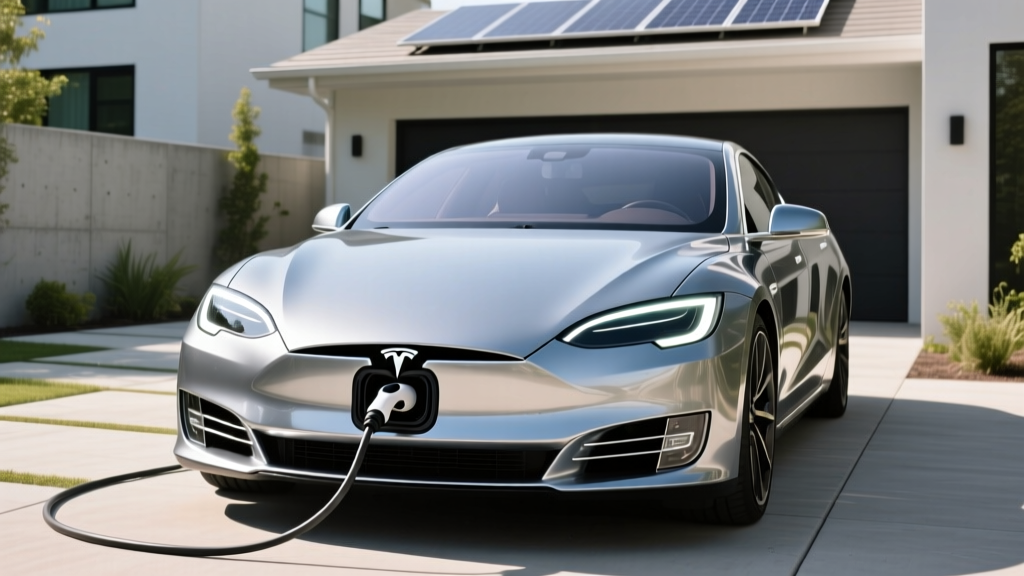
As of the current model year, every new Tesla ships with a Mobile Connector — a compact charging cable with a NACS plug on the car end and a standard NEMA 5-15 household plug on the wall end. This allows Level 1 charging at 120 volts, delivering roughly 1.4 kW of power. That translates to about 3 to 5 miles of range per hour plugged in — enough for overnight top-ups on a low-mileage day, but far too slow for regular use on a vehicle with a 60 to 100 kWh battery.
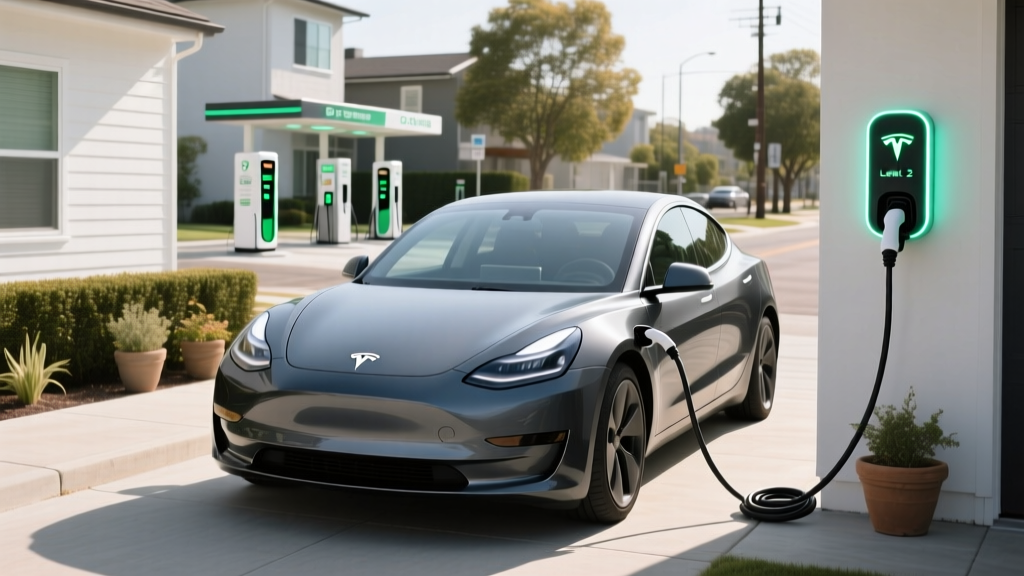
Tesla discontinued the free Wall Connector bundling several years ago. The Tesla Wall Connector is sold separately for approximately $475 and is the recommended home solution for daily charging. Third-party J1772 and NACS chargers also work with Teslas, either natively (if they have a NACS plug) or through an adapter.
Charging Levels Explained: Speed, Power, and Real-World Range Gains
Understanding EV charging requires distinguishing between kW (kilowatts), which measures the rate of power delivery, and kWh (kilowatt-hours), which measures the total energy stored in your battery. Think of kW as the flow rate of a hose and kWh as the size of the tank. Here is how each charging level performs:
| Level | Voltage | Power (kW) | Miles of Range per Hour | Best Use Case |
|---|---|---|---|---|
| Level 1 | 120V AC | 1.2 – 1.9 kW | 3 – 5 mi/hr | Overnight backup, PHEVs, low-mileage days |
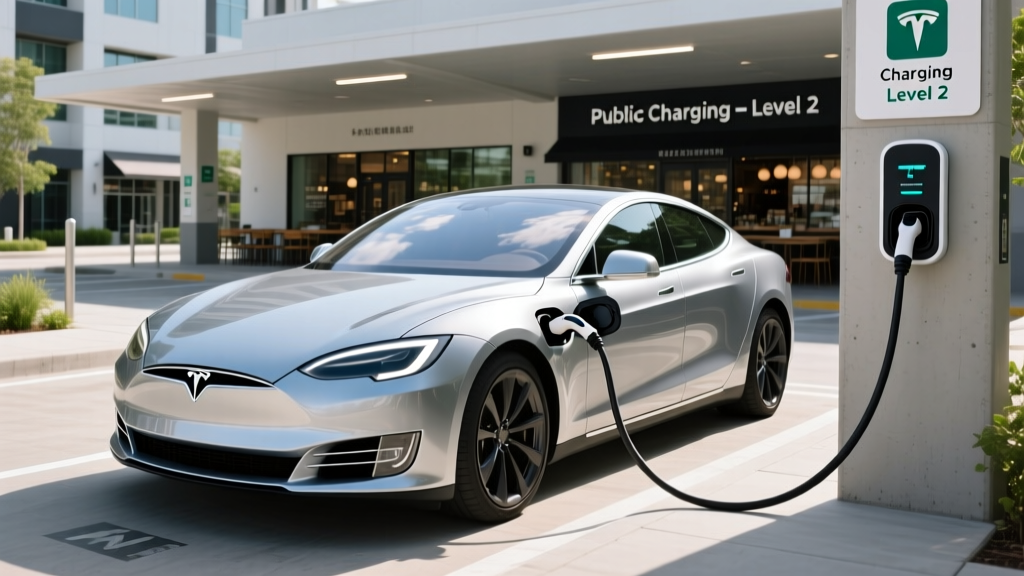
| Level 2 | 240V AC | 7.2 – 19.2 kW | 20 – 60 mi/hr | Daily home charging, workplace, hotels |
| DC Fast | 400–800V DC | 50 – 350 kW | 150 – 1,000+ mi/hr | Road trips, rapid top-ups, 10–80% in 15–30 min |
Charging Time Examples for Common Battery Sizes
Below are estimated 10–80% charging times for typical EV battery capacities. Note that DC fast charging follows a charge curve — peak kW is only sustained up to roughly 50–60% SoC, then tapers significantly to protect battery health.
- 60 kWh battery (Model 3 RWD): ~7.5 hrs Level 2 (7.7 kW) | ~18 min DC fast (peak 170 kW)
- 82 kWh battery (Model Y Long Range): ~9 hrs Level 2 (11.5 kW) | ~25 min DC fast (peak 250 kW)
- 100 kWh battery (Model S/X): ~10.5 hrs Level 2 (11.5 kW) | ~30 min DC fast (peak 250 kW)
Home Charger Installation: Electrical Requirements and Costs
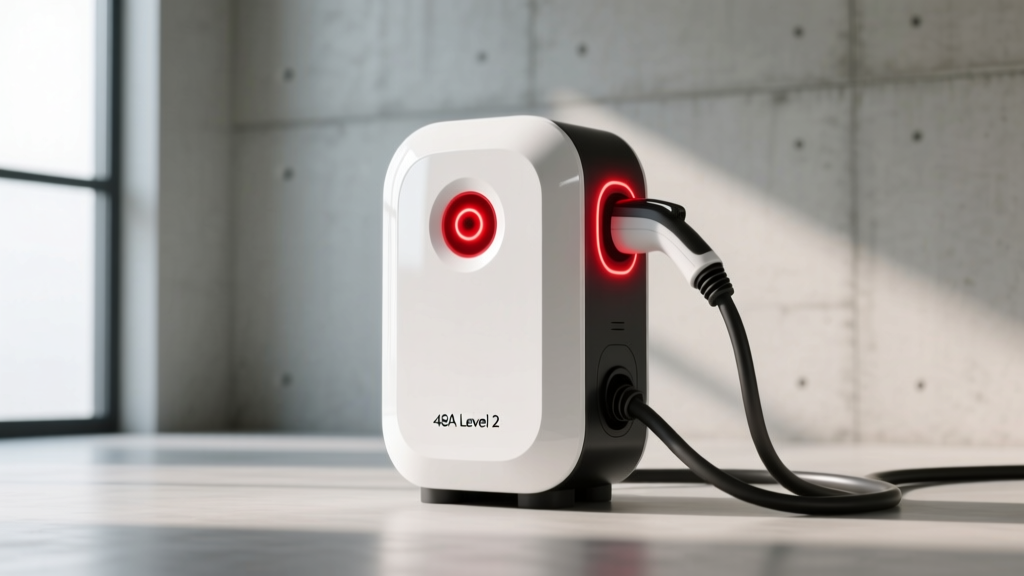
Installing a Level 2 home charger is an electrical project, not just a hardware purchase. The total cost depends on your home's electrical panel capacity, the distance from the panel to the charger location, and local permitting requirements.
Electrical Requirements
A typical Level 2 charger requires a dedicated 240-volt circuit with a breaker rated for the charger's amperage. Common configurations:
- 40-amp circuit / 32-amp continuous draw: Supports up to 7.7 kW — sufficient for most daily needs
- 60-amp circuit / 48-amp continuous draw: Supports up to 11.5 kW — recommended for larger batteries or faster top-ups
- 80-amp circuit / 64-amp continuous draw: Supports up to 15.4–19.2 kW — requires a robust 200-amp (or larger) service panel
The National Electrical Code (NEC) requires that continuous loads not exceed 80% of the breaker rating. A licensed electrician will verify your panel's available capacity before recommending a circuit size.
Panel Upgrade: The Hidden Cost
Many older homes have 100-amp or even 60-amp main service panels. If your panel is already near capacity (running HVAC, electric range, dryer, water heater), adding a 40–60 amp EV circuit may require a panel upgrade to 200 amps. This is the single largest variable in home charging cost and can add $2,000–$5,000+ to your project.
| Component | Cost Range | Notes |
|---|---|---|
| Level 2 Charger Hardware | $300 – $700 | Tesla Wall Connector ~$475; ChargePoint, Emporia, Grizzl-E vary |
| Electrician Labor (standard install) | $500 – $2,000 | Depends on run distance, conduit, drywall work |
| Electrical Permit | $50 – $300 | Varies by municipality; required for code compliance |
| Panel Upgrade (if needed) | $2,000 – $5,000+ | 100A → 200A upgrade; may include utility coordination |
| Total (no panel upgrade) | $850 – $3,000 | Most homes with 200A service fall in this range |
| Total (with panel upgrade) | $3,000 – $8,000+ | Older homes or high-load panels |
Some utilities and state programs offer rebates of $250–$1,500 for home charger installation, and the federal Alternative Fuel Vehicle Refueling Property Credit (IRC §30C) may cover up to 30% of equipment and installation costs (capped at $1,000 for residential property) if you are in an eligible census tract. Consult a tax professional for current-year eligibility.
Connector Compatibility: NACS, CCS, and Adapters
The connector landscape has shifted dramatically. Tesla's proprietary connector — now formally designated the North American Charging Standard (NACS) — has been adopted by Ford, GM, Rivian, Volvo, Hyundai, Kia, and nearly every major automaker for 2025–2026 models. Here is the current compatibility landscape:
| Connector | Used By | Notes |
|---|---|---|
| NACS (Tesla) | Tesla (all models), Ford F-150 Lightning/Mach-E (2025+), GM Ultium vehicles (2025+), Rivian, Volvo, Hyundai/Kia (2025+) | Now the dominant North American standard; access to Tesla Supercharger network |
| CCS1 | Legacy EVs (2018–2024 models from VW, BMW, Mercedes, Hyundai/Kia pre-2025) | Requires NACS-to-CCS adapter for Supercharger access; Electrify America still supports CCS |
| CHAdeMO | Nissan Leaf (legacy), Mitsubishi Outlander PHEV | Effectively deprecated; limited new infrastructure |
| J1772 | All EVs (Level 1/2 AC charging) | Tesla includes a J1772-to-NACS adapter; universal for AC charging |
If you own a Tesla, you charge natively with NACS at home and at Superchargers. If you own a CCS-equipped EV from a prior model year, you will need a CCS-to-NACS adapter (approximately $200–$300 from Tesla or third parties like Lectron) to access the Supercharger network. New CCS vehicles are essentially discontinued for the US market as of 2026.
Cost to Charge: Home vs. Public vs. Gas
One of the strongest ownership arguments for an EV is the per-mile fuel cost. However, the savings depend heavily on where and when you charge.
| Scenario | Price | Cost per Mile* | Annual Cost (12,000 mi) |
|---|---|---|---|
| Home Level 2 (off-peak utility rate) | $0.08 – $0.14/kWh | $0.024 – $0.042 | $288 – $504 |
| Home Level 2 (standard rate) | $0.15 – $0.22/kWh | $0.045 – $0.066 | $540 – $792 |
| Public Level 2 (ChargePoint, etc.) | $0.25 – $0.49/kWh | $0.075 – $0.147 | $900 – $1,764 |
| DC Fast (Electrify America, EVgo) | $0.35 – $0.55/kWh | $0.105 – $0.165 | $1,260 – $1,980 |
| Tesla Supercharger (average) | $0.28 – $0.36/kWh | $0.084 – $0.108 | $1,008 – $1,296 |
| Gas vehicle (27 MPG avg, $3.40/gal) | $3.40/gallon | $0.126 | $1,512 |
*Based on an EV efficiency of 3.0 miles/kWh (approximately 33 kWh/100 mi), typical of a Model Y or Ioniq 5. Your actual efficiency varies with driving style, temperature, and terrain. Source: fueleconomy.gov
The takeaway: home charging at off-peak rates delivers 60–80% savings versus gasoline. Public DC fast charging is roughly cost-parity with gasoline and should be used for road trips, not daily fueling. If you cannot charge at home, an EV's economic advantage narrows considerably — a factor to weigh honestly before purchasing.
Recommended Home Charging Equipment for 2026
Not all Level 2 chargers are equal. Below are top picks based on reliability, smart features, and value. Every recommendation includes power output, connector type, and cable length — critical specs you should never buy without confirming.
Tesla Wall Connector (Gen 3)
- Power: Up to 11.5 kW (48A) on a 60A circuit
- Connector: NACS native; J1772 version available
- Cable: 24 ft
- Smart Features: Wi-Fi updates, load sharing (pair two units on one circuit), Tesla app integration
- Price: ~$475
- Best For: Tesla owners who want seamless integration
ChargePoint Home Flex
- Power: Up to 12 kW (50A) configurable via DIP switch
- Connector: J1772 or NACS (NACS version released 2025)
- Cable: 23 ft
- Smart Features: Wi-Fi, scheduling, Alexa integration, detailed energy tracking
- Price: ~$550–$650
- Best For: Multi-EV households or those wanting granular app controls
Emporia Vue Level 2 Charger
- Power: Up to 11.5 kW (48A)
- Connector: J1772 (NACS adapter available)
- Cable: 24 ft
- Smart Features: Wi-Fi, solar integration (pairs with Emporia Vue energy monitor), time-of-use scheduling
- Price: ~$399
- Best For: Solar-equipped homes and budget-conscious buyers
Grizzl-E Smart
- Power: Up to 10 kW (40A)
- Connector: J1772 or NACS
- Cable: 24 ft
- Smart Features: OCPP-compatible, works with multiple apps, outdoor-rated (NEMA 4)
- Price: ~$449–$549
- Best For: Outdoor installations and extreme climates (-40°F rated)
Safety, Code, and Installation Best Practices
EV charging involves sustained high-current draw — more similar to running an electric furnace than plugging in a phone. Proper installation is non-negotiable for safety and insurance compliance.
- Dedicated circuit: Your charger must be on its own breaker, shared with no other outlets or appliances.
- GFCI protection: NEC 2020 and later require ground-fault circuit interrupter protection for all EV supply equipment, including hardwired units in some jurisdictions.
- Outdoor rating: If your charger is installed outside (garage-exterior wall, carport, driveway post), it must carry a NEMA 3R or NEMA 4 enclosure rating for weather resistance.
- Permitting: Nearly all jurisdictions require an electrical permit for new 240V circuits. Unpermitted work can void homeowner's insurance claims and create resale complications.
- Wire gauge: A 60A circuit typically requires 6 AWG copper wire; a 40A circuit requires 8 AWG. Your electrician will spec this based on run length and local code.
Always use a licensed, insured electrician familiar with EV charging installations. The National Electrical Code (NEC) Article 625 governs EV charging equipment specifically and is updated on a three-year cycle.
Frequently Asked Questions
How much does it cost to install a home EV charger?
A standard Level 2 installation in a home with adequate panel capacity costs $850–$3,000 total (hardware + electrician + permit). If your home requires a panel upgrade from 100A to 200A service, expect $3,000–$8,000+ total. Always get at least two quotes from licensed electricians.
How fast will each charging level add range?
Level 1 (120V) adds 3–5 miles per hour. Level 2 (240V) adds 20–60 miles per hour depending on amperage. DC fast charging adds 150–1,000+ miles per hour at peak power, but tapers above 80% state of charge to protect the battery.
Which connector and charger is compatible with my EV?
All 2026 Tesla models use NACS natively. Most new Ford, GM, Rivian, Hyundai, and Kia EVs also use NACS. Older CCS-equipped vehicles need a CCS-to-NACS adapter for Supercharger access. All EVs accept J1772 for Level 1/2 AC charging (Teslas include a J1772 adapter).
How much does charging cost per mile compared to gas?
Home charging at off-peak rates costs $0.02–$0.04 per mile — roughly 70–80% cheaper than gasoline at $3.40/gallon and 27 MPG. Public DC fast charging costs $0.10–$0.17 per mile, which is near gas parity. Home access is the key to EV fuel savings.
What electrical upgrades might I need?
The most common upgrade is a 200-amp service panel replacement if your current panel lacks capacity for a new 40–60 amp dedicated circuit. Homes with existing 200A panels usually need only the new circuit, breaker, wiring, and receptacle (NEMA 14-50) or hardwired connection. Your electrician will perform a load calculation to determine requirements.
Does the Tesla Mobile Connector count as a real charger?
It is a legitimate Level 1 charger, but at 1.4 kW it is impractical as a primary solution for any Tesla with a battery larger than 60 kWh. Plan on purchasing a Wall Connector or third-party Level 2 unit for daily use.
Can I use a non-Tesla charger with my Tesla?
Yes. Any J1772 Level 2 charger works with a Tesla using the included J1772-to-NACS adapter. NACS-native chargers from ChargePoint, Emporia, and others also work without an adapter. The Tesla app will not track non-Tesla charging sessions, but the car's energy screen will.