The Short Answer: Does Buc-ee's Have EV Chargers?
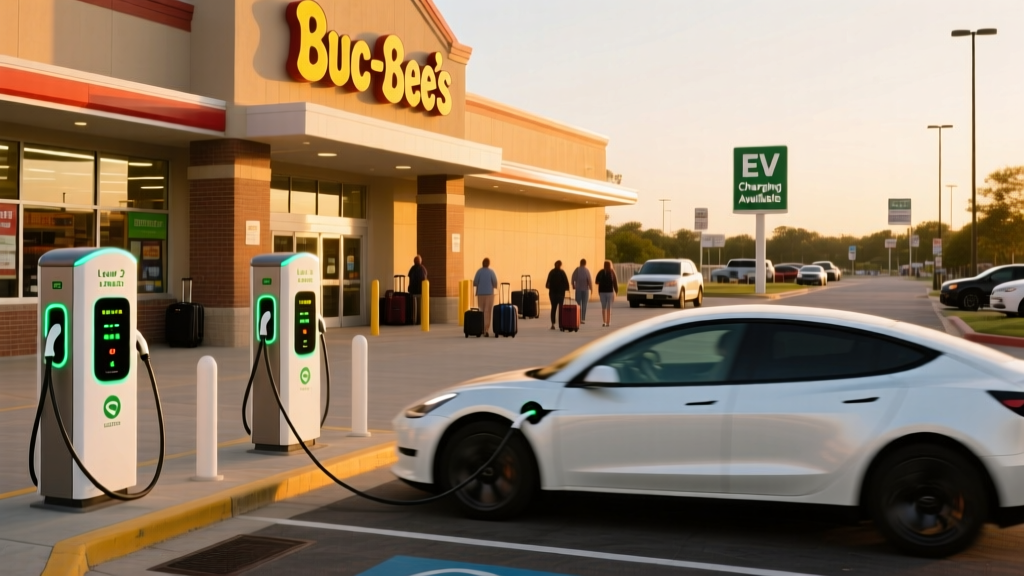
Yes. As of early 2026, Buc-ee's has rolled out DC fast-charging plazas at a growing number of its Texas, Florida, Georgia, Alabama, and Kentucky travel centers. Most locations feature 180 kW to 350 kW CCS1 chargers, with select sites adding NACS (Tesla-standard) connectors or hosting Tesla Supercharger stalls in the same parking area. Availability varies by location—some older Buc-ee's stores have no chargers yet—so checking the Buc-ee's app or PlugShare before your trip is essential.
Buc-ee's partners with networks like Electrify America and EVgo to deploy the hardware. Expect to pay between $0.38 and $0.55 per kWh at these DC fast chargers, depending on the network and whether you have a membership. For context, a 75 kWh battery going from 10% to 80% would cost roughly $28–$41 at Buc-ee's, adding approximately 200–250 miles of range in 20–30 minutes depending on your vehicle's charge curve.
Understanding Charging Levels: Speeds That Actually Matter
Before we break down Buc-ee's specifics and home charging, let's nail the three charging levels every EV owner needs to know. The critical distinction: kW (kilowatts) is power—the rate of energy delivery, while kWh (kilowatt-hours) is energy—the total amount stored in your battery. Think of kW as the width of a hose and kWh as the size of the bucket.
| Level | Voltage | Power (kW) | Miles Added/Hour | Typical Use Case |
|---|---|---|---|---|
| Level 1 | 120V AC | 1.0–1.4 kW | 3–5 mi/hr | Overnight trickle, PHEVs, emergency top-ups |
| Level 2 | 240V AC | 7.2–19.2 kW | 25–70 mi/hr | Home daily charging, workplace, destination |
| DC Fast | 400–800V DC | 50–350 kW | 150–1,200 mi/hr* | Road trips, rapid top-ups (10–80% in 15–40 min) |
*Miles-per-hour at DC fast charging is theoretical peak; actual rates depend on vehicle acceptance rate, battery temperature, and state of charge. Most EVs taper significantly above 80% SoC.
Buc-ee's Charging: What EV Drivers Actually Experience
Buc-ee's travel centers are strategically positioned along major interstate corridors—I-10, I-35, I-45, I-75—making them natural EV road-trip stops. Here's what the charging experience looks like in practice:
Typical Buc-ee's DC Fast-Charger Specs
- Power output: 150 kW to 350 kW per stall
- Connectors: Primarily CCS1; NACS availability expanding through 2025–2026
- Network operators: Electrify America, EVgo, and select Tesla Supercharger co-locations
- Stall count: 4–8 chargers per location (newer builds tend toward 6–8)
- Pricing: $0.38–$0.55/kWh (network-dependent; membership discounts apply)
- Amenities: Full convenience store, restrooms, food service—ideal for the 20–30 minute charge window
Charging Time Examples at Buc-ee's (10–80% Session)
| Vehicle | Battery (kWh) | Max DC Rate | Est. 10–80% Time | Approx. Cost |
|---|---|---|---|---|
| Tesla Model Y LR | 75 kWh (usable) | 250 kW | ~22 min | $29–$38 |
| Hyundai Ioniq 5 | 84 kWh (usable) | 350 kW (800V) | ~18 min | $33–$42 |
| Ford F-150 Lightning | 131 kWh (ext. range) | 155 kW | ~42 min | $52–$68 |
| Chevy Equinox EV | 85 kWh (usable) | 150 kW | ~30 min | $33–$43 |
If you're driving a Tesla and the Buc-ee's location only has CCS1 connectors, you'll need a NACS-to-CCS adapter (Tesla sells one for approximately $250). Conversely, non-Tesla EVs with CCS1 ports can access Tesla Superchargers at select Buc-ee's locations using a Tesla-approved adapter, provided the stall is part of Tesla's open network.
Home EV Charger Installation: Costs, Requirements, and Gotchas
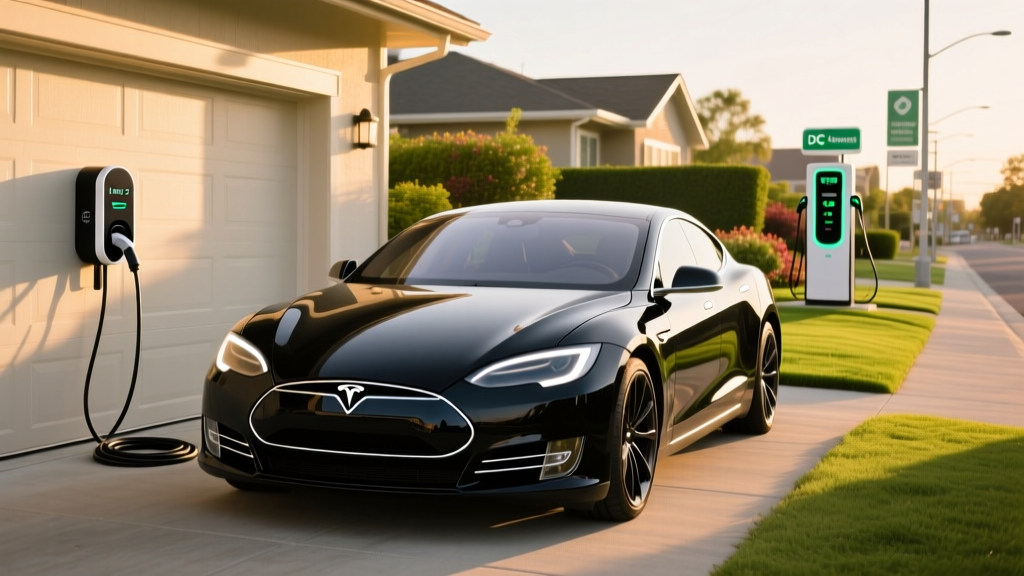
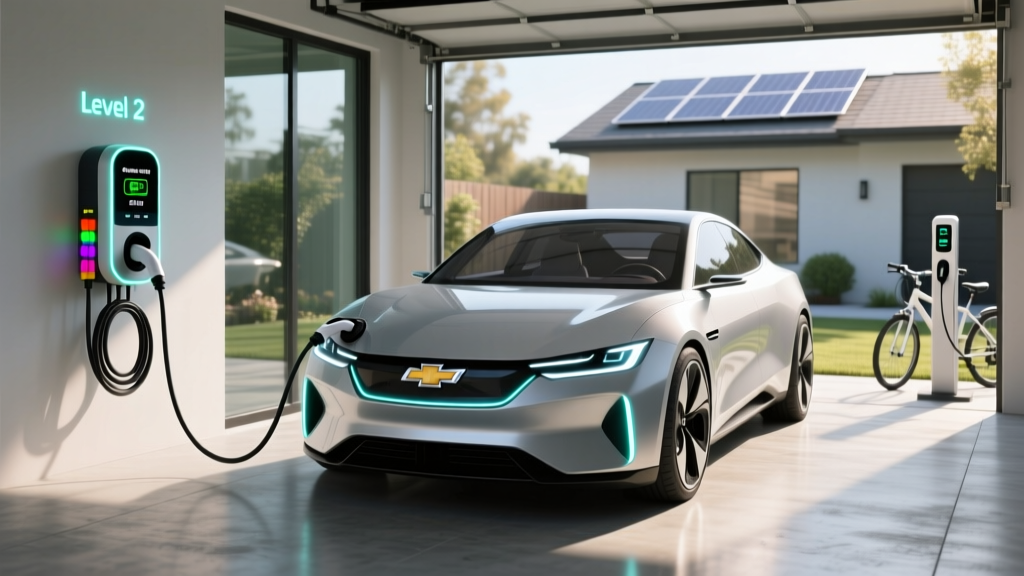
Public DC fast chargers like those at Buc-ee's are great for road trips, but 80–90% of EV charging happens at home. Here's a comprehensive breakdown of what a Level 2 home installation actually involves.
Electrical Requirements for a Level 2 Home Charger
A typical Level 2 home charger requires a dedicated 240V circuit—the same voltage your electric dryer or oven uses. The most common setup is a 60-amp breaker feeding a 48-amp continuous-load charger (electrical code requires the breaker to be rated at 125% of the continuous load). This delivers approximately 11.5 kW of charging power.
Key requirements:
- Dedicated circuit: Your charger cannot share a breaker with other appliances
- Wire gauge: Typically 6 AWG copper for a 60A circuit; 4 AWG for longer runs over 50 feet
- GFCI protection: Required by NEC 2023+ for EV receptacles (some chargers have built-in GFCI)
- Outdoor rating: If installing outside (garage or exterior wall), the charger must carry a NEMA 4 or NEMA 4X rating for weather resistance
- Permit: Most jurisdictions require an electrical permit ($50–$200) with post-installation inspection
Installation Cost Breakdown
| Component | Low Estimate | High Estimate | Notes |
|---|---|---|---|
| Level 2 Charger (hardware) | $350 | $750 | Smart Wi-Fi chargers; basic models from ~$250 |
| Electrician labor | $400 | $1,500 | Depends on run length, wall type, conduit needs |
| Electrical permit | $50 | $200 | Varies by municipality |
| Panel upgrade (if needed) | $1,500 | $4,000 | Older 100A panels often need 200A upgrade |
| Total (no panel upgrade) | $800 | $2,450 | Most modern homes with 200A service |
| Total (with panel upgrade) | $2,300 | $6,450 | Homes built before ~1990 are higher risk |
Which Connector Does Your EV Need?
The connector landscape shifted dramatically in 2024–2026 as nearly every major automaker adopted the NACS (North American Charging Standard, originally Tesla's proprietary plug). Here's where things stand in 2026:
| Connector | Brands Using It (2026 Models) | Adapter Needed? |
|---|---|---|
| NACS (Tesla standard) | Tesla (all), Ford (2025+), GM (2025+), Rivian, Hyundai/Kia (2025+), BMW, Volvo, Polestar | CCS1→NACS adapter for older non-Tesla CCS1 vehicles accessing Superchargers |
| CCS1 | VW ID.4 (carryover), legacy models, some 2024 and earlier EVs | NACS→CCS1 adapter for Tesla vehicles accessing CCS1 stations |
| CHAdeMO | Nissan Leaf (discontinued after 2025), Mitsubishi Outlander PHEV (AC only) | Largely obsolete; limited adapter options |
Bottom line for 2026 buyers: If you're purchasing a new EV, it almost certainly has NACS or will include a CCS1-to-NACS adapter. The CCS1 network is still widely available at Electrify America and EVgo stations, but NACS is rapidly becoming the universal standard.
How Much Does EV Charging Cost Per Mile vs. Gas?
This is the question that decides whether an EV saves you money. The answer depends heavily on where you charge.
| Scenario | Rate | Cost per kWh | Cost per Mile* | Equivalent Gas MPG Cost** |
|---|---|---|---|---|
| Home (off-peak utility rate) | Time-of-use plan | $0.08–$0.14 | $0.024–$0.042 | $0.72–$1.26/gal |
| Home (standard residential rate) | Flat rate | $0.13–$0.20 | $0.039–$0.060 | $1.17–$1.80/gal |
| Public Level 2 (ChargePoint, etc.) | Per kWh or session | $0.20–$0.35 | $0.060–$0.105 | $1.80–$3.15/gal |
| DC Fast (Buc-ee's / Electrify America) | Per kWh | $0.38–$0.55 | $0.114–$0.165 | $3.42–$4.95/gal |
| Gas vehicle (baseline) | $3.40/gal, 28 MPG avg | N/A | $0.121 | $3.40/gal |
*Based on an average EV efficiency of 3.0 miles per kWh (typical for a midsize crossover like the Tesla Model Y or Hyundai Ioniq 5). Your vehicle may range from 2.5 mi/kWh (large truck) to 4.0 mi/kWh (sedan).
**Shows what gas would need to cost per gallon to match the EV cost per mile at 28 MPG combined.
The takeaway: Home charging at off-peak rates makes EVs dramatically cheaper per mile than any gas car. Even DC fast charging at Buc-ee's is roughly comparable to gas on a per-mile basis—and you're getting a full-service travel center experience while you wait. The savings multiply if you have solar panels or a time-of-use plan that lets you charge at $0.06–$0.08/kWh overnight.
Recommended Home Chargers for 2026
After testing and tracking reliability data across dozens of Level 2 chargers, here are the models we recommend based on power output, build quality, smart features, and value.
ChargePoint Home Flex (48A / 11.5 kW)
- Power: Up to 11.5 kW (48A on a 60A circuit); adjustable down to 16A for smaller panels
- Connector: Available in NACS or J1772 (with adapter); 25-foot cable
- Smart features: Wi-Fi, scheduling, energy tracking, Alexa integration
- Price: ~$550–$650
- Best for: Most homeowners wanting flexibility and app control
Wallbox Pulsar Max (48A / 11.5 kW)
- Power: Up to 11.5 kW (48A); supports load balancing to avoid panel upgrades
- Connector: NACS or J1772; 25-foot cable
- Smart features: Wi-Fi + Bluetooth, solar integration, Power Sharing (two chargers on one circuit)
- Price: ~$500–$600
- Best for: Homes with solar panels or those needing dual-charger setups
Tesla Wall Connector (48A / 11.5 kW)
- Power: Up to 11.5 kW (48A)
- Connector: NACS native; includes J1772 adapter in box
- Smart features: Wi-Fi, OTA updates, load sharing, Powerwall integration
- Price: ~$475
- Best for: Tesla owners; excellent value with the included adapter
Emporia Level 2 EV Charger (48A / 11.5 kW)
- Power: Up to 11.5 kW (48A)
- Connector: J1772 (NACS adapter sold separately); 24-foot cable
- Smart features: Wi-Fi, detailed energy monitoring, solar-aware scheduling, integrates with Emporia Vue home energy monitor
- Price: ~$350–$400
- Best for: Budget-conscious buyers who want granular energy data
Safety, Code, and Best Practices
EV charger installation is electrical work that must meet National Electrical Code (NEC) requirements. Here are the non-negotiable safety considerations:
- Always use a licensed electrician. DIY electrical work on 240V circuits is dangerous and will likely void your homeowner's insurance if something goes wrong. Verify your electrician has EV charger installation experience.
- Dedicated circuit is mandatory. NEC 625.40 requires EVSE to have its own individual branch circuit—no sharing with outlets, lights, or appliances.
- GFCI protection. NEC 2023 and later requires ground-fault circuit-interrupter protection for EV receptacles. Many modern chargers include built-in GFCI; confirm with your electrician to avoid redundant (and nuisance-tripping) double-GFCI setups.
- Outdoor installations need NEMA 4 rating. If your charger will be exposed to rain, snow, or hose spray, it must be rated for outdoor use. All chargers listed above carry NEMA 4 ratings.
- Cable management. A 25-foot cable is heavy. Install a cable holster or retractable reel to prevent tripping hazards and connector damage.
- Utility notification. Some utilities require notification before installing a Level 2 charger, especially if it draws over 40A. They may offer rebates or require a meter upgrade.
Frequently Asked Questions
Does every Buc-ee's have EV chargers?
No. As of 2026, EV chargers are available at many but not all Buc-ee's locations. Newer and larger travel centers along major interstates (I-10, I-35, I-75, I-45) are most likely to have DC fast chargers. Use the Buc-ee's app, PlugShare, or your vehicle's built-in navigation to confirm charger availability at a specific location before relying on it.
How much does it cost to install a home EV charger?
Expect $800–$2,450 for a standard Level 2 installation in a home with an adequate 200A electrical panel. If your home needs a panel upgrade (common in pre-1990 homes), add $1,500–$4,000. The charger hardware itself costs $350–$750. Always get at least two quotes from licensed electricians, and ask about local utility rebates that can offset $200–$500 of the cost.
How fast will each charging level add range?
Level 1 (120V): 3–5 miles per hour. Level 2 (240V, 48A): 35–45 miles per hour for most EVs. DC Fast (150–350 kW): 150–1,200 miles per hour at peak, though real sessions taper—plan on 10–80% in 18–40 minutes depending on your vehicle. A full overnight Level 2 charge adds 250–350 miles for most EVs.
Which connector or charger is compatible with my EV?
If your EV is a 2025 or newer model from Tesla, Ford, GM, Hyundai, Kia, BMW, Rivian, or Volvo, it likely uses the NACS connector. Older models (2024 and earlier non-Tesla) typically use CCS1. Check your owner's manual or the charge-port door for the connector label. For home chargers, buy the connector that matches your vehicle—or get a charger with an included adapter (like the Tesla Wall Connector, which includes a J1772 adapter).
How much does EV charging cost per mile compared to gas?
At home off-peak rates ($0.08–$0.14/kWh), EVs cost $0.024–$0.042 per mile—equivalent to gas at $0.72–$1.26 per gallon. At DC fast chargers like Buc-ee's ($0.38–$0.55/kWh), it's $0.114–$0.165 per mile, roughly equivalent to gas at $3.42–$4.95 per gallon. The average gas car at 28 MPG and $3.40/gallon costs about $0.121 per mile. Home charging is where EVs deliver massive savings; public fast charging is roughly cost-parity with gas.
What electrical upgrades might I need for a home charger?
The most common upgrade is a panel replacement from 100A to 200A service ($1,500–$4,000). Other potential upgrades include: adding a sub-panel if your main panel is full, upgrading service entrance wiring for older homes, or installing a smart load-management system (like the Emporia or Wallbox Power Sharing feature) that lets you add a charger without a panel upgrade by dynamically sharing capacity with other circuits. A licensed electrician will perform a NEC Article 220 load calculation to determine what's needed.
Can I charge a non-Tesla EV at a Tesla Supercharger at Buc-ee's?
Yes, but only at Supercharger stalls that Tesla has opened to non-Tesla vehicles (part of their Non-Tesla Supercharger program). You'll need a NACS adapter if your EV has a CCS1 port, and you must use the Tesla app to initiate the session. Not all Supercharger stalls at a given location may be open to non-Tesla vehicles—check the Tesla app for stall-specific availability.
Plan Your Route, But Charge at Home When You Can
Buc-ee's DC fast chargers fill a genuine gap for EV road-trippers crossing Texas and the Southeast, and the amenity-rich environment makes the 20–30 minute charge window genuinely pleasant. But the economics of EV ownership overwhelmingly favor home Level 2 charging: at off-peak utility rates, you'll pay the equivalent of under $1 per gallon, and your car is "full" every morning.
If you're shopping for an EV or planning your first long trip, the priority order is clear: install a Level 2 home charger first, learn your vehicle's real-world charge curve for road-trip planning, and use apps like PlugShare or A Better Routeplanner to map DC fast stops—including Buc-ee's—along your route.