Understanding the Dodge Charger EV Range and Battery
The 2025–2026 Dodge Charger Daytona EV marks Stellantis' first entry into the electric muscle car segment, and buyers researching the Dodge Charger EV range need to look beyond the window sticker. The Charger Daytona R/T trim carries an EPA-estimated 317 miles of range from its 100.6 kWh (usable) lithium-ion NMC battery pack, while the higher-output Scat Pack variant drops to an EPA 260 miles due to its more aggressive power delivery and wider tires.
| Spec | Daytona R/T | Daytona Scat Pack |
|---|---|---|
| EPA Range | 317 mi | 260 mi |
| Battery (usable) | 100.6 kWh NMC | 100.6 kWh NMC |
| Horsepower | 496 hp | 670 hp |
| 0–60 mph | 4.7 sec | 3.3 sec |
| Peak DC Fast Charge | ~175 kW (est.) | ~175 kW (est.) |
| 10–80% DCFC Time | ~28 min (est.) | ~28 min (est.) |
| Level 2 Onboard Charger | 11.5 kW | 11.5 kW |
| Base MSRP | ~$59,590 | ~$73,590 |
| Battery Warranty | 8 yr / 100,000 mi | 8 yr / 100,000 mi |
The Charger Daytona uses Stellantis' STLA Large platform, shared with upcoming electric Jeep and Alfa Romeo models. The large 100.6 kWh pack is necessary to move a vehicle with a curb weight exceeding 5,800 lbs. That mass directly impacts efficiency — the Charger EV's MPGe and kWh/100mi figures trail lighter EVs like the Hyundai Ioniq 6 or Tesla Model 3, which is a trade-off buyers should understand before purchase.
Charging Levels Explained: kW, Speed, and What to Expect
Before we break down equipment and cost, it is essential to distinguish between kW (kilowatts), which measures the rate of power delivery — think of it as the width of the hose — and kWh (kilowatt-hours), which measures total energy stored in the battery — the size of the tank. Confusing these two is the most common mistake new EV owners make.
| Level | Voltage | Power (kW) | Miles Added/Hour | Best For |
|---|---|---|---|---|
| Level 1 | 120V AC | 1.0–1.4 kW | 3–5 mi/hr | Overnight top-off, emergencies |
| Level 2 (Home/Public) | 240V AC | 3.3–11.5 kW | 12–40 mi/hr | Daily home charging, workplace |
| DC Fast Charging | 400V+ DC | 50–350 kW | 150–600+ mi/hr | Road trips, rapid top-ups |
Level 1 charging from a standard 120V household outlet will add roughly 3–5 miles of range per hour on the Charger Daytona. A full recharge from 10% to 100% would take over 4 days — impractical for daily use but adequate for overnight recovery if your daily drive is under 30 miles.
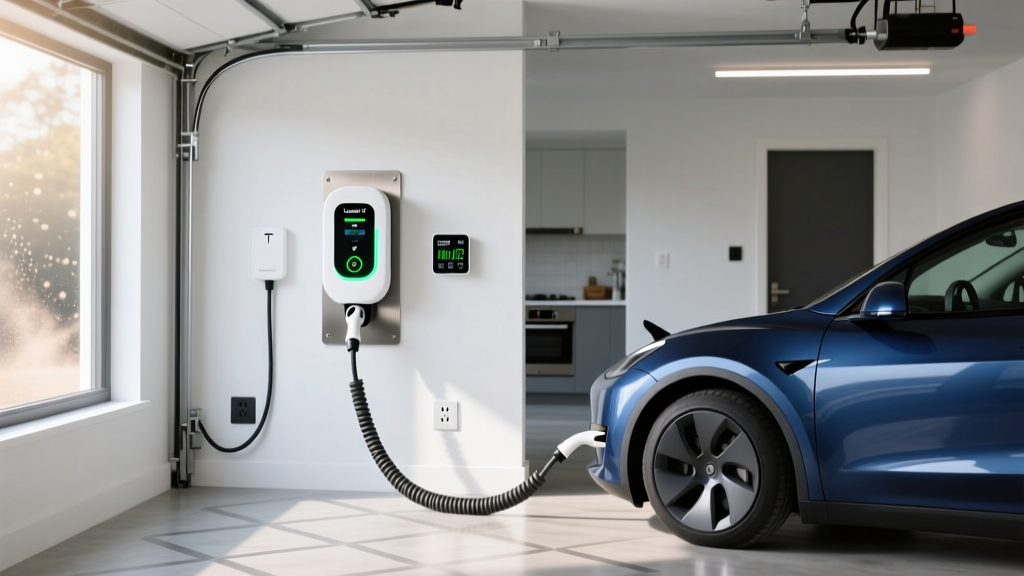
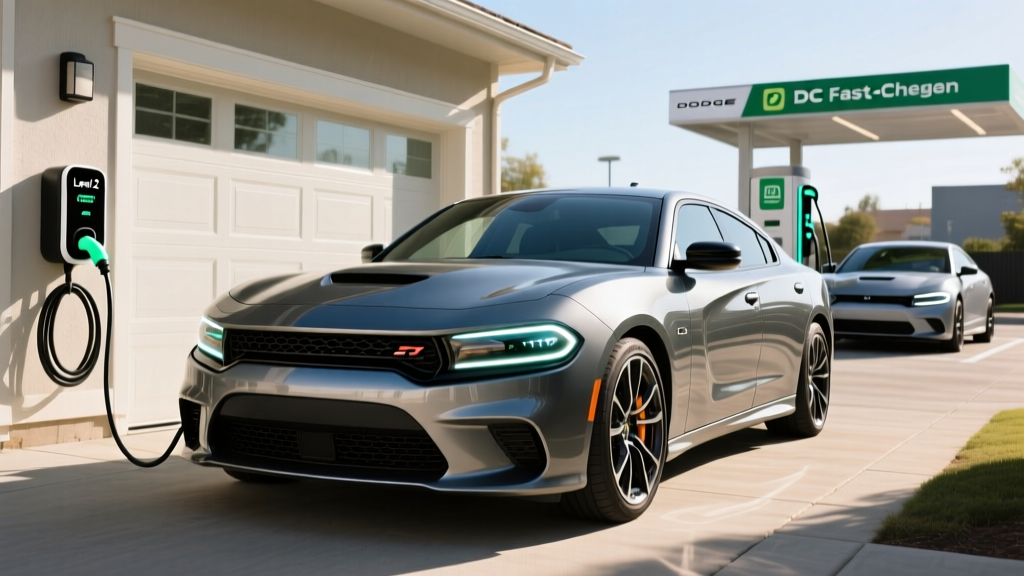
Level 2 is where most Charger EV owners will do 90% of their charging. The Daytona's onboard charger accepts up to 11.5 kW on AC power. At that rate, you're adding roughly 35–40 miles of range per hour, meaning a 10–100% charge takes approximately 9–10 hours — ideal for overnight charging on a home wall connector.
DC Fast Charging bypasses the onboard charger entirely, delivering DC current directly to the battery. The Charger Daytona is estimated to accept up to 175 kW at peak on a compatible DCFC station. A 10–80% session should take approximately 25–30 minutes. Note that charge speed tapers significantly above 80% SoC — charging from 80–100% can take as long as the 10–80% session due to battery protection protocols.
How Much Does It Cost to Install a Home EV Charger?
Installing a dedicated Level 2 home charger for your Dodge Charger EV is the single biggest ownership convenience upgrade you can make. But costs vary dramatically based on your home's electrical infrastructure.
| Component | Typical Cost Range | Notes |
|---|---|---|
| Level 2 Charger (Equipment) | $350–$700 | Smart WiFi-enabled, 32A–48A, 18–25 ft cable |
| Electrician Labor | $500–$2,000 | Depends on run length, conduit, and complexity |
| Electrical Permit | $50–$300 | Varies by municipality; some jurisdictions bundle |
| Panel Upgrade (if needed) | $1,500–$4,000 | Required if panel is at or near capacity (common in pre-2000 homes) |
| Total (no panel upgrade) | $900–$3,000 | Most homes with 200A service and spare capacity |
| Total (with panel upgrade) | $2,500–$7,000 | Older homes with 100A–150A service |
The panel upgrade gotcha: A Level 2 charger on a 48-amp circuit requires a 60-amp breaker. If your home's main panel is 100A or 150A and already near capacity (running central AC, electric range, dryer, water heater), a licensed electrician will need to perform a load calculation per NEC Article 220. If you're over 80% of panel capacity, you'll need an upgrade to 200A service — or consider a smart panel-leveler device like the Emporia Smart Load Center, which dynamically throttles charger draw to avoid tripping the main breaker.
What electrical setup does the Charger EV need? For optimal Level 2 charging at the car's 11.5 kW maximum, you need a 240V circuit with a 60-amp breaker delivering 48 amps continuous (NEC requires circuits rated at 125% of continuous load). A NEMA 14-60 outlet or hardwired connection are both acceptable; hardwired is generally preferred for outdoor installations and avoids GFCI breaker nuisance trips that plague some NEMA outlet setups.
Connector Compatibility: NACS, CCS, and the Charger Daytona
The 2025–2026 Dodge Charger Daytona ships with a CCS1 (Combined Charging System) port, which is the legacy standard used by most non-Tesla automakers. However, the industry is rapidly migrating to NACS (North American Charging Standard), the connector designed by Tesla and now adopted by Ford, GM, Rivian, Volvo, and others.
| Connector | AC Level 2 | DC Fast Charge | Charger Daytona? | Network Access |
|---|---|---|---|---|
| CCS1 | J1772 inlet | CCS combo | Yes (native) | Electrify America, EVgo, ChargePoint |
| NACS (Tesla) | NACS inlet | NACS | Adapter required | Tesla Supercharger network (17,000+ stalls) |
| CHAdeMO | J1772 inlet | CHAdeMO | No (discontinued standard) | Limited legacy stations |
What this means for Charger EV owners: You can use CCS stations natively — Electrify America, EVgo, and ChargePoint all support CCS1. To access Tesla's Supercharger network (which offers superior reliability and coverage), you will need a CCS-to-NACS adapter. Stellantis has indicated that future models will ship with NACS, but for the current Charger Daytona, budget approximately $200–$250 for a reputable adapter from a supplier like Lectron or A2Z. Always verify adapter compatibility with your specific model year before purchase.
For Level 2 AC charging at home or public AC stations, the Charger Daytona uses the standard J1772 connector (the AC portion of the CCS port). Any Level 2 home charger with a J1772 plug will work natively.
Charging Cost Per Mile: Charger EV vs. Gas Muscle Cars
One of the strongest arguments for the Charger Daytona over its gas-powered Hellcat predecessors is fuel cost. Let's run the numbers using realistic 2026 electricity and gasoline prices.
| Scenario | Cost/kWh or Gallon | Cost to "Fill" | Cost Per Mile |
|---|---|---|---|
| Home (off-peak utility rate) | $0.13/kWh | $13.08 (100.6 kWh) | $0.041/mi |
| Home (peak rate, no TOU plan) | $0.22/kWh | $22.13 | $0.070/mi |
| Public Level 2 (ChargePoint, etc.) | $0.25–$0.35/kWh | $25–$35 | $0.08–$0.11/mi |
| DC Fast Charging (EA, EVgo) | $0.35–$0.55/kWh | $35–$55 | $0.11–$0.17/mi |
| Gas: 2024 Charger V8 (20 MPG combined) | $3.40/gal | $61.20 (18-gal tank) | $0.170/mi |
The takeaway: Charging at home on an off-peak utility plan, the Charger Daytona costs roughly 4 cents per mile to fuel — about one-quarter the cost of a gas Charger V8 at 17 cents per mile. Even on public DC fast chargers at premium rates, you're roughly matching or beating gasoline on a per-mile basis.
Over 15,000 miles of annual driving, home charging saves approximately $1,900–$2,100 per year compared to fueling a gas muscle car. Over five years, that's $9,500–$10,500 in fuel savings — a significant offset to the Charger EV's higher purchase price. For current utility rate data, check the EIA electricity price tracker.
Recommended Home Chargers for the Dodge Charger Daytona
Given the Charger Daytona's 11.5 kW onboard charger and CCS/J1772 inlet, here are three Level 2 units that match its capabilities:
Emporia Vue Level 2 Charger
- Power Output: 48A / 11.5 kW (240V)
- Connector: J1772 (NACS version available)
- Cable Length: 24 ft
- Smart Features: WiFi, app scheduling, energy monitoring, solar integration
- Price: ~$399
- Why it fits: Matches the Charger's max AC rate exactly; excellent app; works with Emporia's panel-leveler for older homes
ChargePoint Home Flex
- Power Output: Up to 50A / 12 kW (adjustable via DIP switch)
- Connector: J1772 (NACS adapter available)
- Cable Length: 23 ft
- Smart Features: WiFi, Alexa, app scheduling, flexible amperage
- Price: ~$549
- Why it fits: Adjustable amperage means you can dial it down to 40A if your panel can't support 60A breaker — no electrician re-visit needed
Wallbox Pulsar Plus
- Power Output: 48A / 11.5 kW (240V)
- Connector: J1772
- Cable Length: 25 ft
- Smart Features: WiFi + Bluetooth, app control, Power Sharing for dual installs
- Price: ~$449
- Why it fits: Compact form factor, longest cable in class, NEMA 4 outdoor rating
All three chargers support the Charger Daytona's full 11.5 kW AC charge rate. Choose the ChargePoint Home Flex if your electrical panel is marginal and you need adjustable amperage. Choose the Emporia if you want energy monitoring or plan to integrate solar. The Wallbox is the best pick for outdoor installs where cable reach matters.
Safety, Electrical Code, and Installation Best Practices
EV charging is a high-draw, continuous electrical load — the NEC (National Electrical Code) treats it seriously, and so should you.
- Dedicated circuit required: Your Level 2 charger must be on its own dedicated breaker. Do not share the circuit with other appliances.
- GFCI considerations: The 2020 NEC requires GFCI protection for outlets used for EV charging (Article 625.54). Hardwired installations are exempt from this requirement and often avoid the nuisance tripping that GFCI breakers can cause with some EVSE units. Ask your electrician about hardwiring.
- Outdoor rating: If your charger is mounted outside or in an unsealed garage, ensure the unit carries at least a NEMA 4 (weather-resistant) rating. All three chargers recommended above meet this standard.
- Wire gauge: A 60-amp circuit typically requires 6 AWG copper wire (THHN in conduit) or 4 AWG if the run exceeds 100 feet due to voltage drop. Your electrician will calculate this based on NEC Table 310.15(B)(16).
- Permit and inspection: Nearly all jurisdictions require an electrical permit and post-installation inspection for EV charger circuits. Budget $50–$300 and 1–3 weeks for this process. Skipping the permit risks insurance claim denial in the event of an electrical fire.
Frequently Asked Questions
What is the real-world Dodge Charger EV range on the highway?
The EPA rates the Daytona R/T at 317 miles and the Scat Pack at 260 miles. In real-world highway driving at 70–75 mph, expect the R/T to deliver 250–275 miles and the Scat Pack to deliver 210–230 miles. Cold weather (below 32°F) reduces range by an additional 20–30% due to battery resistance and cabin heating load. The Charger Daytona does include a heat pump on higher trims, which helps mitigate winter losses compared to resistive heating.
How long does it take to charge the Dodge Charger EV at home?
On a 48A / 11.5 kW Level 2 home charger, the 100.6 kWh battery charges from 10% to 100% in approximately 9–10 hours. Most owners plug in when they get home and wake up to a full battery. A typical daily commute of 40–60 miles requires only 2–3 hours of Level 2 charging to replenish.
Does the Dodge Charger EV qualify for the federal tax credit?
The §30D federal EV tax credit has strict requirements including MSRP caps ($55,000 for sedans), buyer income limits, and battery critical-mineral sourcing rules. The Charger Daytona R/T's base MSRP of ~$59,590 exceeds the sedan cap, meaning it likely does not qualify for the full $7,500 credit under current IRS rules. Point-of-sale transfer is available for eligible vehicles, reducing the purchase price at the dealer. Always verify current-year eligibility on fueleconomy.gov and consult a tax professional, as rules change annually.
Can I use Tesla Superchargers with the Dodge Charger Daytona?
Not natively — the Charger Daytona has a CCS1 port, while Tesla Superchargers use NACS. You will need a CCS-to-NACS adapter ($200–$250) to access the Supercharger network. Tesla has begun opening Superchargers to non-Tesla vehicles via their Magic Dock adapter at select stations, but coverage is limited. For the most reliable road-trip charging, plan routes around Electrify America and EVgo CCS stations, or invest in a quality adapter.
Do I need a panel upgrade to charge the Charger EV at home?
It depends on your home's existing electrical service. If you have a 200-amp panel with spare capacity (most homes built after 2005), you likely do not need an upgrade. If you have a 100A or 150A panel with high existing loads (electric heat, AC, range, dryer), a load calculation may show you need an upgrade — costing $1,500–$4,000. A licensed electrician can perform this assessment before you purchase equipment.
How does the Charger EV's efficiency compare to other EVs?
At over 5,800 lbs and 670 hp in Scat Pack trim, the Charger Daytona prioritizes performance over efficiency. Expect combined efficiency in the range of 2.5–3.0 kWh/mile (roughly 112–120 MPGe combined). For comparison, a Tesla Model 3 Long Range achieves around 135 MPGe and a Hyundai Ioniq 6 reaches 140 MPGe. If daily commuting efficiency is your priority, the Charger EV trades some of that for muscle-car performance and presence.