You've been eyeing the 2025 Dodge Charger Daytona EV lease deals — and with Stellantis pricing the R/T trim starting around $52,995 (before incentives), the monthly payments look tempting. But before you sign that lease, you need a charging plan. The Charger Daytona packs a 100.6 kWh usable battery (NMC chemistry) and EPA-estimated range up to 317 miles on the R/T, or 260 miles on the higher-output Scat Pack. That's a big battery, and how you charge it at home will define your daily ownership experience.
This guide walks through every charging decision you'll face as a new Charger EV lessee: home Level 2 installation, DC fast-charging reality, connector compatibility, and exactly what you'll pay per mile compared to a gas-powered Challenger.
Charging Levels Explained: Speeds in kW and Miles Per Hour
The single most important distinction in EV charging is the difference between kW (kilowatts, the rate of power delivery — think of it as the speed of water flowing through a hose) and kWh (kilowatt-hours, the total energy stored — the size of the bucket). The Dodge Charger Daytona's battery holds roughly 100.6 kWh of usable energy. How many kW your charger delivers determines how fast that bucket fills.
| Charging Level | Voltage | Max Power (kW) | Miles of Range Added Per Hour | 10–80% Time (approx.) |
|---|---|---|---|---|
| Level 1 (120V household) | 120V | ~1.4 kW | ~4–5 mi/hr | ~50+ hours |
| Level 2 (240V home/public) | 240V | Up to 11.5 kW (vehicle-limited) | ~32–38 mi/hr | ~7.5–8 hours |
| DC Fast Charging | 400V+ DC | Up to 175 kW peak | ~200+ mi/hr (peak) | ~27–32 min |
For a 100.6 kWh battery, Level 1 charging is essentially a trickle — useful only for topping off if you drive under 30 miles daily. Level 2 at home is the practical baseline for daily ownership, and DC fast charging is your road-trip solution.
Home Level 2 Installation: Electrical Requirements and Costs
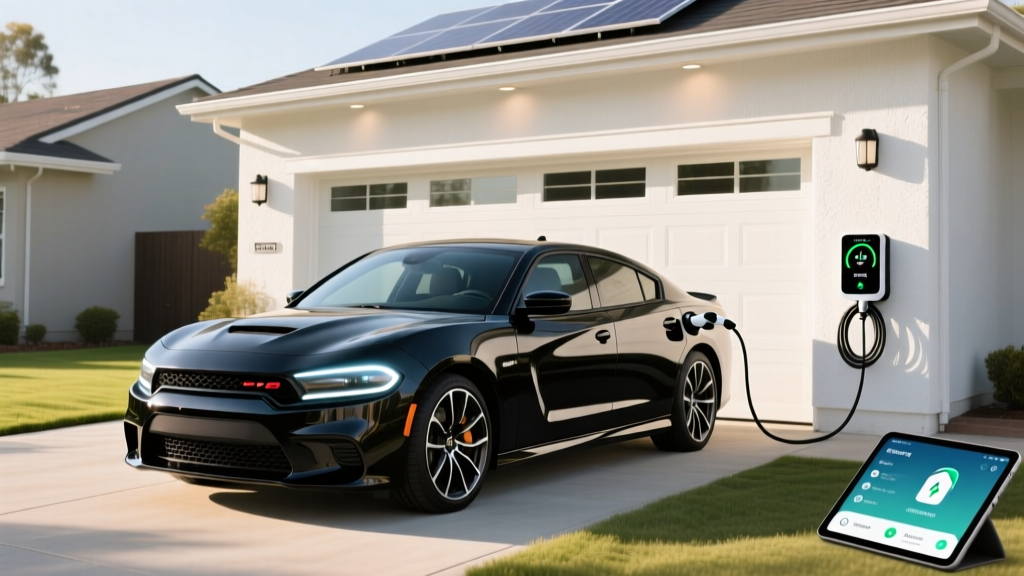
The Charger Daytona accepts up to 11.5 kW on Level 2 AC charging. To deliver that, you need a 240-volt circuit rated for at least 48 amps (EVSE rated at 48A continuous draw requires a 60-amp breaker per the National Electrical Code's 80% rule for continuous loads). If you opt for a 40-amp charger, a 50-amp breaker and circuit suffice, delivering roughly 9.6 kW — still enough to fully recharge the Charger's battery overnight.
What Your Electrical Panel Needs
Before installing any Level 2 charger, assess your home's electrical service:
- 200-amp panel (most homes built after 2000): Usually has sufficient spare capacity for a 48A–60A EV circuit. A licensed electrician will perform a load calculation to confirm.
- 100-amp panel (older homes): Likely requires a panel upgrade to 200 amps before adding a high-amperage EV circuit. This is one of the most common surprises for new EV owners in pre-1990s homes.
- Sub-panels or detached garages: May need a dedicated feeder line from the main panel, adding wire-run cost.
Never skip the permit. Most jurisdictions require an electrical permit for EV charger installations, and your insurance company may deny a claim related to an unpermitted electrical fire. A final inspection ensures the circuit, breaker, and grounding meet NEC Article 625 requirements for EV charging systems.
| Cost Component | Low Estimate | High Estimate | Notes |
|---|---|---|---|
| Level 2 EVSE (hardware) | $350 | $750 | 32A–48A smart chargers |
| Electrician labor (standard install) | $400 | $1,200 | Short wire run, accessible panel |
| Electrical permit | $50 | $200 | Varies by municipality |
| Panel upgrade (if needed) | $1,500 | $4,000 | 100A → 200A service upgrade |
| Extended wire run (50+ ft) | $200 | $800 | Detached garage, long conduit runs |
| Total (no panel upgrade) | $800 | $2,150 | Most typical installations |
| Total (with panel upgrade) | $2,300 | $6,150 | Older homes with 100A service |
The IRS §30C alternative fuel vehicle refueling property credit may cover up to 30% of home charger equipment and installation costs (capped at $1,000) — but eligibility depends on your census tract meeting specific criteria. Consult a tax professional before claiming.
Which Connector Does the Dodge Charger EV Use?
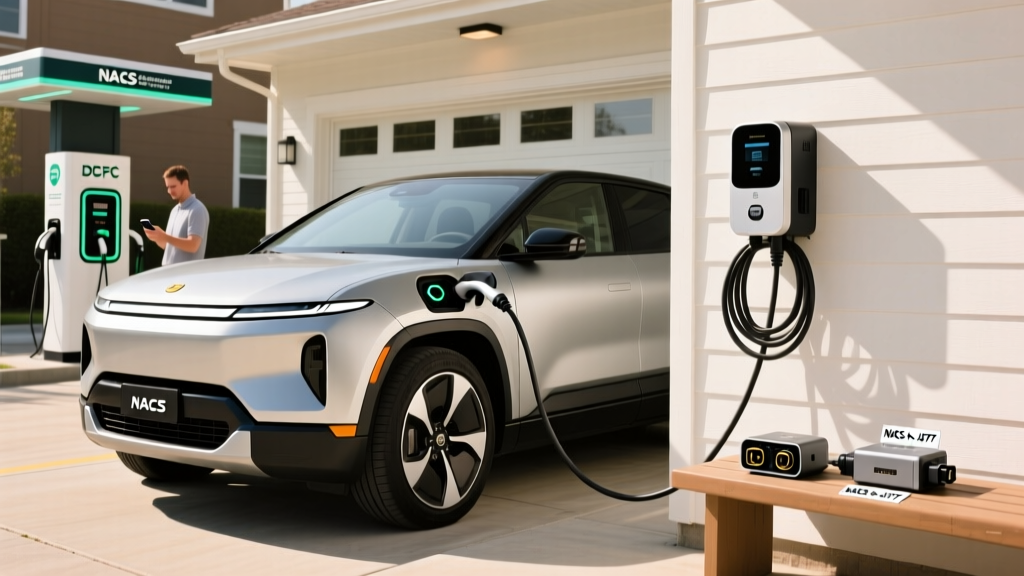
The 2025 Dodge Charger Daytona EV ships with a CCS1 (Combined Charging System) port for DC fast charging and a J1772 inlet for Level 1 and Level 2 AC charging. This matters because the industry is mid-transition: Tesla's NACS connector is becoming the North American standard, with most automakers switching by 2025–2026, but Stellantis has retained CCS1 for the Charger Daytona at launch.
| Connector | Used By | AC Charging | DC Fast Charging | Adapter Needed for Charger EV? |
|---|---|---|---|---|
| J1772 | All non-Tesla EVs (AC) | Yes | No | No — native on Charger Daytona |
| CCS1 | Most non-Tesla EVs (DC) | No | Yes | No — native on Charger Daytona |
| NACS (Tesla) | Tesla, Ford, GM, Rivian, others | Yes | Yes | Yes — CCS-to-NACS adapter needed for Tesla Superchargers |
| CHAdeMO | Nissan Leaf (legacy) | No | Yes | Not applicable — no adapter available |
What this means practically: You can use Electrify America, EVgo, ChargePoint, and most non-Tesla public DC fast chargers natively. To access Tesla Supercharger stations (which now outnumber all other networks combined), you'll need a CCS-to-NACS adapter. Stellantis has not announced a factory NACS retrofit for the Charger Daytona, so plan to purchase an aftermarket adapter (approximately $200–$250 from brands like Lectron or A2Z) if Supercharger access matters in your area.
DC Fast Charging: The 175 kW Peak Reality
Dodge rates the Charger Daytona for up to 175 kW peak DC fast charging. On a capable 350 kW Electrify America or EVgo station, that translates to a 10–80% charge in approximately 27–32 minutes. But peak rate is not sustained rate — and this is where many new EV owners miscalculate road-trip stops.
Like all EVs using NMC lithium-ion cells, the Charger Daytona's charge curve tapers significantly above 80% state of charge to protect battery longevity. Here's what a typical DC fast-charge session looks like:
- 10–40% SoC: Sustains near peak ~160–175 kW — the fastest segment
- 40–60% SoC: Steps down to ~120–140 kW
- 60–80% SoC: Further taper to ~80–100 kW
- 80–100% SoC: Sharp taper below 40 kW — avoid charging past 80% on road trips unless necessary
On a 300-mile road trip, plan one 25-minute stop at 15–20% SoC, charge to 80%, and you'll have enough range to reach your destination or the next charger. Preconditioning the battery (available through the Uconnect EV app or by setting a DC fast-charger as your navigation destination) warms the cells to optimal temperature and can shave 5–10 minutes off your charge time, especially in cold weather.
Cost to Charge: Per-Mile Breakdown vs. Gas
One of the strongest arguments for leasing the Charger EV over a gas V8 Challenger is fuel cost. Here's how the numbers stack up across common charging scenarios, based on the Charger Daytona R/T's efficiency of approximately 2.8–3.2 kWh per mile (roughly 96–105 MPGe combined per fueleconomy.gov):
| Scenario | Price per kWh | Cost Per Mile (Charger EV) | Cost Per Mile (25 MPG gas car at $3.40/gal) |
|---|---|---|---|
| Home charging (off-peak utility rate) | $0.09–$0.13 | $0.027–$0.038 | $0.136 |
| Home charging (standard residential) | $0.14–$0.18 | $0.042–$0.054 | $0.136 |
| Public Level 2 (ChargePoint, etc.) | $0.20–$0.35 | $0.060–$0.105 | $0.136 |
| DC Fast Charging (Electrify America) | $0.35–$0.55 | $0.105–$0.165 | $0.136 |
The takeaway: Home charging is where the economics overwhelmingly favor the EV. At off-peak residential rates, you'll spend roughly $0.03 per mile — about a quarter of what a 25 MPG gas car costs. Even at DC fast-charger rates, the per-mile cost is competitive with gasoline. But if you rely exclusively on public DC fast charging, the cost advantage narrows significantly, and on the highest-priced networks, you may actually pay more per mile than gas.
For a lessee driving 12,000 miles per year with 80% home charging and 20% public DC fast charging, expect annual fuel costs of approximately $550–$750. A comparable gas muscle car at 20 MPG combined would cost roughly $2,040 annually at $3.40/gallon.
Recommended Level 2 Home Chargers for the Charger Daytona
With an 11.5 kW onboard charger, the Charger Daytona benefits from a 48-amp Level 2 EVSE to maximize overnight charging speed. Here are three well-regarded options across different budgets:
Emporia Vue + EV Charger
- Power output: 48A / 11.5 kW (hardwired)
- Connector: J1772 (CCS-compatible)
- Cable length: 24 ft
- Smart features: Energy monitoring, solar integration, scheduled charging, load management
- Price: ~$399
- Best for: Budget-conscious buyers who want smart energy tracking
ChargePoint Home Flex
- Power output: Up to 50A / 12 kW (configurable, hardwired or NEMA 14-50 plug)
- Connector: J1772 (CCS-compatible)
- Cable length: 23 ft
- Smart features: Alexa integration, scheduled charging, charge history, flexible amperage
- Price: ~$549–$699
- Best for: Flexibility — plug-in option means portability if you move
Grizzl-E Smart
- Power output: 40A / 9.6 kW (NEMA 14-50) or up to 48A hardwired
- Connector: J1772 (CCS-compatible)
- Cable length: 24 ft
- Smart features: OCPP-compatible, app scheduling, outdoor-rated (NEMA 4), built in Canada
- Price: ~$499–$599
- Best for: Outdoor installations and extreme-temperature durability
All three deliver sufficient power to fully recharge the Charger Daytona's 100.6 kWh battery overnight (8–10 hours from near-empty). The ChargePoint Home Flex's configurable amperage is particularly useful if your panel has limited spare capacity — you can set it to 32A or 40A without changing hardware.
Safety, Code, and Lease-Specific Considerations
Your Level 2 installation must comply with NEC Article 625 and local building codes. Key requirements:
- Dedicated circuit: The EV charger must be on its own dedicated breaker — no sharing with other appliances or outlets.
- GFCI protection: The 2023 NEC update requires GFCI protection for all EV receptacles (NEMA 14-50 outlets). Hardwired EVSE units have built-in ground-fault protection and may not require an additional GFCI breaker, but local inspectors have final say.
- Outdoor rating: If your charger is installed outside or in an unenclosed carport, it must carry at minimum a NEMA 3R rating (rain-resistant). NEMA 4 (weatherproof) is preferable for harsh climates.
- Cable management: NEC requires that the charging cable not create a trip hazard. Wall-mounted cord organizers or retractable reels are recommended.
Also verify with your lease agreement whether any home charging equipment credits or partnerships exist. Some Stellantis lease promotions include complimentary home charger hardware or discounted installation through partner networks — check your deal sheet before purchasing separately.
Frequently Asked Questions
How much does it cost to install a home EV charger for the Dodge Charger?
For a typical home with a 200-amp panel and a short wire run, expect $800–$2,150 total (equipment, electrician, and permit). Older homes with 100-amp panels may need a $1,500–$4,000 panel upgrade, pushing total costs to $2,300–$6,150. Always get at least two quotes from licensed electricians and verify they include permit costs.
How fast will each charging level add range to the Charger Daytona?
Level 1 (120V) adds roughly 4–5 miles per hour — impractical for a 100.6 kWh battery. Level 2 at 48A/11.5 kW adds approximately 32–38 miles per hour, fully recharging overnight. DC fast charging at 175 kW peak can add 100+ miles in roughly 10 minutes during the peak portion of the charge curve (10–40% SoC).
Can I use Tesla Superchargers with the Dodge Charger EV?
Not natively — the Charger Daytona uses a CCS1 port, while Tesla Superchargers use the NACS connector. You'll need a CCS-to-NACS adapter ($200–$250) and must verify that the specific Supercharger station supports non-Tesla vehicles through Tesla's "Open Supercharging" program. Coverage varies by region.
How much does charging cost per mile compared to gas?
Home charging at off-peak rates costs approximately $0.03 per mile — about 75% cheaper than a 25 MPG gas car at $3.40/gallon ($0.136/mile). Public DC fast charging at $0.45/kWh costs roughly $0.135/mile, essentially matching gasoline. The more you charge at home, the more you save.
What electrical upgrades might I need before installing a charger?
Homes with 100-amp electrical service typically need a panel upgrade to 200 amps ($1,500–$4,000). Even with a 200-amp panel, if your existing loads (HVAC, electric range, dryer) consume most of the capacity, an electrician's load calculation may require a lower-amperage charger circuit or a panel upgrade. Homes with detached garages may also need a new feeder line from the main panel.
Is the Dodge Charger EV eligible for the $7,500 federal tax credit?
Federal §30D tax credit eligibility for the Charger Daytona depends on several factors including final assembly location, battery component sourcing, critical mineral requirements, buyer income caps ($150K single / $300K joint), and the $55,000 MSRP cap for sedans. Because the Charger Daytona R/T starts near $52,995 but options can push it above the cap, trim selection directly impacts credit eligibility. The point-of-sale transfer option (available through registered dealers) lets you apply the credit as an immediate discount. Check current rules at IRS.gov and confirm with your dealer before signing — battery sourcing requirements tighten annually and eligibility can change mid-year.