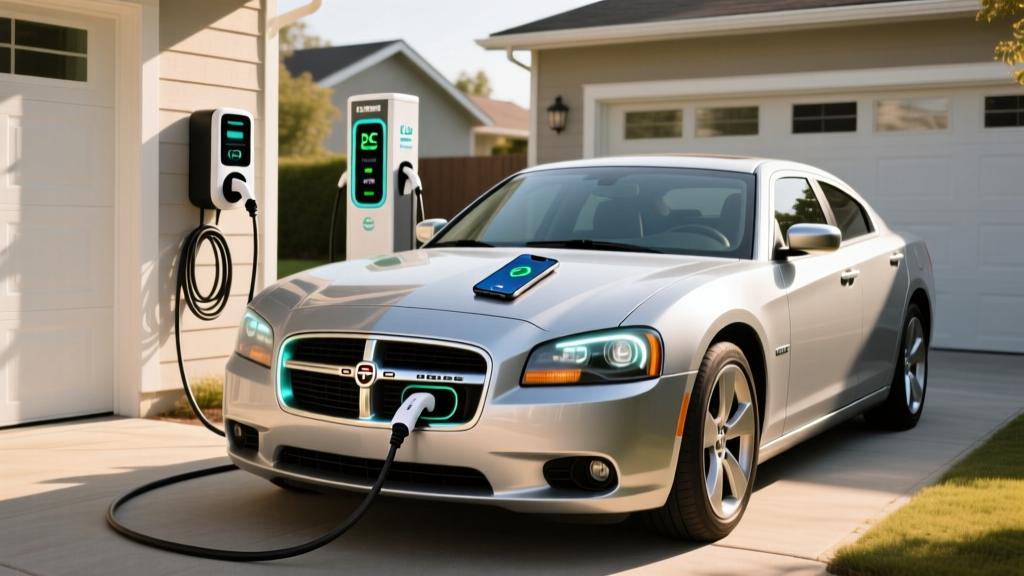
If you're still driving a 2007 Dodge Charger — a car that averaged around 17-21 MPG combined depending on its V6 or V8 — and you're considering the jump to an electric vehicle, the single biggest shift isn't the drivetrain. It's the fueling. You'll trade gas stations for charging cables, and understanding how that works before you buy is the difference between a seamless ownership experience and daily frustration.
This guide breaks down every layer of EV charging in 2026: the three charging levels with exact speeds, what your home's electrical panel can (and can't) handle, which connector your future EV will use, what charging actually costs per mile versus the gasoline your Charger drinks, and which hardware to buy. We'll be precise with numbers — because in EV charging, the difference between a kW (power, or how fast energy flows) and a kWh (energy, or how much your battery stores) is the single most important distinction you'll make.
The Three Charging Levels: Exact Speeds and Range Added
Every EV sold in the US charges at one of three levels. The speed difference between them is enormous — from adding 3 miles of range per hour to adding 180+ miles in 20 minutes. Here's the breakdown.
| Level | Voltage | Power (kW) | Miles of Range Added Per Hour | Best For |
|---|---|---|---|---|
| Level 1 | 120V (standard outlet) | 1.0 – 1.4 kW | 3 – 5 miles | Overnight top-ups, PHEVs, low daily mileage |
| Level 2 | 240V (dryer-style outlet or hardwired) | 3.3 – 19.2 kW | 12 – 70 miles | Daily home charging, workplace, shopping centers |
| DC Fast Charging (Level 3) | 400V – 800V DC direct | 50 – 350 kW | 120 – 250+ miles in 20 min | Road trips, highway corridors, quick top-ups |
A few critical realities behind those numbers:
- Level 1 is the cord that ships with most EVs. Plugged into a standard 120V household outlet, it delivers roughly 1.2 kW. For a 75 kWh battery (like a Tesla Model Y Long Range), a full 0-100% charge takes roughly 60+ hours. It's fine for plug-in hybrids with small batteries (10-18 kWh) or BEVs driven under 30 miles daily, but inadequate as a primary charging strategy for most battery-electric owners.
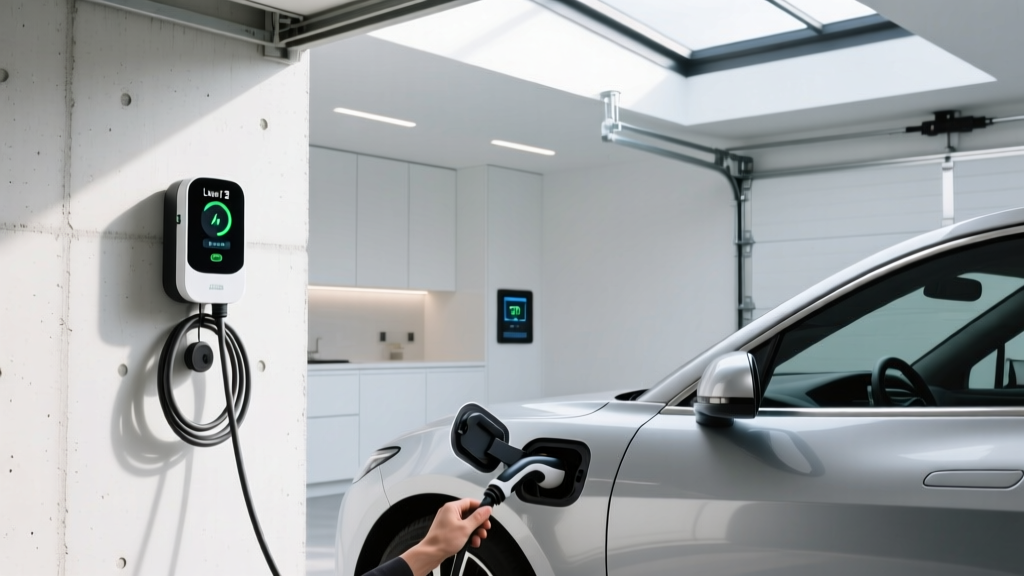
- Level 2 is the home-charging standard. A 48-amp (11.5 kW) Level 2 station on a 240V circuit will fully recharge most EVs overnight in 6-10 hours. This is what 85%+ of EV owners rely on as their primary fuel source.
- DC fast charging is for road trips. Peak speeds (e.g., 250 kW at a Tesla V4 Supercharger or Electrify America 350 kW station) are not sustained. Charging curves taper significantly above 80% State of Charge (SoC) to protect the battery. A "10-80% in 18 minutes" claim means exactly that — the last 20% may take another 15-20 minutes.
- 60 kWh battery (Chevrolet Equinox EV): ~18 min at a 150 kW DCFC; ~5.5 hours on a 48A Level 2
- 82 kWh battery (Volkswagen ID.4): ~28 min at a 175 kW DCFC; ~7 hours on a 48A Level 2
- 100 kWh battery (Ford F-150 Lightning Extended): ~35 min at a 250 kW DCFC (with preconditioning); ~9 hours on a 48A Level 2
Home Charger Installation: Electrical Requirements and True Costs
This is where your home's age matters enormously. If you're moving from a 2007 Dodge Charger parked in the garage of a house built in the 1990s or earlier, your electrical panel may need attention before any EV charger goes in.
What a Level 2 Home Charger Requires
A typical 48-amp Level 2 charger needs a dedicated 60-amp, 240V circuit (the National Electrical Code requires circuits to be rated at 125% of continuous load, so 48A continuous draw = 60A breaker). This is the same voltage as your electric dryer or oven, but it demands its own dedicated breaker — you can't share the circuit.
Your home's electrical panel must have:
- Sufficient amperage capacity: A 200-amp service panel is standard in modern homes and typically handles an EV charger without issue. Older homes with 100-amp service may need a panel upgrade.
- Available breaker slots: You need two adjacent slots for a double-pole 60A breaker.
- Load calculation headroom: A licensed electrician will perform a NEC Article 220 load calculation to confirm your panel can handle the added draw alongside your HVAC, water heater, and other appliances.
Panel Upgrade Reality
If your home has a 100-amp panel (common in houses built before 1990), adding a 60A EV circuit may push total calculated load beyond capacity. A panel upgrade to 200A typically costs $1,500 – $3,500 depending on your utility, local permit fees, and whether new service wire must be pulled from the street. In rare cases involving very old infrastructure, costs can exceed $5,000. This is a non-negotiable safety item — never skip the load calculation.
Installation Cost Breakdown
| Component | Typical Cost Range | Notes |
|---|---|---|
| Level 2 charger hardware | $350 – $750 | Smart Wi-Fi chargers at 40-48A; basic models from $250 |
| Electrician labor (standard install) | $400 – $1,200 | Depends on run length from panel to garage/carport |
| Electrical materials (wire, conduit, breaker) | $100 – $400 | Longer wire runs cost more; 6 AWG copper typical for 48A |
| Permit and inspection | $50 – $250 | Required in most jurisdictions; varies by municipality |
| Panel upgrade (if needed) | $1,500 – $3,500 | 100A to 200A upgrade; not required in most modern homes |
| Total (no panel upgrade) | $900 – $2,600 | Average US install: ~$1,200-$1,800 |
| Total (with panel upgrade) | $2,400 – $6,100 | Older homes with 100A service |
Some utilities offer rebates of $200-$500 for Level 2 charger installation, and certain states provide additional incentives. Check your utility's EV program page before scheduling work.
Connector Compatibility: NACS, CCS1, CHAdeMO, and Adapters
As of 2026, the North American EV charging connector landscape has consolidated significantly, but your EV's charge port still determines where you can plug in — especially at DC fast chargers.
| Connector | Brands Using It (2026 Models) | DC Fast Charge Network Access | Adapter Needed? |
|---|---|---|---|
| NACS (North American Charging Standard) | Tesla (all), Ford, GM, Rivian, Volvo, Polestar, Mercedes-Benz, BMW (select), Hyundai/Kia (2025+ models) | Tesla Supercharger network (17,000+ stalls), growing Electrify America and EVgo NACS stalls | CCS-to-NACS adapters available (~$200-$300) for legacy CCS vehicles charging at NACS stalls |
| CCS1 (Combined Charging System) | Volkswagen, Audi (legacy), BMW (legacy), Stellantis, Honda, some Hyundai/Kia (pre-2025) | Electrify America, EVgo, ChargePoint DCFC | NACS-to-CCS adapter (~$200) needed for Tesla Supercharger access on CCS vehicles |
| CHAdeMO | Nissan Leaf (legacy only; discontinued) | Limited; most networks have deprioritized CHAdeMO stalls | No practical adapter to NACS/CCS; CHAdeMO infrastructure is declining |
The bottom line for 2026 buyers: NACS is the dominant standard. If you're purchasing a new EV, prioritize NACS-equipped models for the broadest fast-charging access via Tesla's Supercharger network (now open to non-Tesla vehicles with NACS ports). CCS1 vehicles can access Superchargers using a Tesla-approved adapter, but verify your specific model's compatibility before relying on it.
For Level 2 home charging, all EVs use the J1772 connector (or NACS, which includes J1772 signaling). Every home Level 2 charger ships with J1772 or NACS — and adapters between the two are inexpensive ($30-$80). You won't have a Level 2 compatibility problem regardless of which EV you buy.
Cost Per Mile: EV Charging vs. Gasoline (Goodbye, Charger V8)
The 2007 Dodge Charger with a 5.7L Hemi V8 averaged roughly 18 MPG combined. At $3.50/gallon (a reasonable 2026 national average), you're spending roughly $0.194 per mile on fuel. Let's compare that to EV charging across scenarios.
| Charging Scenario | Cost per kWh | EV Efficiency (kWh/mile) | Cost Per Mile | Annual Fuel Cost (12,000 mi) |
|---|---|---|---|---|
| Home Level 2, off-peak utility rate | $0.08 – $0.12 | 0.28 – 0.33 | $0.022 – $0.040 | $264 – $480 |
| Home Level 2, standard utility rate | $0.14 – $0.18 | 0.28 – 0.33 | $0.039 – $0.059 | $468 – $708 |
| Public Level 2 (ChargePoint, workplace) | $0.20 – $0.35 | 0.28 – 0.33 | $0.056 – $0.116 | $672 – $1,392 |
| DC Fast Charging (Electrify America, EVgo) | $0.35 – $0.55 | 0.28 – 0.33 | $0.098 – $0.182 | $1,176 – $2,184 |
| 2007 Dodge Charger 5.7L V8 | $3.50/gallon | 18 MPG | $0.194 | $2,328 |
Key takeaways from these numbers:
- Home charging is where EV economics win decisively. An EV charged primarily at home on off-peak rates costs 80-85% less per mile than your V8 Charger. Even on standard rates, you'll save $1,600-$1,800 annually at 12,000 miles/year.
- Exclusive DC fast charging erodes savings. If you can't charge at home and rely entirely on public DCFC at $0.45-$0.55/kWh, your per-mile cost approaches that of a fuel-efficient gas car. Home charging access is the economic keystone of EV ownership.
- Time-of-use (TOU) plans amplify savings. Most utilities offer EV-specific TOU rates with super off-peak windows (e.g., midnight to 6 AM) at $0.06-$0.09/kWh. Schedule your charger to activate during these windows for the lowest possible cost.
Recommended Home Level 2 Chargers for 2026
Not all Level 2 chargers are equal. The best units combine reliable hardware, smart scheduling features (to leverage TOU rates), adequate cable length, and proper safety certifications. Here are five proven models across price points.
ChargePoint Home Flex (NACS or J1772)
- Power: Up to 11.5 kW (48A) on a 60A circuit; adjustable down to 16A for lower-capacity panels
- Connector: Available in NACS or J1772 (adapter included for the other standard)
- Cable length: 23 feet
- Smart features: Wi-Fi, app-based scheduling, Alexa integration, energy tracking
- Price: ~$550-$650
- Best for: Flexibility — the amperage adjustment is invaluable for homes with limited panel capacity
Tesla Wall Connector (NACS)
- Power: Up to 11.5 kW (48A) on a 60A circuit
- Connector: NACS native (includes J1772 adapter in box)
- Cable length: 24 feet
- Smart features: Wi-Fi, OTA updates, power sharing (link up to 6 units on one circuit), Tesla app integration
- Price: ~$450-$500
- Best for: Tesla owners and NACS-vehicle buyers; power sharing is ideal for two-EV households
Emporia Vue Level 2 Charger
- Power: Up to 11.5 kW (48A)
- Connector: J1772 (NACS adapter available separately)
- Cable length: 24 feet
- Smart features: Wi-Fi, solar integration (pairs with Emporia Vue energy monitor), TOU scheduling
- Price: ~$350-$400
- Best for: Budget-conscious buyers; solar-home integration is a standout feature
Grizzl-E Smart (United Chargers)
- Power: Up to 10 kW (40A) on a 50A circuit
- Connector: J1772 or NACS
- Cable length: 24 feet
- Smart features: Wi-Fi, OCPP compatibility, adjustable amperage
- Price: ~$450-$550
- Best for: Cold-climate durability — rated to -40°F, built in Canada, IP67 outdoor rating
EnelX JuiceBox Pro 48
- Power: Up to 11.5 kW (48A)
- Connector: J1772 (NACS adapter available)
- Cable length: 25 feet
- Smart features: Wi-Fi, smart grid integration, utility demand-response compatible
- Price: ~$550-$650
- Best for: Utility-program participants; demand-response compatibility can earn bill credits
Safety, Permits, and Code Compliance
EV charging involves sustained high-current draw — often 8-10 hours continuously. This is fundamentally different from the intermittent loads of a microwave or hair dryer, and the electrical code treats it accordingly.
Non-negotiable safety requirements:
- Dedicated circuit: Your Level 2 charger must have its own breaker — never share a circuit with other appliances. Continuous loads (defined as 3+ hours) require a circuit rated at 125% of the charger's amperage.
- GFCI protection: NEC 2020 and later require GFCI (Ground Fault Circuit Interrupter) protection for all EV charging outlets. Hardwired installations may use ground-fault protection at the breaker. Outdoor installations always require GFCI.
- Outdoor rating: If your charger is installed outside (carport, driveway pedestal), it must carry at minimum an IP55 rating (dust and water-jet resistant). IP67 (submersible) is preferable in heavy-rain or snow regions.
- Permit and inspection: Virtually all US jurisdictions require a permit for new 240V circuit installations. The inspection verifies wire gauge, breaker sizing, grounding, and GFCI compliance. Skipping the permit risks insurance denial if an electrical fire occurs.
- Wire gauge: A 48A charger on a 60A breaker requires minimum 6 AWG copper wire (or 4 AWG aluminum). Longer runs (over 50 feet) may need upsized wire to limit voltage drop below 3%.
Hire a licensed electrician who has specific EV charger installation experience. Ask whether they perform NEC Article 220 load calculations and whether they pull permits as standard practice — if the answer to either is no, find another electrician.
Frequently Asked Questions
How much does it cost to install a home EV charger?
A standard Level 2 home charger installation (48A, hardwired or NEMA 14-50 outlet, 60A breaker) costs between $900 and $2,600 all-in when your electrical panel has sufficient capacity. This includes the charger ($350-$750), electrician labor ($400-$1,200), materials ($100-$400), and permit ($50-$250). If your home needs a panel upgrade from 100A to 200A service, add $1,500-$3,500. Get at least two quotes and confirm the electrician pulls a permit.
How fast will each charging level add range?
Level 1 (120V) adds 3-5 miles per hour — enough for PHEVs and low-mileage drivers. Level 2 (240V, 48A) adds 25-40 miles per hour depending on your EV's onboard charger acceptance rate, fully recharging most EVs overnight. DC fast charging at 150-350 kW can add 100-200+ miles in 15-25 minutes, but charging speed tapers above 80% SoC to protect battery health. See the EPA's fueleconomy.gov for model-specific charging data.
Which connector/charger is compatible with my EV?
In 2026, most new EVs use the NACS connector (Tesla, Ford, GM, Rivian, Hyundai/Kia, Volvo, and others). Some legacy models still use CCS1 (older VW ID.4, BMW iX). The Nissan Leaf used CHAdeMO but is discontinued. For home Level 2 charging, all EVs are compatible with any J1772 or NACS charger using inexpensive adapters. For DC fast charging, verify your EV's charge port matches the network's connector — Tesla Superchargers now serve NACS-equipped non-Tesla vehicles directly.
How much does charging cost per mile vs gas?
Home charging on off-peak rates costs $0.02-$0.04 per mile — roughly 80-85% less than a 2007 Dodge Charger V8 at $0.19/mile. Even on standard residential rates ($0.14-$0.18/kWh), EVs cost $0.04-$0.06 per mile. Public DC fast charging at $0.35-$0.55/kWh costs $0.10-$0.18 per mile, approaching gas-car economics. The economic case for EVs depends heavily on home charging access.
What electrical upgrades might I need?
Homes with 200-amp electrical service (standard since the 1990s) typically need no panel upgrade — just a new 60A double-pole breaker and wire run. Homes with 100-amp service (common pre-1990) often need a panel upgrade to 200A, costing $1,500-$3,500. Your electrician will perform a load calculation per NEC Article 220 to determine this. Some utilities offer managed charging programs that allow lower-amperage installs (e.g., 32A on a 40A breaker) to avoid panel upgrades — ask your utility about these options.
Can I charge my EV with solar panels?
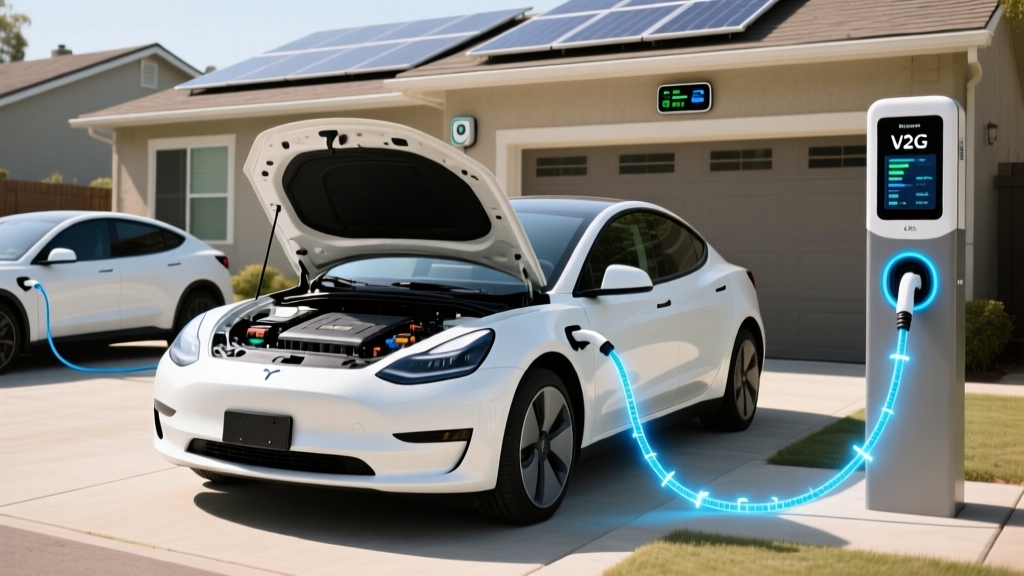
Yes, and it's one of the most cost-effective EV ownership strategies. A home solar system generating 8-10 kW during peak daylight hours can directly offset Level 2 charging. Pair it with a smart charger (like the Emporia Vue or ChargePoint Home Flex) that schedules charging during solar production windows. With net metering, excess solar credits can further reduce your effective charging cost to near zero. Consult the IRS residential clean energy credit page for solar + storage tax credit details.
Your Next Steps: A Decision Checklist
If you're ready to move from your 2007 Dodge Charger to an EV, here's your charging preparation sequence:
- Check your electrical panel. Find your main breaker — is it 100A or 200A? Note available breaker slots. This determines whether a panel upgrade is needed.
- Call your utility. Ask about EV-specific time-of-use rates, charger rebates, and managed charging programs. Some utilities will cover part of the installation cost.
- Get two electrician quotes. Specify a 48A Level 2 charger on a 60A circuit. Confirm they pull permits and perform load calculations.
- Choose your charger. Match the connector to your EV (NACS for most 2026 models), prioritize smart features for TOU scheduling, and ensure adequate cable length for your parking setup.
- Install before your EV arrives. Lead times for electrician scheduling can be 2-6 weeks. Have your charger operational before delivery day — you'll want that first full overnight charge ready to go.
The transition from a gas-guzzling Charger to an EV is one of the most impactful upgrades you can make — both for your wallet and your driving experience. But the charging infrastructure is the foundation. Get it right, and you'll never think about "refueling" the same way again.