The all-electric Dodge Charger Daytona has redefined what an American muscle EV can be, pairing brutal acceleration with a tech-forward cabin. But behind the aggressive styling and the Dodge Charger EV interior's panoramic displays lies a massive battery pack that demands a serious charging strategy. Whether you're eyeing the R/T or the range-topping Scat Pack, understanding how to feed this 100.5 kWh (usable) NMC battery efficiently is the difference between effortless daily driving and frustrating public-charger dependency.
This guide covers everything Charger EV owners and prospective buyers need: charging levels and real-world speeds, home installation costs and electrical requirements, connector compatibility, and the actual cost per mile compared to a gas V8. We'll also recommend specific Level 2 hardware that pairs well with the Charger's onboard charger.
Dodge Charger EV Battery and Charging Specs at a Glance
Before we break down charging options, here are the hard numbers that define the Charger Daytona's energy appetite. The 2025–2026 Charger Daytona uses Stellantis' STLA Large platform with an NMC (nickel-manganese-cobalt) lithium-ion battery. The Scat Pack trim produces up to 670 horsepower with a 0–60 mph time of 3.3 seconds, while the R/T delivers 496 hp. EPA range varies significantly by trim and wheel size.
| Specification | R/T (Coupe) | Scat Pack (Coupe) |
|---|---|---|
| Battery (usable) | 100.5 kWh, NMC | 100.5 kWh, NMC |
| EPA Range | ~317 miles | ~260 miles |
| Real-World Highway Range | ~250–270 mi | ~210–230 mi |
| Max DC Fast Charge Rate | ~175 kW (peak) | ~175 kW (peak) |
| 10–80% DC Fast Charge | ~32 minutes | ~32 minutes |
| Onboard AC Charger (Level 2) | 11 kW (48A @ 240V) | 11 kW (48A @ 240V) |
| Connector (North America) | CCS1 (NACS adapter avail.) | CCS1 (NACS adapter avail.) |
| Base MSRP | ~$51,590 | ~$57,590 |
| Battery Warranty | 8 years / 100,000 mi | 8 years / 100,000 mi |
Charging Levels Explained: Speeds, Power, and What They Mean
The single most important distinction in EV charging is between kW (kilowatts), which measures power — how fast energy flows — and kWh (kilowatt-hours), which measures energy capacity — how much the battery holds. Think of kW as the flow rate of a hose and kWh as the size of the bucket. The Charger Daytona's bucket is 100.5 kWh; the hose size varies by charging level.
| Level | Voltage | Max Power (kW) | Miles of Range per Hour | Best For |
|---|---|---|---|---|
| Level 1 (120V outlet) | 120V AC | 1.4–1.9 kW | ~3–5 mi/hr | Emergency top-ups, overnight for short commutes |
| Level 2 (240V home/public) | 240V AC | 7.2–19.2 kW | ~20–55 mi/hr | Daily home charging, workplace, shopping centers |
| DC Fast Charging | 400–800V DC | 50–350 kW | ~150–600+ mi/hr | Road trips, rapid top-ups (10–80%) |
Level 1 is what you get from a standard household outlet. At 1.4 kW, filling the Charger's 100.5 kWh battery from empty would take roughly 70+ hours — impractical as a primary strategy. Level 1 is only viable for PHEVs with small batteries or as a trickle-charge supplement.
Level 2 is the backbone of daily EV ownership. The Charger Daytona's onboard AC charger accepts up to 11 kW (48 amps at 240V). At that rate, a full charge from 10% takes roughly 9–10 hours — perfect for overnight replenishment. A 48-amp Level 2 station delivers about 30–35 miles of range per hour of charging.
DC Fast Charging bypasses the onboard charger and feeds DC power directly to the battery. The Charger Daytona peaks at approximately 175 kW on a capable station, achieving a 10–80% charge in about 32 minutes. However, charging follows a curve: the battery pulls peak power between roughly 10–50% state of charge, then tapers significantly above 80% to protect cell health. Charging from 80–100% on DC fast can add another 25–30 minutes — which is why road-trip strategy focuses on 10–80% sessions.
Home Charger Installation: Costs, Electrical Requirements, and Gotchas
Installing a dedicated Level 2 home charger is the single best investment a Charger Daytona owner can make. Here's what's actually involved.
Electrical Requirements
To fully utilize the Charger's 11 kW onboard charger, you need a 240V circuit rated for at least 60 amps (a 48-amp continuous load requires a circuit rated at 125% of that, per NEC code). This means running 6-gauge copper wire (or 4-gauge aluminum) from your electrical panel to a NEMA 14-60 outlet or a hardwired wall connector.
If you opt for a 40-amp circuit (delivering 32 amps continuous, or about 7.7 kW), you'll charge slightly slower — roughly 22–25 miles of range per hour — but this can work if your panel has limited capacity.
Panel Upgrade Reality
Many homes built before 2000 have 100-amp or 150-amp main panels. Adding a 60-amp EV circuit to an already-loaded panel may require a panel upgrade to 200 amps, which is one of the most expensive surprises in EV ownership. An electrician will perform a load calculation (NEC Article 220) to determine if your panel can handle the additional draw. If an upgrade is needed, budget an additional $1,500–$3,500 on top of the charger installation.
Installation Cost Breakdown
| Component | Cost Range | Notes |
|---|---|---|
| Level 2 Charger (Equipment) | $400–$750 | Smart Wi-Fi chargers, 40–48A, 240V |
| Electrician Labor | $500–$2,000 | Depends on run length, wall type, conduit |
| Electrical Permit | $50–$250 | Required in most jurisdictions; varies by locality |
| Panel Upgrade (if needed) | $1,500–$3,500 | 100A → 200A service upgrade |
| Total (no panel upgrade) | $950–$3,000 | Most common scenario for modern homes |
| Total (with panel upgrade) | $2,450–$6,500 | Older homes with 100A service |
Always hire a licensed electrician and pull a permit. Unpermitted electrical work can void homeowners insurance and create serious fire risk. The National Electrical Contractors Association maintains a directory of qualified installers.
Safety and Code Considerations
- Dedicated circuit: Your Level 2 charger must have its own dedicated breaker — no sharing with dryers, ovens, or HVAC.
- GFCI protection: NEC 2020 and later require GFCI (ground-fault circuit interrupter) protection for outdoor receptacles and many indoor garage installations. Hardwired chargers often have built-in GFCI, eliminating the need for a GFCI breaker.
- Outdoor rating: If your charger mounts outside, ensure it carries a NEMA 4 or IP65 rating for weather resistance.
- Cable management: A 24-foot cable is standard; some chargers offer 25-foot options. Plan mounting height at roughly 4 feet for ergonomic reach to the Charger's rear-quarter charge port.
Connector Compatibility: NACS, CCS1, and Adapter Options
The 2025–2026 Dodge Charger Daytona ships with a CCS1 (Combined Charging System) connector — the same standard used by most non-Tesla EVs sold in North America. However, the charging landscape is shifting rapidly toward Tesla's NACS (North American Charging Standard), which Stellantis has committed to adopting on future models.
| Connector | Network Access | Charger Daytona Compatible? |
|---|---|---|
| CCS1 | Electrify America, EVgo, ChargePoint, Ionity (EU) | ✅ Native — no adapter needed |
| NACS (Tesla) | Tesla Supercharger network (17,000+ stalls) | ⚠️ Requires CCS-to-NACS adapter (~$150–$250) |
| CHAdeMO | Largely deprecated in North America | ❌ Not compatible; network shrinking |
Why the adapter matters: Tesla's Supercharger network remains the most reliable and widespread DC fast-charging infrastructure in the US. Purchasing an official or certified CCS-to-NACS adapter (expected to be available from Stellantis or third-party suppliers like Lectron) unlocks access to Superchargers at up to the Charger's 175 kW peak rate. Confirm adapter certification before purchasing — uncertified adapters can damage the vehicle's charge port or battery management system.
For Level 2 home and public AC charging, the Charger uses a standard J1772 connector (the AC portion of CCS1). All Level 2 home chargers sold in North America include J1772 plugs, so no adapter is needed for home charging.
Charging Cost Per Mile: EV vs. Gas V8 Comparison
One of the Charger Daytona's most compelling arguments is running cost. Let's compare real charging expenses against the 2024 gas-powered Dodge Charger Scat Pack (6.4L V8, 485 hp, EPA-rated 18 MPG combined).
| Scenario | Cost per kWh / Gallon | Cost per Mile (Charger EV) | Cost per Mile (Gas V8) |
|---|---|---|---|
| Home charging (off-peak utility rate) | $0.13/kWh | $0.040 | — |
| Home charging (peak rate) | $0.22/kWh | $0.068 | — |
| Public Level 2 (ChargePoint/EVgo) | $0.35/kWh | $0.108 | — |
| DC Fast Charging (Electrify America) | $0.48/kWh | $0.149 | — |
| Gasoline ($3.50/gal, 18 MPG combined) | $3.50/gal | — | $0.194 |
The math: The Charger EV consumes approximately 3.2–3.5 kWh per mile (roughly 97–105 MPGe combined, per fueleconomy.gov). At the national average residential electricity rate of ~$0.17/kWh, home charging costs about $0.055 per mile — roughly 72% cheaper per mile than the gas V8 at $3.50/gallon.
Even at DC fast-charging prices ($0.48/kWh), the EV costs $0.149/mile — still less than the gas car. The savings widen further if you have access to time-of-use utility plans with off-peak rates below $0.10/kWh, or free workplace/solar charging.
Over 15,000 miles per year, home-charging the Charger EV saves roughly $2,100–$2,400 annually compared to fueling the gas Scat Pack. Over a 5-year ownership cycle, that's $10,500–$12,000 in fuel savings alone — a significant offset against the EV's higher purchase price.
Recommended Home Level 2 Chargers for the Dodge Charger EV
Given the Charger Daytona's 11 kW onboard charger and CCS1 connector, here are three Level 2 stations that maximize charging speed, reliability, and smart features.
1. ChargePoint Home Flex (Best Overall)
- Power Output: Up to 12 kW (50A) — exceeds the Charger's 11 kW acceptance
- Connector: J1772 (native CCS1 AC compatibility)
- Cable Length: 23 feet
- Smart Features: Wi-Fi, app scheduling, utility demand-response integration, energy tracking, Alexa support
- Price: ~$649
- Why it works: Flexible amperage (16–50A) lets you match your circuit capacity. UL-listed, NEMA 4 outdoor-rated, and works with virtually every utility's time-of-use programs.
2. Emporia Level 2 EV Charger (Best Value)
- Power Output: Up to 11.5 kW (48A)
- Connector: J1772
- Cable Length: 24 feet
- Smart Features: Wi-Fi, real-time energy monitoring via Emporia app, solar integration, scheduling
- Price: ~$399
- Why it works: Excellent energy monitoring pairs well with the Charger's large battery. If you have rooftop solar, the Emporia can prioritize solar-diverted energy for charging — potentially dropping your per-mile cost to near zero.
3. Tesla Wall Connector + CCS Adapter (Best for Supercharger Fans)
- Power Output: Up to 11.5 kW (48A)
- Connector: NACS (requires CCS-to-NACS adapter for Charger Daytona)
- Cable Length: 24 feet
- Smart Features: Wi-Fi, over-the-air updates, power sharing between multiple units, load management
- Price: ~$450 (charger) + ~$150–$250 (adapter)
- Why it works: If you also own a Tesla or plan to adopt NACS vehicles in the future, the Wall Connector is a future-proof choice. The power-sharing feature lets two chargers share one 60A circuit — useful for two-EV households.
Inside the Dodge Charger EV Interior: Displays, Controls, and Charging UX
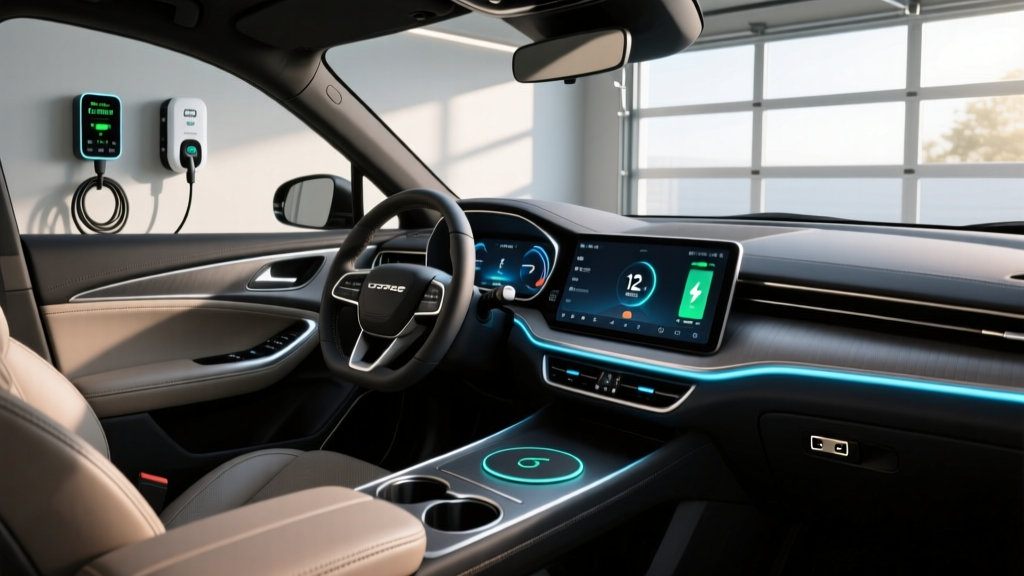
The Dodge Charger EV interior is dominated by a 12.3-inch digital instrument cluster and a 12.3-inch Uconnect 5 infotainment touchscreen, angled toward the driver. The Uconnect 5 system includes native EV-specific features: real-time energy flow visualization, charge scheduling, preconditioning settings, and a built-in route planner that integrates charging stops for longer trips.
Preconditioning matters. The Charger Daytona's battery thermal management system can warm or cool the pack before you arrive at a DC fast charger — either automatically when a charging stop is set in navigation, or manually via the app. A preconditioned battery charges significantly faster in cold weather, potentially shaving 10–15 minutes off a 10–80% session in freezing temperatures. Always precondition before fast-charging in winter.
The charge port is located on the driver-side rear quarter panel. The illuminated "Fratzog" logo on the charge door provides a visual state-of-charge indicator — pulsing while charging, solid when complete. The Uconnect app mirrors this with remote monitoring, letting you check SoC, start/stop sessions, and set departure-time preconditioning from your phone.
Federal Tax Credit and Incentive Considerations
The Dodge Charger Daytona EV's eligibility for the §30D federal tax credit (up to $7,500) depends on several factors that shift yearly. As of 2026, key requirements include:
- MSRP cap: Sedans/coupes must have an MSRP ≤ $55,000. The Charger R/T (~$51,590) may qualify; the Scat Pack (~$57,590) likely exceeds the cap.
- Buyer income cap: AGI ≤ $150,000 (single) / $300,000 (joint) for the tax year.
- Battery sourcing: Critical minerals and battery components must meet escalating domestic/free-trade-agreement sourcing percentages. Stellantis has not confirmed full compliance for all Charger trims — verify on the IRS clean vehicle credit list before purchasing.
- Point-of-sale transfer: Eligible buyers can transfer the credit to the dealer for an immediate price reduction at purchase, rather than waiting to claim it on their tax return.
Always confirm current eligibility on the IRS clean vehicle credits page and consult a tax professional. State and utility incentives (typically $500–$2,000 for charger installation) vary by jurisdiction — check your local utility's EV programs and the Alternative Fuels Data Center for details.
Frequently Asked Questions
How much does it cost to install a home EV charger for the Dodge Charger?
Expect $950–$3,000 for a typical installation (equipment + electrician + permit) if your electrical panel has sufficient capacity. If a panel upgrade from 100A to 200A is required, total costs rise to $2,450–$6,500. Always get multiple quotes from licensed electricians and verify that a permit will be pulled.
How fast will each charging level add range to the Charger Daytona?
Level 1 (120V) adds about 3–5 miles per hour — essentially useless for the Charger's 100+ kWh battery. Level 2 (240V, 48A) adds roughly 30–35 miles per hour, fully replenishing overnight. DC fast charging at 175 kW can add ~150+ miles in 15 minutes during the peak portion of the charge curve (roughly 10–50% SoC).
Which connector is compatible with the Dodge Charger EV?
The 2025–2026 Charger Daytona uses CCS1 natively for both AC Level 2 and DC fast charging. A CCS-to-NACS adapter (~$150–$250) unlocks Tesla Supercharger access. CHAdeMO is not compatible. All home Level 2 chargers with J1772 plugs work without adapters.
How much does charging cost per mile vs. gas?
At the national average home electricity rate (~$0.17/kWh), the Charger EV costs about $0.055 per mile to charge. The gas Charger Scat Pack at 18 MPG and $3.50/gallon costs $0.194 per mile. That's a 72% per-mile savings for the EV when charging at home — translating to roughly $2,100–$2,400 saved annually over 15,000 miles.
What electrical upgrades might I need for a Level 2 charger?
You'll need a dedicated 240V circuit rated for 60 amps (for a 48A charger) or 50 amps (for a 40A charger). If your panel is already near capacity — common in older homes with 100A service — an electrician may recommend a panel upgrade to 200A ($1,500–$3,500). A load calculation per NEC Article 220 determines this. Homes with 200A panels and available breaker slots typically need no panel upgrade.
Can I charge the Dodge Charger EV at a Tesla Supercharger?
Yes, with a certified CCS-to-NACS adapter. The Charger can accept up to its 175 kW peak rate on V3 and V4 Superchargers. Confirm adapter compatibility and certification before purchase, as not all third-party adapters support the full power delivery protocol. Tesla's in-app payment and stall availability make Superchargers the most reliable DC fast-charging network for road trips.
How long does the Charger EV battery last, and what does replacement cost?
Stellantis warranties the battery for 8 years or 100,000 miles (whichever comes first) against capacity loss below ~70%. NMC batteries in liquid-cooled packs like the Charger's typically retain 85–92% capacity after 100,000 miles based on industry degradation data. Full battery replacement (if needed out of warranty) is estimated at $12,000–$18,000 including labor, though prices are expected to decline as battery costs continue to fall through 2026 and beyond.
Bottom line: The Dodge Charger Daytona EV rewards owners who invest in proper home charging infrastructure. A 48-amp Level 2 station on a dedicated 60-amp circuit delivers full overnight replenishment at a fraction of the gas V8's fuel cost. Budget $1,000–$3,000 for installation, pick up a CCS-to-NACS adapter for road trips, and use the Uconnect 5 preconditioning features to maximize charging speed. The Charger EV interior's tech is impressive, but the real ownership advantage lives in your garage.