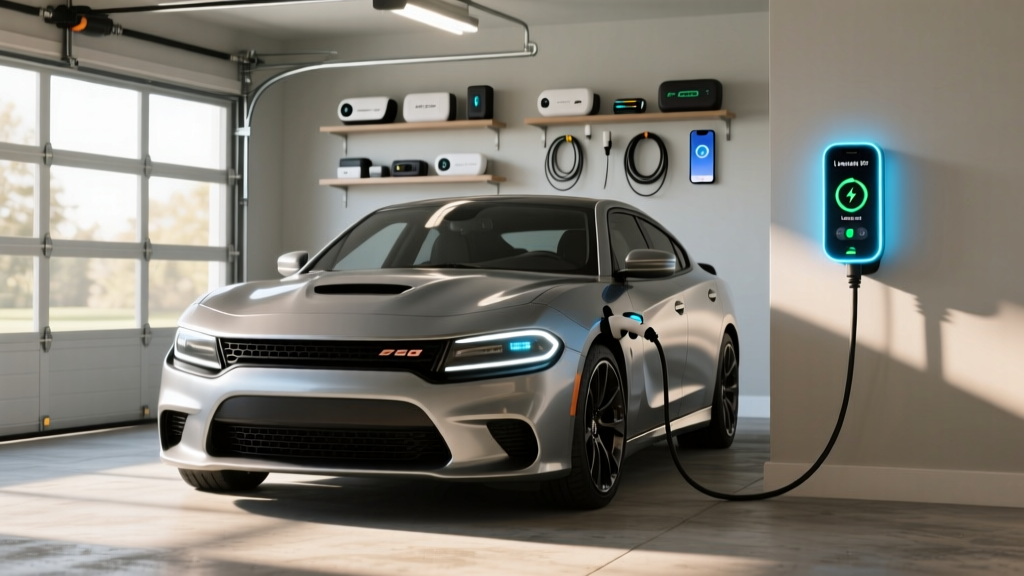
The 2025 Dodge Charger Daytona EV didn't just enter the electric muscle segment — it redefined expectations. With a 0-60 mph time of 3.3 seconds in the Scat Pack trim and a 100 kWh battery pack, this is a heavy, high-performance EV that demands serious charging infrastructure. If you're considering the Charger EV, understanding the dodge charger ev 0-60 performance is only half the equation. The other half is whether your home electrical system, local public chargers, and wallet can keep up with a 100 kWh battery.
This guide covers everything you need to charge a Dodge Charger EV at home and on the road — from panel upgrades and Level 2 installation costs to DC fast-charging curves and real-world cost-per-mile math.
Dodge Charger EV Performance and Battery Specs at a Glance
Before planning your charging setup, you need the exact numbers that dictate your infrastructure requirements. The Charger Daytona comes in two primary configurations for 2025–2026:
| Spec | Daytona R/T | Daytona Scat Pack |
|---|---|---|
| 0-60 mph | 4.7 seconds | 3.3 seconds |
| Horsepower | 496 HP | 670 HP |
| Battery (usable) | ~100 kWh (NMC) | ~100 kWh (NMC) |
| EPA Range | 317 miles | 260 miles |
| Real-World Range (highway) | ~260–280 miles | ~210–230 miles |
| Max DC Fast Charge | ~175 kW peak | ~175 kW peak |
| 10–80% DCFC Time | ~27 minutes | ~27 minutes |
| Level 2 Charge Rate | 11.5 kW (48A) | 11.5 kW (48A) |
| Connector | CCS1 (NACS adapter avail.) | CCS1 (NACS adapter avail.) |
| Base MSRP | ~$59,590 | ~$73,590 |
| Battery Warranty | 8 yr / 100,000 mi | 8 yr / 100,000 mi |
Charging Levels Explained: kW, Miles Per Hour, and Your Charger EV
Understanding the difference between kW (power — the rate of energy delivery) and kWh (energy — the battery's total capacity) is the single most important concept in EV ownership. Think of kW as the flow rate of a hose and kWh as the size of the bucket. A 100 kWh battery charged at 10 kW takes roughly 10 hours from empty; at 100 kW, roughly one hour.
| Charging Level | Voltage / Amperage | Power (kW) | Miles Added/Hour | Charger EV 10–80% Time |
|---|---|---|---|---|
| Level 1 (120V outlet) | 120V / 12A | ~1.4 kW | ~3–4 mi/hr | ~55+ hours (impractical) |
| Level 2 (240V home) | 240V / 48A | 11.5 kW | ~28–35 mi/hr | ~7 hours (0–100%) |
| DC Fast Charging | 400V+ / variable | Up to 175 kW peak | ~350–500 mi/hr (peak) | ~27 min (10–80%) |
For a 100 kWh battery like the Charger Daytona's, Level 1 charging is effectively useless for daily needs — it would take multiple days to recover a full charge. Level 2 is the minimum practical home solution. DC fast charging is for road trips, with the understanding that peak kW rates only hold through the middle of the charge curve before tapering above 80% State of Charge (SoC) to protect battery health.
Home Level 2 Charger Installation: Costs, Electrical Requirements, and Panel Upgrades
The Charger Daytona's onboard charger accepts up to 11.5 kW (48 amps) on Level 2. To deliver that, you need a 240V circuit rated for at least 60 amps (EV chargers are considered continuous loads under the National Electrical Code, meaning the circuit must be rated at 125% of the charger's maximum draw: 48A × 1.25 = 60A).
Electrical Requirements for a 48-Amp Level 2 Charger
- Circuit: Dedicated 60-amp, 240V breaker
- Wire gauge: 6 AWG copper (or 4 AWG aluminum)
- Outlet or hardwire: NEMA 14-60 receptacle or direct hardwire (hardwire preferred for 48A+)
- GFCI protection: Required by NEC 2020+ for EV receptacles; hardwired units have built-in ground-fault protection
- Permit: Required in most jurisdictions — typically $50–$200
Installation Cost Breakdown
| Component | Simple Install (panel nearby) | Complex Install (panel far / upgrade needed) |
|---|---|---|
| Level 2 Charger (hardware) | $400–$700 | $400–$700 |
| Electrician labor (2–6 hrs) | $300–$600 | $800–$2,000 |
| Electrical permit | $50–$150 | $50–$200 |
| Panel upgrade (100A → 200A) | N/A | $1,500–$3,500 |
| Conduit / wiring materials | $100–$300 | $300–$800 |
| Total Estimated Cost | $850–$1,750 | $3,050–$7,200 |
Connector Compatibility: CCS1, NACS, and Charger EV Adapter Options
The 2025–2026 Dodge Charger Daytona ships with a CCS1 (Combined Charging System) port. This is the legacy standard used by most non-Tesla EVs. However, the industry has shifted decisively toward NACS (North American Charging Standard), and Stellantis has confirmed future models will adopt NACS natively.
| Connector Type | Used By | Charger EV Compatibility | Adapter Needed? |
|---|---|---|---|
| CCS1 | Ford (2024-), GM (2024-), VW, Hyundai, Stellantis | Native port | No — direct plug |
| NACS (Tesla) | Tesla, Ford (2025+), GM (2025+), Rivian, others | Via adapter | Yes — CCS-to-NACS adapter (~$200–$250) |
| CHAdeMO | Nissan Leaf (legacy), Mitsubishi | Not compatible | N/A — network is declining |
What this means practically: At Electrify America, EVgo, and ChargePoint DCFC stations with CCS cables, you plug directly in. To access Tesla Superchargers (which now welcome non-Tesla EVs at many locations via the "Magic Dock" or your own adapter), you'll need a CCS-to-NACS adapter. Stellantis is expected to offer one through Mopar. Keep one in the frunk.
Cost to Charge the Dodge Charger EV: Home vs. Public vs. Gas Comparison
A 100 kWh battery is large. Charging costs vary dramatically depending on where and when you plug in. Here's the real math for the Charger Daytona R/T (EPA-rated ~317 miles, real-world ~270 highway):
| Charging Scenario | Rate ($/kWh) | Cost for 0–100% (100 kWh) | Cost Per Mile (270 mi real) |
|---|---|---|---|
| Home off-peak (utility TOU) | $0.08–$0.12 | $8.00–$12.00 | $0.03–$0.04 |
| Home standard rate | $0.14–$0.18 | $14.00–$18.00 | $0.05–$0.07 |
| Public Level 2 (ChargePoint, etc.) | $0.20–$0.35 | $20.00–$35.00 | $0.07–$0.13 |
| DC Fast Charging (EA, EVgo) | $0.35–$0.55 | $35.00–$55.00 | $0.13–$0.20 |
| Gas equivalent (25 MPG, $3.40/gal) | — | $36.72 | $0.14 |
The takeaway: Home off-peak charging is roughly 70–75% cheaper per mile than gasoline. Even at standard residential rates, you're saving 50–60%. But exclusive reliance on DC fast charging can approach or exceed gas costs on a per-mile basis — which is why home Level 2 is non-negotiable for daily ownership economics.
Time-of-use (TOU) plans from your utility can dramatically reduce costs. Many utilities offer EV-specific rates with off-peak windows from 11 PM to 6 AM at $0.08–$0.10/kWh. Schedule your charger accordingly.
Best Level 2 Home Chargers for the Dodge Charger Daytona (2025–2026 Picks)
To max out the Charger's 11.5 kW onboard charger, you need a 48-amp Level 2 unit on a 60-amp circuit. Here are three proven options that match the Charger Daytona's needs:
Emporia Level 2 Smart Charger
- Power Output: 48A / 11.5 kW (240V)
- Connector: CCS1 (J1772 + CCS combo)
- Cable Length: 24 feet
- Smart Features: Wi-Fi, app scheduling, energy monitoring, solar integration, TOU optimization
- Installation: Hardwire required (recommended for 48A)
- Price: ~$400
- Why it works: Best value 48A charger with excellent energy tracking — useful for monitoring the Charger's large battery draws
ChargePoint Home Flex
- Power Output: Up to 50A / 12 kW (adjustable 16–50A)
- Connector: CCS1 (J1772 + CCS combo)
- Cable Length: 23 feet
- Smart Features: Wi-Fi, app, Alexa integration, flexible amperage for older panels
- Installation: NEMA 14-50 plug or hardwire
- Price: ~$550–$700
- Why it works: Adjustable amperage lets you dial down to 32A (40A circuit) if your panel can't support 60A — no upgrade needed
Tesla Wall Connector (with CCS adapter)
- Power Output: 48A / 11.5 kW (240V, 60A circuit)
- Connector: NACS native (CCS1 requires separate adapter on vehicle side)
- Cable Length: 24 feet
- Smart Features: Wi-Fi, OTA updates, power sharing with second unit, load management
- Installation: Hardwire only
- Price: ~$475
- Why it works: If you also own a Tesla or plan to go NACS in the future, this future-proofs your garage. Use a CCS-to-NACS adapter on the Charger's port.
DC Fast Charging on the Road: Charger Daytona Charge Curve Reality
The Charger Daytona's ~175 kW peak DC fast-charge rate is competitive but not class-leading. More importantly, peak kW tells only part of the story. Here's what actually happens during a charging session:
- 10–40% SoC: The charger ramps to peak (~175 kW), adding roughly 6–7 miles per minute
- 40–60% SoC: Sustains near-peak, averaging ~155–165 kW
- 60–80% SoC: Tapers to ~100–120 kW to manage battery temperature
- 80–100% SoC: Sharp taper below 50 kW — the final 20% can take as long as the first 70%
This is why the industry standard metric is 10–80% time (~27 minutes for the Charger Daytona). For road trips, charge to 80% and go. The last 20% is only worth pursuing if you're at your overnight destination.
Safety, Code, and Installation Best Practices
EV charging involves sustained high-current draws that push residential electrical systems harder than most household appliances. Follow these non-negotiable safety requirements:
- Dedicated circuit: Your Level 2 charger must have its own dedicated breaker — never share a circuit with other appliances
- Continuous load rule: NEC defines EV charging as a continuous load. A 48A charger requires a 60A breaker (48 × 1.25 = 60)
- GFCI protection: NEC 2020 (Article 625.54) requires GFCI protection for EV receptacles. Hardwired chargers include internal ground-fault protection
- Outdoor rating: If installing outdoors, ensure the charger carries a NEMA 4 or NEMA 4X rating for weather resistance
- Permit and inspection: Always pull an electrical permit. A post-installation inspection by your local authority having jurisdiction (AHJ) verifies code compliance and protects your homeowner's insurance coverage
- Use a licensed electrician: DIY 240V work is dangerous and may void insurance. Always hire a licensed, insured electrician familiar with NEC Article 625 (EV charging)
Frequently Asked Questions
How much does it cost to install a home EV charger for the Dodge Charger EV?
For a straightforward installation with an adequate electrical panel nearby, expect $850–$1,750 total (charger hardware + electrician + permit). If your home needs a panel upgrade from 100A to 200A, costs rise to $3,050–$7,200. Get a load calculation from a licensed electrician before committing.
How fast will each charging level add range to the Charger Daytona?
Level 1 (120V) adds roughly 3–4 miles per hour — impractical for a 100 kWh battery. Level 2 (240V, 48A) adds approximately 28–35 miles per hour, fully charging overnight in about 7–8 hours. DC fast charging at peak rates adds 350–500 miles per hour but is limited to ~27 minutes for a 10–80% session.
Which connector is compatible with the Dodge Charger EV?
The 2025–2026 Charger Daytona uses a CCS1 connector natively. This works directly with Electrify America, EVgo, and ChargePoint DCFC stations. For Tesla Supercharger access, you'll need a CCS-to-NACS adapter (approximately $200–$250 from Mopar or third-party suppliers). CHAdeMO is not compatible.
How much does charging the Charger EV cost per mile compared to gas?
At home off-peak rates ($0.08–$0.12/kWh), the Charger Daytona costs approximately $0.03–$0.04 per mile — roughly 70–75% less than a comparable 25 MPG gas muscle car at $3.40/gallon ($0.14/mile). Even at DC fast-charging rates ($0.35–$0.55/kWh), per-mile costs ($0.13–$0.20) are comparable to or slightly above gasoline.
What electrical upgrades might I need for a 48-amp Level 2 charger?
The most common upgrade is a panel replacement from 100A to 200A service ($1,500–$3,500). You may also need a new dedicated 60-amp breaker slot, upgraded service conductors, or a sub-panel if your main panel is full. Homes with 200A+ service and open breaker slots typically need no panel upgrade. A licensed electrician's load calculation is the definitive answer.
Does the Dodge Charger EV qualify for the federal tax credit?
As of 2025–2026, the §30D federal EV tax credit has strict requirements including buyer income caps ($150K single / $300K joint), vehicle MSRP caps ($55K sedans — which excludes the Charger Daytona at ~$59K+), and battery critical-mineral sourcing rules. The Charger Daytona R/T and Scat Pack currently exceed the sedan MSRP cap, making them ineligible for the full $7,500 credit. Always verify current rules at IRS.gov and consult a tax professional.
Can I use a portable Level 2 charger instead of a wall-mounted unit?
Yes, but with caveats. Portable Level 2 units (like the Lectron V-Box or Emporia portable) can plug into a NEMA 14-50 outlet and deliver up to 40A (9.6 kW) — slightly less than the Charger's 48A maximum. You'll need a dedicated 50-amp circuit for the receptacle. Portable units offer flexibility if you move or need to charge at multiple locations, but wall-mounted hardwired units are safer and support the full 48A draw.