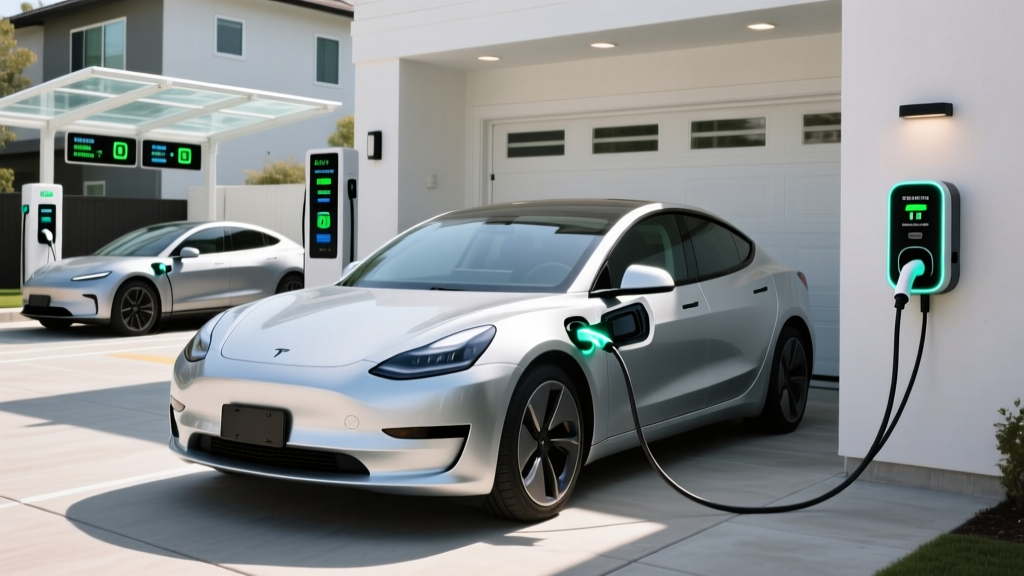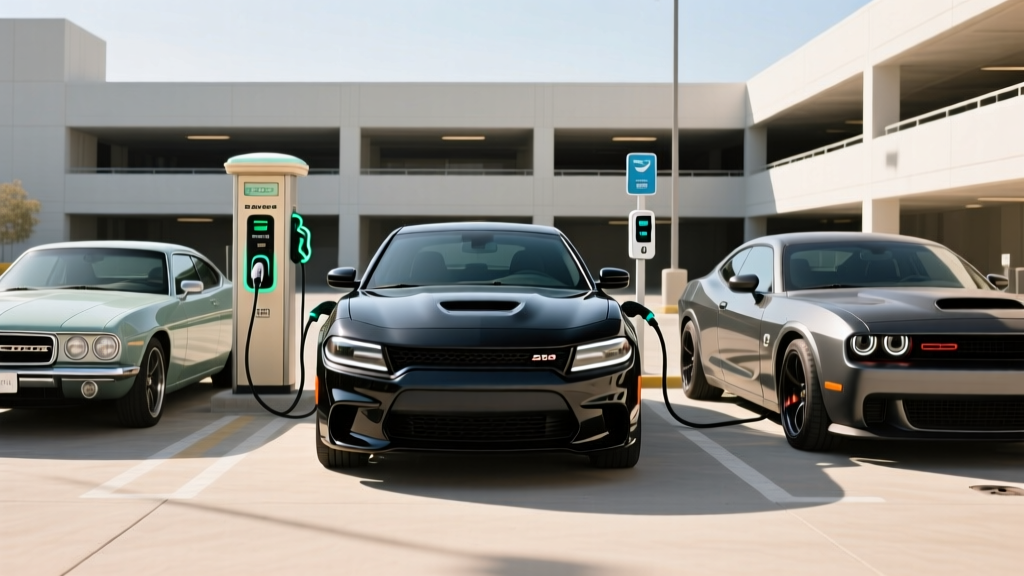
If you're cross-shopping a used Dodge Challenger, a gas Charger, or the new 2026 Dodge Charger EV (Daytona), the charging conversation is the single biggest ownership variable. The Challenger ended production after the 2023 model year, the gas Charger is gone too, and the all-electric Charger Daytona is now on dealer lots with Stellantis' 800-voltage architecture, NACS ports, and up to 319 miles of EPA range. This guide breaks down exactly what it takes to charge the Charger EV at home and on the road — and how that compares to fueling the last of the HEMI Challengers.
Charger EV vs Challenger: The Power and Energy Primer
Before we talk charging hardware, we have to get the units right, because this is where most EV newcomers trip. kW (kilowatts) measures power — the rate at which energy flows into the battery, like the flow rate of a gas pump nozzle. kWh (kilowatt-hours) measures energy — the total amount stored in the battery, like gallons in a fuel tank. The 2026 Dodge Charger Daytona Scat Pack carries a 100.6 kWh (gross) lithium-ion NMC battery pack, while the R/T trim uses the same pack with different software tuning. You fill that pack using kW, and you drive using kWh.
For context against the discontinued Challenger: a 2023 Dodge Challenger R/T Scat Pack with the 6.4L HEMI and a 18.5-gallon tank cost roughly $65 to fill at $3.50/gallon and delivered about 330 miles of real-world range (EPA combined 18 mpg). The Charger Daytona Scat Pack, EPA-rated at 260 miles, costs about $13 to "fill" on home electricity at $0.13/kWh — but takes longer. That time gap is what the rest of this guide is about solving.
Charging Levels Explained: Speeds, kW, and Miles Per Hour
Every Charger EV owner will interact with three charging tiers. Here's what each actually delivers, measured in both kW and the more practical "miles of range added per hour":
| Level | Voltage | Max Power (kW) | Miles of Range/Hour | Typical Use Case |
|---|---|---|---|---|
| Level 1 (120V) | 120V AC | 1.4 kW | ~4-5 mi/hr | Emergency top-off, low-mileage days |
| Level 2 (240V) | 240V AC | 11.5 kW (onboard limit) | ~34-38 mi/hr | Home daily charging, workplace |
| DC Fast Charge | 200-500V DC | ~175 kW peak | ~150-400 mi/hr (curve dependent) | Road trips, highway corridors |
Two real-world caveats: the Charger Daytona's onboard AC charger caps at 11.5 kW, so a 48-amp home wallbox is the sweet spot. And the DC fast-charge peak of ~175 kW only holds from roughly 10% to 45% state of charge before tapering — expect a 10-80% session in about 27 minutes on a functioning 350 kW CCS/NACS station, per Dodge's published figures.
Home Level 2 Installation: Electrical Requirements and Real Costs
Most Charger EV owners will want a 240V Level 2 wallbox in the garage. Here's what that actually requires electrically and financially.
Electrical Requirements
- Circuit: Dedicated 60-amp breaker (to deliver 48 amps continuous, per NEC 80% rule)
- Wire: 6 AWG copper (THHN in conduit or 6/2 NM-B Romex for short indoor runs)
- Panel capacity: You need at least 60 amps of spare capacity on your main service panel. A 200-amp panel serving a modern home with gas appliances usually has room; a 100-amp panel in an older home almost certainly does not.
- Permit: Required in virtually every US jurisdiction — typically $50-$200, and it triggers an inspection.
- GFCI: NEC 2020+ requires GFCI protection on 240V EV circuits in garages; quality wallboxes include this internally.
Panel Upgrade: The Hidden Cost
If your home has a 100-amp service or your panel is already near capacity (electric range, dryer, HVAC, water heater), you'll need either a panel upgrade to 200 amps ($2,500-$5,000) or a load-management device like the Emporia Smart Load Center or Span panel that dynamically shares amperage between the EVSE and other circuits. Skipping this assessment is the #1 reason EV charger installs balloon past initial quotes.
Installation Cost Breakdown
| Line Item | Low End | High End | Notes |
|---|---|---|---|
| Level 2 EVSE hardware (48A, 24ft cable) | $450 | $750 | ChargePoint Home Flex, Emporia Level 2, Wallbox Pulsar Plus |
| Electrician labor (2-6 hours) | $400 | $1,800 | Varies with run length, conduit, drywall work |
| Materials (wire, conduit, breaker) | $100 | $400 | Long runs in conduit cost more |
| Permit & inspection | $50 | $250 | Municipality dependent |
| Panel upgrade (if needed) | $2,500 | $5,000 | 100A → 200A service upgrade |
| Total (no panel upgrade) | $1,000 | $3,200 | Most homes with 200A service |
| Total (with panel upgrade) | $3,500 | $8,200 | Older homes, 100A service |
The federal Residential Clean Energy Credit (IRS §25D) does NOT cover EV chargers after 2022. However, the Alternative Fuel Vehicle Refueling Property Credit (§30C) offers up to $1,000 (30% of hardware + install, capped) for home charger installs in eligible census tracts — check your zip code against IRS guidance, as eligibility is location-specific and tied to low-income or non-urban census tracts.
Connector Compatibility: NACS, CCS, and the Charger EV
The 2026 Dodge Charger Daytona ships with a NACS (Tesla-style) charge port, reflecting Stellantis' decision to adopt the North American Charging Standard across its EV lineup. This is a significant practical advantage: it grants native access to Tesla Superchargers (the most reliable DC fast-charging network in North America) without an adapter.
| Connector | Native Support? | Adapter Needed? | Network Access |
|---|---|---|---|
| NACS (Tesla) | Yes (native port) | No | Tesla Supercharger, Electrify America (NACS stalls) |
| CCS1 (legacy) | Via adapter | NACS-to-CCS adapter (~$150-$200) | Older Electrify America, EVgo, ChargePoint DC stalls |
| CHAdeMO | No | Not practically available | Nissan Leaf legacy — effectively obsolete for this vehicle |
| J1772 (Level 2 public) | Via adapter | NACS-to-J1772 adapter (usually included) | Public Level 2 at malls, workplaces, hotels |
If you're coming from a Challenger or gas Charger, think of the NACS port like having a universal fuel filler — it works at the most stations. CCS1 is being phased out at new station deployments, so NACS-native vehicles like the Charger Daytona will have an expanding access advantage through the late 2020s.
Charging Cost Per Mile: Charger EV vs Challenger vs Gas Charger
This is where the math tips hard toward electric, depending on how and where you charge. Below are real scenarios based on the Charger Daytona R/T's efficiency of approximately 3.0 mi/kWh (roughly 111 MPGe combined per fueleconomy.gov) and the 2023 Challenger R/T's 18 mpg combined.
| Scenario | Cost/kWh or Gallon | Cost Per Mile (Charger EV) | Cost Per Mile (Challenger 6.4L) |
|---|---|---|---|
| Home charging (off-peak utility rate) | $0.11/kWh | $0.037 | — |
| Home charging (national avg residential) | $0.17/kWh | $0.057 | — |
| Public Level 2 (ChargePoint, etc.) | $0.30/kWh | $0.10 | — |
| DC Fast Charge (Electrify America) | $0.48/kWh | $0.16 | — |
| Gasoline (national avg, regular) | $3.20/gal | — | $0.178 |
| Gasoline (premium required, 91 octane) | $3.70/gal | — | $0.206 |
The takeaway: home charging delivers fuel cost at roughly 20-30% of what a Challenger's HEMI demands. Even DC fast charging on the road is cheaper per mile than premium gasoline. The break-even point — where public DC charging costs more than gas — only happens at rates above $0.60/kWh, which is rare but does exist at some airport and convenience-store chargers.
Charging Time Examples: What to Expect With the Charger Daytona's 100.6 kWh Pack
The Charger Daytona's large battery means longer fill times than smaller EVs. Here are realistic charging durations from various states of charge:
- Level 1 (120V, 1.4 kW): 10% → 80% takes approximately 50 hours. Only viable for overnight trickle when you've driven less than 40 miles that day.
- Level 2 (240V, 48A / 11.5 kW): 10% → 80% takes approximately 6 hours. Plug in at 10 PM, full by 4 AM. This is the daily-driver sweet spot.
- Level 2 (240V, 32A / 7.7 kW): 10% → 80% takes approximately 9 hours. Acceptable if your charger or circuit is limited, but you'll want to plug in earlier.
- DC Fast Charge (~175 kW peak): 10% → 80% in approximately 27 minutes. Note the charge curve: the first 20% fills rapidly (peak kW), then tapers significantly above 60% SoC to protect battery longevity.
- DC Fast Charge, 80% → 100%: Add another 25-30 minutes. The taper is steep — only pursue a full fill on road trips when your next leg demands it.
Preconditioning matters. The Charger Daytona's thermal management system will precondition the battery when you navigate to a DC fast charger via the infotainment system. This warms the pack to optimal temperature and can reduce your 10-80% time by 5-8 minutes, especially in cold weather. Skipping preconditioning in sub-40°F temperatures can cut peak charge rate by 30-40%.
Recommended Home Charging Equipment (2026)
For the Charger Daytona's 11.5 kW onboard charger, you want a 48-amp, 240V hardwired wallbox. Here are three proven options that match the vehicle's capabilities:
ChargePoint Home Flex (NACS)
- Power: Up to 12 kW (50A) — covers the Charger's 11.5 kW onboard limit
- Connector: NACS native (2025+ models)
- Cable length: 24 feet
- Smart features: Wi-Fi, app scheduling, utility demand-response integration, Alexa
- Price: ~$699 (hardware only)
- Best for: Reliable daily driver with excellent app and scheduling
Emporia Level 2 EV Charger
- Power: Up to 11.5 kW (48A)
- Connector: NACS or J1772 (select at purchase)
- Cable length: 24 feet
- Smart features: Wi-Fi, solar integration (pairs with Emporia Vue energy monitor), load management
- Price: ~$449 (hardware only)
- Best for: Budget-conscious buyers, solar-home owners, panel-load management
Wallbox Pulsar Plus (NACS)
- Power: Up to 11.5 kW (48A)
- Connector: NACS (2025+ revision)
- Cable length: 25 feet
- Smart features: Wi-Fi + Bluetooth, Power Sharing (daisy-chain two units on one circuit), app control
- Price: ~$599 (hardware only)
- Best for: Two-EV households sharing a single 60A circuit
All three are NEMA 4-rated (indoor/outdoor) and should be hardwired by a licensed electrician rather than plugged into a 14-50 outlet — hardwired connections eliminate a common failure point and satisfy most local code requirements without GFCI breaker complications.
Safety, Code, and Installation Best Practices
A few non-negotiable rules for any Charger EV home charging setup:
- Dedicated circuit only. Never share the EVSE circuit with another appliance. A 60A breaker serving only the charger is the standard.
- Hardwired over plug. A 14-50 receptacle is code-legal in many areas but requires a GFCI breaker ($100-$150 extra) that can nuisance-trip. Hardwired installs avoid this and are more reliable long-term.
- Outdoor rating. If your install is on an exterior wall or in an uncovered carport, the EVSE must be NEMA 4 (weatherproof). All three units above qualify.
- Cable management. A 24-25 foot cable is long enough for most garages. Mount the holster at bumper height to avoid dragging the cable on concrete, which degrades insulation over time.
- Permit and inspect. Unpermitted EVSE installs can void homeowner's insurance claims related to electrical fire. The $50-$200 permit is cheap protection.
- Utility notification. Many utilities offer EV-specific time-of-use (TOU) rates that drop overnight charging to $0.08-$0.11/kWh. Call your utility before install — some require a separate meter or smart thermostat integration to qualify.
Frequently Asked Questions
How much does it cost to install a home EV charger for the Dodge Charger EV?
Expect $1,000-$3,200 for a straightforward install on a 200-amp panel with a short wire run. Older homes needing a panel upgrade to 200A should budget $3,500-$8,200 total. The hardware itself (a quality 48A NACS wallbox) runs $450-$750.
How fast will each charging level add range to the Charger Daytona?
Level 1 (120V) adds about 4-5 miles per hour. Level 2 (240V, 48A) adds roughly 34-38 miles per hour. DC fast charging at peak rate adds the equivalent of 150+ miles in 15 minutes, but only in the 10-45% SoC window before tapering.
Which connector is compatible with the 2026 Charger EV?
The Charger Daytona uses a native NACS port, giving it direct access to Tesla Superchargers and new NACS-equipped Electrify America stations. For legacy CCS1 stations, you'll need a NACS-to-CCS adapter. A NACS-to-J1772 adapter (typically included with the vehicle) handles public Level 2 chargers.
How much does charging the Charger EV cost per mile vs fueling a Challenger?
Home charging at the national average ($0.17/kWh) costs roughly $0.057/mile. A 2023 Challenger R/T on premium gasoline costs about $0.206/mile. Even the most expensive public DC fast charging ($0.48/kWh) comes in at $0.16/mile — still below the Challenger's fuel cost.
What electrical upgrades might I need for a home charger?
The most common upgrade is a panel capacity assessment. If your main panel is 100A or near capacity, you'll need a 200A service upgrade ($2,500-$5,000). Alternatives include smart load-management devices that share amperage dynamically between the EVSE and heavy appliances like electric dryers or ranges.
Does the Charger EV battery warranty cover degradation?
Stellantis covers the Charger Daytona's high-voltage battery for 8 years / 100,000 miles (10 years / 150,000 miles in CARB states like California, New York, and Massachusetts), warranting it against capacity loss below 70% of original. This is industry-standard and consistent with NHTSA-tracked EV warranty norms.
Is the Charger Daytona eligible for the $7,500 federal EV tax credit?
Eligibility under IRS §30D depends on MSRP caps (sedans must be under $55,000 — the Charger Daytona R/T starts at $51,990 and may qualify, while the Scat Pack at $61,990 exceeds the cap), buyer income limits ($150K single / $300K joint AGI), and battery critical-mineral and component sourcing rules that shift annually. The point-of-sale transfer option allows dealers to apply the credit as a down-payment reduction if you qualify. Always verify current-year eligibility with your tax professional before purchasing.