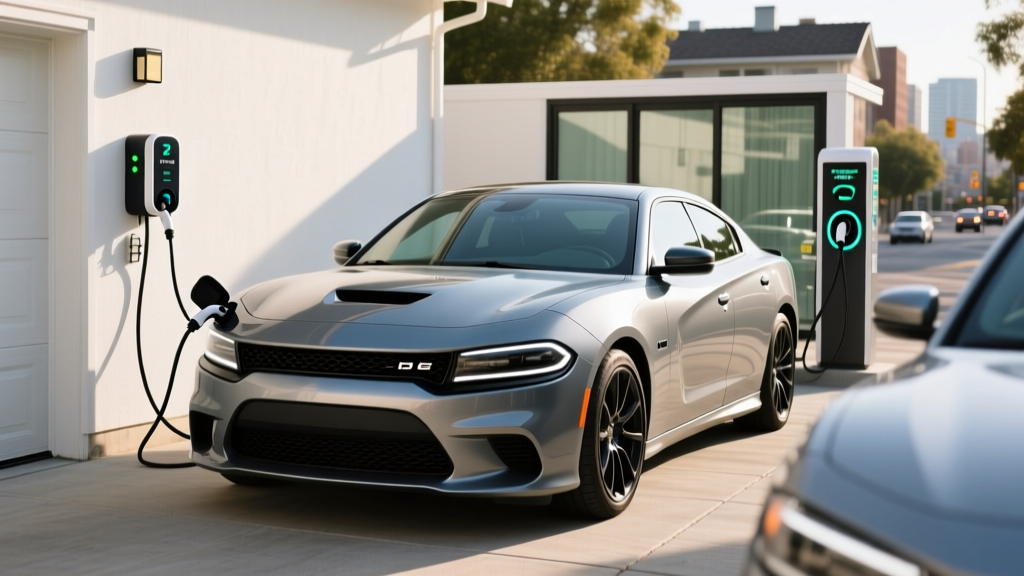
The Dodge Charger Daytona has rewritten the muscle-car playbook, trading the 5.7L HEMI V8 for an 800-volt architecture, up to 670 horsepower, and a 100.5 kWh (gross) battery pack. But owning an electric muscle car means mastering a new kind of refueling — one measured in kilowatts, charge curves, and connector types instead of octane ratings and fuel-pump nozzles.
Whether you've just taken delivery of a 2025 Charger Daytona R/T or Scat Pack, or you're researching before you buy, this guide covers every charging scenario you'll face: Level 1 trickle, Level 2 home, and DC fast charging on the road. We'll break down exact costs, equipment picks, electrical requirements, and what you can realistically expect from each session.
kW (kilowatts) = the rate of power delivery, like water pressure from a hose. A 150 kW DC fast charger delivers energy quickly.
kWh (kilowatt-hours) = the total amount of energy stored, like the size of a water tank. The Charger Daytona's battery holds roughly 100.5 kWh gross (~93 kWh usable).
Mixing these up is the single most common EV mistake. We'll keep them precise throughout this guide.
Charging Levels Explained: Speeds in kW and Miles Per Hour
There are three ways to put electrons into the Charger Daytona's battery. Each serves a different purpose in your ownership routine.
| Level | Voltage / Amperage | Power (kW) | Miles of Range Added per Hour | Best Use Case |
|---|---|---|---|---|
| Level 1 (120V) | 120V / 12A | ~1.4 kW | ~4-5 miles/hr | Overnight top-off, emergencies |
| Level 2 (240V) | 240V / 32A-48A | 7.7-11.5 kW | ~25-38 miles/hr | Daily home charging |
| DC Fast Charging | 400-800V DC | Up to ~175 kW peak | ~500+ miles/hr (at peak) | Road trips, rapid top-ups |
The Charger Daytona's onboard charger accepts up to 11.5 kW on Level 2 AC — meaning a 48-amp, 240-volt circuit will max out its AC capability. On DC fast charging, the 800-volt architecture enables peak rates approaching 175 kW on capable chargers, though sustained rates taper as the battery fills past 80% state of charge (SoC) to protect cell health.
Home Level 2 Installation: Electrical Requirements, Costs & Panel Upgrades
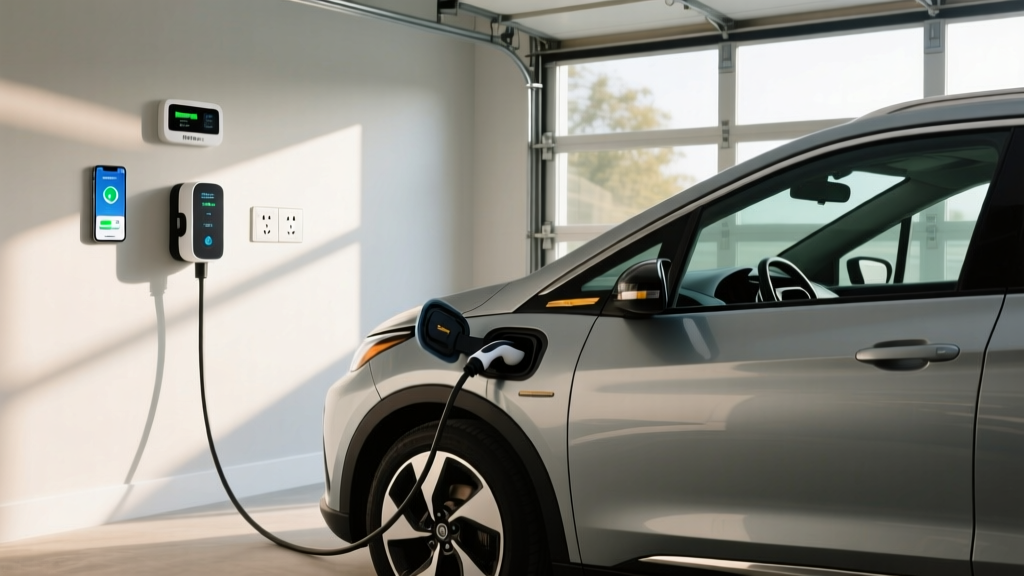
Level 2 home charging is where 85-90% of Charger Daytona owners will do their charging. But installing a 240-volt circuit isn't plug-and-play — it requires a dedicated circuit, proper wire gauge, and potentially a panel upgrade if your home's electrical service is older or undersized.
Electrical Requirements for the Charger Daytona
To take full advantage of the car's 11.5 kW onboard charger, you need a 240V / 48-amp dedicated circuit on a 60-amp breaker (NEC code requires circuits to be rated at 125% of continuous load, so 48A continuous = 60A breaker). If you opt for a 40-amp charger (like the popular ChargePoint Home Flex at 40A), a 50-amp breaker with 6-gauge copper wire will suffice.
Key specs your electrician will confirm:
- Wire gauge: 6 AWG copper for 48A; 8 AWG for 32-40A (verify local code)
- Breaker: 60A double-pole for 48A chargers; 50A for 40A chargers
- Receptacle: NEMA 14-50 (most common) or hardwired connection (often preferred for 48A+)
- GFCI protection: Required by NEC 2020+ for outdoor receptacles; hardwired units may not require a separate GFCI breaker depending on jurisdiction
- Outdoor rating: NEMA 4 or NEMA 4X enclosure if the charger is installed outside or in an exposed garage bay
Do You Need a Panel Upgrade?
This is the question that can turn a $1,200 charger install into a $4,500 project. Here's how to assess:
You likely DON'T need an upgrade if: Your home has a 200-amp (or larger) main service panel with at least 2-4 open breaker slots, and your existing loads (HVAC, electric range, dryer, water heater) don't already consume most of the panel's capacity.
You likely DO need an upgrade if: Your panel is 100-amp service (common in homes built before 1990), your panel is full with no open slots, or you already have multiple high-draw 240V appliances running simultaneously. A panel upgrade to 200A typically costs $1,800-$3,500 depending on your utility and local labor rates.
A licensed electrician will perform a load calculation per NEC Article 220 to determine whether your panel can handle the additional 48A continuous draw. Don't skip this step — an overloaded panel is a fire hazard.
Home Charger Installation Cost Breakdown
| Item | Low Estimate | High Estimate | Notes |
|---|---|---|---|
| Level 2 Charger (Equipment) | $350 | $750 | 40A-48A smart charger, NACS or J1772 |
| Electrician Labor (standard run) | $500 | $1,500 | Depends on wire-run distance from panel to garage |
| Permit & Inspection | $50 | $250 | Varies by municipality |
| Panel Upgrade (if needed) | $1,800 | $3,500 | 100A → 200A service upgrade |
| Total (no panel upgrade) | $900 | $2,500 | Most homes with 200A service |
| Total (with panel upgrade) | $2,700 | $6,000 | Older homes with 100A service |
Some utility companies offer rebates of $250-$500 for Level 2 charger installation, and certain states provide additional incentives. Check your local utility's EV programs before scheduling work.
Connector Compatibility: NACS, CCS1, and What the Charger Daytona Uses
The connector landscape has shifted dramatically. Here's where the Dodge Charger Daytona fits in and what adapters you may need.
| Connector | Type | Used By | Charger Daytona Compatibility |
|---|---|---|---|
| CCS1 (Combined Charging System) | AC + DC | Most non-Tesla EVs (2015-2024) | Native on 2025 Charger Daytona |
| NACS (North American Charging Standard / Tesla) | AC + DC | Tesla; adopted by Ford, GM, Rivian, others (2025+) | CCS-to-NACS adapter required for Supercharger access |
| CHAdeMO | DC only | Nissan Leaf (legacy) | Not compatible; network is declining |
| J1772 | AC only (Level 1/2) | All non-Tesla EVs (AC portion of CCS) | Native (top portion of CCS1 inlet) |
The 2025 Dodge Charger Daytona ships with a CCS1 inlet. This gives you native access to Electrify America, EVgo, ChargePoint DC stations, and any J1772 Level 2 charger. However, as Tesla's Supercharger network — the largest and most reliable DC fast-charging network in North America — opens to non-Tesla vehicles, you'll want a CCS-to-NACS adapter (approximately $200-$250 from approved suppliers like Lectron or A2Z) to access Superchargers that support NACS-equipped non-Tesla vehicles.
Stellantis has signaled future models may adopt NACS natively, but for the current Charger Daytona generation, CCS1 is your native connector. Plan your adapter purchases accordingly.
Cost to Charge: Home vs. Public vs. Gas Comparison
One of the strongest ownership arguments for the Charger Daytona over its gas-powered predecessor is fuel cost — but the savings depend heavily on how and where you charge.
| Scenario | Rate ($/kWh) | Cost for Full Charge (~93 kWh usable) | Cost per Mile |
|---|---|---|---|
| Home — Off-Peak (Time-of-Use) | $0.09-$0.13 | $8.37-$12.09 | $0.03-$0.04 |
| Home — Standard Residential Avg | $0.16 | $14.88 | $0.05 |
| Public Level 2 (workplace, mall) | $0.20-$0.30 | $18.60-$27.90 | $0.06-$0.09 |
| DC Fast Charging (Electrify America, EVgo) | $0.35-$0.55 | $32.55-$51.15 | $0.10-$0.16 |
| Gas Equivalent (2025 Charger 5.7L V8, 19 MPG combined, $3.50/gal) | — | $58.16 (for 317 mi) | $0.18 |
The numbers tell a clear story: home charging at off-peak rates delivers fuel costs at roughly one-fifth the per-mile price of premium gasoline. Even at standard residential rates, you're paying about $0.05/mile versus $0.18/mile for a comparable V8 muscle car. The savings narrow at DC fast-charging rates — which is why home Level 2 is the economic backbone of EV ownership.
For a driver covering 12,000 miles annually and charging 80% at home (off-peak) and 20% at DC fast chargers, the annual fuel cost lands around $540-$720, compared to roughly $2,200 for the gas Charger at 19 MPG and $3.50/gallon. That's $1,500+ in annual fuel savings before factoring in reduced maintenance (no oil changes, fewer brake replacements thanks to regenerative braking).
DC Fast Charging Times: What to Expect on the Road
The Charger Daytona's 800-volt platform is designed for rapid DC charging, but real-world charge times depend on the station's maximum output, ambient temperature, and battery preconditioning.
Here are realistic 10-80% charge time estimates for the Charger Daytona's ~93 kWh usable battery at different charger power levels:
- 350 kW station (e.g., Electrify America ultra-fast): ~27-32 minutes (peak ~175 kW, tapering above 60% SoC)
- 150 kW station (common CCS): ~38-45 minutes
- 50 kW station (older CHAdeMO/CCS): ~90-100 minutes
- Level 2 at 11.5 kW (home or destination): ~8.5 hours for a full 0-100% charge; roughly 6 hours for 10-80%
According to EPA data on fueleconomy.gov, the Charger Daytona achieves approximately 2.8-3.2 kWh/mile depending on trim and driving conditions, which translates to the EPA range estimates of roughly 260-317 miles depending on the R/T or Scat Pack configuration and wheel size.
Recommended Home Chargers for the Charger Daytona
Not all Level 2 chargers are equal. Here are three well-regarded options matched to the Charger Daytona's 11.5 kW onboard charger capability, with specifics on power output, cable length, smart features, and pricing.
ChargePoint Home Flex
- Power Output: Up to 11.5 kW (48A) on 240V/60A circuit; configurable down to 16A
- Connector: J1772 (CCS AC compatible); NACS version available
- Cable Length: 23 feet
- Smart Features: Wi-Fi, ChargePoint app scheduling, Alexa integration, energy tracking, load sharing with second unit
- Price: ~$550-$700
- Best For: Flexible amperage settings; ideal if your panel can't support a full 48A draw
Emporia Vue Smart Home EV Charger
- Power Output: Up to 11.5 kW (48A) hardwired; 9.6 kW (40A) with NEMA 14-50 plug
- Connector: J1772 (NACS version available)
- Cable Length: 24 feet
- Smart Features: Wi-Fi, Emporia app with real-time energy monitoring, solar-integration scheduling, time-of-use optimization
- Price: ~$350-$400
- Best For: Budget-conscious buyers who want full smart features and solar pairing
Tesla Wall Connector (with CCS adapter) / Grizzl-E Smart
- Grizzl-E Smart Power: Up to 11.5 kW (48A) on 240V/60A circuit
- Connector: J1772
- Cable Length: 24 feet
- Smart Features: Wi-Fi, OCPP-compatible, over-the-air firmware updates, usage tracking
- Price: ~$450-$550
- Best For: Durability (IP67 rated, -40°F to 122°F); excellent for unheated garages and outdoor installs
All three chargers are UL-listed (or ETL-listed), support scheduled charging for time-of-use rate optimization, and can be hardwired or plugged into a NEMA 14-50 receptacle. Hardwired installations are generally preferred for 48A chargers because NEMA 14-50 receptacles can overheat under sustained high-amperage loads if not installed to exacting standards — a known issue that has prompted safety advisories from some EV communities.
Safety, Code Compliance & Best Practices
EV charging draws high current for hours at a time — far longer than a dryer or oven cycle. Safety isn't optional.
- Dedicated circuit: Your Level 2 charger must be on its own dedicated breaker. Never share a circuit with another 240V appliance.
- GFCI protection: NEC 2020 and later requires GFCI protection for outdoor EV receptacles. Indoor hardwired installations may be exempt depending on local code amendments — your electrician will confirm.
- Outdoor rating: If installing outside, the charger must carry a NEMA 4 (splash-resistant) or NEMA 4X (corrosion-resistant) rating. The Grizzl-E Smart and ChargePoint Home Flex both meet this requirement.
- Cable management: Use a wall-mounted cable organizer to prevent tripping hazards and connector strain. Never let the cable rest on the ground where vehicles can drive over it.
- Permit & inspection: Most jurisdictions require an electrical permit for a new 240V circuit. The inspection ensures proper wire gauge, breaker sizing, grounding, and GFCI compliance. Skipping the permit can void your homeowner's insurance coverage for electrical fires.
- Don't use extension cords: Never use an extension cord between your charger and the vehicle or between the wall and the charger. This introduces resistance, heat, and fire risk.
Frequently Asked Questions
How much does it cost to install a home EV charger for the Dodge Charger Daytona?
A standard Level 2 installation (equipment + electrician + permit) runs $900-$2,500 for homes with an existing 200-amp panel and a short wire run. If your home needs a panel upgrade from 100A to 200A service, total costs rise to $2,700-$6,000. Always get 2-3 quotes from licensed electricians, and confirm they have specific EV charger installation experience.
How fast will each charging level add range to the Charger Daytona?
Level 1 (120V) adds roughly 4-5 miles of range per hour — adequate for overnight top-offs if you drive less than 40 miles daily. Level 2 (240V, 48A) adds approximately 35-38 miles per hour, easily refilling a full day's driving in 2-3 hours. DC fast charging at a 180+ kW station can add 150+ miles in about 15 minutes at peak rate, though this tapers significantly above 60% SoC.
Which connector does the Dodge Charger Daytona use, and will I need adapters?
The Charger Daytona uses a CCS1 connector for both AC Level 2 and DC fast charging. This works natively with Electrify America, EVgo, and most non-Tesla public chargers. To access Tesla Superchargers (now opening to non-Tesla vehicles), you'll need a CCS-to-NACS adapter (~$200-$250). The CHAdeMO connector (used by older Nissan Leafs) is not compatible and that network is being phased out.
How much does charging cost per mile compared to gas for the Charger Daytona?
At home off-peak rates ($0.10-$0.13/kWh), the Charger Daytona costs roughly $0.03-$0.04 per mile to "fuel." At standard residential rates (~$0.16/kWh), it's about $0.05/mile. A comparable gas-powered Dodge Charger with a V8 at 19 MPG combined and $3.50/gallon fuel costs approximately $0.18/mile. Even DC fast charging at $0.45/kWh comes in at roughly $0.15/mile — still cheaper than premium gasoline. The savings are most dramatic when you charge at home consistently.
What electrical upgrades might I need before installing a home charger?
The most common upgrade is a panel service increase from 100A to 200A, costing $1,800-$3,500. You may also need a new breaker slot (most panels have space, but some older panels are full), upgraded wire from the utility meter to the panel, or a sub-panel in the garage if the main panel is far away. Your electrician's load calculation per NEC Article 220 will identify what's required. Some homeowners also opt for a smart electrical panel (like SPAN) to manage circuit-level loads dynamically, which can avoid a full panel upgrade in some cases.
Does the Dodge Charger Daytona qualify for the federal EV tax credit?
Federal §30D tax credit eligibility depends on the vehicle's MSRP, your adjusted gross income, and battery-component/critical-mineral sourcing requirements. As of current IRS rules, the credit can be up to $7,500 and may be transferred to the dealer as a point-of-sale discount. However, eligibility is highly specific to the buyer's income (capped at $150K single / $300K joint for sedans) and the vehicle's MSRP cap ($55,000 for sedans). The Charger Daytona Scat Pack's MSRP may exceed the sedan cap, while the R/T may qualify — verify current-year rules with a tax professional before relying on the credit in your purchase decision.
Sources: EPA fueleconomy.gov, Stellantis/Dodge official specifications, IRS §30D guidance, NEC 2020/2023 electrical code. All pricing reflects 2025-2026 market estimates and is subject to regional variation.