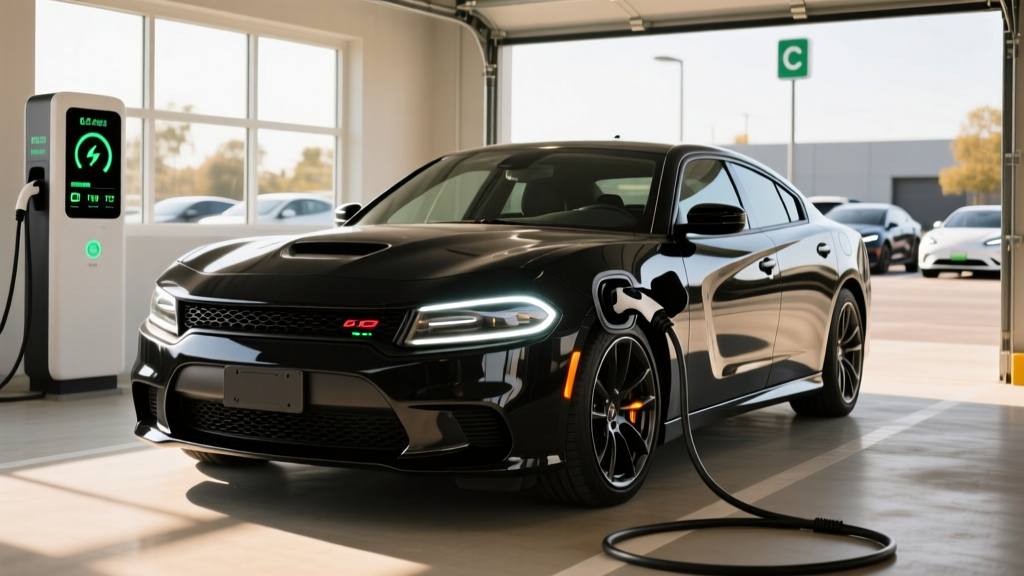
The Dodge Charger Daytona represents a pivotal moment for Stellantis: a muscle-car icon reborn as a battery-electric vehicle on the STLA Large platform. With a 100.5 kWh (usable) battery pack and up to 317 miles of EPA-estimated range on the R/T trim, the Charger EV demands a serious charging strategy. Whether you're eyeing the 496-hp R/T or the 670-hp Scat Pack, understanding how to keep this 5,800-pound coupe charged efficiently at home and on the highway is essential before you sign the paperwork.
This guide covers everything you need to know about charging the Dodge Charger electric lineup — from Level 1 trickle charging to DC fast-charging curves, home installation costs, connector compatibility, and real-world cost-per-mile comparisons against the gas-powered Hellcat it replaces.
Battery: 100.5 kWh usable, NMC chemistry | Max DC charge rate: 175 kW (peak) | Onboard AC charger: 11.5 kW | Connector: CCS1 (NACS adapter available) | EPA range: 317 mi (R/T), 260 mi (Scat Pack) | 0-60 mph: 4.7s (R/T), 3.3s (Scat Pack) | Starting MSRP: ~$51,990 (R/T)
How Each Charging Level Adds Range to the Charger Daytona
Before plugging in, it's critical to understand the difference between kW (kilowatts — the rate of power delivery, like water pressure from a hose) and kWh (kilowatt-hours — the total energy stored, like the size of the bucket). Your Charger's battery holds roughly 100.5 kWh of energy. The kW rating of a charger determines how fast that bucket fills.
Here's how the three charging levels translate into real-world range recovery for the Dodge Charger Daytona, based on its average efficiency of approximately 3.0 miles per kWh (roughly 111 MPGe combined per fueleconomy.gov EPA data):
| Charging Level | Voltage / Amperage | Max Power (kW) | Miles of Range Added Per Hour | 0–100% Full Charge Time |
|---|---|---|---|---|
| Level 1 (120V household) | 120V / 12A | ~1.4 kW | ~4 mi/hr | ~72 hours |
| Level 2 (240V home/public) | 240V / 48A | 11.5 kW (vehicle-limited) | ~34 mi/hr | ~9 hours |
| DC Fast Charging | 400V architecture | 175 kW (peak) | ~525 mi/hr (peak rate) | 10–80% in ~27 min |
Real-world caveat: Level 1 charging at 4 miles per hour is essentially useless as a primary strategy for the Charger Daytona. If you drive 40 miles round-trip daily, you'd need 10 hours plugged into a standard 120V outlet just to recover that range. Level 1 works only for overnight top-offs or emergency trickle charging.
Level 2 at home is the practical baseline. The Charger's 11.5 kW onboard AC charger means that even if you install a 48-amp (11.5 kW) wall unit, you'll max out the vehicle's AC acceptance rate. A full overnight charge from empty is realistic in about 9 hours — perfect for starting every morning with a full battery.
DC fast charging at 175 kW peak sounds impressive, but understand the charge curve: the Charger Daytona will sustain its peak rate roughly between 10% and 40% state of charge, then progressively taper. By 60% SoC, expect the rate to drop to around 100–120 kW, and above 80% it slows dramatically to protect the battery. That 10–80% time of approximately 27 minutes assumes optimal battery preconditioning and a charger capable of delivering the full 175 kW.
Home Charger Installation: Electrical Requirements and Real Costs
Installing a dedicated Level 2 home charger for the Dodge Charger electric isn't a simple plug-and-play affair — especially given the vehicle's large 100.5 kWh battery that benefits from the fastest Level 2 rate you can supply. Here's what your electrician will evaluate:
Electrical Requirements for Optimal Home Charging
- Circuit: Dedicated 60-amp breaker (to support a 48-amp continuous charger load, per NEC 80% rule)
- Wire: 6 AWG copper (or 4 AWG aluminum) for runs up to ~100 feet
- Voltage: 240V single-phase (standard US residential split-phase)
- Outlet option: NEMA 14-60 receptacle (if using a plug-in charger) or hardwired connection (preferred for 48A+ units)
- Panel capacity: Minimum 200-amp service recommended for homes adding a 60A EV circuit alongside existing loads
The Charger Daytona's 11.5 kW onboard charger accepts up to 48 amps continuously. Running a 40-amp circuit (32A continuous / 7.7 kW) will still work but adds roughly 3 hours to a full charge compared to the full 48A setup. For a battery this large, the 60-amp circuit investment is worthwhile.
Home Charger Installation Cost Breakdown
| Cost Component | Simple Install (Panel Adjacent) | Complex Install (Long Run / Upgrade) |
|---|---|---|
| Level 2 Charger Equipment (48A smart unit) | $500–$750 | $500–$750 |
| Electrician Labor (licensed) | $400–$800 | $1,200–$2,500 |
| Electrical Permit | $50–$150 | $50–$200 |
| Wiring & Conduit (6 AWG copper) | $100–$200 | $400–$900 |
| Panel Upgrade (100A → 200A, if needed) | N/A | $1,500–$3,500 |
| Total Estimated Cost | $1,050–$1,900 | $3,650–$7,850 |
Panel upgrade reality check: Homes built before 2000 frequently have 100-amp or 150-amp service panels. Adding a 60-amp EV circuit to a panel already serving electric dryers, ranges, HVAC, and water heaters may exceed safe load calculations. Budget an additional $1,500–$3,500 for a panel upgrade if your electrician determines it's necessary. Always get a professional load calculation before committing — don't assume your panel has headroom.
The IRS §30D credit does not cover home charging equipment for new EV purchases (the previous §30C alternative fuel infrastructure credit expired and was replaced with a commercial-focused credit). However, some utility companies offer rebates of $250–$1,000 for Level 2 charger installations — check with your local provider.
Connector Compatibility: CCS1, NACS, and What the Charger Daytona Uses
The 2025–2026 Dodge Charger Daytona ships with a CCS1 (Combined Charging System) port. This is the standard used across most non-Tesla EVs in North America. However, the industry is rapidly shifting toward the NACS (North American Charging Standard) developed by Tesla, and Stellantis has committed to adopting NACS on future models.
| Connector Type | Native Compatibility | Charger Daytona Access | Adapter Needed? |
|---|---|---|---|
| CCS1 | Yes (native port) | Electrify America, EVgo, ChargePoint DC | No |
| NACS (Tesla) | No (not native) | Tesla Superchargers (open network) | Yes — CCS-to-NACS adapter (~$200–$250) |
| CHAdeMO | No | Legacy stations (phasing out) | Not available — skip these stations |
| J1772 (Level 2 AC) | Yes (CCS includes J1772) | All public Level 2 stations | No |
Practical advice: Buy a CCS-to-NACS adapter (Stellantis-approved or a reputable third-party unit from Lectron or A2Z) to unlock Tesla Supercharger access. As of 2026, Tesla's Supercharger network has over 25,000 stalls in North America — many now open to CCS-equipped vehicles via adapter. This dramatically expands your road-trip charging options, especially in rural corridors where Electrify America coverage is sparse.
For home Level 2 charging, your wall-mounted charger will use a J1772 connector (the top portion of the CCS plug). Any J1772-equipped home charger works natively with the Charger Daytona — no adapter needed.
Charging Cost Per Mile: Charger Daytona EV vs. Gas Hellcat
The financial case for the Dodge Charger electric hinges on fuel cost savings. Here's how the per-mile cost breaks down across different charging scenarios compared to a gasoline Dodge Charger Hellcat (rated at 15 MPG combined):
| Scenario | Rate | Cost Per kWh | Cost Per Mile (Charger EV) | Cost Per Mile (Gas Hellcat @ 15 MPG) |
|---|---|---|---|---|
| Home Off-Peak (utility TOU rate) | $0.09/kWh | $0.09 | $0.030 | $0.233 ($3.50/gal) |
| Home Standard Rate | $0.16/kWh | $0.16 | $0.053 | $0.233 ($3.50/gal) |
| Public Level 2 (ChargePoint, etc.) | $0.25/kWh | $0.25 | $0.083 | $0.233 ($3.50/gal) |
| DC Fast Charging (Electrify America) | $0.48/kWh | $0.48 | $0.160 | $0.233 ($3.50/gal) |
The bottom line: Even at expensive public DC fast chargers ($0.48/kWh), the Charger Daytona costs about $0.16 per mile — still 31% cheaper than the Hellcat at $3.50/gallon. Charge primarily at home on off-peak rates and your fuel cost drops to roughly $0.03/mile, an 87% reduction versus gasoline.
Over 15,000 miles per year, that translates to:
- Home off-peak charging: ~$450/year
- Gas Hellcat (15 MPG, $3.50/gal): ~$3,500/year
- Annual fuel savings: ~$3,050
Over five years, fuel savings alone can offset $15,000+ of the Charger Daytona's higher purchase price — before factoring in reduced maintenance (no oil changes, fewer brake replacements due to regenerative braking).
Recommended Level 2 Home Chargers for the Charger Daytona
To maximize the Charger Daytona's 11.5 kW onboard AC charger, you want a 48-amp Level 2 unit on a 60-amp dedicated circuit. Here are three proven options that match the vehicle's requirements:
Emporia Vue + Level 2 Charger
Power Output: 48A / 11.5 kW (240V)
Connector: J1772 (CCS compatible)
Cable Length: 24 ft
Smart Features: Wi-Fi, energy monitoring via Vue panel integration, scheduled charging, solar-aware charging
Installation: Hardwired (60A circuit)
Price: ~$599 (charger) + installation
Best for: Homes with Emporia Vue energy monitors; solar owners wanting to charge on excess production
ChargePoint Home Flex
Power Output: Up to 50A / 12 kW (configurable 16–50A)
Connector: J1772 (CCS compatible)
Cable Length: 23 ft
Smart Features: Wi-Fi, ChargePoint app scheduling, Alexa integration, flexible amperage settings
Installation: Hardwired or NEMA 14-60 plug
Price: ~$699 (charger) + installation
Best for: Flexibility — adjust amperage to match your circuit capacity without buying a new unit
Wallbox Pulsar Plus (48A)
Power Output: 48A / 11.5 kW (240V)
Connector: J1772 (CCS compatible)
Cable Length: 25 ft
Smart Features: Wi-Fi + Bluetooth, myWallbox app, Power Sharing (two units on one circuit), Eco-Smart solar mode
Installation: Hardwired (60A circuit)
Price: ~$649 (charger) + installation
Best for: Two-EV households needing power sharing; compact form factor
Editor's pick for the Charger Daytona: The ChargePoint Home Flex earns the nod for its configurable amperage. If your panel can't support a full 60A circuit today, you can set the Flex to 40A or 32A and upgrade later without replacing the hardware. The 25-foot cable on the Wallbox is also worth noting if your garage layout requires extra reach.
Safety, Electrical Code, and Installation Best Practices
Level 2 EV charging draws significant continuous current for hours at a time — far longer than most household appliances. Cutting corners on safety is a false economy. Here's what the National Electrical Code (NEC) and best practices require:
- Dedicated circuit: Your EV charger must have its own dedicated breaker — no sharing with other outlets or appliances. A 48A charger requires a 60A breaker (NEC 80% continuous-load rule).
- GFCI protection: The 2020 NEC (Article 625.54) mandates GFCI protection for all EV charging receptacles rated 150V to ground or less and 60A or less. Hardwired chargers may be exempt depending on local code interpretation — confirm with your electrician and AHJ (Authority Having Jurisdiction).
- Outdoor rating: If your charger is mounted outdoors or in an open carport, it must carry a NEMA 4 or IP65 weatherproof rating. All three chargers recommended above meet this standard.
- Wire gauge: 6 AWG copper minimum for 60A circuits. For runs exceeding 100 feet, your electrician may specify 4 AWG to prevent voltage drop — a real efficiency concern that wastes energy and slows charging.
- Permit and inspection: Virtually every jurisdiction requires an electrical permit for a new 240V circuit. The inspection ensures code compliance and protects your home insurance coverage. Skipping permits risks claim denial if a fire originates from unpermitted work.
- Cable management: Use a wall-mounted cable organizer or retractor. A 25-foot charging cable left on a garage floor is a trip hazard and degrades the cable insulation over time.
Public DC Fast Charging: What to Expect on Road Trips
The Charger Daytona's 175 kW peak DC fast-charge rate places it in the mid-tier among 2026 EVs. For context, the Hyundai Ioniq 5 peaks at 240 kW, while the Ford Mustang Mach-E peaks at 150 kW. Here's what realistic road-trip charging looks like:
10–80% charge time: ~27 minutes (at a 175+ kW charger, battery preconditioned)
Range added in 15 minutes: ~140–160 miles (at peak rate, tapering as SoC rises)
Range added in 30 minutes: ~210–240 miles
Key caveat: Cold batteries (below 50°F / 10°C) can increase 10–80% times by 30–50% without adequate preconditioning. Always use the Charger's navigation-based battery preconditioning when routing to a charger.
Plan road-trip stops around 200-mile intervals to stay in the 10–80% sweet spot where charging is fastest. Pushing to 90%+ at a DC fast charger is painfully slow — the last 10% can take as long as the first 50% due to the charge-curve taper. Charge to 80%, get back on the road, and stop again when needed.
For cross-country travel, the Electrify America network offers the most CCS-native coverage along major US interstates. With a CCS-to-NACS adapter, Tesla Superchargers (many now open to non-Tesla vehicles) add another 5,000+ stations to your options. Use apps like PlugShare or A Better Routeplanner to verify charger availability and real-time status before committing to a stop.
Frequently Asked Questions: Dodge Charger Electric Charging
How much does it cost to install a home EV charger for the Dodge Charger Daytona?
Expect $1,050–$1,900 for a straightforward installation (panel nearby, short wire run, no panel upgrade needed). Complex installations with long conduit runs or a 200-amp panel upgrade can range from $3,650–$7,850. Always get quotes from at least two licensed electricians, and verify they include permit costs in their estimate.
How fast will each charging level add range to the Charger EV?
Level 1 (120V): approximately 4 miles per hour. Level 2 (240V, 48A): approximately 34 miles per hour. DC fast charging (at peak 175 kW): roughly 525 miles per hour equivalent, but only sustained briefly — practical road-trip charging adds about 140–160 miles in a 15-minute session.
Which connector and charger is compatible with my Dodge Charger Daytona?
The Charger Daytona uses a CCS1 connector natively. This works with all J1772 Level 2 chargers (home and public) and all CCS-equipped DC fast chargers. To use Tesla Superchargers, you'll need a CCS-to-NACS adapter ($200–$250). CHAdeMO chargers are not compatible and are being phased out across North America.
How much does charging the Charger Daytona cost per mile versus gas?
Charging at home on off-peak rates (~$0.09/kWh) costs roughly $0.03 per mile. Public DC fast charging at $0.48/kWh runs about $0.16 per mile. A comparable gas-powered Charger Hellcat at 15 MPG with $3.50/gallon fuel costs approximately $0.23 per mile. Home charging saves 85–87% on fuel costs.
What electrical upgrades might I need for a Level 2 charger?
The most common upgrade is a panel service increase from 100A or 150A to 200A, which costs $1,500–$3,500. Your electrician will perform a load calculation to determine if your existing panel can safely support a 60A EV circuit alongside your other electrical loads. Older homes (pre-2000) are most likely to need this upgrade.
Can I use a Tesla Supercharger with the Dodge Charger Daytona?
Yes, but only with a CCS-to-NACS adapter. The Charger Daytona's native CCS1 port does not physically fit Tesla's NACS connector. Purchase a Stellantis-approved or reputable third-party adapter (Lectron, A2Z EV) for $200–$250. Confirm that the specific Supercharger station is open to non-Tesla vehicles via the Tesla app before driving there.
Does the Dodge Charger Daytona support vehicle-to-home (V2H) or vehicle-to-load (V2L)?
As of the 2025–2026 model year, Stellantis has not enabled V2H or V2L functionality on the Charger Daytona. The STLA Large platform is technically capable of bidirectional charging, and Stellantis has indicated future software updates may enable this feature, but it is not currently available. Do not plan your home backup power strategy around this feature until it is officially activated.